
Investing in artificial intelligence (AI) without building a strong AI culture can limit the value your company gets from it. When employees lack clear guidance, they may avoid AI or use it inconsistently. Neither approach helps your organization get the full value from its investment.
HR can help close that gap. By applying proven culture and change management practices, you can build trust, set expectations, and help employees use AI effectively. The goal is to make responsible AI use part of how people work every day.
Contents
What is AI culture?
How is AI impacting the workplace?
How ready is HR to lead AI adoption?
Why employees resist AI adoption
Why building an AI culture matters
5 building blocks of a strong AI culture in HR
What is AI culture?
An AI culture entails employees knowing how, when, and why to use AI in their daily work. This means that in addition to corporate policies and technology investments, employees’ everyday behavior helps create that culture.
Real culture shows up in what people do when they face a task on their own. Do they default to traditional workflows or use an approved AI tool when it can help? As Herb Kelleher, co-founder and former CEO of Southwest Airlines, famously said: “Culture is what people do when no one is looking.”
Consider a company that buys 800 AI assistant licenses. Six months later, internal data shows that only 60 employees log in and use AI tools regularly. This means the business invested in the technology, but employees never built it into their work.
It’s important to note that the software itself may not be the problem; employees may see it as risky or unfamiliar. They may also lack the guidance, training, and support needed to change established habits.
Building an AI-enabled workplace means looking beyond software rollouts. A healthy AI culture gives employees clear rules and expectations, as well as room to experiment safely and learn how AI can improve their work. This helps AI adoption become a daily habit, as employees use AI because they understand how it helps them work faster or more effectively.

How is AI impacting the workplace?
Enterprise AI investment continues to accelerate, with global technology spending projected to reach $6.37 trillion. But buying technology doesn’t mean employees will use it effectively.
When companies introduce new tools without preparing their teams, employees may hide their concerns or use unapproved workarounds. Without effective change management, large technology investments can create more friction instead of better business results. Here are some of the main challenges HR needs to address.
AI adoption doesn’t always translate into business impact
McKinsey’s State of AI Global survey found that 44% of respondents now reported AI scaling across their enterprise, up from 38% a year earlier. However, the share reporting an impact on earnings before interest and taxes (EBIT) is largely unchanged.
AI can speed up tasks such as drafting emails or pulling data, but faster individual tasks won’t fix inefficient processes. Teams can still struggle if the workflows around those tasks remain slow or unclear. For HR, this means adoption metrics aren’t enough. You also need to understand how AI changes workflows and contributes to measurable business outcomes.
Employees are worried about job security
41% of workers fear AI will replace some or all of their duties. If leaders don’t explain how jobs may change, employees can see AI as a threat to their livelihoods. This fear can make them reluctant to experiment with new tools or openly discuss how they use them.
HR can help by giving employees clear information about changing roles, skills, and expectations. Managers also need support to have these conversations with their teams.
Skills requirements are changing
AI is changing the skills companies need. McKinsey found that over one-third of respondents expected AI to reduce their company’s total headcount in the coming year.
This makes workforce planning and reskilling increasingly important. HR needs to identify which tasks AI may change and which skills employees will need as their roles evolve.
Creating an AI-ready culture requires effective AI use, responsible adoption, and integration into everyday ways of working. Invest in continuous learning to stay current as AI tools, practices, and expectations evolve.
AIHR’s Artificial Intelligence for HR Certificate Program will help you:
✅ Apply AI effectively, safely, and securely in your day-to-day HR work
✅ Write effective prompts and improve the quality of Gen AI outputs
✅ Identify practical AI applications across different HR domains and workflows
✅ Develop an AI strategy that supports responsible adoption and builds AI readiness
💡 Explore the AIHR Demo Portal to preview lessons and discover the AI learning resources available to help you build your skills.
AI can affect workplace culture
Recent Gallup research shows that only 24% of employees say AI has improved their company culture, while another 25% say it has made their culture worse.
Introducing AI without clear communication can create suspicion and friction. Employees need psychological safety, meaning they can ask questions, admit mistakes, and raise concerns without fear of punishment. HR can support this by creating opportunities for open discussion and giving employees safe ways to test AI.
Managers may not know how to guide employees
Half of the Fortune 500 chief HR officers Gallup surveyed aren’t confident in their managers’ ability to guide employees on using AI at work.
Without clear guidance, employees have to guess which tools and uses are acceptable. This can lead to inconsistent adoption and increase security risks. Give managers practical guidance they can use with their teams. This should cover approved tools, acceptable use cases, data protection, and where employees can get help.
Unapproved AI use creates additional risk
According to Lenovo’s survey of 6,000 employees worldwide, more than 70% of employees use AI weekly, and up to one-third of these users operate outside IT oversight. Employees may turn to unauthorized AI tools when approved options are unavailable, slow, or too restrictive.
HR, IT, and Legal need to make responsible AI use practical. Use clear policies to tell employees what they can use, what they can share, and where the boundaries are.
How ready is HR to lead AI adoption?
HR is increasingly expected to support AI transformation across the organization while improving its own operations. In practice, this can mean shaping policy, building skills, supporting managers, and guiding adoption. To do this credibly, HR needs to strengthen its own AI capabilities first. Here’s what you need to know about HR’s current AI readiness:
- Adoption varies across HR: Only 39% of organizations use AI within their HR functions. Senior executives have the highest usage, with 73% of HR directors using AI. Usage is roughly 65% among managers and individual contributors.
- Recruitment leads AI adoption: Recruiting is the clear leader in adoption, with 27% of companies using AI in talent acquisition. Learning and development follows at 17%, then organizational design and DEI at around 5%.
- Governance exists, but confidence lags: AIHR’s research found that 66% of HR teams have policies, oversight mechanisms, and risk mitigation processes in place. However, a policy doesn’t guarantee confident practice, and governance maturity varies widely by organization size. Additionally, 19 U.S. states have enacted AI-related workplace legislation, but 57% of HR professionals in those states said they were aware of the regulations.
- Skills aren’t keeping pace with demand: Only 35% of HR teams feel confident they have the skills, exposure, and development opportunities to use AI in daily work. The biggest gap is having the right skills to use AI effectively and responsibly. While upskilling does happen, it’s often self-directed, informal, or limited to a few individuals.
- Strategy is still taking shape: Only 30% of HR teams have a clear purpose, expected value, and relevant use cases for AI in HR. This indicates a gap in knowing where to use AI and how to show its value.
- Infrastructure is a weak link: Only 29% of HR teams feel confident they have the data, tools, and infrastructure to support AI at scale. The biggest gap is knowing which tools they need to implement AI solutions.
These gaps make it harder for HR to guide AI adoption across the organization. Building HR’s own capabilities gives you practical experience to draw on when supporting managers and employees.
Why employees resist AI adoption
When employees feel threatened by or uncertain about AI, they often stick with familiar ways of working. Mandating software use may create basic compliance, but it won’t necessarily build confidence or help employees use AI effectively. Resistance to AI adoption often comes from three human factors:
- Unclear boundaries: Employees know AI carries risks, but they may not know where your company draws the line. Without clear rules, they may avoid AI or turn to unapproved tools.
- Confidence gaps: People don’t always admit when they struggle with new technology. Without role-specific training, employees may feel unsure about prompting AI or checking its output. Instead, they tend to rely on familiar manual methods that feel safer.
- Replacement anxiety: Employees may worry that faster workflows will lead to fewer jobs. If leaders don’t explain how roles will evolve, people may see AI as a threat instead of a useful tool.
You can’t address these issues through policies alone. Employees need practical support, honest communication, and opportunities to build confidence.
Why building an AI culture matters
Companies that successfully integrate AI change how work gets done rather than simply adding new tools to existing processes.
McKinsey & Company research found that 74% of high-performing organizations have redesigned workflows around AI, compared with 24% of other organizations. This suggests that meaningful AI adoption requires changes to processes and habits.
Giving employees access to a tool is only the starting point, since adopting AI is a human change management process. Employees need clear guidelines, psychological safety, useful technology, and ongoing support before new ways of working become routine.
5 building blocks of a strong AI culture in HR
Before HR can lead the wider organization in AI readiness, it needs a strong foundation of its own. Focus on these five building blocks to strengthen AI culture within HR.
1. Strategy: Move from experiments to intentional usage
The problem: AIHR’s AI readiness research found that only 30% of HR teams have defined a clear purpose, expected value, and specific AI use cases. Your team may invest in tools for candidate screening or drafting performance reviews, but those tools won’t automatically improve hiring speed or productivity. You need to connect them to daily workflows and measure the results.
The AI culture goal: Connect each AI tool to a business goal and define how you’ll measure success.
What to build:
- A simple tracker connecting each AI tool to a specific business goal
- A list of three to five high-value HR tasks where AI could add value first
- A plan that identifies which leaders own each AI outcome.
2. Governance: Shift from risk avoidance to responsible enablement
The problem: Rigid bans don’t always stop employees from using AI. Instead, employees may turn to unapproved “shadow AI” tools outside your organization’s oversight. For example, an employee may paste sensitive company information into a public AI platform to complete a task, potentially exposing the organization to privacy, legal, and security risks.
The AI culture goal: Create simple guidelines that protect sensitive employee data, while giving employees room to use approved AI tools safely.
What to build:
- Clear rules showing approved daily AI tasks and prohibited uses
- A quick review process for higher-risk AI use cases
- Regular collaboration among HR, IT, and Legal to identify and manage risks.
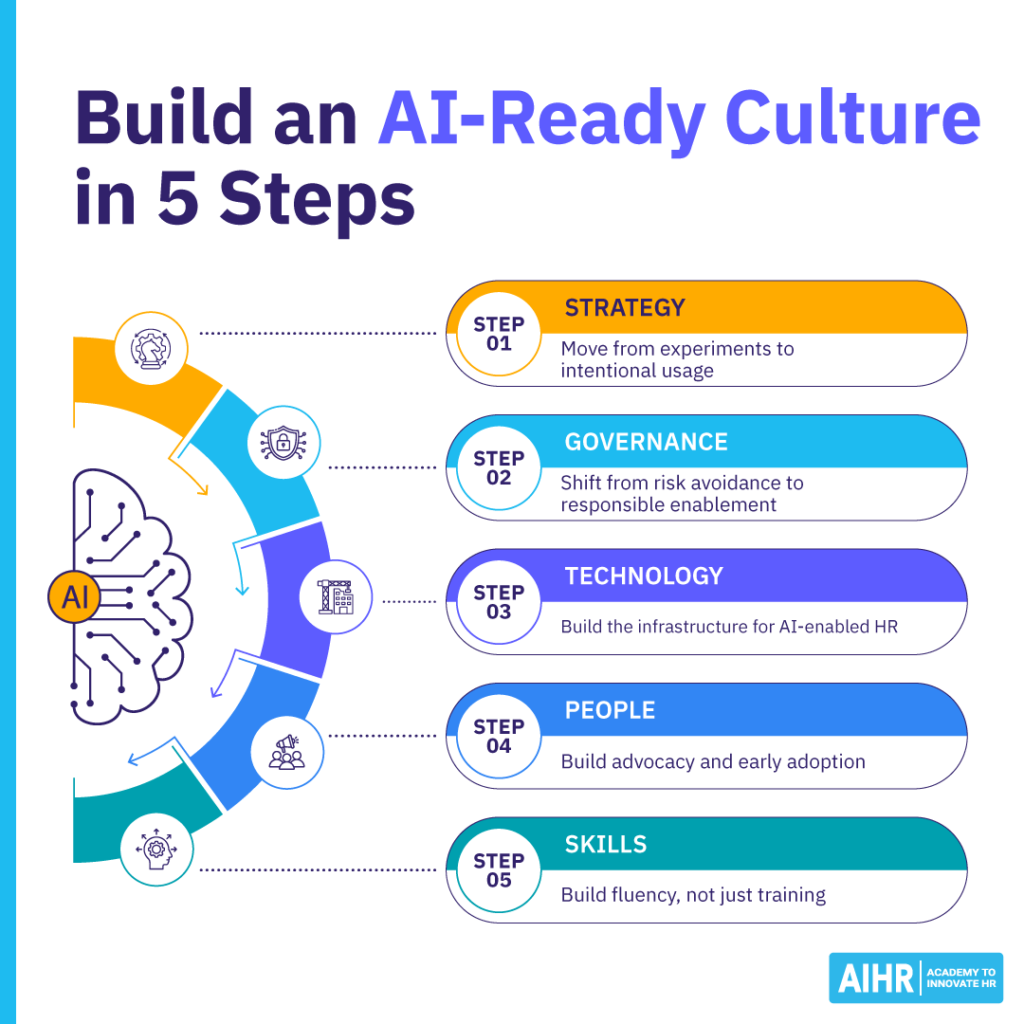
3. Technology: Build the infrastructure for AI-enabled HR
The problem: Only 29% of HR teams are confident they have the data, tools, and infrastructure to support AI at scale. Adding AI to disconnected legacy systems can amplify existing data problems, or create more manual work when tools can’t share reliable information.
The AI culture goal: Improve your core HR systems and data, so AI tools can work with accurate, accessible information.
What to build:
- A consolidated human resources information system (HRIS) to reduce fragmented legacy systems
- A data cleanup plan that identifies inaccurate, duplicate, or incomplete information
- Clear security requirements for connecting AI tools to existing databases.
4. People: Build advocacy and early adoption
The problem: Employees may hesitate to use AI when they’re unsure how it will affect their jobs, and policies alone won’t change that. People need to see practical examples of how AI can support their work, as well as clarity about how their roles may change.
The AI culture goal: Show employees how AI can support their work and reduce repetitive tasks, and give them opportunities to learn from colleagues who are already using it effectively.
What to build:
- A network of AI champions across HR functions who can provide hands-on peer support
- Practical, role-specific guides for using AI in everyday HR tasks
- An internal library of proven AI use cases and lessons learned.
5. Skills: Build AI fluency, not just training
The problem: Research shows that 82% of HR professionals use AI in their day-to-day work. But many haven’t received practical, job-specific AI training. Without that training, HR professionals may struggle to evaluate AI output or use data responsibly in real workplace situations.
The AI culture goal: Build practical, role-specific skills so HR professionals can use, test, and challenge AI output with confidence.
What to build:
- Practical workshops based on real HR tasks
- A safe “sandbox” where employees can test prompts without using real employee data
- A simple checklist to track AI skill development over time.
Next steps
Building a strong AI culture starts with connecting technology to the way people actually work. Give employees clear boundaries, practical skills, reliable tools, and space to experiment safely. Start within HR, learn what works, and use those lessons to support the wider organization.
Building your own AI skills can help you take a more active role in this change. To ensure you’re ready to do so, check out AIHR’s Artificial Intelligence for HR Certificate Program to help you develop practical AI skills for HR, and strengthen your function’s AI readiness.