
Data privacy and ethics in AI for HR have become critical leadership priorities as artificial intelligence takes on a greater role in hiring, workforce planning, performance management, and employee development. While AI can help organizations make faster and more informed decisions, concerns about the quality and integrity of the data driving those decisions are growing just as quickly.
Deloitte’s Global Human Capital Trends research found that 95% of executives are concerned about the accuracy of data used in AI-enabled talent processes. It’s a growing challenge for HR leaders: before organizations can trust AI recommendations, they must first trust the data behind them.
As AI becomes more deeply embedded in people decisions, HR’s responsibility extends beyond protecting employee information to ensuring that workforce data is accurate, fair, transparent, and governed appropriately. In this guide, we look at the data privacy and ethical risks HR is facing, as well as best practices that HR can implement.
Contents
Why AI data privacy and ethics should be an HR priority
Key data privacy and ethical risks of AI in HR
Best practices for data privacy and ethics in AI for HR
Key takeaways
- Combining AI with poor-quality, incomplete, or historically biased data can lead to flawed hiring, promotion, workforce planning, and employee development decisions.
- AI-generated insights, predictions, and workforce analytics can create new categories of sensitive employee data that require the same level of protection and governance.
- AI can support decision-making, but HR leaders remain responsible for reviewing recommendations, challenging outputs, and making final decisions on high-impact people matters.
- Transparency, explainability, fairness testing, and clear governance frameworks help organizations build confidence among employees, candidates, regulators, and business leaders.
Why AI data privacy and ethics should be an HR priority
AI adoption in HR is accelerating rapidly. According to McKinsey, while only 19% of core HR processes currently apply generative AI at scale, a further 32% are already in pilot phases. At the same time, HR functions are managing increasingly detailed digital records covering employee skills, performance, development, compensation, engagement, and workforce planning. McKinsey found that 93% of organizations already document employee skills in HR systems, creating rich datasets that AI tools can analyze, predict, and act upon.
Yet capability development is struggling to keep pace. Across Europe, only 21% of employees have received formal training in generative AI, creating a growing risk that powerful tools are being used without a clear understanding of privacy obligations, bias risks, or governance requirements.
As a result, HR leaders face several key challenges:
- Legal and regulatory exposure: AI-powered HR tools often process protected, regulated, or sensitive personal information. As governments strengthen privacy protections and introduce new AI regulations, organizations must demonstrate that their systems comply with employment law, anti-discrimination requirements, data protection obligations, and emerging AI governance frameworks.
- Trust: Employees increasingly expect transparency around how their organizations collect, analyze, and use data, particularly when AI-assisted decisions happen across the employee life cycle.
- Decision quality: AI systems learn from historical information, inheriting both the strengths and weaknesses of the data they are trained on. Incomplete records, historical inequities, inconsistent evaluations, or unrepresentative datasets can influence recommendations and predictions, leading to flawed hiring decisions, unequal access to opportunities, distorted succession planning, or inaccurate workforce forecasts.
- Reputation: Employees, candidates, regulators, and business leaders increasingly expect fairness, transparency, and accountability. When organizations cannot clearly explain how AI systems reach conclusions, confidence can decline rapidly, and reputational damage can extend far beyond the original technology issue.
- Adoption: AI initiatives create value when managers understand the recommendations they receive, and employees trust the processes that support them. Sustainable adoption depends on systems that are transparent, governed responsibly, monitored consistently, and supported by meaningful human oversight.

Key data privacy and ethical risks of AI in HR
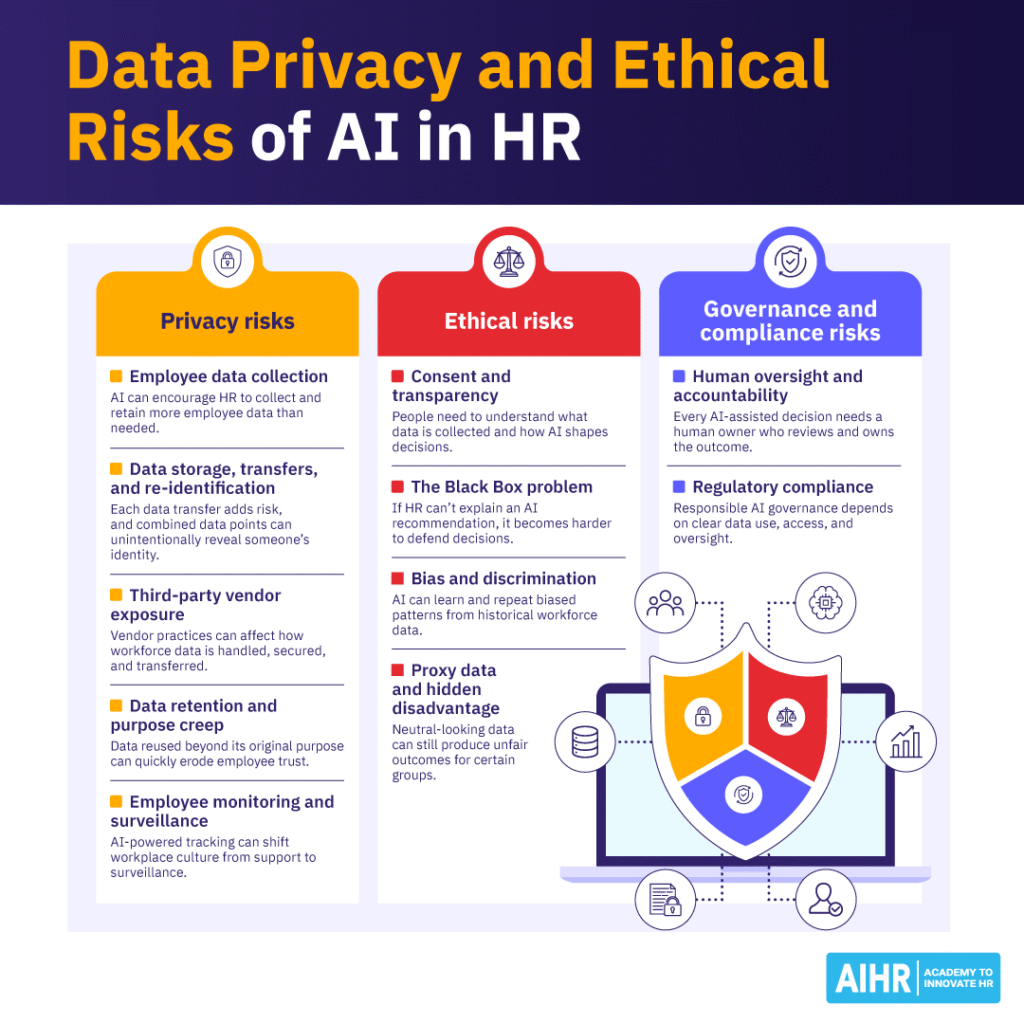
HR sits at the intersection of personal data, employment decisions, and organizational trust. That makes even seemingly minor weaknesses in data management or AI governance a potential source of privacy, ethical, and governance and compliance risks. Let’s take a closer look.
Privacy risks
Employee data collection
AI systems depend on data. The more information they receive, the more patterns they can identify and the more predictions they can generate. This creates a temptation to collect and retain large volumes of employee information, often beyond what is necessary for a specific purpose.
The challenge is that HR data extends far beyond names and employee numbers. Predictions about promotion readiness, attrition risk, or future performance become new categories of personal information that require the same level of protection as the underlying data used to create them.
Data storage, transfers, and re-identification
Employee information frequently moves between HR systems, analytics platforms, payroll providers, learning systems, and AI applications. Every transfer creates additional privacy, security, and compliance considerations.
Even when organizations remove direct identifiers like names and email addresses, privacy risks may remain. The ‘mosaic effect’ occurs when multiple pieces of seemingly harmless information, like location, department, tenure, and job level, are combined to reveal an individual’s identity.
Third-party vendor exposure
Vendor relationships can expose organizations to risks associated with data handling practices, model training processes, security controls, and cross-border data transfers.
Deloitte notes that as organizations connect more AI tools and data pipelines, their risk exposure increasingly extends beyond internal systems to include the broader vendor ecosystem. Understanding how providers collect, store, use, and protect workforce data has therefore become a critical component of AI governance.
Data retention and purpose creep
Data collected for one purpose often becomes attractive for another. Consider an organization that collects employee wellbeing survey data to identify support needs and improve workplace culture. If managers later use team-level wellbeing scores, stress indicators, or comments linked to small departments to inform promotion or performance discussions, trust can erode rapidly. This is especially risky when employees shared that data for support, not evaluation.
Responsible organizations establish clear retention periods, defined use cases, and transparent policies that prevent data from being reused beyond its intended purpose.
Employee monitoring and surveillance
AI has significantly expanded the ability to track employee behavior. Organizations can analyze communication patterns, system activity, productivity metrics, collaboration data, and workplace interactions in ways that were previously impossible.
While these insights can support workforce planning and employee wellbeing initiatives, excessive monitoring can create a culture of surveillance rather than support.
For example, during the shift to remote and hybrid work, some organizations introduced AI-powered productivity monitoring tools that tracked keyboard activity, screen time, and application usage. While leaders sought greater visibility into workforce activity, employee concerns about surveillance quickly emerged. Several organizations subsequently revised their monitoring practices, focusing on outcomes and performance indicators rather than continuous activity tracking.
Ethical risks
Consent and transparency
Trust depends on understanding. Employees and candidates increasingly expect clear explanations about what data is collected, how it is used, and where AI contributes to decision-making. Transparency becomes particularly important when AI influences hiring, promotion, performance management, workforce planning, or employee development decisions.
When people cannot understand how decisions are made, confidence in both the technology and the organization can quickly decline.
The black box problem
Imagine a manager receives an AI-generated notification that an employee is a high attrition risk. If the system cannot explain which factors contributed to that prediction, HR may struggle to determine whether it’s accurate, fair, or influenced by incomplete data. Without explainability, leaders may find it difficult to justify decisions or interventions to employees and stakeholders.
Many advanced AI models can generate highly accurate recommendations while providing limited visibility into how those recommendations were produced, but if HR professionals cannot understand or explain an AI-generated outcome, they may struggle to defend that decision to employees, regulators, auditors, or legal stakeholders.
Bias and discrimination
Bias remains one of the most widely discussed risks in HR AI because the consequences directly affect people’s careers and opportunities.
One of the most widely cited examples comes from Amazon, which abandoned an experimental AI recruitment tool after discovering it systematically disadvantaged female candidates. Trained on a decade of historical resumes from a male-dominated industry, the system learned to favor patterns associated with male applicants and downgraded resumes containing terms such as ‘women’s.’
In reality, historical hiring patterns, performance evaluations, compensation decisions, and promotion records can all contain embedded human biases. AI systems trained on this information may learn and replicate those patterns, even when discrimination was never intended.
Proxy data and hidden disadvantage
Bias does not require the use of protected characteristics like race, gender, or age. AI systems often identify patterns through proxy variables that appear neutral on the surface. Educational background, location, tenure, communication style, or career history may indirectly correlate with protected characteristics and produce unintended disparities in outcomes.
Because these relationships are often difficult to detect, organizations must actively test AI systems for fairness rather than assume neutrality.
Governance and compliance risks
Human oversight and accountability
One of the most common governance failures occurs when organizations assume that AI recommendations are objective and therefore require less scrutiny.
In practice, accountability cannot be delegated to technology. Every AI-assisted decision requires a clearly identified human owner who remains responsible for reviewing outputs, challenging recommendations, and making final decisions. Governance frameworks should define who approves AI systems, who monitors them, who responds to concerns, and who ultimately owns outcomes.
Regulatory compliance
As AI becomes more deeply embedded in workforce decisions, regulators are increasingly focusing not only on whether organizations comply with the law but also on whether they can demonstrate transparency, accountability, and responsible governance throughout the AI use cases.
The common thread across all regulatory risks is that they rarely originate from technology alone. They emerge from decisions about what data is collected, how it is used, who has access to it, and how much oversight exists throughout the process. Organizations that recognize this distinction are better positioned to build AI programs that are both innovative and trusted.
Data privacy and ethics are essential to using AI safely and effectively in HR. Your team needs the skills to assess risks, protect employee data, and apply AI in ways that support both people and business goals.
AIHR’s AI for HR Boot Camp equips your team to:
✅ Spot high-impact AI opportunities across HR processes
✅ Improve HR workflows with generative AI tools and techniques
✅ Address privacy, ethics, and risk considerations in AI use
✅ Build an AI strategy that supports secure, effective adoption
🎯 Use AI in HR in ways that protect people, data, and business value.
Best practices for data privacy and ethics in AI for HR
Responsible AI does not happen by accident. It is the result of deliberate decisions about how you collect, manage, govern, and use throughout the employee life cycle.
AIHR research shows that organizations create more value from AI when they pair adoption speed with clear guardrails for privacy, fairness, accountability, and transparency.
The following practices can help HR teams build trust while reducing privacy, ethical, and compliance risks.
1. Audit and map data flows before adopting any AI tool
Before implementing any solution, HR should map the complete journey of employee data, including what information is collected, where it originates, how it is processed, who can access it, whether it is shared with third parties, and how long it is retained.
This process often reveals hidden risks, including unnecessary data collection, unmanaged vendor access, and cross-border data transfers that create compliance obligations. Responsible AI begins with understanding the data ecosystem before introducing new technologies into it.
2. Apply data minimization and clear purpose boundaries
One of the most effective ways to reduce privacy risk is to limit the amount of data entering AI systems in the first place. Collect only the information required for a clearly defined HR purpose and avoid sharing data simply because it is available.
Where possible, remove direct identifiers, anonymize datasets, and use aggregated information rather than individual employee records, and establish clear rules that prevent teams from reusing data for unrelated purposes without review and approval.
3. Vet vendors as thoroughly as you vet employees
Responsible AI governance extends beyond organizational boundaries and into the broader vendor ecosystem. Before introducing any third-party solution, HR should understand how the vendor manages privacy, security, governance, and bias mitigation.
Ask direct questions about model training practices, subcontractors, data retention policies, bias testing methodologies, audit capabilities, and compliance certifications. Request documentation that explains how decisions are generated and what safeguards exist to protect employee information.
4. Build transparency into the employee experience
Employees are far more likely to trust AI when they understand how it is being used. Be transparent about when AI supports HR processes, what data it processes, how outputs are used, and where human oversight exists.
Explain how AI contributes to recruitment, workforce planning, employee support, performance management, or career development initiatives. Some organizations even include AI disclosure statements in recruitment processes, informing candidates when AI assists with resume screening or interview scheduling.
5. Keep humans accountable for high-stakes decisions
AI can identify patterns, summarize information, and generate recommendations, but it cannot understand organizational context, workplace relationships, legal nuance, or the human impact of a decision. In a study of nearly 50,000 AI use cases, researchers still found human judgment essential when evaluating AI-generated outputs.
Use AI to inform decisions, not make them. Require human review for any recommendation that could influence hiring, promotion, performance, pay, disciplinary action, or employee wellbeing. The higher the impact on people, the greater the need for human oversight.
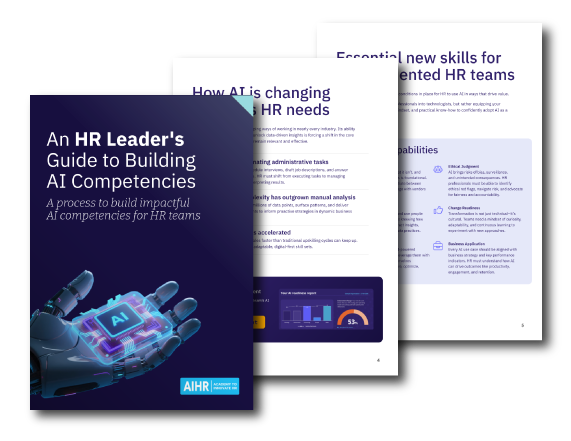
Human oversight is only effective when HR teams have the skills to assess AI-generated outputs, recognize limitations, and make informed decisions. AIHR’s HR Leader’s Guide to Building AI Competencies outlines how to build these capabilities across your HR team.
6. Test for bias before and after deployment of AI tools
Before implementation of an AI-powered tool, review datasets for representation gaps and variables that may correlate with protected characteristics. Once systems are operational, regularly compare outcomes across demographic groups and monitor for unintended disparities in hiring, promotion, pay, development opportunities, and performance outcomes.
Bias monitoring should become a recurring governance activity rather than a one-time project completed during implementation.
7. Create a challenge and correction process
Trust increases when people know there is a path to question decisions. Employees and candidates should have a clear mechanism to challenge AI-influenced outcomes, request explanations, correct inaccurate information, or escalate concerns for human review. This process should be simple, visible, and supported by documented response procedures.
The goal is not simply to resolve disputes, but to demonstrate accountability and reinforce confidence that AI systems remain subject to review and correction when required.
8. Document everything
Effective governance depends on traceability. Maintain an inventory of approved AI tools and record what data each system uses, who approved it, how outputs are reviewed, and when the system was last audited. Many organizations are now introducing AI model cards or AI registers that capture a tool’s purpose, data sources, limitations, known risks, and ownership responsibilities.
Strong documentation supports compliance efforts, simplifies audits, and enables organizations to investigate concerns quickly when issues arise.
9. Monitor continuously and re-audit regularly
AI governance is an ongoing responsibility rather than a project with a finish line. Models change, vendors release updates, and regulations evolve. New data creates new risks, so establish regular reviews that assess privacy controls, security measures, bias indicators, employee feedback, complaints, override rates, and vendor changes.
Organizations should treat AI governance as a continuous cycle of monitoring, testing, learning, and improvement. Quarterly reviews provide a practical starting point for most HR teams.
10. Use the three-question test before expanding any AI application
When organizations move beyond routine use cases, governance frameworks and policies may not always provide clear answers. In these situations, you can use a simple decision-making framework built around three questions:
- Is it legal?
- Is it aligned with our policies and governance standards?
- Is it ethically right?
If uncertainty exists at any stage, pause implementation and investigate further before proceeding. Responsible AI is ultimately built on a combination of compliance, governance, and ethical judgment.
Next steps
As AI becomes more deeply embedded in HR, the conversation must extend beyond efficiency, automation, and productivity. HR leaders are increasingly responsible for ensuring that AI systems operate in ways that are lawful, fair, transparent, and aligned with organizational values. The quality of AI-driven outcomes depends not only on the technology itself, but on the decisions people make about the data they collect, the safeguards they implement, the oversight they maintain, and the accountability they are willing to accept.
Ultimately, responsible AI is about protecting trust. Employees need confidence that their data is handled with care, candidates need assurance that opportunities are evaluated fairly, and leaders need governance frameworks that support innovation without compromising ethics. Organizations that embed privacy, transparency, fairness, and human oversight into every stage of AI adoption will be better positioned to realize the benefits of AI while protecting what matters most: their people.
The future of AI in HR depends on how organizations combine technology with human judgment, empathy, and accountability. Businesses that get this balance right will be best positioned to create value from AI.
To build these capabilities, enroll your HR team in AIHR’s AI for HR Boot Camp. The program helps HR teams develop practical AI skills and see measurable results in 1–3 months through self-paced learning, live sessions, and expert Q&A.