

An HR Manager certification can help you prove you’re ready to lead people, programs, and strategy. The best one for you depends on where you are now: how much HR experience you have, whether you need formal recognition, and which skills your next role will test.
This guide compares the leading HR Manager certifications and certificate programs side by side. You’ll see what each one requires, what it costs, and how to sequence them so every credential you earn supports the next step in your HR career.
Contents
Do you need a certification to become an HR Manager?
4 best HR Manager certifications to consider
What skills should an HR Manager course build?
How to choose the right option for your career stage
Do you need a certification to become an HR Manager?
No, but it can help you get there faster. The U.S. Bureau of Labor Statistics (BLS) notes that HR managers typically need a bachelor’s degree and several years of related work experience, and certification can help your résumé stand out to prospective employers.
The role pays well and continues to grow. BLS reported a median annual wage of $140,030 for HR managers in May 2024, and projects 5% employment growth to 2034. When several experienced candidates compete for the same role, those with a recognized HR Manager certification is likely to have an edge over their competitors.
Hiring managers still want to see what you’ve done (e.g., a policy you rewrote, or managers you coached), and the right certification can strengthen these achievements. If you’re not sure you need a management-level credential yet, check out AIHR’s guides to Human Resources management certifications and how to become HR certified to learn about broader options.
It’s also worth noting the difference between a certification and a certificate program. A certification is an exam-based credential awarded by a certifying body, such as SHRM or HRCI. You meet eligibility criteria, pass a proctored exam, and keep the credential active by earning recertification credits. Essentially, it confirms that your knowledge meets industry standards.
A certificate program, such as those AIHR offers, is a structured course of study that ends with a certificate of completion or achievement. Strong programs include projects, templates, and assessments you complete along the way, and help you build skills you can apply at work right away.

4 best HR Manager certifications to consider
The certifications and programs below are designed specifically for current and aspiring HR managers, or for HR management as a discipline:
1. HR Manager Certificate Program (AIHR)
AIHR’s HR Manager Certificate Program is built for new and aspiring HR managers who want to move beyond core HR tasks and create HR strategies.
- Format and duration: 100% online and self-paced, with 35 hours of learning and 12 months of access. Ends with a capstone assignment and exam; you earn a certificate upon completion.
- Topics covered: HR management and leadership, business strategy and governance through a Mini MBA for HR, HR strategy, lean and agile HR, and HR operating models.
- Best for: HR generalists and HRBPs preparing for a management role, and new HR managers who want a practical framework for strategy, team leadership, and operating model decisions.
- Cost: $1,125 as a standalone program, or included in Full Academy Access at $1,850 per year, which covers all 16+ AIHR certificate programs.
2. Strategic Human Resources Leadership (eCornell)
eCornell’s Strategic Human Resources Leadership certificate helps HR managers connect people strategy to business strategy.
- Format and duration: Online, with six two-week courses completed over three months (three to five hours of study per week).
- Topics covered: HR leadership, aligning HR with organizational strategy, diversity and inclusion in practice, talent management, strategic engagement, and talent analytics.
- Best for: HR managers and directors who want a university-branded certificate and a cohort-paced structure.
- Cost: $3,900.
HR Manager certifications can help you expand beyond day-to-day HR responsibilities. Develop the business, strategy, and leadership skills you’ll need to make a bigger organizational impact.
AIHR’s HR Manager Certificate Program prepares you to:
✅ Align HR strategy with business goals and translate priorities into action
✅ Understand business operations, governance, and the wider context shaping HR decisions
✅ Lead change, influence stakeholders, and build support for strategic initiatives
✅ Design agile HR teams and operating models that improve flexibility and efficiency
💡 Explore the AIHR Demo Portal to preview lessons, browse practical resources, and discover what you can learn next.
3. Human Resources Management Certificate (UCLA Extension)
UCLA Extension’s Human Resources Management Certificate is a 36-unit program that covers the core areas an HR Manager oversees.
- Format and duration: Fully online, or combined online and in-person study. Includes eight required courses, plus eight units of electives. Courses are open enrollment, so you can start anytime and take individual courses before committing to the full certificate.
- Topics covered: HR management fundamentals, the financial side of HR, talent acquisition, compensation and benefits design, employee relations and legal aspects of HR, HR development, and ethics.
- Best for: HR specialists aiming for a management role and professionals moving into HR, particularly in the U.S., since the legal coursework focuses on U.S. and California employment law.
- Cost: Estimated program tuition of $8,600, plus a $200 application and candidacy fee, and about $1,100 for textbooks and materials.
4. Level 7 Advanced Diploma in Strategic People Management (CIPD)
The Level 7 Advanced Diploma in Strategic People Management certification is CIPD’s most senior qualification. It’s set at a postgraduate level, and is built for HR professionals stepping into strategic leadership.
- Format and duration: Delivered through CIPD-approved study centers online, in person, or in a blended format. It includes four core units, three specialist units, and one optional unit, and most learners take about 16 to 24 months to complete it.
- Topics covered: Strategic people management, the changing business environment and its impact on work, people management and development strategies for performance, and business research and analysis.
- Best for: Experienced HR managers and HRBPs moving into senior roles, especially in the U.K. and other markets where CIPD membership carries weight. Completing it leads to Associate CIPD membership.
- Cost: Between £3,000 and £7,000, (depending on the training provider and study format), plus CIPD membership (which varies by level).
What skills should an HR Manager course build?
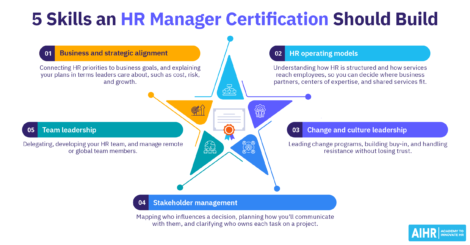
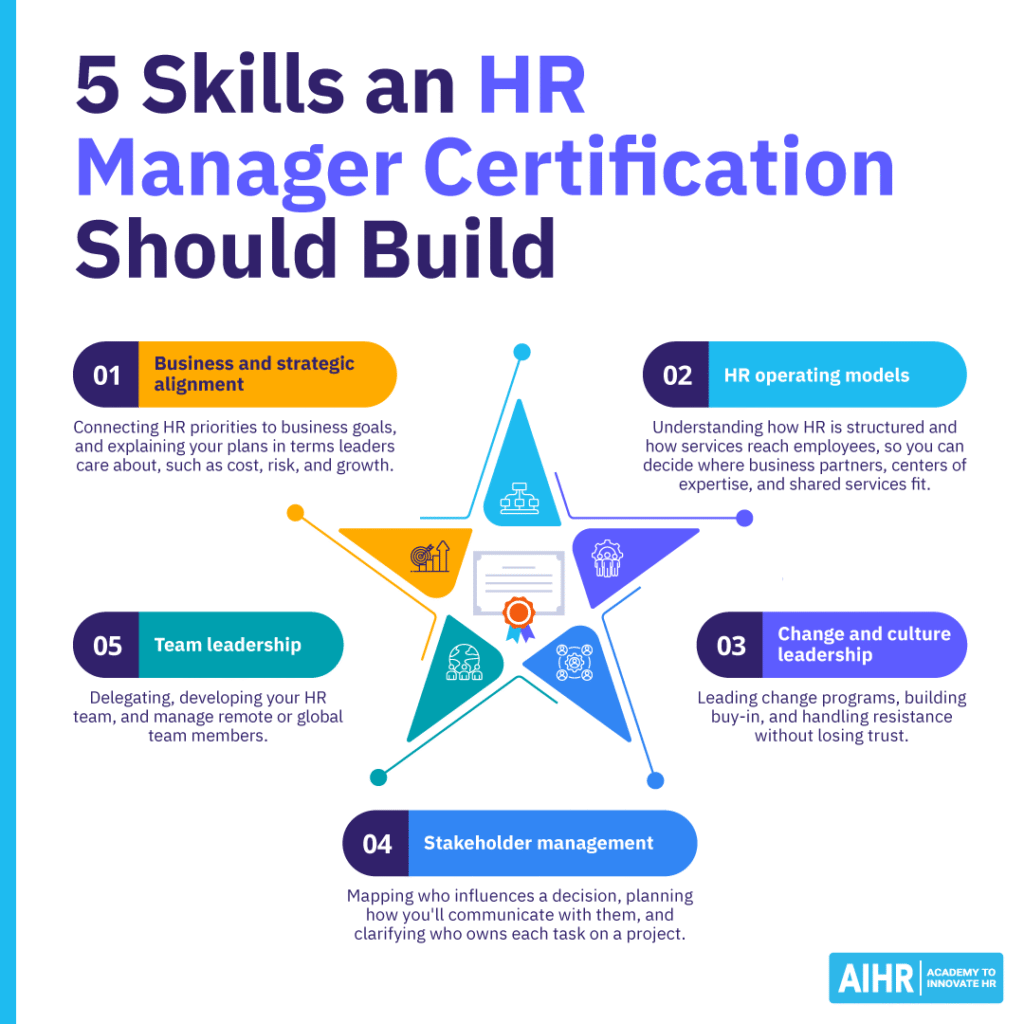
When you move into management, the work shifts from running HR processes to shaping how HR supports the business. A strong program should prepare you for that shift in these five areas:
- Business and strategic alignment: Connecting HR priorities to business goals, and explaining your plans in terms leaders care about, such as cost, risk, and growth.
- HR operating models: Understanding how HR is structured and how services reach employees, so you can decide where business partners, centers of expertise, and shared services fit.
- Change and culture leadership: Leading change programs, building buy-in, and handling resistance without losing trust.
- Stakeholder management: Mapping who influences a decision, planning how you’ll communicate with them, and clarifying who owns each task on a project.
- Team leadership: Delegating, HR team development, and remote or global HR team management.
Use these areas as a checklist when you review a syllabus. Exam-based credentials tend to test your knowledge of them, while applied programs should give you a chance to practice them through projects you can reuse.
Examples include a stakeholder map, an HR strategy draft, or a proposed operating model. Those work samples are also useful in interviews, because they show how you think as a manager.
How to choose the right option for your career stage
The right choice depends on your current career stage and whether a certification or certificate program can help prepare you for an HR Manager role at that stage. Find the situation closest to yours below:
You’re aiming for your first HR Manager role
Start by building management-level skills, especially if you don’t yet meet the experience requirements for the PHR or SHRM-SCP. A skills-based program such as AIHR’s HR Manager Certificate Program helps you practice strategy, operating models, and stakeholder work before you’re accountable for them.
If you want a formal credential as well, the SHRM-CP doesn’t require any experience, and there are also routes to HR certification without a degree.
You’ve just stepped into management
Your first months will test how you prioritize, lead your team, and work with senior leaders. Applied learning usually pays off faster than exam preparation at this stage, because you can use it immediately.
Look for a program that helps you with work you already do (e.g., a stakeholder map for your first leadership meetings, or a RACI template that clarifies who owns each HR process). The HR Manager Certificate Program includes guides and templates for all three, and can help you show how you’ve shaped your company’s HR function in a performance review.
You’re moving into a strategic or senior role
Once you meet the experience criteria, the SHRM-SCP or SPHR can validate strategic-level expertise against a recognized standard. Check your eligibility against the work you’ve done.
SHRM counts work such as developing HR policies, overseeing integrated HR operations, and aligning HR strategy with organizational goals, and you need at least 1,000 hours of it per calendar year. HRCI, on the other hand, designed the SPHR for professionals who plan HR policy rather than implement it.
You already hold a SHRM or HRCI credential
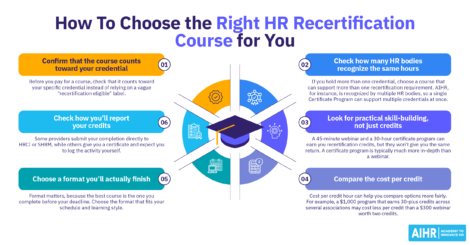
You need recertification credits every three years: 60 PDCs for SHRM, and 60 credits for the PHR and SPHR. The SPHR also requires at least 15 of those to be Business credits. A mix of webinars can get you to 60, but it likely doesn’t teach you new HR skills. A program that builds new skills and earns credits means your learning hours, however, count toward both goals.
AIHR’s HR Manager Certificate Program, for example, is eligible for 22 SHRM PDCs (more than a third of your SHRM requirement), and 22 HRCI Business credits (more than the SPHR’s Business minimum). Credit amounts vary by program, so check the provider’s listing before you enroll.
You work outside the U.S.
PHR and SPHR content is grounded in U.S. laws and regulations, so check what employers in your market recognize. HRCI offers international versions, and CIPD is widely recognized in the U.K. AIHR’s Certificate Programs are suited for any HR professional, regardless of your location. The programs are available online and are self-paced. AIHR is also globally recognized by 15+ HR associations, including SHRM, HRCI, HRPA, CPHR, ATD, and CIPD for recertification.
Next steps
The best HR Manager certification is the one that matches your current career stage and prepares you for your next move. If you need formal validation and meet the eligibility criteria, an exam-based credential from SHRM or HRCI is a strong choice. If you need the skills to lead an HR function, start with a structured, applied certificate program.
A practical next step is to preview a program before you commit. AIHR’s HR Manager Certificate Program helps you build skills in HR strategy, business acumen, operating models, and team leadership through self-paced lessons and hands-on projects. It’s also eligible for SHRM and HRCI recertification credits, so it keeps working for you after completion.