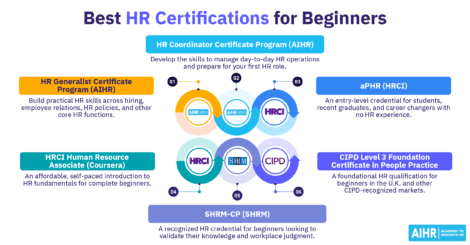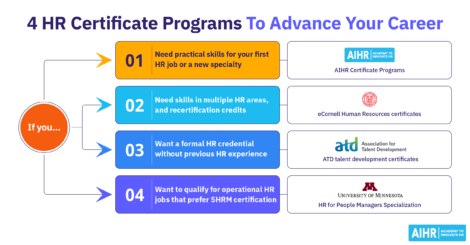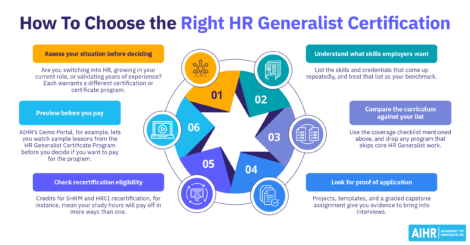

If you’re wondering whether getting HR certification without experience is possible, you’ll be glad to know the answer is “yes”. Various pathways and resources are available to facilitate this journey, making HR certificates more accessible to individuals from different educational and career backgrounds.
Payscale noted that having an HR certification positively influences an HR professional’s chances of getting a promotion and salary hike. 82% of HR assistants surveyed said they have been promoted in the last 5 years. HR directors also reported increased chances of promotion if they had the proper HR credentials.
Contents
What is an HR certification?
Why get an HR certification for your HR career?
Do you need experience to get an HR certification?
HR certifications that don’t require HR experience
AIHR Certificate Programs to consider
What do HR certifications cost?
4 steps to get HR certified without experience
How to get HR experience
What is an HR certification?
An HR certification can mean one of two things. The first is exam-based: you study, sit an exam through a reputable HR training organization, usually after gaining relevant work experience, and the credential you earn proves what you already know.
The second is a certificate program that teaches you practical skills. An AIHR Certificate Program, for instance, builds the modern, practical skills, so you can immediately apply what you have learned on the job.
Credentials and certificate programs aren’t mutually exclusive; instead, you can take both together or after each other. You can not only grow your skill set with a certificate program but also maintain your existing certification by earning credits through course completion.
For example, AIHR is recognized by SHRM to offer Professional Development Credits (PDCs) for SHRM-CP or SHRM-SCP recertification activities, and its Certificate Programs count toward recertification credits with HRCI, HRPA, CPHR, ATD, and CIPD.
So, an HR certification is, generally, a credential or certificate program that recognizes your Human Resources knowledge and skills, whether you earn it by passing an exam after gaining relevant experience or by completing an HR domain-specific training program.

Why get an HR certification for your HR career?
HR certifications are valuable investments in your career. Here are some of the reasons why:
- Validate your expertise: They signal to employers that you know HR principles and practices, making you an attractive candidate for HR positions.
- Boost your professional credibility: Employers and clients are more likely to trust you to do HR work because you’ve undergone professional development.
- Increase your chances of getting hired for an HR job: You have an edge over other applicants who don’t have formal HR credentials and are also applying for the same position.
- Can lead to new career opportunities: You can apply for senior, leadership, and management HR roles in your company or other organizations. In short, it can help you advance in your career and reach your long-term goals.
- Keeps you up-to-date within your profession: Completing HR certificate programs provides you with new ideas, best practices, and the latest trends in human resources. These programs expand your knowledge and skill set so you excel in various HR roles.
- Many HR certifications are globally recognized and respected by organizations: This is your advantage if you are looking for a job overseas. It makes you more marketable to employers and shows you can adapt to various HR environments.
- Provides networking opportunities: HR certifications give you the confidence to meet and network with industry experts and thought leaders in the human resources industry. AIHR offers a vibrant membership community where you can connect with HR professionals.
- Offers specialization opportunities: HR certifications offer courses in specific HR areas, such as recruitment, employee relations, compensation or benefits, or HR analytics. These courses give you an in-depth understanding of your chosen HR niche, which many employers value.
- Enhances your job security and stability during uncertain economic times: An HR certification helps you stay relevant and up-to-date within your expertise to remain competitive and valuable during industry changes.
Enrolling in an HR certificate program can help you build practical skills while you develop your professional experience.
AIHR’s HR Generalist Certificate Program gives you the tools and foundational knowledge to:
✅ Understand key HR processes in recruitment, payroll, performance management, and employee engagement
✅ Develop and implement HR policies and processes across the employee lifecycle
✅ Navigate difficult workplace conversations with practical communication and conflict management techniques
✅ Plan and structure HR operations while linking your work to business priorities and measurable outcomes
💡 Explore the AIHR Demo Portal to preview lessons and discover learning resources as you plan your HR career.
Do you need experience to get an HR certification?
Experience is not always required to earn an HR certification, and the extent you need it depends on which credential or program you choose.
Traditional, exam-based HR certifications set their own bar. HRCI’s PHR asks for professional-level HR experience through one of three paths: 1 year with a master’s degree, 2 years with a bachelor’s degree, or 4 years with no degree. SPHR requires four years of experience with a master’s degree, five years with a bachelor’s degree, or seven years with no experience.
SHRM’s Senior Certified Professional (SHRM-SCP) works the same way, requiring at least three years in a strategic-level HR role, or three years holding the SHRM-CP while you move into one.
While other exam-based certifications may not have stringent eligibility requirements. For example, HRCI’s aPHR is designed for people who haven’t worked in HR yet, and no HR experience is required. SHRM-CP doesn’t set an experience requirement either; it just expects a working knowledge of HR practices, which you can pick up through a relevant degree or through the job itself.
When an HR certification does require experience, most bodies build in alternative routes. Relevant education, such as an undergraduate or graduate degree in HR, business administration, or a related field, often substitutes for some of the required years. Internships, volunteer HR work, leadership roles in student organizations, and employer apprenticeship or career-pathing programs can all count, too, depending on the certifying body’s rules.
Certificate programs like AIHR’s often don’t have eligibility requirements. Whether you’re new to HR, moving into a specialist track, or already leading a team, you can enroll and start building the skill immediately, because the program is designed to teach you the domain rather than test whether you already know it.
If you’re early in your HR career or changing direction, you can build the specific skills you need now, through an HR certification course, instead of waiting until you’ve banked enough professional-level hours to qualify for an exam-based credential.
Once you do hold a certification, most require you to keep it current through continuing education, which you can typically earn through workshops, webinars, and further coursework rather than by retaking the original exam.
HR tip
There are various HR certifications, each with its own focus. Research what kind of HR role you’re interested in (e.g., Generalist Certificate Program, Compensation and Benefits Certification, Recruitment etc.,) and choose a certification aligned with your career aspirations.
HR certifications that don’t require experience
Below, we will unpack some of the HR certifications that don’t require experience:
AIHR Certificate Programs
AIHR’s Certificate Programs require no HR experience or degree to enroll, although for some intermediate and advanced programs, it is recommended to better understand the coursework. The Certificate Programs offer skills-based learning focused on broad HR capabilities or a specific HR domain, such as AI in HR, people analytics, HR business partnering, or organizational development.
They’re all 100% online and self-paced, and completing them counts toward SHRM PDCs and HRCI recertification credits, among others.
Access to a standalone Certificate Program costs $1,125 per program, while Full Academy Access, which includes all 17+ AIHR Certificate Programs, the expert community, resource library, and 85+ courses, costs $1,850 annually.
aPHR (HRCI)
The Associate Professional in Human Resources (aPHR) is HRCI’s entry-level credential, and it’s the one HRCI certification that requires zero HR experience. aPHR certification requirements are brief: a high school diploma or equivalent is sufficient, with no work history required.
It costs $400 in total (a $100 non-refundable application fee, plus a $300 exam fee). The credential stays valid for three years, and you’ll need 45 recertification credits to keep it active.
SHRM-CP (SHRM)
The SHRM-CP works from a different angle. SHRM doesn’t require a degree, an HR title, or previous HR experience to sit for the exam, though a working knowledge of HR practices is recommended.
Pricing is set at $399 for SHRM members and $499 for non-members, while recertification requires 60 professional development credits every three years.
aPHRi (HRCI)
HRCI’s aPHRi certification is the aPHR equivalent for HR professionals building a career outside the U.S. It has the same zero-experience policy: a high school diploma or global equivalent is enough to apply, and no prior HR work history is required.
Like the aPHR, the exam costs $400 in total. The credential remains valid for 3 years, with 45 recertification credits required to keep it active, and the exam is also offered in Arabic for candidates testing in that market.
Level 3 Foundation Certificate in People Practice (CIPD)
The CIPD Level 3 Foundation Certificate works differently from HRCI’s and SHRM’s single-exam model. There are no formal entry requirements beyond a minimum age (typically 16 to 19, depending on the study center) and a recommended level of literacy and numeracy. Rather than taking one proctored exam, you complete four written assignments over roughly eight to 12 months of part-time study through a CIPD-approved center.
Fees aren’t centrally fixed the way HRCI’s or SHRM’s are. According to the CIPD, the course costs between £1,300 and £2,300, plus a separate annual CIPD student membership fee of £118. At the same time, the exact final price depends on which training provider you choose. Once you finish it, you automatically get CIPD Foundation membership, the first rung of CIPD’s professional ladder.
Fundamental Payroll Certification (PayrollOrg)
PayrollOrg’s Fundamental Payroll Certification (FPC) skips the HR Generalist path altogether and certifies payroll knowledge specifically. It has no experience or education prerequisites, and you don’t need to be a member of PayrollOrg to register.
The exam consists of 150 questions over three hours, and costs $359 for PayrollOrg members and $459 for non-members. The credential is valid for three years, and you’ll need 60 recertification credit hours to keep it active.
Which one should you choose?
Start with what you actually need. If you’re moving into an HR role and need practical skills you can apply immediately, an AIHR Certificate Program is the better starting point, as it has no eligibility requirements or exam to prepare for. Instead, you get structured, practical training in the specific HR area your new role calls for.
If your employer or the role itself requires a specific HR credential, check which certification applies to your jurisdiction first. In the U.S., this usually means the aPHR or SHRM-CP.
If you’re building an HR career outside the U.S., aPHRi covers the same ground internationally, and in the UK, CIPD’s Level 3 Foundation Certificate is the equivalent starting point. If payroll is your route into HR, PayrollOrg’s FPC is the credential to check instead.
Many HR professionals apply for or enroll in both. For example, you could enroll in an AIHR Certificate Program to build the skills now, and apply for a formal certification later, or even at the same time to validate your knowledge.
Since AIHR is recognized by SHRM to offer PDCs for SHRM-CP or SHRM-SCP recertification, and its Certificate Programs also count toward recertification credits with HRCI, HRPA, CPHR, ATD, and CIPD, the program you complete now can still be useful afterward.
Option | Experience required | Best for |
AIHR Certificate Programs | None. | Immediately applicable, in-demand HR skills through self-paced online learning, plus a resource library of useful templates. Also counts toward SHRM PDCs and HRCI recertification credits. |
aPHR (HRCI) | None; only high school diploma or equivalent. | A formal, employer-recognized credential that proves foundational HR knowledge. |
SHRM-CP (SHRM) | No degree or HR title required, though basic HR knowledge is recommended. | A widely recognized credential for HR-adjacent professionals who want to take a competency-based exam. |
AIHR Certificate Programs to consider
The following foundational programs are useful if you need to build the practical, in-demand skills you can immediately apply on the job:
- HR Coordinator Certificate Program: Day-to-day coordination and administrative HR skills for people moving into their first HR support role, with no prior HR title required.
- Artificial Intelligence for HR Certificate Program: This program covers practical AI use cases for HR work over approximately 32.5 hours.
- Digital HR 2.0 Certificate Program: HR technology, automation, and employee experience skills for driving digital HR transformation over 36 hours.
- HR Generalist Certificate Program: Broad, practical HR operations skills that map directly onto what the aPHR and SHRM-CP exams test. This program is a solid starting point if you want to obtain either credential.
- Sourcing & Recruitment Certificate Program: End-to-end recruiting skills with no formal entry requirements. This program is worth considering if your goal is a talent acquisition or recruiting role rather than a generalist one.
Every program includes a resource library of templates and playbooks you can put to work immediately, and completing one counts toward SHRM PDCs or HRCI recertification credits alongside whichever certification you choose above.
What do HR certifications cost?
Below is a run-down of the costs of the different HR certifications that require no experience:
- AIHR Certificate Programs: Standalone enrollment is priced at $1,125 per program. You can also get Full Academy Access to all 17 AIHR certificate programs for $1,850 a year. All the programs are 100% online and self-paced, so you can fit them around your work schedule.
- aPHR: $400 in total. The exam is available year-round through Pearson VUE or OnVUE remote proctoring.
- SHRM-CP: $399 for SHRM members and $499 for non-members, available in two testing windows per year.
- aPHRi: $400 in total, with the same structure as the aPHR; built for HR careers outside the U.S.
- CIPD Level 3: Between £1,300 and £2,300, plus an annual £118 CIPD student membership fee; assessed through coursework rather than a single exam.
- FPC: $359 for PayrollOrg members and $459 for non-members; provides a payroll-focused route into HR.
In terms of timeline, AIHR Certificate Programs usually require between 25 and 45 hours of study each. For the other certifications on the list, most candidates spend six to 12 weeks studying part-time before sitting the aPHR, SHRM-CP, aPHRi, or FPC exam. CIPD’s Level 3 takes longer (typically eight to 12 months) because it’s coursework-based rather than exam-based.
All the prices listed above are exclusive of study materials, which typically add another $50 to a few hundred dollars, depending on the prep course you choose.
Did you know?
AIHR is recognized by SHRM to offer Professional Development Credits (PDCs) for SHRM-CP® or SHRM-SCP® recertification activities, and its certificate programs can also support recertification activity with HRCI, HRPA, and CPHR. If you’re starting from zero HR experience, AIHR’s HR Generalist Certificate Program and HR Coordinator Certificate Program are both built for that stage: no prior HR experience required, and the skills align with what the aPHR and SHRM-CP exams test for.
4 steps to get HR certified without experience
Gaining an HR certification without prior experience is a strategic way to enter the field of Human Resources. Here’s a roadmap to navigate this process:
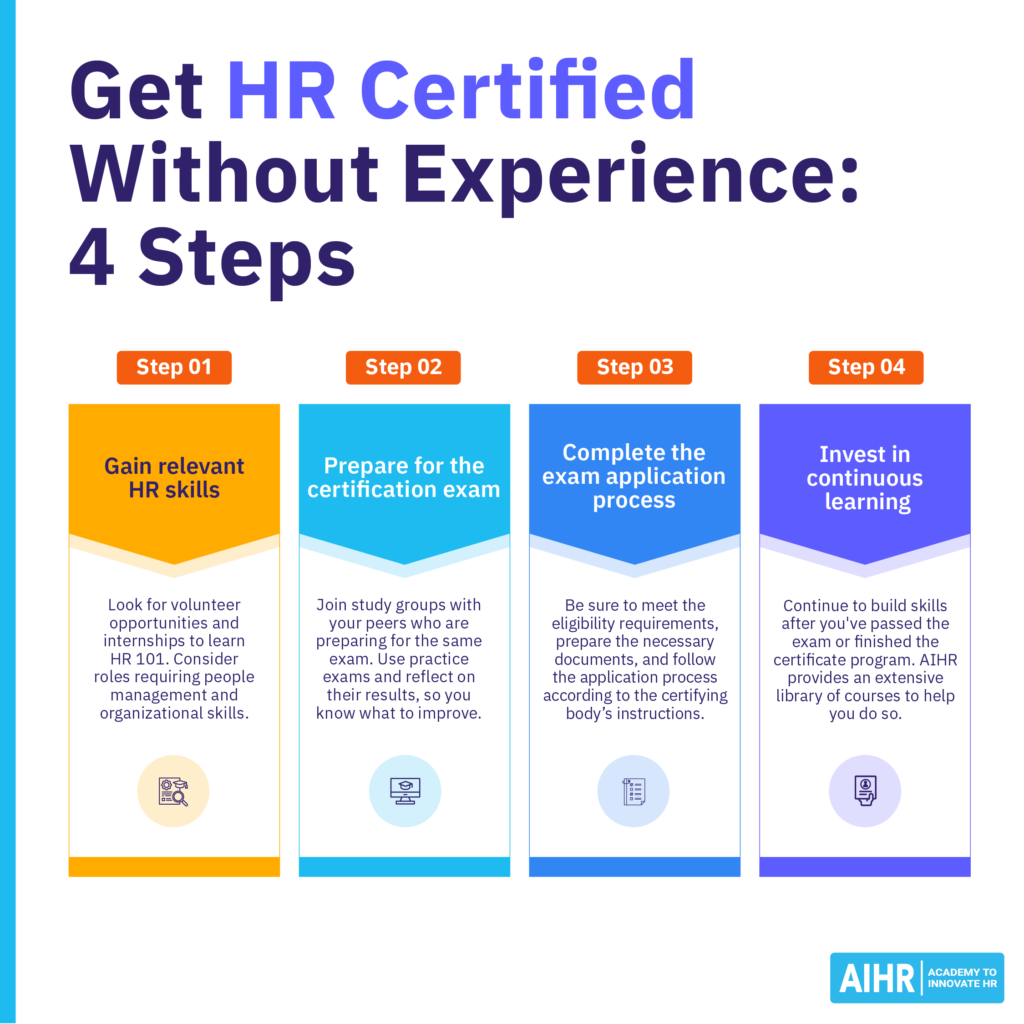
Step 1: Gain relevant HR skills
You can start building basic HR knowledge even if you have not gained formal HR experience. Be on the lookout for volunteer opportunities and internships to learn HR 101.
Consider working in customer service, administration, or any position focusing on people management and organizational skills, as these can also provide relevant experience.
Step 2: Prepare for the certification exam
Join study groups with your peers who are also preparing for the same examination, so you get motivated and get help to understand complex topics. Use practice exams to familiarize you with the format and types of questions that will be asked in the test.
Reflect on practice test results so you’ll know what to improve. Create a study plan covering all topics discussed in the course. Use the recommended resources and materials so you are fully prepared.
Step 3: Complete the exam application process
Be sure to meet the eligibility requirements for the certification you’re applying for, including education, certificate program completion, and sometimes work experience. Prepare all the documents, such as certificates of completion, IDs, and educational transcripts.
Follow the application process as outlined by the certifying body, which typically includes completing an application form and paying an exam fee. Monitor the status of your application.
Step 4: Invest in continuous learning
Getting certified can help advance your HR career, but it may not be enough. HR is changing quickly, especially with AI reshaping how the function works, so staying relevant means continuing to build skills after you’ve passed your exam or finished your certificate program.
AIHR’s learning platform provides an extensive library of online training courses and mini-courses that let you build specific skills (including AI in HR) with practical online learning.
HR tip
Once certified, maintain your credentials by attending workshops, seminars, and courses to earn the required continuing education credits. Stay updated on the renewal processes to ensure your certification is recovered.
How to get HR experience
For aspiring HR professionals looking to gain experience and broaden their expertise in the field, the following tips can help pave the way for a successful career in Human Resources:
- Cross-skilling within your organization: Volunteer on projects or tasks outside your job, like participating in recruitment events. Look for job opportunities in payroll or ER to understand how HR impacts these departments.
- Job shadowing: You can request to shadow HR staff in your company or through your work connections to gain hands-on experience in daily HR tasks and challenges. Learn about different aspects of HR, like benefits management, talent acquisition, or compliance, so you’ll know which one you’d like to specialize in.
- Joining professional HR associations: Join esteemed human resource associations like SHRM (Society for Human Resource Management) or HRCI (HR Certification Institute) to access resources, workshops, and networking events. Be an active member by participating in seminars and conferences to build connections and stay informed about the latest industry trends and best practices.
- Applying for entry-level HR positions: Search for positions that serve as a stepping stone into the HR field, such as HR assistant or recruiter assistant roles, even if they require minimal experience. Arrange your resume to highlight relevant skills (communication skills, organizational skills) and HR-related experience like internships or volunteer work.
- Continued education: Enroll in HR certification programs or pursue a degree in human resources to gain comprehensive knowledge and credentials to enhance your resume. Attend webinars, take online courses, and read industry publications for the newest updates on the sector.
- Developing technology skills: Learn standard HR tools like application tracking systems (ATS), human resource information systems (HRIS), and employee performance management tools. Learn data analysis software, as HR is now gearing towards making data-driven decisions.
Next steps
Pick the certification that aligns best with your current professional stage or future career goals. If you have zero HR experience and you’re job-hunting in the U.S., start with the aPHR or SHRM-CP. If you’re building an HR career outside the U.S., the aPHRi covers the same ground internationally. If you have no formal qualifications at all, CIPD’s Level 3 Foundation Certificate is the more suitable option. And if payroll is your way into HR, the FPC gets you there without a generalist detour.
Whichever route you take, pair the credential with practical skill-building: AIHR’s HR Generalist Certificate Program and HR Coordinator Certificate Program cover the day-to-day HR operations these exams test on, the Artificial Intelligence for HR Certificate Program and Digital HR 2.0 Certificate Program build the modern skills none of them test yet, and the Sourcing & Recruitment Certificate Program is worth considering if recruiting is what you want to explore.