An AIHR Course is standalone, single-subject online training built around one specific HR topic typically lasting two to 10 hours, drawn from AIHR’s library of 85+ courses.
Like AIHR Certificate Programs, each course is 100% online and self-paced, combining video lessons, reading materials, and downloadable templates and guides. All courses are taught by AIHR’s faculty of world-class practitioners from the same instructor pool behind the certificate programs.
How AIHR courses are structured
Each AIHR course focuses on one topic end-to-end across a small number of sequential training modules, with coursework you need to complete but no exam involved. Study time ranges from one hour (Lean Management, HR Coordinator Resource Pack) to 16 hours (HR Data Science in R), with most courses requiring between two and 10 hours (e.g., Learning Analytics and Diversity, Equity, Inclusion & Belonging, respectively).
Each module combines video lessons with reading materials, a short quiz to check the learner’s understanding, and at least one downloadable resource. This could be a guidebook, template, or worksheet that can be used right away. Learners can also see who’s teaching them, as every course names its instructor and their real-world qualifications.
The courses cover every major HR domain: AI, talent acquisition, people analytics, compensation and benefits (C&B), DEIB, digital HR, HR operations, organizational development, learning and development (L&D), and HR leadership. AIHR has courses for HR professionals of all levels, from those in entry-level roles to seasoned practitioners.
The table below offers some examples of the courses AIHR offers for four different levels:
Level | AIHR Course examples |
Foundational | |
Intermediate | |
Advanced | |
Expert |
Who should take an AIHR Course?
An AIHR Course is a good fit if you:
- Want job-ready depth on one topic instead of broad coverage across a domain: HR Statistics in Excel (15 hours), for instance, teaches essential statistical knowledge and how to apply it to HR with Excel, while Skills Gap Analysis (five hours) teaches learners methods to accurately identify current and future learning needs.
- Are a specialist going deeper into a function you already work in: Prime examples include Recruitment Analytics for talent acquisition, or Pay Principles for compensation.
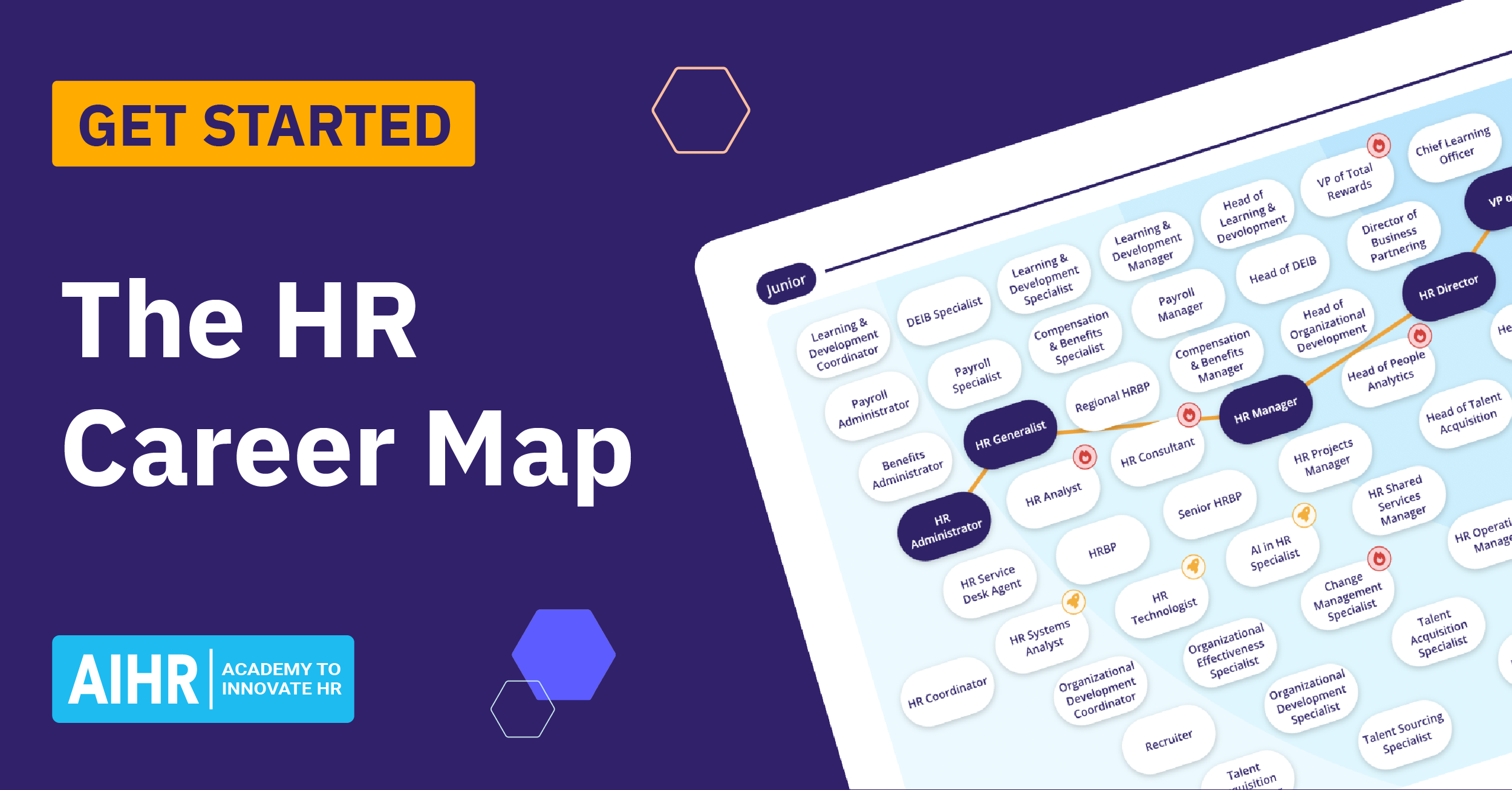
- Want to achieve specific HR Career goals: AIHR Courses allow you to mix and match courses into a personalized path, based on your own skills gaps and goals.
- Are strengthening a soft skill alongside your technical work: Courses like Consulting & Communication Skills and Learning Soft Skills allow you to improve existing soft skills to complement your technical skills.
- Are a people manager or an aspiring leader: Courses such as HR Management or Mastering Business Strategy can help you excel in your current position, and even prepare you for a future leadership role.
The difference between an AIHR Course, a Certificate Program, and a Mini Course
A Certificate Program is the most extensive learning option AIHR offers, with each one lasting 25 to 45 hours across multiple modules and ending in a capstone project that earns you a certificate. A Mini Course is the quickest option, typically lasting half an hour to two hours and focusing on a narrow, often current topic.
An AIHR Course is somewhere between the two: more extensive than the quick primers offered by Mini Courses, but shorter and less intensive than a full Certificate Program. It’s designed to teach one HR topic thoroughly rather than a whole domain.
How to enroll in an AIHR Course
AIHR Courses aren’t sold as standalone purchases. Each one is bundled into the Certificate Program it belongs to (for example, Coaching for HR is included in the Learning & Development Certificate Program), which costs $1,125 for 12 months of access.
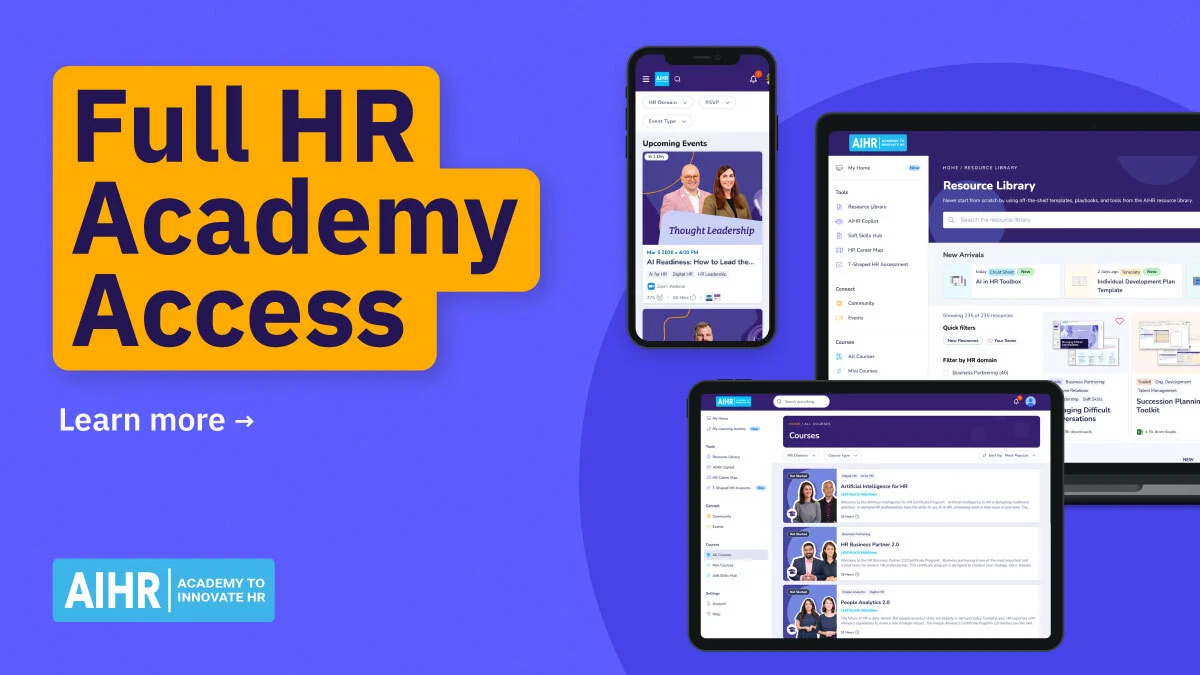
AIHR Courses are also available as part of Full Academy Access, which unlocks all 16 Certificate Programs, 70 Courses, and 85+ Courses for $1,850 per year. Browse all the AIHR Courses to see which certificate program each one belongs to, and which one is best for you.