
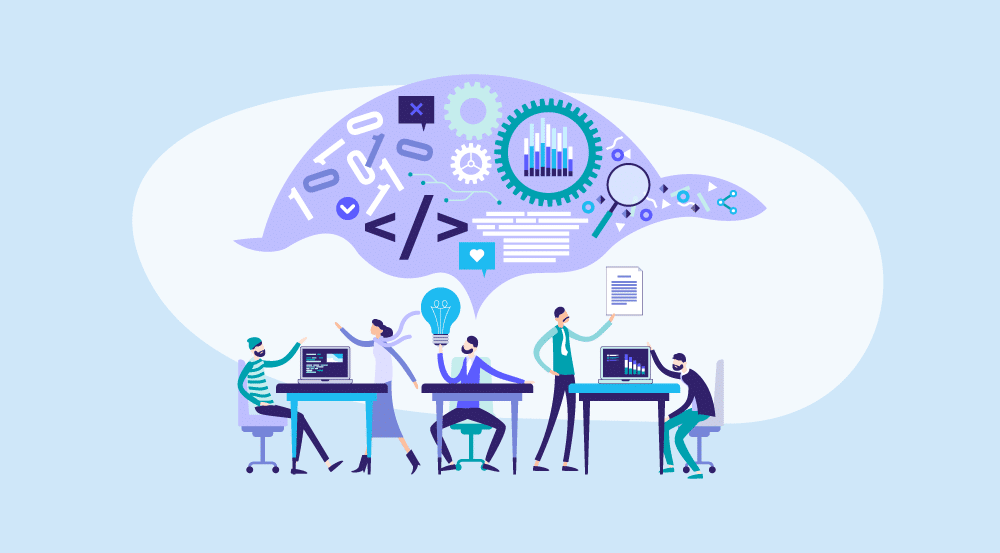
Making AI work for your HR function starts with knowing where it can help, and an AI hackathon is a hands-on way for your team to find out. Gathering AI hackathon ideas for HR teams is the first step. The opportunities of AI and automation in HR are plenty: from drafting policies and internal communications to summarizing training materials, researching HR trends, and automating responses to common employee queries, to name just a few.
To help your team get started, we’ve put together 15 AI hackathon ideas, including the problem they address and a potential AI solution to consider. You’ll also learn what an AI hackathon involves and get practical tips for running your own.
Contents
What is an AI hackathon?
15 ideas for your HR team’s AI hackathon
8 practical tips for running an AI hackathon for your HR team
What is an AI hackathon?
An AI hackathon is a live, time-boxed training session, in-person or virtual, where HR teams build an AI tool for an everyday HR task or process. The goal is to build a demo or a prototype that quickly proves value and gives your organization tangible examples of how AI can have a positive impact on the business.
The ideal AI hackathon format depends on the size of your organization. In smaller companies, a company-wide hackathon can work well, while in larger enterprises, a function-led AI hackathon is usually easier to run and govern. The duration of the hackathon varies and depends mostly on how much time you want to dedicate to it. In most companies, this ranges from a couple of hours or half a day to one, or even two full days.
An AI hackathon brings your HR team together to build one or more AI tools for tasks or processes you all handle. Because the whole team builds and uses these tools, everyone follows the same workflows and standards when using AI for those tasks. That makes a hackathon a practical way to move from individual AI use to a more structured, team-wide approach.

15 ideas for your HR team’s AI hackathon
The use of AI in HR is already widespread and will continue to grow. HR departments apply AI technology in virtually every HR function, from recruitment, hiring, and onboarding to workforce planning, HR analytics, L&D, HR business partnering, talent management, offboarding, and more.
This offers plenty of hackathon opportunities for HR teams wanting to accelerate and increase their AI adoption. Let’s explore some realistic AI hackathon ideas that your team can work on, including the issues they try to solve and potential AI solutions.
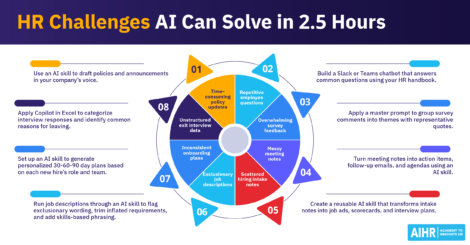
1. AI for HR communications
- The issue: Updating company policies and ensuring that they and your HR team’s (company-wide) announcements are in the company’s tone of voice is often a time-consuming and tedious task.
- The potential AI solution: A custom AI assistant (such as a Claude skill) that drafts policy updates and announcements in the company’s tone of voice, ready for review.
2. Managing inquiries with an AI chatbot
- The issue: Many HR teams spend a lot of time manually answering the same employee questions and queries over and over again. Not only is this a repetitive task for HR, but it can also be frustrating for employees having to wait for an answer.
- The potential AI solution: A chatbot in Slack or Microsoft Teams that answers common questions using your HR handbook and passes anything it can’t answer to the right person in HR.
The best AI ideas create value when teams have the space and guidance to build and test them.
AIHR’s AI Hackathon helps HR teams bring practical use cases to life in an expert-led session.
✅ Prioritize the most promising AI use cases
✅ Build a working AI-enabled HR workflow
✅ Create measurable time savings
✅ Give every team member hands-on experience
🎯 Move from ideas to a practical first AI win.
3. An employee feedback analysis tool
- The issue: A common issue that HR teams have with analyzing employee feedback from open-text survey questions is the sheer volume of unstructured data and the time it requires to process it manually.
- The potential AI solution: If you have a relatively small batch of comments (e.g., between 50 and 200 responses), a master prompt can work well to cluster open-text survey comments into themes with representative quotes. For larger surveys, you could build a bare-bones version of a multi-step AI workflow that tags each comment by theme and sentiment, counts the themes, and summarizes the results. It takes more setup, but it makes comparing teams and tracking changes over time much easier.
4. Streamlining HR meetings (e.g., meeting summary plus follow-up email)
- The issue: AI note-takers in tools like Google Meet and Microsoft Teams now capture summaries and action items automatically. However, their output is generic, so someone on your HR team still has to rework it for your action tracker, write the follow-up email, and prepare the next agenda.
- The potential AI solution: An AI skill that takes the auto-generated notes or transcript and produces follow-ups in your team’s own format, such as action items ready for your tracker, a follow-up email in your tone of voice, and a draft agenda for the next meeting based on open items. It also works with manual notes from meetings you can’t record, such as sensitive employee relations discussions.
The AI Hackathon session was one of the most valuable AI sessions I’ve attended. I initially found the idea of AI agents intimidating, but AIHR made the technology approachable through practical examples and real-world applications. I left the session inspired by the potential of AI agents to streamline employee relations processes, automate repetitive tasks, and improve overall HR workflows.

5. Conducting a learning needs analysis
- The issue: When you conduct a learning or training needs analysis, the data you need is often spread across different places, such as training surveys, performance reviews, skills assessments, and manager feedback. Gathering it all and translating it into clear training needs takes a lot of manual work.
- The potential AI solution: A master prompt that analyzes anonymized training survey results and manager feedback for one team or department. It could group the skill gaps people mention, rank them by how often they come up, and suggest which ones to tackle first based on the team goals you add to the prompt.
6. An automated job pricing template
- The issue: Accurate job pricing can be the decisive factor in a candidate accepting or refusing your offer. But manually finding and pulling the latest data from platforms such as PayFactors and Mercer to update your job-pricing templates is time-consuming and error-prone.
- The potential AI solution: A reusable job-pricing prompt that pulls PayFactors and Mercer data (or data from any other compensation and market benchmarking resource relevant for your pricing) into the job-pricing template, with a rule against making up missing data.
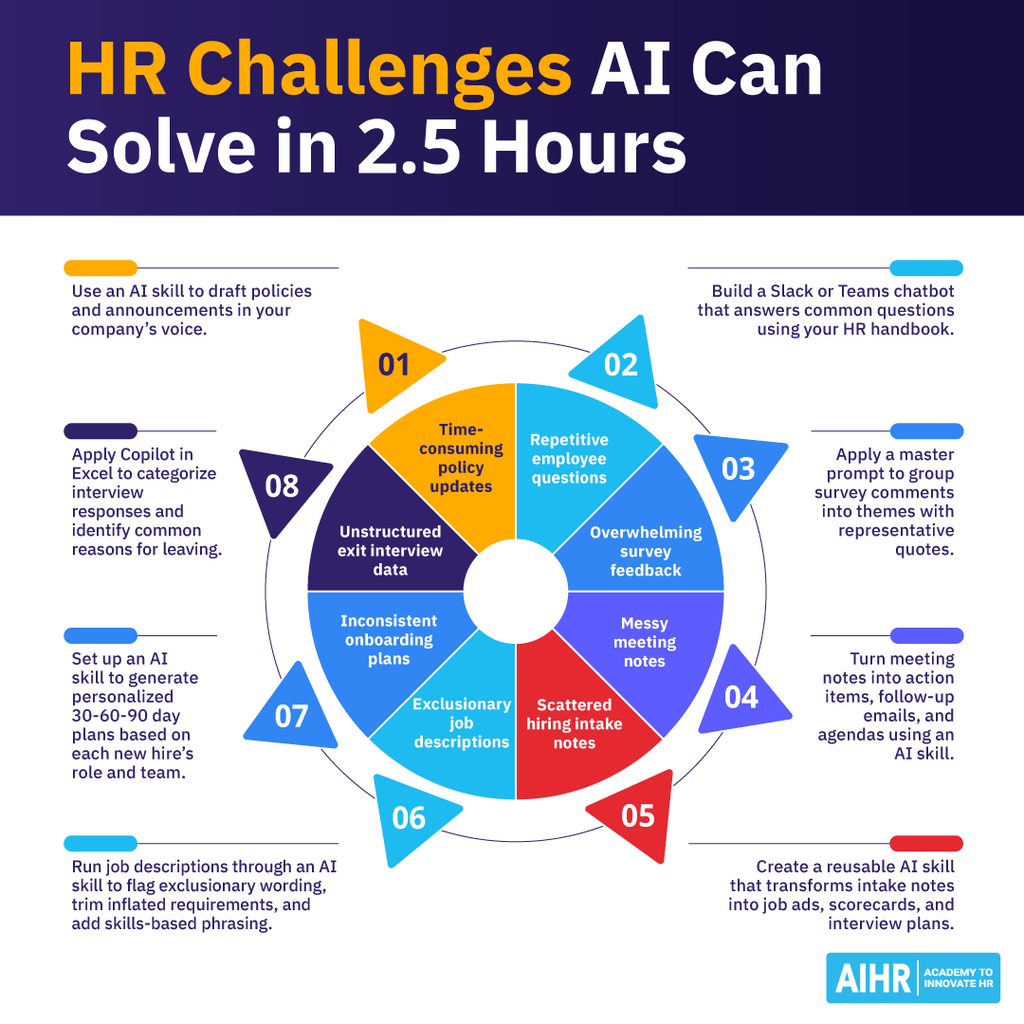
7. A repeatable hiring process
- The issue: In many organizations, large parts of the hiring process are still unstructured, and the job intake is a good example. This is the meeting where the recruiter and hiring manager agree on what the role needs, but the outcome often lives in scattered notes or emails.
- The potential AI solution: An AI skill that turns intake meeting notes or a completed intake form into a draft job ad, candidate scorecard, and interview plan, ready for the hiring manager to review.
8. A competency-based interview questions generator
- The issue: The interview process is oftentimes still unstructured and set to judge candidates on requirements like education and credentials that aren’t predictive of success. As a consequence, you can overlook potentially great candidates for the job.
- The potential AI solution: A master prompt that builds structured interview question sets from a job description and the role’s required competencies. A master prompt is a detailed, reusable prompt that already contains your competency framework, rating scale, and question format, and works in any AI tool. It returns behavioral questions, follow-up probes, and a scoring guide for each competency, so every interviewer assesses candidates the same way.
9. Interview preparation tool
- The issue: Interviewers often walk into interviews having only skimmed the candidate’s CV minutes before. Recruiters can prepare a brief for each interviewer, but writing one for every candidate takes time, and the format often varies by hiring manager, so some interviewers get much more context than others.
- The potential AI solution: A master prompt or skill that prepares a one-page interview brief from the candidate’s CV and the job description. The brief could summarize relevant experience and highlight areas to explore during the interview, so every interviewer starts with the same information.
10. Interview notes summarizer
- The issue: We’re staying with the interview phase of the hiring process a bit longer, this time to tackle some of the issues that occur after the interview has taken place. Interviewers regularly take notes that are disorganized, include recency bias, subjective impressions, or legally risky remarks.
- The potential AI solution: A master prompt or agent that turns messy interview notes into a summary organized against the scorecard criteria, highlighting where evidence is strong, thin, or missing. The hiring decision stays with the panel, and the tool only makes the debrief sharper.
11. Inclusive job descriptions checker
- The issue: Even well-written job descriptions can contain gendered wording, unnecessary requirements, or jargon that discourages qualified candidates from applying. These issues are easy to miss when you write or review job descriptions under time pressure.
- The potential AI solution: A skill that reviews a job description and returns a version with gendered or exclusionary language flagged, inflated requirements trimmed, and skills-based phrasing added. Seeing the original and revised versions next to each other also helps your team spot patterns to avoid in future job descriptions.
12. A Performance Improvement Plan (PIP) reviewer
- The issue: Even with a performance improvement plan (PIP) template, managers often fill it with vague goals, subjective language, or too few concrete examples. This makes PIPs harder for employees to act on and creates fairness and legal risks for your organization.
- The potential AI solution: A skill that reviews a manager’s draft PIP and suggests improvements before it goes to HR. It could rewrite vague goals into specific, measurable ones, flag subjective or emotional wording, and point out where the plan needs more examples or clearer check-in dates.
13. A personalized onboarding planner
- The issue: A well-planned employee onboarding process helps you retain new hires and get them up to speed faster, but in many organizations, onboarding is still ad hoc. Each manager plans it differently, and HR repeats the same manual work for every new hire.
- The potential AI solution: A skill that creates an onboarding plan based on the new hire’s role, team, location, and seniority. With a list of key internal documents and an overview of who does what in each team added as reference files, it could suggest a custom 30-60-90 day plan, a reading list, and a “who to meet” list.
14. Performance review feedback
- The issue: The challenges with (a manager’s) performance review feedback are similar to those with interview notes; the feedback often contains subjective, potentially problematic or biased remarks, and might be unstructured or informal.
- The potential AI solution: A skill or master prompt that rephrases a manager’s informal notes into a review draft that is specific, constructive, and focused on behavior and results. It could also flag remarks that may reflect bias, so managers can rethink them before the review is final.
15. Exit and stay interview analyzer
- The issue: The main issue with data from open-ended questions in stay interviews, pulse checks, and exit interviews is that it takes time to gather it, process it manually, and then translate it into applicable (management) interventions.
- The potential AI solution: A spreadsheet that analyzes an anonymized export of stay and exit interview answers. Your team could set up an AI function, such as AI in Google Sheets or COPILOT in Excel, that tags each answer based on a predefined list of reasons, such as career growth, pay, or manager relationship. A pivot table could then show the most common reasons per department, and a final prompt could draft practical actions for managers, ready for HR to review.
Important to know
Most of the solutions above, such as master prompts, skills, and AI functions in spreadsheets, are simple enough to build within a few hours, which makes them a good fit for your first AI hackathon. Once your HR team has more experience with AI, you could run an agentic AI hackathon, where teams build AI agents that complete multi-step tasks on their own.
Practical tips for running an AI hackathon for your HR team
As you’ve seen in the previous section, the possibilities and ideas for AI hackathon projects are endless. There are, however, a couple of practical tips to keep in mind when running an AI hackathon for your HR team, including:
- Choose a format that works for you: Decide whether the hackathon will take place in-person or virtually and how long it will run for. This depends, among other things, on where your HR team is located (e.g., are people based in the same geographical location) and how much time you can spare for the AI hackathon.
- Consider expert facilitation: If you don’t have the time or in-house expertise to organize the hackathon yourself, you can bring in an external expert facilitator. AIHR’s AI Hackathon for HR teams, for example, takes your team from choosing a challenge to a working AI-enabled workflow in a single 2.5-hour online session, guided by an HR and AI expert.
- Identify the challenges to tackle: Ask your team for input and ideas while keeping in mind your HR objectives where possible. List the various options on a single sheet.
- Prioritize: Depending on how many AI hackathon ideas you end up with, and the size of your HR team, you need to decide which challenges to prioritize. Perhaps start with the one(s) that most of the team agree on and are keen to build a solution for.
- Organize a kick-off event: Schedule a kick-off event in the week before the hackathon. Use this moment to explain the hackathon format to the HR team. Share the list of ideas and let the team members choose which build they would like to participate in during the hackathon.
- Define the minimum viable prototype: Define what the teams must demo so that they actually build something and not just plan.
- Build enablement into the hackathon: Make sure to provide some sort of support and easily accessible resources during the event. At AIHR, for example, we set up a helpdesk channel during our AI hackathon, and we shared an AI starter pack with the team.
- Host the hackathon build day: The following week, it’s time to have the actual hackathon and let the team develop AI tools to tackle the issues they wanted to work on. If you have AI champions (employees with more advanced AI skills) on your HR team or within the broader organization, you may want to ask them to check in on the various sub-teams to assist and provide support where needed.
- Organize a demo event: Once the hackathon is over, schedule a moment for the various teams to demonstrate their builds. This can be half a day, or, if your HR team is smaller, perhaps a couple of hours. Ask the teams to present their workflows, even if the tool they built wasn’t successful, and have them share their challenges and learnings.
A final word
An AI hackathon helps your team move beyond theory and lets them experience for themselves how they can apply AI to real HR challenges they encounter every day, creating a shared team-bonding experience, tangible results, and momentum to keep going.
The AI hackathon ideas for HR teams listed in this article can be a great source of inspiration if you want to organize a hackathon for your own department.