

If you’re researching what training you need for Human Resources, you’re very likely not even coming from a traditional HR background, either. According to AIHR’s State of HR research, only 18% of HR professionals start their careers in HR as their first or second role, and most come from the humanities, social sciences, or administration, learning the job on the go rather than through structured training.
This is probably one of the reasons you want to understand what training is right for your current or future HR role. We unpack these for you in this guide, including whether it’s essential to have an HR degree, what the other alternatives are, and what HR learning can help you develop core and specialist HR competencies to stand out in the job market.
Contents
Formal education: What degree do you need in HR?
Professional HR certifications: SHRM, HRCI, and AIHR
Core HR knowledge to develop
Specialist HR knowledge to develop
The skills gap most HR training misses
Certificate, degree, or certification: Which HR training path is right for you?
FAQ
Formal education: What degree do you need in HR?
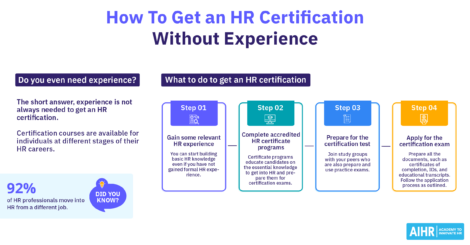
While a handful of entry-level HR roles will take you on with administrative experience alone, most employers still ask for a bachelor’s degree, and the Bureau of Labor Statistics counts human resources, business, communications, and psychology among the fields that qualify. An HR degree gets you to the fundamentals fastest. A business or psychology degree gets you there too, just by a different route, picking up the commercial thinking or people-reading skills the job also demands.
If you want to test the field before committing to four years, an associate degree or diploma can get you into entry-level roles such as HR assistant or coordinator faster. For management and director-level roles, a master’s degree in HR, organizational leadership, or an MBA becomes more common, mostly because those roles need business fluency an undergraduate program doesn’t always build. Our guide to HR job requirements breaks down what employers expect at each level.
None of this is the whole story, though: a degree gives you the theory, and what you do with it next, through certification and applied skill-building, turns that theory into a job you’re actually ready to do.

Professional HR certifications: SHRM, HRCI, and AIHR
Once you have some HR experience, or sometimes before you do, an HR certification will help you prove what you know. The Society for Human Resource Management’s (SHRM) SHRM-CP and SHRM-SCP are behavioral, competency-based credentials recognized across the US.
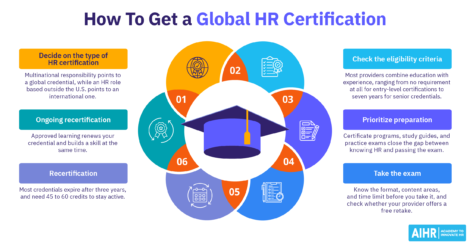
The HR Certification Institute’s (HRCI) PHR and SPHR certifications lean more toward the technical side, testing your grasp of employment law, compliance, and HR operations. Between them, they cover most of what employers mean when they ask for someone “HR certified”. Our guide to becoming HR certified walks through eligibility for both.
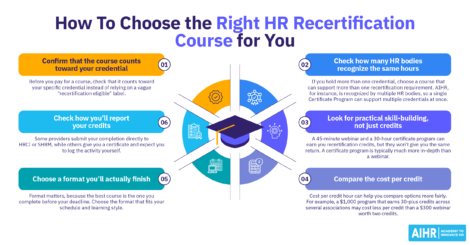
However, neither one teaches you the skills to apply on the job. You still need to build that underlying competence somewhere, and that’s where a practical HR certificate program is highly valuable. AIHR’s Certificate Programs, including HR Generalist, People Analytics, and HR Business Partner 2.0, are built around applied capstone projects and case studies rather than exam prep, so you finish with something you’ve actually done, not just a score you passed.
AIHR is recognized by SHRM to offer Professional Development Credits (PDCs) for SHRM-CP® or SHRM-SCP® recertification activities, so you can both build the skill with a certificate program, then use SHRM or HRCI to validate it.
Employment law and HR operations also move quickly enough that a credential earned five years ago can go stale, and recertification credits exist for exactly that reason. Treat an HR certification as a milestone, not the finish line. Our roundup of the best HR certifications compares options by career stage if you’re not sure where to start.
Core HR knowledge to develop
Whatever path you take, a degree, an HR certification, or an HR certificate program, you need broad capability across the core competencies every HR role now requires. AIHR’s T-Shaped HR Competency Model, now in its fourth iteration and shaped by AIHR’s global HR community across 140+ countries, outlines six competencies: Business Acumen, Data Literacy, Digital Agility, AI Fluency, People Advocacy, and Execution Excellence.
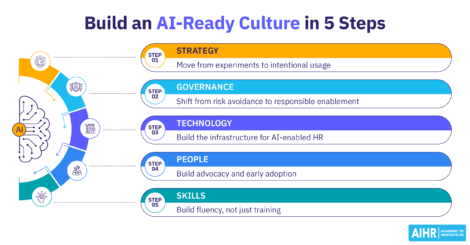
Business Acumen connects your work to how the organization creates value, Data Literacy turns people data into decisions, Digital Agility and AI Fluency keep you current as HR technology changes, People Advocacy keeps the human side of the job central, and Execution Excellence, the personal effectiveness to follow through consistently, is what turns the other five from knowledge you hold into practice you actually apply.
Choosing an online HR course is an important step in your professional development. Before you enroll, it helps to see how the learning experience supports practical skill-building and continuous growth.
AIHR’s Demo Portal gives you a preview of what learning with AIHR looks like:
✅ Watch sample lessons from AIHR’s HR courses and certificate programs
✅ Explore practical guides, templates, and resources you can apply in your HR work
✅ See how bite-sized online learning fits around your schedule and career goals
✅ Discover learning paths that help you choose the right next step for your HR development
💡 Visit the Demo Portal to explore the platform and find the learning experience that fits your goals.
Specialist HR knowledge to develop
Core competencies alone aren’t enough. You also need depth on the vertical bar of the T, and that covers two things. The first is specialist expertise in at least one HR domain, whether that’s talent acquisition, compensation and benefits, or HR Generalist work covering a bit of everything.
The second is leadership competencies, such as change leadership and building credibility and trust, which matter once you start managing people.
A Talent Acquisition Specialist without data literacy struggles to turn a hiring plan into a business case a CFO will approve. Someone with strong business acumen and AI fluency but no functional depth can talk strategy convincingly without being able to execute it. Either way, you’re missing half of what the role actually needs.
The skills gap most HR training misses
Even HR professionals with real depth on the vertical bar often find themselves short on the horizontal one, the core competencies that determine how far that specialty goes. AIHR’s Future-Ready HR Skills Report, based on research with 961 HR teams and 13,665 HR professionals, found that only 50% of HR teams believe they have the right skills to deliver the impact the business expects of them.
Three capabilities consistently fall short: digital agility is the lowest-rated skill across the population, data literacy ranks second-lowest, and business acumen shows uneven growth even among experienced professionals. All three are core competencies in the T-Shaped model, and every strategic HR role depends on them.
Generic upskilling doesn’t hold up against the complexity of real HR work. Off-the-shelf e-learning explains concepts but skips the complexity, and seniority-based development assumes skills grow with tenure, even though the data show they don’t.
AIHR’s Certificate Programs work differently: each one is built around a core competency, like developing your AI Fluency or People Analytics skills, and specialist competencies, for example, strategic talent acquisition or organizational development. This ensures that what you learn maps directly to the work you actually do.
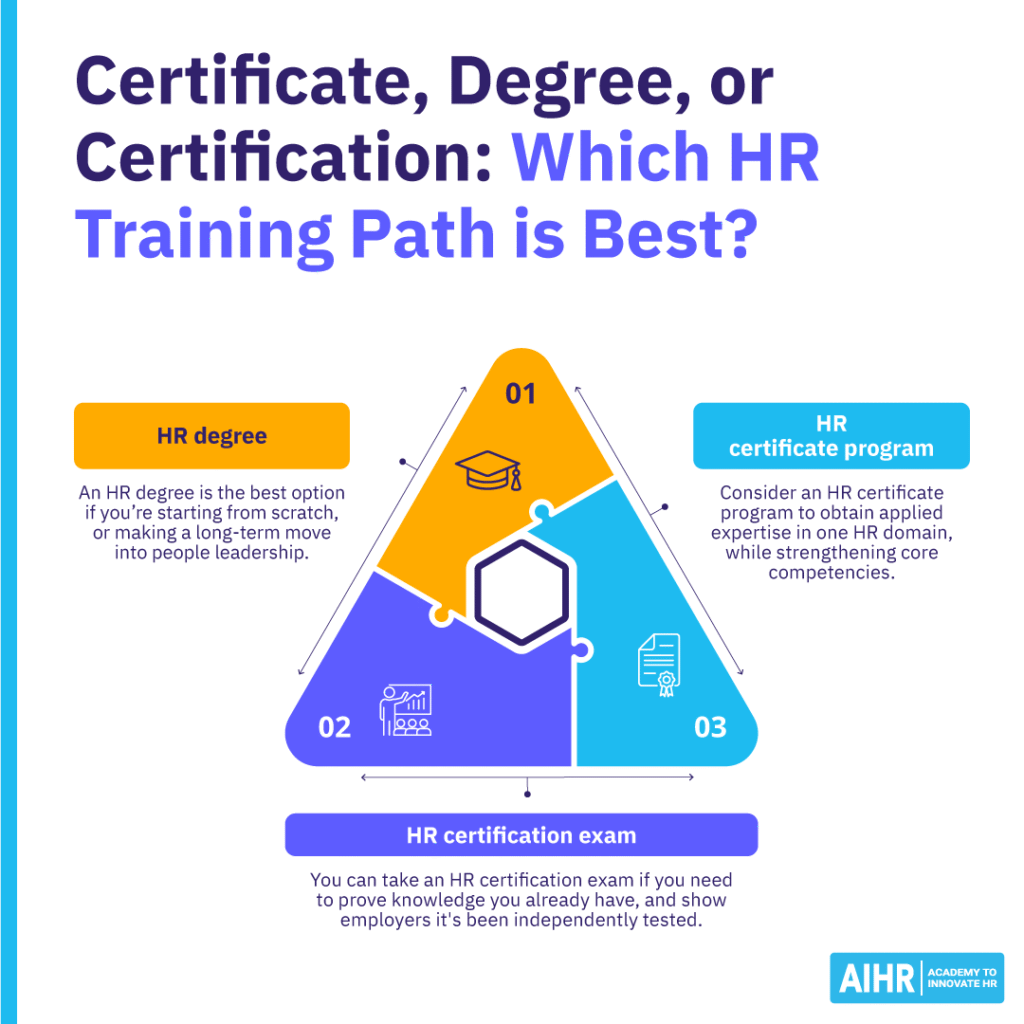
Certificate, degree, or certification: Which HR training path is right for you?
Here’s a quick breakdown to help you decide which route is right for you:
Path | Duration | Best for | Limitations |
HR degree | Two to four years, covering HR theory, business fundamentals, and often, a research component | Starting from scratch, or a long-term move into people leadership | Too slow if you already have work experience and need to close a specific skills gap fast |
HR certification exam | Two to four moths of study (SHRM recommends around 100 hours) | Proving knowledge you already have; shows employers it’s been independently tested | Tests what you know rather than teaching you anything new, so it works best after you’ve built the skill elsewhere |
HR certificate program | 25 to 45 hours of self-paced content | Building applied expertise in one HR domain, (e.g., HR business partnering, people analytics, or AI in HR), while strengthening core competencies like data literacy and business acumen | Doesn’t confer a formal degree credential, since the focus is on practical skills you can apply on the job immediately, not academic theory |
Read our guide to HR qualifications for a fuller comparison.
In practice, most HR careers combine more than one path. Start with an HR degree or HR certificate program for the foundation.
Add a SHRM or HRCI certification once you have enough experience to sit for it. Then continue your education by taking HR certificate programs as your role expands. Treat the three as complementary HR learning you pick up in the order your career needs them.
Where to go from here
HR training isn’t a single decision; it’s a combination you build over a career: a foundation, a credential, and the specific skills your role demands next.
Our report shows that only half of HR teams currently believe they have the right skills to deliver on what the business expects, which is why AIHR’s Certificate Programs help you build the practical, applied skills that close that gap, and are designed to sit alongside the SHRM or HRCI credential you already have or plan to earn.
FAQ
Most HR roles require formal education (typically a bachelor’s degree), a professional HR certification such as SHRM-CP or HRCI’s PHR, and training in core and specialist competencies. Core skills include business acumen, data literacy, digital agility, AI fluency, people advocacy, and execution excellence. Specialist skills depend on your HR domain, such as talent acquisition, compensation and benefits, or HR generalist work. A certificate program is the fastest way to build both.
The same combination: A relevant degree or certificate program for foundational knowledge, a recognized certification like SHRM-CP or PHR to validate it once you have experience, and ongoing skill-building in your specialist domain and the core competencies around it as your role grows.
Yes, particularly for entry-level roles such as HR assistant or coordinator. Our guide on how to get into HR covers the transferable skills that count most, and a certificate program can substitute for some of what a degree provides.
If it’s built around applied skills rather than test prep, yes. It’s what turns theoretical knowledge into the job-ready competence employers are actually screening for.