

Thinking about a career in Human Resources? Whether you’re just starting out or moving over from another role, the course you choose shapes how quickly you get hired and how far you grow. A degree for Human Resources can give you a strong foundation. But it isn’t your only route in, and many employers don’t require one.
In this guide, you’ll compare the main options: associate, bachelor’s, and master’s degrees, professional certifications, and online HR certificate programs. You’ll see the skills each one builds, the career paths it leads to, and how to pick the one that fits your goals, budget, and schedule.
Contents
What is the best course to study for HR?
Do you really need a degree to work in HR?
Common Human Resources education requirements
Which degree or course is best for an HR career?
How do you choose the right HR course or degree?
What is the best HR qualification?
FAQ

What is the best course to study for HR?
The best course to study for HR depends on your experience, budget, time, and target role. There isn’t one right answer, and a degree in HR is sometimes not required by employers. Here’s a quick way to match your situation to a course:
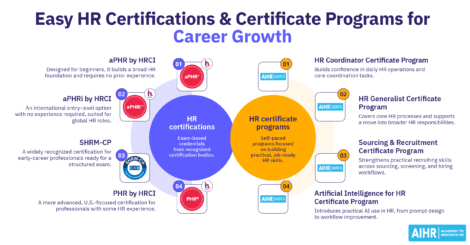
- You’re new to HR and don’t have a degree: Start with a practical online HR certificate program, such as AIHR’s HR Coordinator Certificate Program, which requires no previous HR skills. Pair it with hands-on experience. You can also work toward an entry-level credential like the aPHR, which requires no HR experience.
- You have a degree in another field and want to switch to HR: You often don’t need a second degree. A focused certificate program, such as AIHR’s HR Generalist Certificate Program, helps you build the HR knowledge to make the move.
- You want a traditional, long-term academic route: An associate or bachelor’s degree in HR, business, or organizational psychology gives you a broad foundation.
- You’re already in HR and want to specialize or advance: A specialist certificate program in an area like people analytics, HR business partnering, or AI in HR builds targeted skills quickly. A master’s degree or MBA is an option if you’re aiming for senior leadership and employers in your market expect one.
Why AIHR is an option to consider
The Academy to Innovate HR (AIHR) is an online learning platform for HR professionals and teams. It offers 16+ certificate programs across HR domains, from HR fundamentals to people analytics, HR business partnering, and AI in HR.
- Flexible: Each certificate program takes 25 to 45 hours, is 100% online and self-paced, and includes 12 months of access.
- Practical: Programs combine video lessons, quizzes, assignments, real-world case studies, and downloadable templates. They’re built by HR practitioners for HR professionals.
- Verifiable: You earn a digital certificate by passing the capstone exam at the end of the program. You can share and verify it on LinkedIn.
- Recognized for recertification credits: AIHR is recognized by SHRM to offer Professional Development Credits (PDCs) for SHRM-CP® or SHRM-SCP® recertification activities. Its programs are also eligible for HRCI, HRPA, CPHR, and ATD credits, and AIHR is CPD-accredited by CPD UK, allowing CIPD members to record AIHR programs as verified Continuing Professional Development.
- Trusted: AIHR has trained 85,000+ HR professionals in 180+ countries. Learners rate it 4.66 out of 5 from 12,000+ verified reviews on Reviews.io, and 96% of students recommend AIHR.
An AIHR certificate isn’t a degree or a formal professional certification like the SHRM-CP or PHR. It’s designed to build practical HR skills, and it works alongside those credentials rather than replacing them.
Do you really need a degree to work in HR?
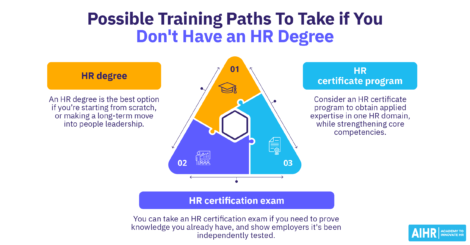
The short answer? Not always. There are no official education requirements to work in HR, and many people build a successful HR career without a formal HR degree.
In fact, fewer than 1 in 10 HR leaders have an HR-specific degree, and 31% have a degree outside HR or business, according to BambooHR’s analysis of 162 HR leaders at top Fortune 500 and Inc. 5000 companies. AIHR’s State of HR research also found that only 18% of HR professionals start in HR as their first or second role.
Degree requirements are also becoming less common in job ads overall. In January 2024, 52% of U.S. job postings on Indeed didn’t mention a formal education requirement, up from 48% in 2019, according to the Indeed Hiring Lab. That figure covers all occupations, not only HR.
That said, many entry-level HR jobs still ask for a bachelor’s degree. Check postings for the roles and locations you’re targeting. If they list a degree, a degree in HR or business can make you a more attractive candidate. If they focus on skills and experience, a certificate program plus hands-on experience may be enough to get started.
Common Human Resources education requirements
While there are no official education requirements for people who want to work in HR, some qualifications regularly appear in job ads for HR professionals, including:
- Bachelor’s degree in Human Resources, Organizational Psychology, Business, or a related field for entry- and mid-level roles.
- Master’s degree in HR or an MBA with an HR focus for senior roles.
- Professional HR certifications like SHRM-CP, SPHR, or aPHR, which validate your HR knowledge through an exam.
- HR certificate programs, such as AIHR’s, which show you’ve built practical skills in a specific HR area.
Not every credential has a degree requirement. According to SHRM, you don’t need a degree or previous HR experience to apply for the SHRM-CP. HRCI states that no HR experience is required for the aPHR.
Advance your HR career with Full Academy Access
From skills development to practical resources, AIHR’s Full Academy Access gives you the complete toolkit to grow, lead, and thrive in HR.
✅ Learn from all 16+ certificate programs and 85+ courses and mini courses, with content upgrades as new courses launch
✅ Download and apply 300+ templates, playbooks, and tools from the HR Resource Library
✅ Accelerate your career with personal coaching and weekly webinars with HR experts
✅ Stay connected through the expert community, the Soft Skills Hub, and AIHR Copilot.
🎓 Make your HR career unstoppable with access to every AIHR Certificate Program.
Which degree or course is best for an HR career?
There’s no one-size-fits-all answer. The right option depends on where you are in your career, your budget, and your future goals. Here’s how the main routes compare at a glance:
Degree or course | Typical time | Best for |
Associate degree in HR | About 2 years | Entry-level roles and a lower-cost academic start |
Bachelor’s degree in HR | About 4 years | Roles where employers list a bachelor’s degree |
HR certificate program (such as AIHR) | 25 to 45 hours per AIHR program | Career switchers, new HR professionals, and specialists building practical skills |
Master’s degree in HR or MBA with an HR focus | 1 to 2 years full-time, 2 to 5 years part-time | Senior and strategic HR roles |
If you’re starting a career in HR through an academic route, an associate or bachelor’s degree is a common place to begin. These programs cover HR fundamentals, business operations, and communication skills to help you land your first role and grow from there.
1. Associate degrees in Human Resources
An associate degree in Human Resources provides an introduction to the ethics, legal issues, and core business administration theories you need to succeed in an entry-level HR role.
The two-year curriculum of an associate degree program is the equivalent of the first two years of a bachelor’s degree. It gives students the knowledge they need to specialize in HR roles, such as benefits, hiring, recruitment, and L&D.
Example associate degrees in Human Resources
- Ashworth College: Associate Degree in Human Resources
- Northeast Wisconsin Technical College: Human Resources: Associate Degree
- Bryant & Stratton College: Human Resources Specialist Associate Degree
- Penn State University: Labor and HR Associate Degree.
Skills you’ll gain
- HR fundamentals (HR management, employment law, benefits, etc.)
- Basic business operations and communication
HR career paths with an associate degree
An associate degree in Human Resources enables you to pursue:
- An entry-level position as an:
- HR Assistant
- HR Specialist
- Payroll Administrator
- Or a position as a:
- Hiring Associate
- Recruiting Associate
- Or gain experience, continue with a bachelor’s degree for more advanced roles, or grow into a management role.
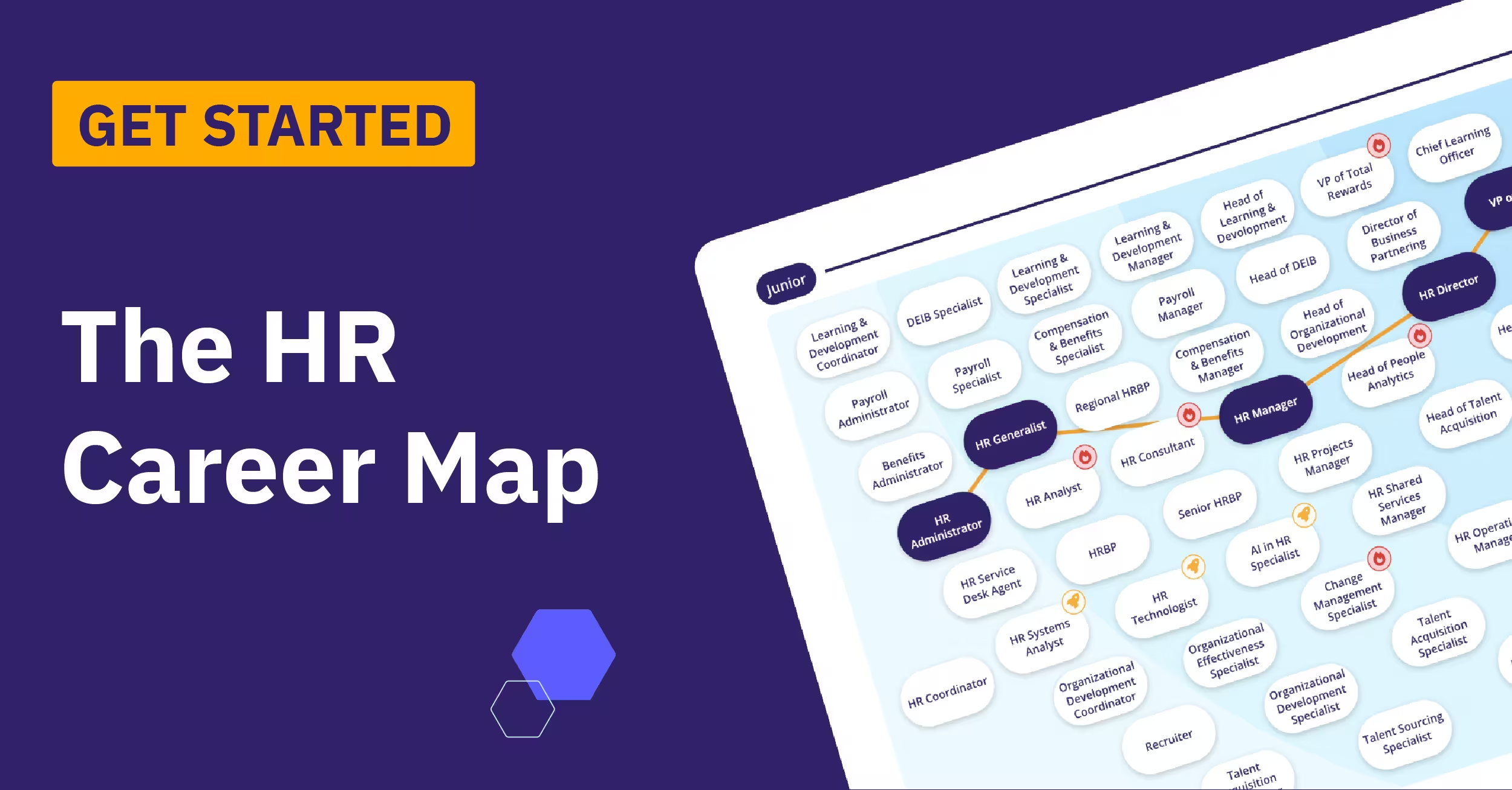
There are many HR careers you can pursue. Use our free HR Career Map to explore roles, salary ranges, and key skills, and see what your path could look like.
Pros and cons
Like any option, an associate degree in HR has benefits and drawbacks.
Pros:
- Lower costs: Earning an associate degree in HR is generally more affordable than getting a bachelor’s degree, making it a more budget-friendly option.
- Good for entry-level positions: An associate degree can help you qualify for and land entry-level roles in HR.
- Builds a strong foundation: The curriculum covers key HR knowledge and skills, giving you a solid starting point in the field.
- Easier path to further education: If you choose to pursue a bachelor’s degree later, an associate degree often allows you to complete the program in two years instead of four.
Cons:
- Lower earning potential: Those with an associate degree may earn less than individuals with a bachelor’s degree or higher.
- Increased competition: There may be more competition for entry-level roles, as some employers prioritize candidates with bachelor’s degrees.
- Limits on career growth: Career advancement into senior or managerial positions may require a bachelor’s degree, meaning additional qualifications could be needed down the road.

2. Bachelor’s degree in HR
A bachelor’s in HR is one of the most common academic routes into the field. This four-year degree gives you a broader and deeper understanding of how to manage people, improve performance, and support business goals.
Example bachelor’s degrees in Human Resources
- University of Maryland Global Campus: Online Bachelor’s Degree: Human Resource Management
- Grand Canyon University: Bachelor’s Degree in Human Resources Management
- Athabasca University: Bachelor of Human Resources and Labour Relations
- Ottawa University: Online Bachelor of Arts in Human Resources
Topics typically covered in an HR bachelor’s degree program include:
- HR fundamentals: Human Resources Management, including Talent Acquisition, Training and Development, Compensation and Rewards, Performance Management, Global HRM, and Labor Laws.
- Special topics in HRM: Building effective teams, leadership development and skills, ethics and HRM, diversity and inclusion, conflict management, and more.
HR career paths with a bachelor’s degree
A bachelor’s degree in Human Resources enables you to pursue a career as:
- A Human Resources Manager
- A Learning and Development Manager
- An HR Business Partner
- An HR Generalist
- A Human Resources Specialist.
These are just a few options. Your HR career can take many shapes based on your aspirations, experience, and circumstances.
Pros and cons
Let’s take a look at some of the benefits and potential drawbacks of a bachelor’s degree in Human Resources:
Pros
- Higher earning potential: HR professionals with a bachelor’s degree often earn more than those with an associate degree.
- More job opportunities: A bachelor’s degree can open up more entry-level and advanced roles where employers list a degree as a requirement.
- Variety of career paths: With a bachelor’s in HR, you can pursue roles such as HR Generalist, HRBP, Talent Acquisition Specialist, L&D Manager, and more.
Cons
- Significant investment: A bachelor’s degree requires a lot of time and money. These programs typically take four years and can cost tens of thousands of dollars.
- Limited focus on business skills: Most HR programs include some business modules, but critics argue HR professionals need a stronger grasp of business principles, communication, and strategy. They suggest combining a business degree with HR-specific learning, such as a certificate program, for a more well-rounded skill set.
3. Online Human Resources certificate programs
If you’re switching careers into HR, starting without an HR degree, or looking to specialize, an online HR certificate program can be a smart choice. These programs are shorter and more affordable than a degree, and they focus on practical skills you can apply at work right away.
AIHR’s 16+ certificate programs each take 25 to 45 hours, are 100% online and self-paced, and include 12 months of access. Every program ends with a capstone project consisting of a practical capstone assignment and a capstone exam. You earn your digital certificate by passing the capstone exam with a score of 70% or higher.
Examples of AIHR Certificate Programs
For people new to HR:
- HR Coordinator Certificate Program (designed for people new to HR or aiming for their first HR job; no previous HR skills needed)
- Master HR fundamentals across the entire employee lifecycle.
- Learn to craft, implement, and maintain HR policies that support business needs.
- Gain HR project management skills and apply AI tools to manage competing demands.
- Develop confident communication skills to represent HR effectively.
- HR Generalist Certificate Program (a good fit for beginners, first HR hires, and people moving into an HR role)
- Learn how HR processes keep your organization running.
- Get hands-on by developing your own strategic HR function.
- Create end-to-end HR processes, from recruitment to employee engagement.
For HR professionals who want to specialize or advance:
- People Analytics Certificate Program (no prior statistics or technical knowledge required)
- Learn how HR analytics can be used to drive business value.
- Get hands-on by analyzing people data in Excel.
- Build interactive HR dashboards and reports in Microsoft Power BI.
- HR Manager Certificate Program (designed for new and aspiring HR managers and leaders)
- Gain a deep understanding of business, organizational design, and HR operating models.
- Become a culture champion, drive change, get buy-in, and build trust.
- Learn to align HR strategies with business goals and design and implement an agile, project-based approach to HR.
- Artificial Intelligence for HR Certificate Program
- Understand the AI landscape and how to confidently leverage AI in HR.
- Master the use of generative AI in HR to deliver high-quality work.
- Develop and execute an AI strategy for business success.
- HR Business Partner 2.0 Certificate Program
- Boost your business acumen to link HR strategy to business outcomes.
- Develop core HRBP competencies across consulting, HR metrics, and AI fluency.
- Apply employee experience techniques to improve interactions with the business.
Skills you’ll gain
The skills you develop in an AIHR certificate program depend on the program you choose. Every AIHR program is shaped by the T-Shaped HR Competency Model, which helps you become a T-shaped HR professional. The model’s six core competencies are:
- Business Acumen: Business acumen is the ability to understand a company’s purpose, goals, and vision, and create activities, policies, and processes that align with them.
- Data Literacy: Data literacy means being able to critically analyze data, extract meaningful insights, and apply them effectively to specific needs.
- Digital Agility: Digital agility is the ability to use technology to improve HR efficiency and drive business growth and value.
- AI Fluency: AI fluency combines the technical skills and judgment to use AI responsibly in HR.
- People Advocacy: People advocacy is about championing employees and fostering a positive organizational culture. It involves helping people reach their potential and ensuring strong communication.
- Execution Excellence: Execution excellence focuses on how HR teams effectively execute their responsibilities, ensuring HR delivers value to all stakeholders.
Each of these skills is essential for HR professionals looking to make a meaningful impact in their organizations.
HR career paths with a certificate program
An HR certificate program can help you build a career in various HR functions, such as talent acquisition, people analytics, learning and development, or compensation and benefits. If you’re new to the field, combining a certificate program with hands-on experience, such as volunteering for HR projects or taking an entry-level role, strengthens your application.
Pros and cons
HR certificate programs come with their benefits and drawbacks. Here’s a breakdown:
Pros
- No degree needed to start: You don’t need an HR degree to enroll. Programs like AIHR’s HR Coordinator Certificate Program require no previous HR skills.
- Flexibility: Certificate programs are more flexible than associate or bachelor’s degrees. AIHR’s programs are 100% online and self-paced, so they’re easier to fit around work.
- Faster: An AIHR certificate program takes 25 to 45 hours, compared with years for a degree.
- Affordable: These programs are typically much more affordable than most degree programs.
- Specialized knowledge: Certificate programs focus on specific areas of HR, like talent acquisition or people analytics, allowing for in-depth learning in a particular domain.
- Great for career switchers: If you don’t have an HR background, these programs give you essential knowledge and skills to move into the field.
- Recertification credits: If you already hold an HR certification, AIHR learning can count toward keeping it current. AIHR is recognized by SHRM to offer PDCs for SHRM-CP® or SHRM-SCP® recertification activities, and its programs are eligible for HRCI credits.
- Networking opportunities: AIHR learners join the AIHR community, where they can connect, ask questions, and share ideas with peers worldwide.
Cons
- Limited scope: Since specialist certificate programs focus on one area, they may not give you a broad, theoretical understanding of the HR field on their own.
- May not be enough for every role: Some employers still require a degree, so an HR certificate alone might not meet every job’s qualifications. An AIHR certificate is also not a degree or a professional certification like the SHRM-CP.
Continuing education opportunities
HR careers rarely follow a straight line. According to AIHR’s State of HR research, 11% of HR professionals explore careers that involve transitions between HR and other business functions.
If you’re preparing to enter or return to HR, certificate programs and continuing education can help you refresh and build essential skills. Relevant options include AIHR’s HR Manager and HR Business Partner 2.0 Certificate Programs, as well as professional certifications like SHRM-CP or HRCI’s PHR.
4. Master’s degree in HR or MBA with an HR focus
If you’re aiming for a leadership or strategic role, pursuing a master’s degree in Human Resources or an MBA with an HR focus is a great way to deepen your expertise while transitioning into the field. A master’s degree typically takes 1-2 years for full-time students or 2-5 years for part-time students.
Examples of Master Degree Programs for HR
- Western Governors University: Human Resource Management Master’s Degree
- USC Online: Master of Science in Human Resource Management
- York University: Master of Human Resource Management
Skills you’ll gain
Common topics covered in HR master’s programs include:
- Strategic Human Capital Management
- HR Analytics and Technology
- Talent Development
- Global HR Practices.
HR career paths with a master’s degree
A master’s degree in HR enables you to pursue a career as:
- A VP of HR
- An HR Director
- A Talent Acquisition Manager
- A Labor Relations Specialist
- And many other things.
Pros and cons
Choosing to obtain a master’s in HR has similar pros and cons to the ones we’ve seen earlier:
Pros
- Higher earning potential: A master’s degree often leads to higher salaries since it qualifies you for more senior positions.
- Specialized knowledge and skills: A master’s program provides expertise in areas like HR tech, analytics, talent acquisition, and labor law.
- Career advancement: For those with experience in related fields, a master’s can help you transition into senior HR roles with the right knowledge and skills.
Cons
- High cost: The price of a master’s program can be steep, often running into tens of thousands of dollars.
- Time commitment: Completing a master’s takes at least one or two years, and balancing coursework with work or personal life can be challenging.
HR master’s degree fast fact
57% of HR leaders have a master’s degree or higher.
How do you choose the right HR degree?
There are many types of degrees available for Human Resources, so choosing the right one depends on a few key factors:
- Check what employers ask for: Review 10 to 20 job postings for your target role and location. Note how many list a degree, a certification, or only skills and experience.
- Assess your time: How much time can you dedicate to your studies? A full-time student may have room for a degree. If you’re working full-time or managing family responsibilities, a self-paced online program may fit better.
- Set your budget: Are you open to taking out a loan for a degree? If you’re employed, would your company cover part of the cost of your HR education?
- Clarify your career goals: Are you just starting out and exploring HR, or are you an experienced professional moving into the field? Your target role and salary will shape which option is best for you.
What is the best HR qualification?
There isn’t one “best” HR qualification. It depends on your time, budget, career goals, and what employers in your market ask for. For instance, if the roles you want list a bachelor’s or master’s degree in HR, a certificate program alone may not be enough.
But if employers focus on skills and experience, or you already have a degree in another field, a certificate program can be the faster route. For example, if you’ve worked in another function, such as Finance, and want to move into HR leadership, the HR Manager Certificate Program, designed for new and aspiring HR managers and leaders, can help you build the HR knowledge to make the switch. Ultimately, the right qualification depends on your situation and market conditions.
To sum up
You don’t always need an HR degree to build a career in HR. Degrees suit people who want a long-term academic foundation or whose target employers require one. Online HR certificate programs, such as those from AIHR, suit career switchers, people starting without an HR degree, and HR professionals who want practical, specialized skills. Whatever your goals, there’s a route that fits your needs.
FAQ
The best course to study for HR depends on your starting point. A degree in HR is sometimes not required by employers. If you’re new to HR or switching careers, an online HR certificate program, such as those offered by the Academy to Innovate HR (AIHR), is a flexible option: each takes 25 to 45 hours and is 100% online and self-paced. If your target employers require a degree, an associate or bachelor’s degree in HR or business is a common academic route.
There are no official degree requirements to work in HR. Many employers list an associate or bachelor’s degree in HR, business, or a related field, but others hire based on skills, experience, and credentials. Fewer than 1 in 10 HR leaders at top U.S. companies hold an HR-specific degree, according to BambooHR.
Yes, it’s possible to work in HR without a degree. Here’s how:
1. Gain relevant HR experience
2. Complete well-recognized HR certificate programs
3. Prepare for a professional certification exam, such as the SHRM-CP or aPHR
4. Apply for the certification exam.
What you need to start a career in Human Resources depends on your situation and the job market. For example, if you’re just starting out, an associate degree or an HR certificate program, combined with hands-on experience and applications for entry-level positions, may be enough.