
SHRM’s State of the Workplace report found that HR priorities are shifting away from recruitment and toward leadership development, employee experience, and learning. That shift is reshaping HR Manager responsibilities in real time, and it’s why the role now calls for both empathy and strategic clarity. McKinsey adds another layer, arguing that HR needs to modernize its processes and act as a genuine business partner, one that drives performance, boosts retention, and shapes culture in ways that can be measured. That’s a bigger brief than the role used to carry, and it means HR Managers now have to balance day-to-day operational excellence with a longer view of organizational growth.
Contents
What is an HR Manager?
What does an HR Manager earn?
What are an HR Manager’s responsibilities?
HR Manager vs. HR Business Partner: What’s the difference?
Qualifications needed to become an HR Manager
Career paths for an HR Manager
FAQ
What is an HR Manager?
An HR Manager is a key leadership role, responsible for overseeing an organization’s HR function and aligning people strategy with business objectives. Step into the role and you’ll design and implement HR policies, manage the full recruitment and hiring lifecycle, supervise onboarding and training, administer compensation, benefits, and performance appraisal systems, and keep the organization compliant with relevant labor laws. You’ll also act as a strategic partner to executives, advising on workforce planning, talent management, succession, and organizational culture.
In day‑to‑day practice, HR Managers are the bridge between management and employees: mediating disputes, communicating change, reinforcing company values, and supporting engagement and wellbeing. That usually means gathering and analyzing HR metrics to inform decision-making, developing strategic initiatives to improve retention and performance, and coordinating training and development programs. The role is both operational and strategic, and the best HR Managers move fluidly between the two.

What does an HR Manager earn?
According to Indeed, HR Manager salaries range from $56,817 to $126,243, with the average at $84,692 per year.
Senior HR Managers, or those with specialized responsibilities, can earn upward of $100,000, and top earners approach $126,000 to $138,000 depending on experience and company size.
Landing or growing into an HR Manager role takes more than time on the job. Employers want proof that you can align people strategy with business goals, run HR like a strategic function, and lead a team from day one.
AIHR’s HR Manager Certificate Program gives you the tools to:
✅ Gain a deep understanding of business, organizational design, and HR operating models
✅ Align HR strategy with business goals and clearly contribute to the bottom line
✅ Design and implement an agile, project-based approach to HR
💡 Preview lessons from the program in AIHR’s Demo Portal to get an idea of what to expect.
What are an HR Manager’s responsibilities?
As an HR Manager, you’ll shape the employee experience and align your organization’s people with its strategic objectives. That means juggling people-centric work and operational tasks on the same day, which takes real interpersonal skill, legal knowledge, and business acumen. Here’s the full range of responsibilities that make HR Managers central to building resilient, high-performing teams.
Recruitment and onboarding
You’ll oversee the entire talent acquisition process, from workforce planning and job advertising through screening, interviewing, and selecting candidates. Because you’ll work closely with hiring managers to nail down role alignment and cultural fit, you’ll also be the one designing the structured onboarding programs that help new hires get up to speed quickly.
Employee engagement and retention
A big part of the job is cultivating a workplace culture where people feel valued, motivated, and aligned with where the organization is headed. In practice, that means designing and running engagement surveys, acting on the feedback they yield, building recognition programs, and backing wellness initiatives that reduce turnover and lift satisfaction.
Leadership and manager support
Supporting line managers is a critical part of the role, and one that gets overlooked far too often. You’ll coach leaders on people management, conflict resolution, team dynamics, and performance conversations, which builds leadership capability across the whole business.
SHRM reports that leadership and manager development is HR’s top priority for 2025, and the third priority for US workers, yet only 42% of workers and 37% of HR professionals believe their organizations are effective in this area. Because workers with highly effective managers are twice as likely to feel satisfied and fulfilled at work, closing that gap is one of the highest-leverage moves an HR Manager can make.
Performance management
You’ll develop and maintain performance appraisal systems that support continuous feedback, career growth, and accountability. That involves setting KPIs, coordinating performance reviews, training managers on effective coaching techniques, and identifying high-potential employees for succession planning.
Learning and development
You’ll identify skill gaps and design training initiatives so employees have the capabilities they need for their current roles and whatever comes next. Depending on the goal, that might mean in-house workshops, e-learning platforms, mentorship programs, or leadership development pipelines built around your organization’s specific needs.
Compensation and benefits
You’ll structure fair, competitive compensation frameworks, informed by market benchmarking and internal equity, and manage the benefits that go with them.
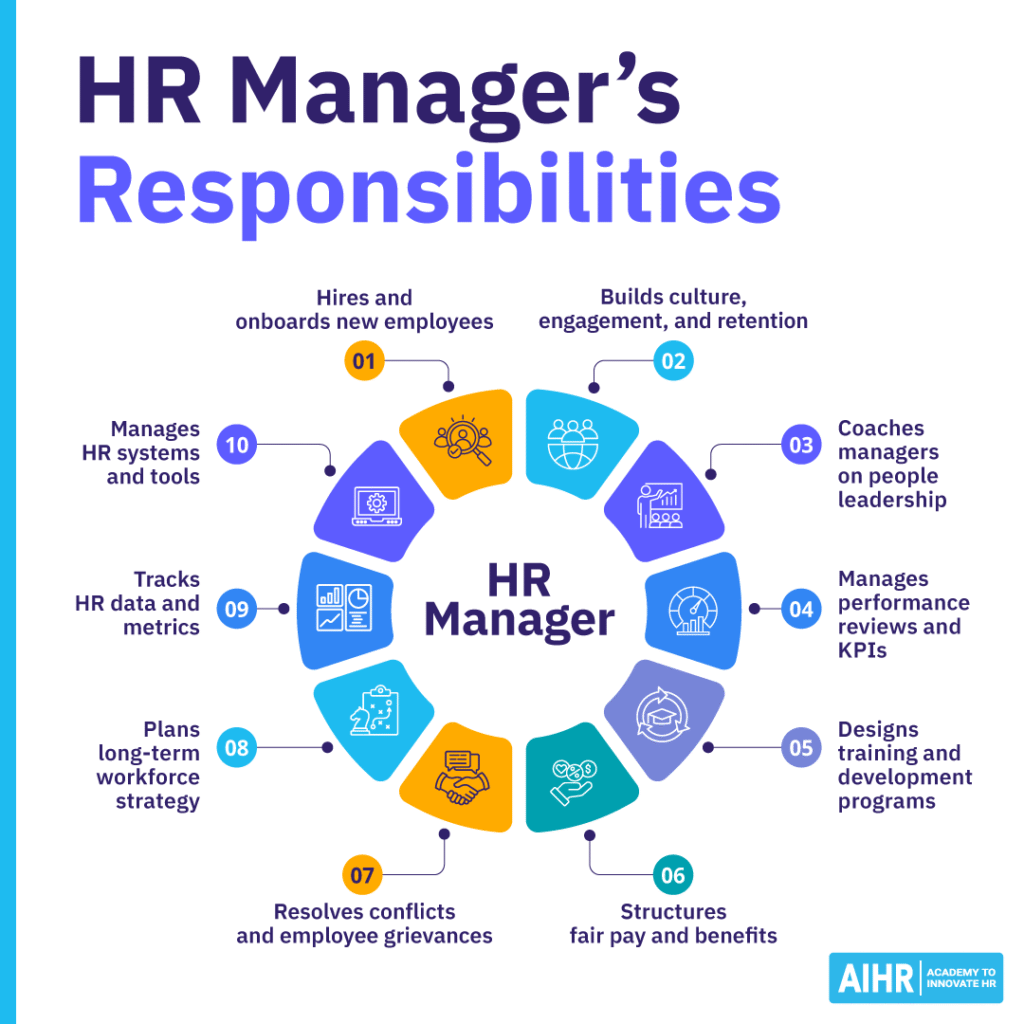
Employee relations
When workplace conflicts or grievances arise, you’ll mediate discussions, conduct investigations, and uphold disciplinary procedures fairly and in accordance with due process. As the liaison between employees and leadership, you’ll also be responsible for maintaining open communication and ensuring people feel psychologically safe.
Strategic workforce planning
Beyond daily operations, you’ll contribute to long-term business planning: forecasting talent needs, modeling workforce scenarios, and advising on organizational design. That insight is what helps leaders make informed decisions about growth, restructuring, or reskilling.
Workforce analytics and HR reporting
You’ll collect and analyze workforce data to inform decision-making, tracking metrics like turnover rate, time-to-hire, training ROI, and employee engagement.
HR technology and systems management
Modern HR runs on technology, so you may end up overseeing Human Resource Information Systems (HRIS), payroll platforms, performance management tools, and learning management systems (LMS). That’ll mean evaluating new solutions, managing vendor relationships, and making sure every system meets both business needs and data privacy standards.
HR tip
Build influence beyond the HR department
You’ll earn influence through insight and collaboration, not by enforcing policy. Once you’re in the role, actively build relationships across finance, operations, and IT. Understanding what those departments are up against is what lets you anticipate workforce needs, co-create solutions, and position HR as an enabler of business performance, not just a compliance function.
HR Manager vs. HR Business Partner: What’s the difference?
An HR Manager and an HR Business Partner (HRBP) can look similar on paper, especially in smaller organizations where one person handles both, but the two roles have different focuses.
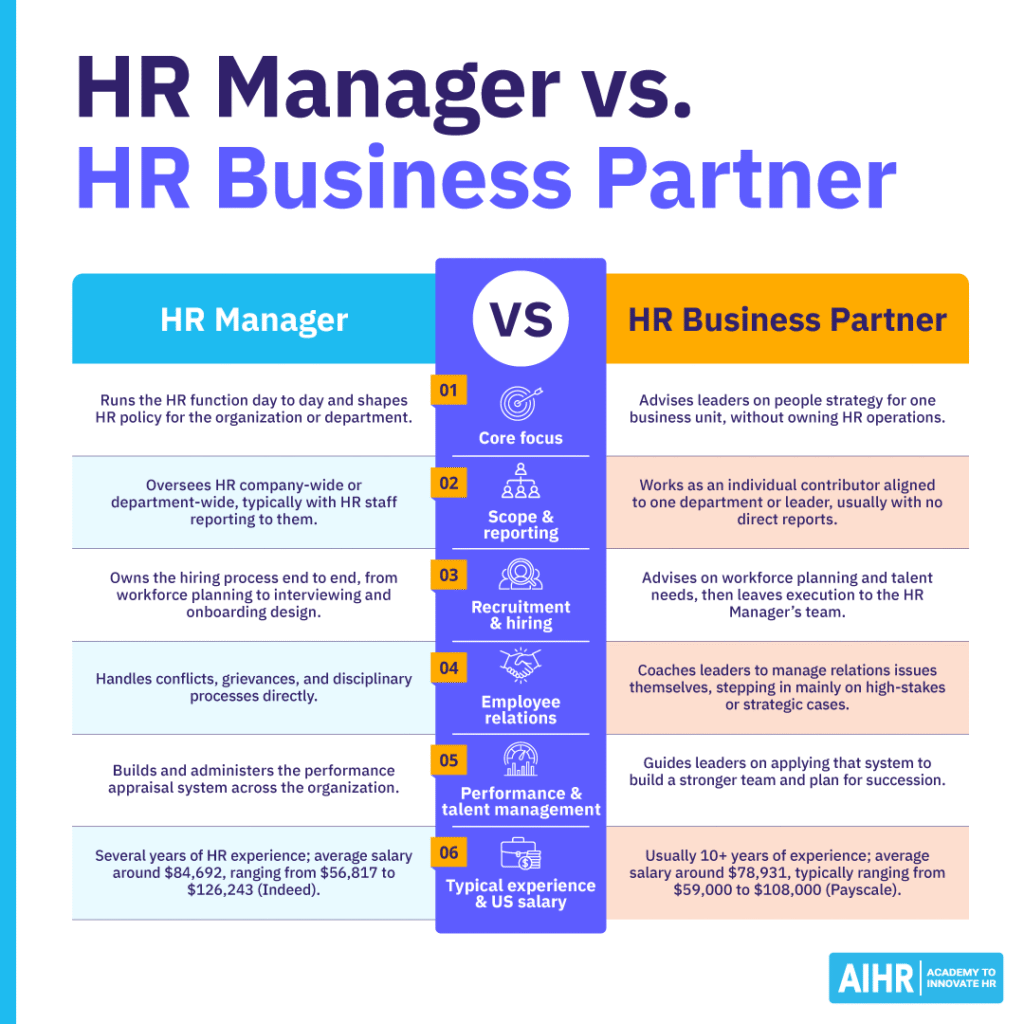
An HR Manager owns and runs the HR function, with policies, programs, and often HR staff reporting up to them, while an HRBP sits closer to the business, acting as a strategic advisor to one department, region, or leader rather than running HR operations directly. As a company grows, the two roles are usually split so HR can cover the administrative and strategic sides of the business at the same time.
Core focus
Runs the HR function day to day and shapes HR policy for the organization or department.
Advises leaders on people strategy for one business unit, without owning HR operations.
Scope and reporting
Oversees HR company-wide or department-wide, typically with HR staff reporting to them.
Works as an individual contributor aligned to one department or leader, usually with no direct reports.
Recruitment and hiring
Owns the hiring process end to end, from workforce planning to interviewing and onboarding design.
Advises on workforce planning and talent needs, then leaves execution to the HR Manager’s team.
Employee relations
Handles conflicts, grievances, and disciplinary processes directly.
Coaches leaders to manage relations issues themselves, stepping in mainly on high-stakes or strategic cases.
Performance and talent management
Builds and administers the performance appraisal system across the organization.
Guides leaders on applying that system to build a stronger team and plan for succession.
Typical experience and US salary
Several years of HR experience; average salary around $84,692, ranging from $56,817 to $126,243 (Indeed).
Usually 10+ years of experience; average salary around $78,931, typically ranging from $59,000 to $108,000 (Payscale).
Qualifications needed to become an HR Manager
To become an HR Manager, you typically need a combination of formal education, professional certification, and ongoing training.
Here’s what that usually looks like:
Bachelor’s degree
A four-year degree in Human Resource Management, Business Administration, Psychology, or a related field is typically required, and it gives you the theoretical and practical grounding that a career in HR is built on.
Master’s degree (preferred but not required)
Some employers prefer a graduate degree, such as a Master’s in Human Resource Management (MHRM) or an MBA with an HR concentration, especially for strategic or senior roles.
Professional certifications (strongly valued)
Industry-recognized credentials signal expertise and professional commitment. Common ones include:
- SHRM-CP (Society for Human Resource Management – Certified Professional)
- SHRM-SCP (Senior Certified Professional)
- PHR (Professional in Human Resources)
- SPHR (Senior Professional in Human Resources)
None of these are mandatory, but they’re often preferred, particularly for mid to senior roles.
Ongoing professional development
To stay effective and compliant, you’ll be expected to keep up with employment law, HR technology, and workforce trends. That might mean attending SHRM conferences, completing continuing education units (CEUs), or taking courses or certificate programs in areas like HR analytics, DEI, or labor law updates.
Skills and competencies of an HR Manager
To succeed as an HR Manager, you’ll need to combine strategic thinking with day-to-day execution, balancing people-focused leadership with technical HR know-how.
Technical skills
- HRIS platforms: You need hands-on experience with systems like Workday, BambooHR, ADP, Oracle HCM, or SAP SuccessFactors.
- Data analysis and reporting: You should be comfortable building dashboards, spotting trends, and turning data into decisions, using tools like Excel, Power BI[1], or your HRIS’s built-in analytics.
- Labor law and compliance: A solid grasp of employment legislation matters because you’re the one ensuring compliance in hiring, compensation, termination, leave, and workplace safety, and updating internal policy whenever the law changes.
- Performance management systems: You need to be skilled at designing and running performance frameworks that include goal-setting, feedback loops, and evaluations.
- Recruitment and onboarding systems: Expertise in applicant tracking systems (ATS), job board integrations, and digital onboarding tools helps you build a hiring process that actually runs efficiently.
- Training and development planning: You should know how to assess skill gaps, design learning paths, and measure training outcomes, and be familiar with learning management systems (LMS), coaching programs, and external training providers.
Soft skills
- Communication and interpersonal skills: Whether you’re facilitating a difficult conversation, presenting to executives, or writing a policy, you need to communicate with clarity, empathy, and influence.
- Empathy and emotional intelligence: Managing sensitive issues, such as conflict, performance concerns, or personal hardship, requires both empathy and discretion.
- Problem-solving and decision-making: You need to assess a situation, weigh your options, and land on a fair, effective solution, because productivity and morale depend on it.
- Leadership and team-building: HR Managers need to inspire others, guide performance, and model inclusive, values-based leadership across the business.
- Confidentiality and ethical integrity: From personnel records to grievances, you handle some of the most sensitive information in the business, so integrity, sound judgment, and strict confidentiality aren’t optional.
AIHR certificate programs to help develop your HR Manager skills
As the HR Manager role continues to expand, staying effective means going beyond compliance and policy. These AIHR programs give you the practical frameworks and strategic insight you need to handle everything the role now demands:
1. HR Manager Certificate Program
The HR Manager Certificate Program gives you a practical, end-to-end understanding of how to support people across all seven stages of the employee life cycle. It’s built for HR professionals who want to strengthen their foundations while expanding their strategic and cross-functional capabilities.
Key skills supported:
- Manage every phase, from attraction and onboarding to development, retention, and exit, using structured, people-first approaches.
- Build communication skills and strategies for working across departments and levels.
- Build scalable HR processes that improve both employee experience and business outcomes.
- Strengthen core skills across HR policies, systems, and workforce support.
Ideal for: New and mid-level HR Managers who want to consolidate their foundational knowledge and build confidence across the full employee experience.
2. Talent Management and Succession Planning Certificate Program
The Talent Management and Succession Planning Certificate Program teaches you how to drive long-term growth by aligning people strategy with business needs, covering how to design talent pipelines, build internal mobility frameworks, and plan for future leadership needs.
Key skills supported:
- Build future-ready teams by identifying, developing, and retaining high-potential talent.
- Assess current capability against future needs, and catch gaps early.
- Connect career paths, development plans, and organizational strategy for measurable impact.
- Develop internal career paths that increase engagement and reduce turnover.
Ideal for: HR Managers who want to contribute to business growth by building strong talent pipelines and succession strategies.
3. Diversity, Equity, Inclusion & Belonging Certificate Program
This Diversity, Equity, Inclusion & Belonging Certificate Program equips you to build fairer, more inclusive workplaces by identifying systemic bias, redesigning policies, and supporting belonging at every stage of the employee journey.
Key skills supported:
- Learn to audit HR processes for bias and redesign them for equity.
- Develop tools to educate and support managers in creating psychologically safe teams.
- Use diversity data and feedback to set goals, track progress, and refine initiatives.
- Build skills to engage with and support employees from diverse backgrounds, identities, and experiences.
Ideal for: HR Managers who want to embed inclusion into everyday practices and ensure all employees feel seen, valued, and supported.
Career path for an HR Manager
The HR Manager role can lead to a range of leadership, strategic, and specialist positions. You may want to shape organization-wide people strategy, move into senior HR leadership, or build deeper expertise in a specific HR domain.
Career path 1: HR Manager to HR Leadership
HR Manager → HR Director → VP of HR
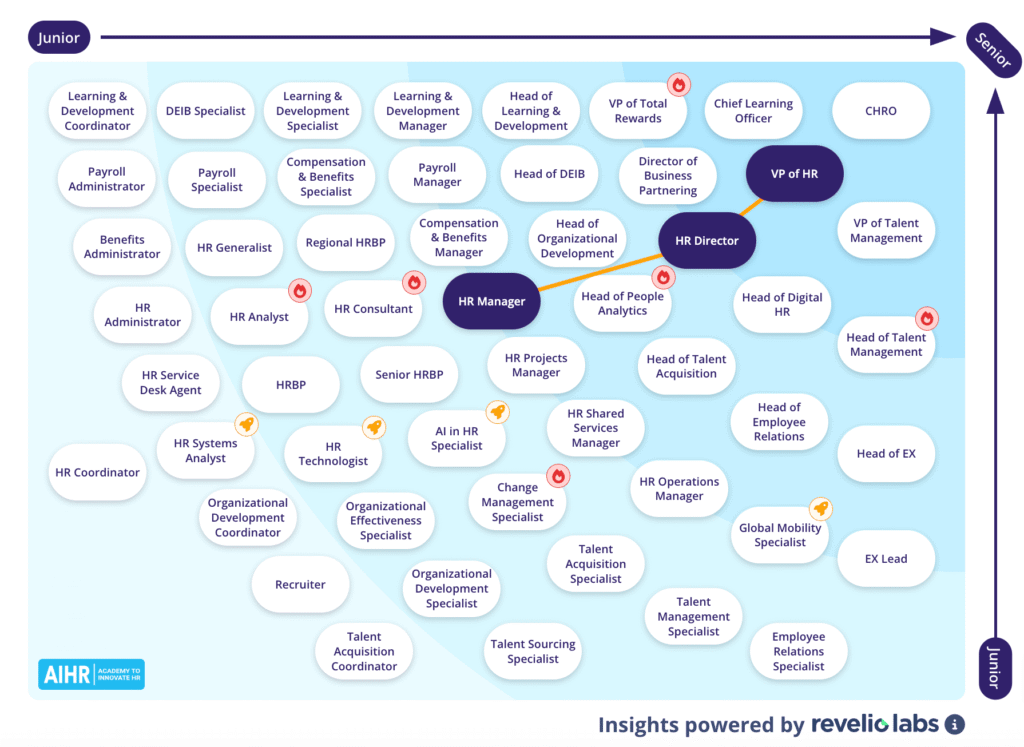
Choose this path if: You want to lead a people strategy across teams, regions, or business units. This path suits HR professionals who enjoy aligning HR priorities with business goals, advising senior leaders, and building strong, values-driven cultures. It’s also a natural fit if you want to grow from managing day-to-day HR work into leading HR strategy at an organizational level.
Skills and interests aligned:
- Strategic business partnering and workforce planning
- Leading and mentoring HR teams
- Organizational design and change management
- Building and executing enterprise-level people strategies
- Influencing C-suite and cross-functional stakeholders
Lateral moves to consider:
- HR Projects Manager: A good move if you want to lead HR transformation, improve HR processes, and manage cross-functional initiatives.
- HR Operations Manager: A strong option if you want to build deeper expertise in HR systems, compliance, processes, and scalable HR delivery.
- HR Shared Services Manager: A fit if you enjoy improving employee support, standardizing HR services, and leading service delivery teams.
- Regional HRBP: A useful move if you want to strengthen your business partnering skills across multiple locations, teams, or business units.
Next steps
Whether your passion lies in data, strategy, inclusion, or digital transformation, advancing your career starts with one intentional step: reflect on where you already add the most value and where you want to grow, pick one area of expertise to deepen based on your strengths and long-term goals, and commit to building that capability through focused, relevant learning.
Upskilling doesn’t have to be overwhelming. The most powerful shifts usually come from consistent, targeted development, and choosing a specialization that fits your interests and your organization’s needs is what makes you a more strategic, more influential HR professional.
If you’re ready to invest in your growth and future-proof your career, explore AIHR’s certificate programs and take the next step toward becoming the kind of HR leader businesses can’t do without.
FAQ
An HR Manager oversees an organization’s HR function, handling recruitment, onboarding, performance management, compensation, employee relations, and workforce planning, while also acting as a strategic partner to executives.
An HR Manager runs the HR department and typically has staff reporting to them, while an HR Business Partner is an individual contributor who advises one business unit on people strategy without owning HR operations.
In the U.S., HR Managers earn an average of $84,692 a year, with salaries ranging from $56,817 to $126,243 depending on experience and organization size, according to Indeed.
Most employers require a bachelor’s degree in Human Resources, business, or a related field, along with a certification like SHRM-CP, SHRM-SCP, PHR, or SPHR. A master’s degree can help for senior or strategic roles.
HR Managers can progress into HR leadership roles or Chief People Officer positions, or specialize in areas like DEIB, digital HR, or talent management and succession planning.