

You can meet most of the requirements for an HR role and still pause at one line in the job posting: “HR certification preferred.” It’s easy to read that as a sign that HR certification is the missing piece between you and the HR job you want. Sometimes, it is.
A recognized HR certification can show employers that you understand core HR concepts, from hiring and onboarding to compliance, benefits, and employee relations. But HR job postings rarely point to certification alone. Employers also look for practical proof that you have the HR skills needed for the specific role.
So, are HR certifications worth it? Yes, if it helps you prove you’re ready for the HR role you want.
In this guide, we’ll break down when an HR certification can strengthen your application, when experience matters more, and how to turn your certification into evidence that hiring managers can trust.
Contents
Are HR certifications worth it?
What hiring managers look for in HR candidates
What an HR certification does for your job search
Which HR certification matches your situation?
Certification and practical skills: How they work together
Key takeaways
- A certification helps most early in your HR career, as it indicates baseline knowledge when you don’t have much HR experience yet.
- A certification doesn’t guarantee you’ll land an HR job. Employers still hire based on skills, judgment, communication, and role fit.
- Your career stage should guide your choice. Entry-level certifications typically require no HR experience, while more advanced programs suit those with more HR exposure.
- Certifications can get you noticed, while skills help you get hired. Combine your certification with projects, examples, and real HR practice.
Are HR certifications worth it?
Yes, HR certifications are worth it when they help you build and prove job-ready HR skills. For early-career candidates, a certification can strengthen your resume and help you get noticed.
For experienced HR professionals, it works best when you can connect the credential to real examples of HR work, such as improving onboarding, supporting employee questions, managing HR data, or advising managers. The key is to treat certification as part of your career strategy, not the whole strategy. Employers want to know what you can do with your HR knowledge. That means pairing your certification with practical skills, role-specific examples, and clear interview stories
Use this table to decide whether certification is the right next step and which skills you need to build next. The third column is the most important one. It shows where certification should lead: stronger, role-relevant capability.
Your situation | Is an HR certification worth it? | Skills you need to build |
You have no HR experience | Yes, if it helps you learn HR basics and gives you something concrete to discuss in interviews. | HR operations, employee lifecycle basics, onboarding, HR documentation, confidentiality, and HR communication. |
You’re changing careers into HR | Yes, if it helps translate your existing experience into HR-relevant capability. | Recruiting support, employee relations basics, policy interpretation, stakeholder communication, and HR process thinking. |
You’re applying for HR assistant or HR coordinator roles | Often, especially if job postings list certification as preferred. | HRIS basics, employee records, onboarding coordination, benefits administration, payroll support, compliance basics, and employee query handling. |
You already work in HR but don’t have a credential | Yes, if it supports your next move or helps you formalize what you already do. | HR reporting, process improvement, employee relations, workforce planning basics, and stronger business communication. |
You’re aiming for a promotion or more strategic HR role | It can help, but only if you pair it with proof of impact. | Business acumen, consulting skills, data-driven decision-making, stakeholder management, change management, and strategic workforce planning. |
Use the skills column as your decision filter. An HR certification is more valuable when it helps you build the capabilities employers expect for the role you want. For example, if you are targeting HR Coordinator roles, prioritize learning that helps you support onboarding, maintain employee records, answer basic policy questions, and work with HR systems. If you are moving toward people analytics, focus on HR data, reporting, dashboarding, and evidence-based decision-making.
This is where a practical HR certificate program can help. Instead of studying HR concepts in isolation, look for courses that help you create work samples, apply frameworks, and practice real HR tasks. Those examples make it easier to show a hiring manager how your qualifications connect to the job.

What hiring managers look for in HR candidates
Before you decide whether an HR certification helps, look at what it competes with in a hiring decision. HR hiring managers rarely evaluate certification on its own. They look at the full picture: relevant experience, demonstrated skills, communication and judgment, and commitment to HR as a profession.
A certification mostly supports commitment and baseline knowledge. It can also support demonstrated skills if the program includes practical assignments, templates, case work, or projects you can discuss in interviews.
For entry-level HR roles, employers often look for evidence that you can handle the day-to-day work: keeping employee records accurate, coordinating onboarding, supporting recruitment, answering basic policy questions, protecting confidential information, and using HR systems or spreadsheets.
This can help when your résumé is still thin. If you are switching careers or have recently graduated, an HR certification can show that you have invested in HR fundamentals. But the stronger signal is what you can do with that learning.
Certification may become less of a priority as you gain experience. When a hiring manager compares two HR candidates, they will look more closely at what each person has done. They will want concrete examples of employee support, process improvement, HR reporting, manager communication, or problem-solving.
It also helps to understand how applications are filtered. Larger employers may use applicant tracking systems to scan resumes for keywords, including SHRM-CP, PHR, aPHR, HRIS, onboarding, employee relations, or benefits administration. Smaller companies may rely on a hiring manager to review resumes manually. In both cases, certification can help you get noticed, but practical proof helps you move forward.
An HR certification can help you show commitment to the field, and a reputable certificate program can help you build practical, applicable skills you can apply immediately to your HR role.
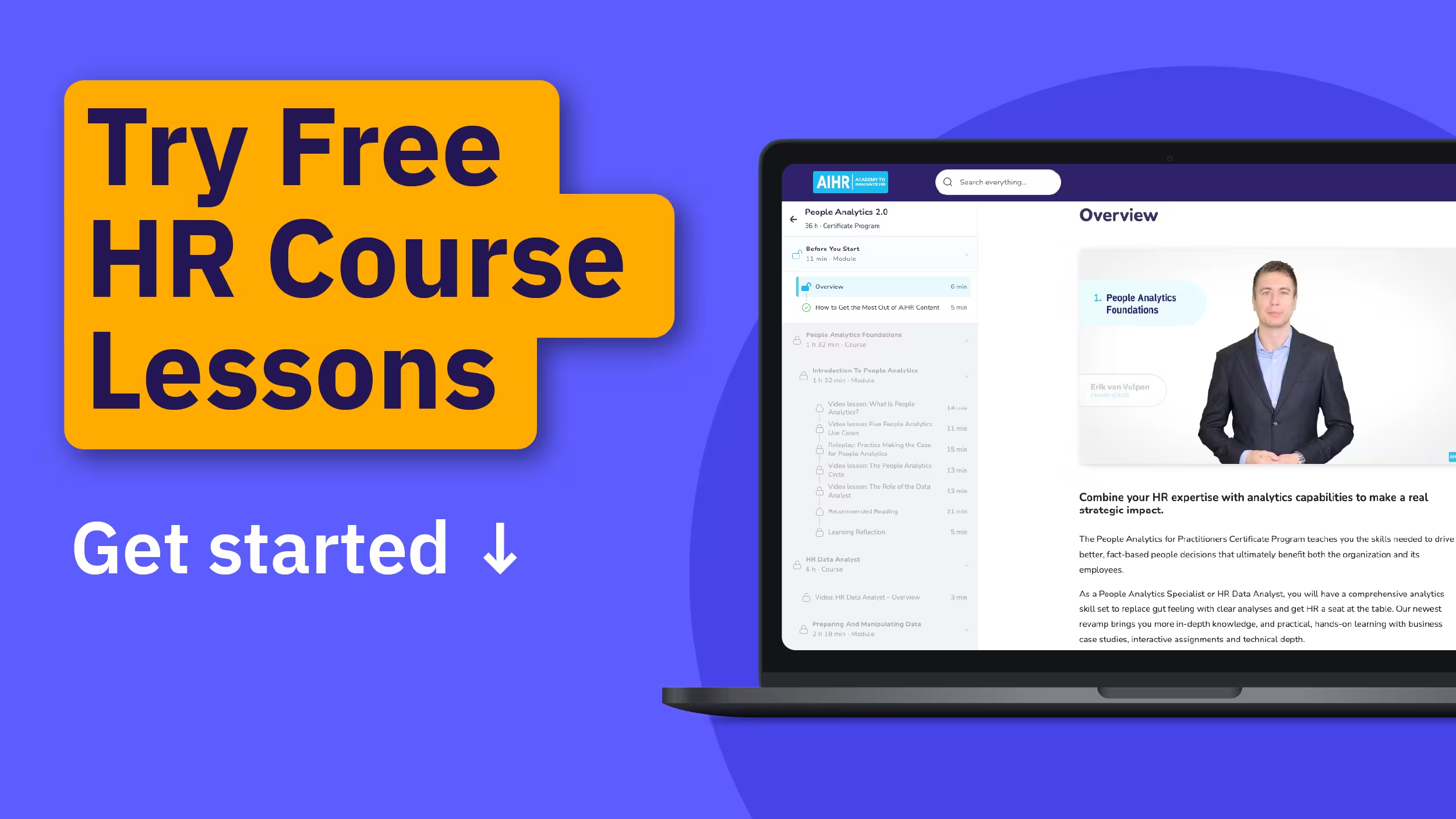
AIHR’s Demo Portal lets you explore practical HR learning by:
✅ Sampling HR lessons to see which topics match the roles you’re aiming for
✅ Browsing practical tools, templates, and guides used in day-to-day HR work
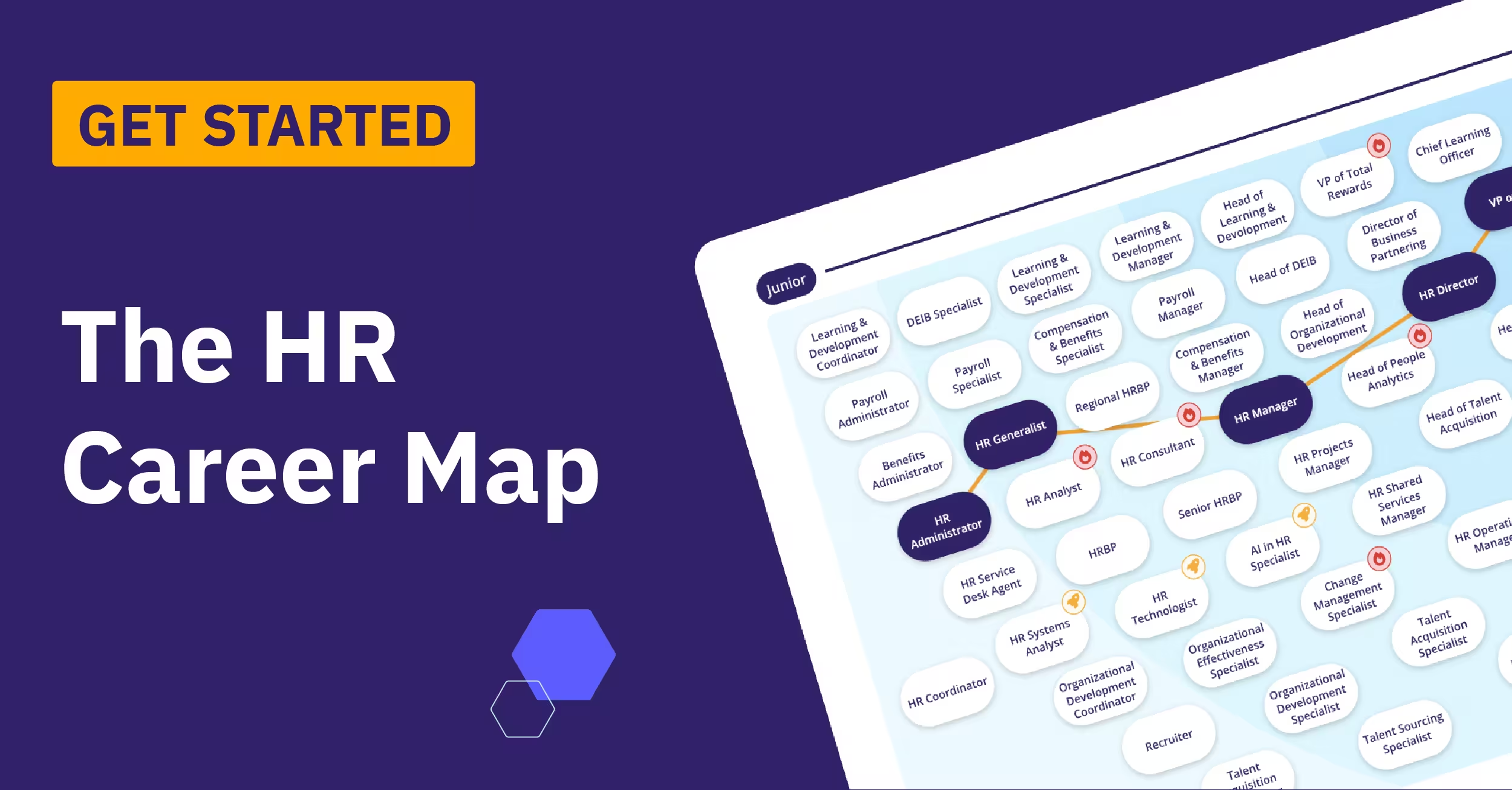
✅ Exploring different HR career paths and identifying the skills each one requires
✅ Using AIHR Copilot to get learning suggestions based on your goals and interests
🎓 Use the Demo Portal for a closer look at learning that can support your next HR career move.
What an HR certification does for your job search
A certification can support your job search in a few clear ways:
- It helps your résumé pass the first screen: HR job descriptions often list certifications as preferred qualifications, though some mid-level and senior roles may list them as required. If the role names SHRM-CP, PHR, or aPHR, having that credential can keep your application in the pool.
- It validates knowledge your work history doesn’t show yet: An HR certification gives employers proof you understand HR fundamentals. This helps when you’re moving from administration, operations, customer service, office management, or another related field.
- It shows a commitment to HR: Studying for an exam or finishing a certification program shows you take your career path seriously. This can help you stand out from other entry-level candidates with similar experience.
- It has a reported salary association: SHRM states that HR professionals who pass the SHRM certification exam report salaries 14% to 15% higher than peers who don’t. While this guarantees you higher pay, it’s still a positive association.
- It can create practical evidence: If the program includes assignments, templates, or projects, you can turn that work into interview examples or portfolio-style proof.
Despite these advantages, an HR certification does not prove you can run a fair investigation, coach a manager, design an onboarding process, or analyze turnover. To make the credential work harder, connect it to examples that show how you think and how you would apply HR knowledge at work.
For entry-level candidates, the most immediate benefit is access. A certification can help you land interviews you might not get otherwise. The career and salary benefits usually come later, once you combine your certification with experience, projects, and measurable results.
Which HR certification matches your situation?
A fair question at this stage is: What jobs can I get with an HR certificate or certification? The answer depends on the certification and your experience. A foundational credential can support applications for HR Assistant, HR Administrator, HR Coordinator, Recruiting Coordinator, or People Operations Assistant roles. More senior roles usually expect experience and a professional credential.
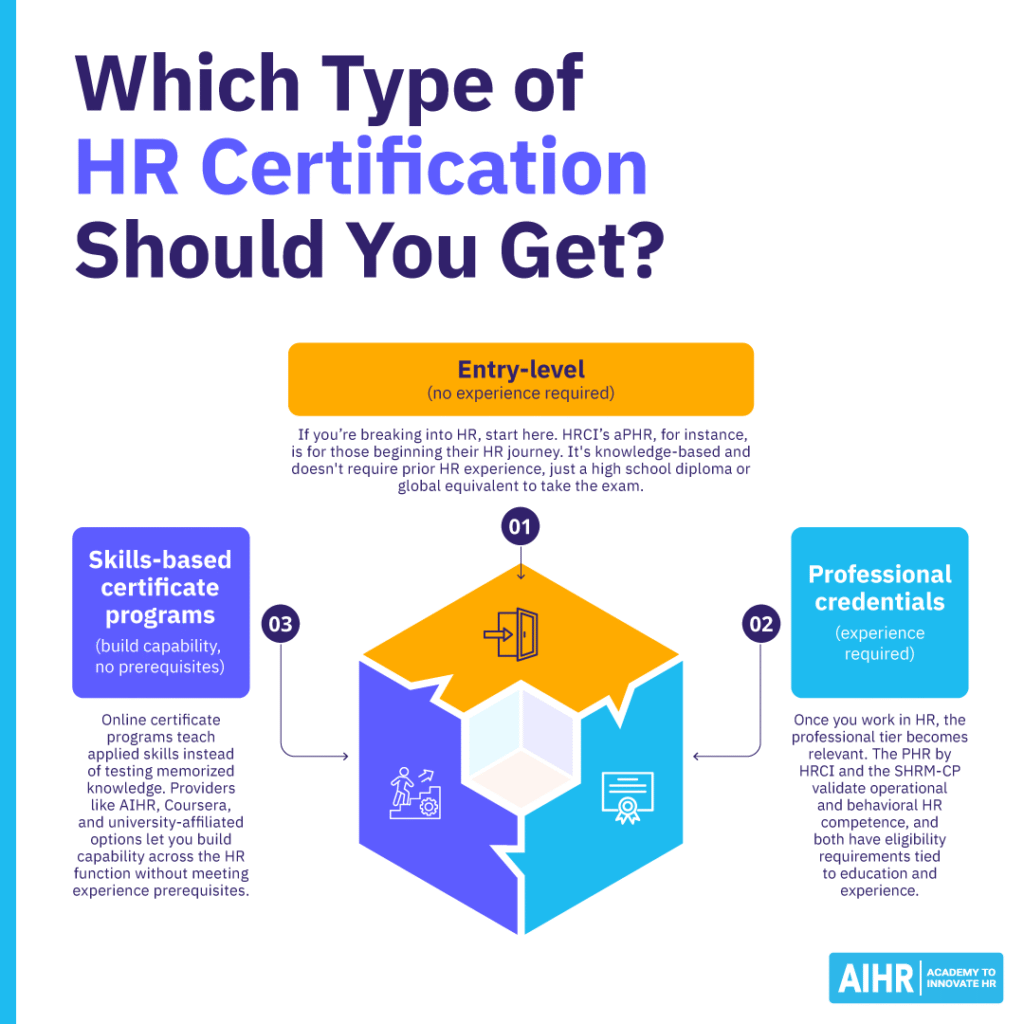
The options fall into three groups:
Entry-level HR credentials
If you’re trying to break into HR, start here. The Associate Professional in Human Resources (aPHR) from HRCI is for those starting their HR journey. No HR experience is required for this knowledge-based certification, though you’d need a high school diploma or global equivalent to apply. The aPHR allows you to show baseline HR knowledge when your résumé doesn’t include HR job titles yet, making it useful before you even land your first HR role.
Professional credentials for HR
Once you are working in HR or performing HR-related duties, professional certification becomes more relevant. The Professional in Human Resources (PHR), also by HRCI, focuses on technical and operational HR knowledge, including U.S. laws and regulations. HRCI requires professional-level HR experience, with the exact requirement depending on your education level.
The SHRM-CP is for people who perform general HR or HR-related duties, students, and people pursuing a career in HR management. SHRM says candidates don’t need an HR title, degree, or previous HR experience to apply, though basic HR knowledge is recommended. These credentials carry more weight once you have practical exposure, and are a better fit when you can connect exam knowledge to real HR work.
Skill-based HR certificate programs that build capability
A certificate program is different from an exam-based certification. It focuses on learning and practical assignments rather than passing a formal credentialing exam. This route can be useful when you need to build skills and show proof points in interviews.
AIHR’s certificate programs help learners build practical skills in specific HR domains, such as AI in HR, HR business partnering, people analytics, and talent acquisition. AIHR offers structured online HR certificate programs and shorter courses covering HR domains, with hands-on labs and capstone projects that help learners apply concepts to real HR scenarios.
AIHR is recognized by several HR associations, including SHRM, HRCI, HRPA, CPHR, ATD, and CIPD. It is also recognized by SHRM to offer Professional Development Credits (PDCs) for SHRM-CP® or SHRM-SCP® recertification activities.
Certification and practical skills: How they work together
An HR certification can help you get noticed, but practical skills help you show that you’re ready to do the job. The most valuable approach is to choose learning that helps you build HR knowledge and apply it in ways employers can recognize.
Hiring managers want to know that you understand HR concepts, but they also want to see how you would use them at work. For example, can you support onboarding? Keep employee records accurate? Answer basic policy questions? Coordinate interviews? Communicate clearly with employees and managers? Use HR data to spot a people-related issue?
This is where the right HR certificate program can make a difference. A strong program gives you practical tools, assignments, templates, and scenarios that help you build skills you can use on the job.
For example, two candidates may both say they understand onboarding. One can explain what onboarding means. The other can show a 30-day onboarding plan, explain how they would coordinate manager check-ins, and describe how they would track whether a new hire has the tools, access, and support they need. The second candidate gives the hiring manager clearer evidence of job readiness.
That’s why HR certifications and certificate programs are most valuable when they help you build proof alongside knowledge.
Next steps
If you want to build practical HR skills, AIHR’s HR Coordinator Certificate Program is a great place to start. It covers HR fundamentals across the employee life cycle, HR policy work, HR project management, AI-supported prioritization, and communication skills. It also doesn’t require any previous HR experience.
You can preview the AIHR learning experience and get a clear picture of what to expect with its Certificate Programs through the Demo Portal before enrolling.