
The Human Resources Director sits at the top of the HR function, shaping how an entire organization hires, develops, and supports its people. It’s one of the most senior roles in HR, and for many professionals, it’s the goal that guides a decade of career moves.
If you’re aiming for that seat, you need a clear picture of what the role involves, what it pays, and the path that gets you there. This guide walks through what an HR Director does, a sample job description, salary, the qualifications and skills employers expect, and the steps to reach the role.
Contents
What is a Human Resources Director?
What does a Human Resources Director do?
Human Resources Director job description
Human Resources Director salary
Human Resources Director qualifications, experience, and skills
How to become a Human Resources Director
Human Resources Director interview questions
FAQ
What is a Human Resources Director?
A Human Resources Director is the senior leader who oversees the HR function and aligns HR strategies with the organization’s business objectives. It’s one of the most senior roles in HR, calling for empathy, sound judgment, and strong communication to set policy and represent both the business and its people.
According to Zippia, around 57% of HR Directors work in large organizations of over 10,000 employees, 24% in Fortune 500 companies, and 12% in healthcare. In smaller organizations, HR Directors usually report directly to the CEO, while in larger businesses, they report to the VP of HR or CHRO.

What does a Human Resources Director do?
A Human Resources Director leads the whole HR function, but the real work is judgment. Most days come down to balancing two things that often pull in opposite directions: what the business wants and what its people need. Sitting with that tension and making calls that hold up on both sides is the core of the job.
The role splits between strategic and operational work, and the mix shifts as you climb. An HR Manager spends most of the day running programs and solving immediate problems. An HR Director spends more of it deciding which problems are worth solving, where HR should invest, and how the people agenda supports the company’s goals. The higher you go, the more the job is about direction and less about delivery.
Company size shapes it too. In a smaller organization, an HR Director is hands-on and may run recruitment, employee relations, and compliance directly. In a larger one, they lead through managers and specialists, and the job becomes less about doing the work and more about setting priorities, managing stakeholders, and taking ownership of results at the leadership table.
What makes it demanding is the simultaneous mix of pressures. HR Directors make decisions under legal and budgetary constraints, mediate between staff and management, and remain steady during sensitive moments such as disciplinary cases and layoffs. The best ones pair that judgment with data, using HR metrics to back their calls rather than relying solely on instinct.
Human Resources Director job description
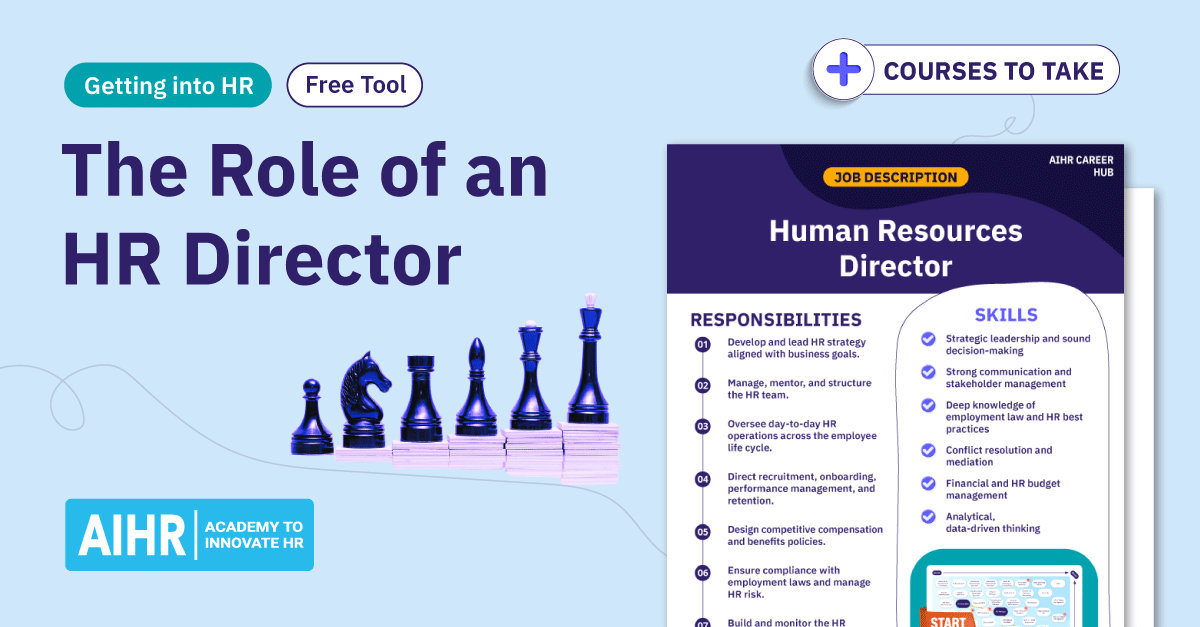
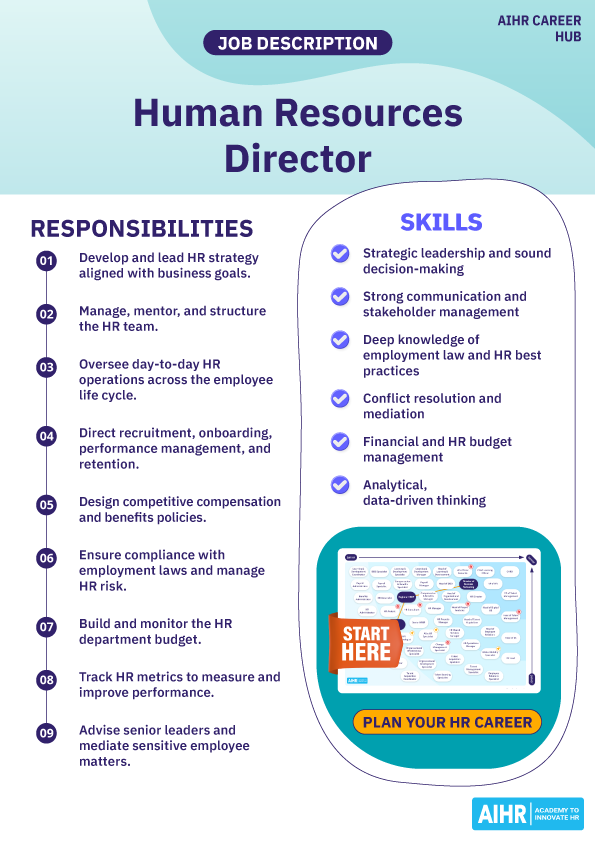
The exact scope of an HR Director role varies by company size and industry, but most job descriptions share a common core. Use the sample below as a starting point and adapt the details to your organization.
Role summary |
The Human Resources Director leads the HR function and shapes the people strategy that supports the organization’s goals. Reporting to the CEO or CHRO, this role oversees the HR team and owns key decisions across talent, compensation, compliance, and employee experience. |
Key responsibilities |
|
Qualifications and skills |
|
Human Resources Director salary
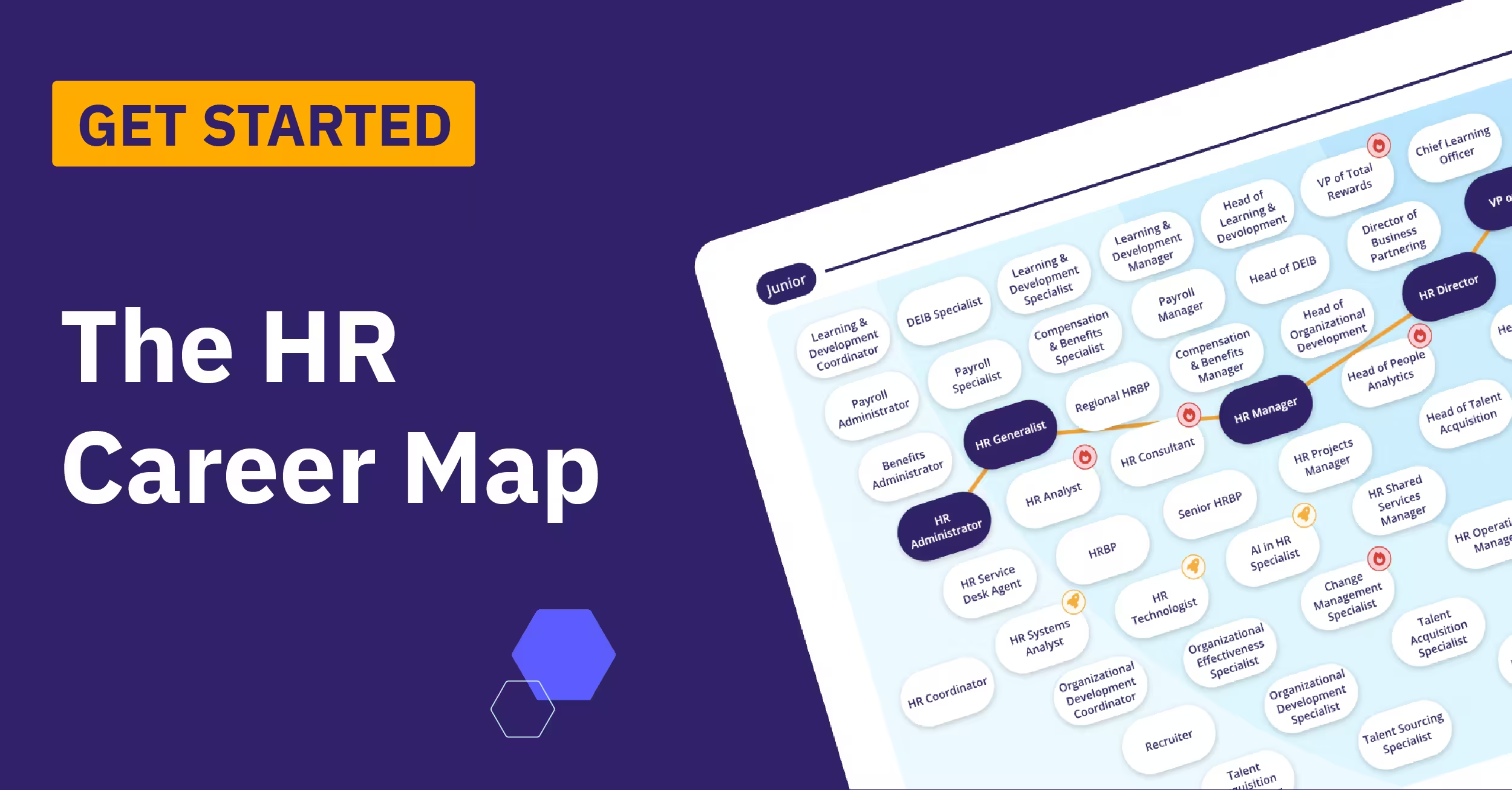
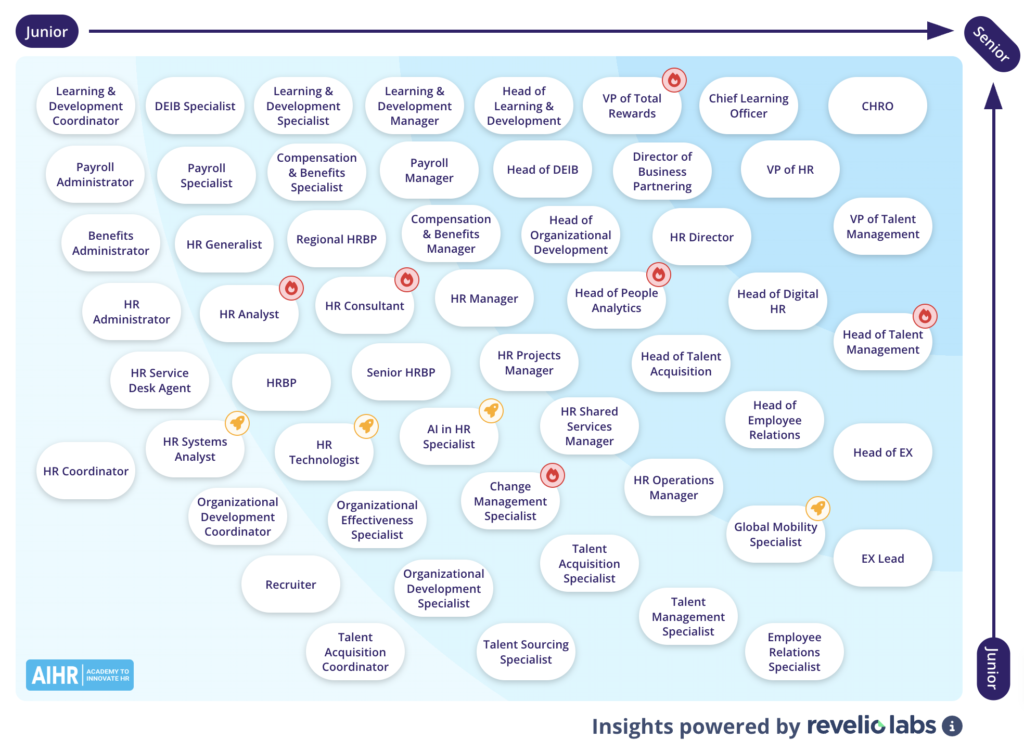
The Human Resources Director is a senior leadership role, and the pay reflects that. According to Revelio Labs, the source of the salary data on AIHR’s HR Career Map, the annual salary for this role typically ranges from $84,000 to $192,000. These figures are based on real-time workforce data and labor market trends.
Keep in mind that factors such as geographic location, industry, years of experience, and the size of the organization will influence where a given role falls within that range.
Becoming an HR Director means moving from running HR programs to shaping the people strategy behind them. HR professionals need the skills to lead teams, advise the business, and connect HR decisions to organizational goals.
AIHR’s HR Manager Certificate Program teaches you to:
✅ Build a business-driven HR strategy aligned with company goals
✅ Understand HR operating models and how to design the HR function
✅ Develop the leadership skills needed to guide HR teams and stakeholders
✅ Use HR metrics and KPIs to measure impact and improve HR performance
💡 Check out the lessons in AIHR’s Demo Portal for a clear idea of what you’ll get.
Human Resources Director qualifications, experience, and skills
1. Education
In addition to a relevant Bachelor’s degree (HR, business management, organizational development, psychology), most employers prefer HR Director candidates to have a Master’s degree in Human Resources, Business Administration, or Labor Relations.
There are also online certifications you can take to develop further skills and competencies required for the role:
- HR Manager Certificate Program (AIHR): This online program will expand your Human Resource expertise to cover lean management and a deeper understanding of HR operations. You will learn how to have a ‘big picture’ perspective of business, OD, and HR operating models, adapt a business-driven HR strategy, design an agile HR function, and develop leadership skills fit for an HR Director.
- Senior Certified Professional (SHRM-SCP): To qualify, you must have at least three years of experience performing strategic-level HR or HR-related duties and currently be in a managerial HR role. This course will teach you to develop HR policies, implement integrated HR operations, direct the entire HR department, and align HR strategies with organizational objectives.
An MBA in Human Resources can help you develop a more practical approach to leadership and workforce planning grounded in real experience. Check out some of the online MBA degrees offered by different universities:
- Online MBA in Human Resources Management (Maryville University): This course can help you prepare for a senior HR professional position and earn mastery in the strategic and policy-making aspects of HR management. It covers topics such as employee hiring and retention, employment law and compliance, compensation, and benefits.
- Master of Business Administration, Human Resources (Pittsburg State University): This course covers common business subjects such as business finance and managerial accounting, with an HR emphasis on strategies for developing Human Resources, foundations and applications, and organizational development and change. Students can attend face-to-face, online, or hybrid classes.
2. Years of experience
An HR Director should have between 10 to 15 years of experience in the field of Human Resources. This experience provides solid exposure and application of recruitment, compensation, training and development, performance management, and employee relations.
3. Knowledge areas
Additionally, an HR Director should have a good knowledge of:
- Strategic HR management: Advanced knowledge of HR operations and how they align with the company’s overall business strategy.
- Workforce planning: Analyzing and forecasting staffing supply and demand to ensure the company always has the right person for the role.
- Organizational development: Understanding organizational structure and functions, change management, and practices to cultivate a positive company culture.
- Employment laws and regulations: Deep understanding of labor regulations, employment laws, and compliance requirements to ensure business practices are ethical and legal.
- Talent acquisition and retention: High proficiency with recruitment strategies, onboarding, and other HR techniques to attract and retain talent.
- Compensation and benefits: Knowledgeable in creating competitive compensation packages, attractive benefits plans, and incentives aligned with industry standards.
- Performance management: Overseeing strategies to manage employee performance to increase productivity and help achieve organizational objectives.
- Training and development: Familiar with training needs analysis, training methods, learning management systems, and creation of employee development programs.
- Employee relations: The ability to manage conflicts, disputes, and grievances while maintaining a positive and harmonious work environment.
- Change management: Leading the transition or transformation of an organization’s goals, processes, or technologies.
- HR technology: Managing HR tech systems and leveraging data analytics to make informed decisions about talent management, employee engagement, and other HR functions.
- Diversity, equity, and inclusion: Understanding the importance of building a diverse workforce and executing fair and equitable initiatives.
4. Skills
- Leadership: Leading a team of HR professionals to run hiring, development, and retention operations. They represent the HR department in the company’s leadership team and make decisions quickly and correctly, especially in time-critical situations.
- Finance: Developing and monitoring the budget of the HR department. This is a critical skill to ensure resources are appropriately segmented and managed according to individual and team needs.
- Conflict resolution: Managing employee conflicts before they escalate through proper mediation and the fielding of complaints. This skill also applies when facing labor disputes, negotiating pay, and discussing insurance claims.
- Analytical skills: Thorough analysis of HR data to evaluate the effectiveness of HR processes, determine areas to improve, and make data-driven HR decisions.
- Organizational skills: Effective management of HR activities, including handling multiple projects simultaneously, prioritizing essential tasks, and meeting deadlines. They must also ensure employee information is stored correctly and kept up to date.
- Problem-solving skills: They must display sound judgment to handle challenges and risks in the HR department, gathering all the data and weighing the pros and cons to make correct decisions.
- Communication and interpersonal skills: Communicating HR policies effectively. HR Directors should be role models for building good working relationships, so they must know how to collaborate and establish rapport with stakeholders at all levels.
- Public speaking: HR Directors communicate company policies to all employees and give HR presentations to management for review and approval. The ability to speak to large groups is essential.
How to become a Human Resources Director
Your journey to becoming an HR Director will take significant time and dedication. As a general guideline, reaching this position would take around 10 to 15 years.
Here’s a breakdown of a potential timeline:
- Learn the HR fundamentals in an entry-level role like HR Assistant or HR Coordinator. Starting in these roles allows newcomers to the HR field to begin building the essential skills and knowledge for growing their HR career. During these initial two to four years, professionals can consider pursuing foundational HR certifications to validate their knowledge and skills.
- Gain experience and specialization in a specific HR function by pursuing roles like Recruitment Specialist, Benefits Specialist, or Employee Relations Specialist. As you move into these specialized roles over three to five years, obtaining specific certifications in these areas can enhance your expertise and make you a recognized specialist in that function.
- Advance to HR Generalist or managerial roles, which let you diversify your experience across multiple HR functions, team leadership, and project management, and expand your capacity to handle broader responsibilities. This stage can span five to seven years, during which you need to keep upskilling through Human Resources Management courses and advanced training.
- Progress to a role where you perform strategic tasks and collaborate with senior business leaders. Suitable positions include Senior HR Manager or HR Assistant Director. In this phase, which may last two to four years, continuous learning in leadership and strategy will bolster your credibility when interacting with top executives and making strategic decisions.
- Reach the HR Director position after accumulating 10 to 15 years of experience across multiple HR responsibilities. This role involves leading various HR functions, aligning HR practices with organizational goals, and providing high-level leadership.

While this timeline provides a general overview of becoming an HR Director, some individuals may reach the role in fewer or more years based on their unique HR Career Map, skills, education, experience, and opportunities. Other factors include industry, company size, and the complexity of the HR role.
Earning advanced degrees, pursuing continuous professional development, and taking on roles with increasing responsibility can all speed up the path to becoming an HR Director.
Human Resources Director interview questions
As you prepare for your Human Resources Director job interview, it’s essential to anticipate the questions you are most likely to be asked so you can prepare your responses in advance. Here are common interview questions for an HR Director:
1. Can you share an example of a time you successfully managed a challenging employee relations issue?
Hiring teams ask this to understand how you handle sensitive workplace situations. In your answer, show that you can stay fair, calm, and discreet under pressure. Use a specific example where you resolved the issue, protected confidentiality, and helped maintain a healthy work environment.
2. How have you aligned HR strategy with wider business goals in a previous role?
This question focuses on your ability to think beyond day-to-day HR operations. Interviewers want to see how you connect people priorities to business needs. A strong response should explain how you turned company goals into HR actions, for instance, workforce planning or retention initiatives, and what results followed.
3. Tell us about a time you led HR through a significant business change.
HR Directors often play a key role during mergers, restructures, leadership changes, or growth periods. Use this question to show how you guided employees and leaders through uncertainty. Focus on how you communicated the change, supported managers, reduced disruption, and kept HR aligned with business priorities.
4. How do you approach performance management and employee development?
Interviewers use this question to understand how you balance improving performance with supporting employee growth. In your answer, explain how you set clear expectations and work with managers to guide their teams, while creating space for regular feedback and ongoing development. Show how this approach contributes to broader business outcomes, such as higher productivity, better retention, and a stronger internal talent pipeline.
Next steps
Becoming an HR Director takes time, typically 10 to 15 years spent climbing from entry-level roles to specialist and management positions. But the professionals who get there fastest tend to do more than accumulate experience. They deliberately build the strategic and leadership skills the role demands, and they back them with credentials that prove it.
That’s where focused upskilling pays off. AIHR’s HR Manager Certificate Program helps you make the shift from running HR programs to leading the function, with the skills to build a business-driven HR strategy, design an effective HR operating model, and lead teams and stakeholders with confidence. It’s a practical next step toward the director’s seat, no matter where you’re at on the journey.
FAQ
A Human Resources Director is the senior leader responsible for an organization’s entire HR function. They set the people strategy, lead the HR team, and align HR priorities with the company’s business goals, while overseeing areas like talent, compensation, compliance, and employee relations. In smaller organizations, they often report to the CEO; in larger ones, to a VP of HR or CHRO.
The main difference is scope and seniority. An HR Manager oversees day-to-day HR operations, such as recruitment, employee relations, and performance management, typically for a team or business unit. An HR Director sits above that, setting HR strategy for the whole organization, leading the HR function, and making decisions on budget, structure, and priorities. In short, the manager focuses on delivery, while the director focuses on direction.
According to Revelio Labs, the source of the salary data on AIHR’s HR Career Map, HR Directors in the U.S. typically earn between $84,000 and $192,000 a year. Actual pay depends on factors such as geographic location, industry, years of experience, and organization size.