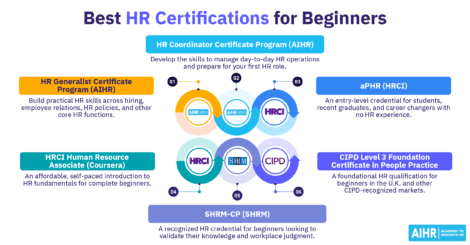

Easy HR certifications are usually the ones with lower entry barriers, beginner-friendly prep, and a realistic path to completion. For many people, that means starting with an entry-level credential, such as the aPHR or aPHRi. For others, a practical certificate program may be the better first move, especially if the goal is to build practical HR skills through structured, hands-on learning you can apply directly in your day-to-day work
This guide explains what makes an HR certification feel easy, covers four HR certifications that are often seen as more accessible, and helps you decide whether a certification or a certificate program is the better fit.
Contents
What makes an HR certification “easy”?
Certification vs. certificate program: Which one is the right choice for you?
4 easy HR certifications to consider
HR certificate programs from AIHR
Tips for choosing the right easy HR certification
FAQ
Key takeaways
- Easy HR certifications usually have lower entry requirements, beginner-friendly prep, and a realistic path to completion.
- aPHR and aPHRi are among the most accessible starting points for beginners with little or no HR experience.
- SHRM-CP and PHR can also be accessible, but they involve more commitment than aPHR or aPHRi.
- If you want practical skills you can use right away, a certificate program may be a better first step than an exam-based certification
What makes an HR certification “easy”?
When you look for an easy HR certification, you’re probably not looking for something low-value. You’re looking for a realistic starting point.
In most cases, an “easier” certification comes down to three things:
- Entry requirements: Do you need prior HR experience or a degree?
- Exam scope: How broad and complex is the content?
- Preparation path: How structured and manageable is the study process?
For example, HRCI’s aPHR and aPHRi are often seen as accessible starting points because they require no prior HR experience and only a high school diploma or equivalent. SHRM-CP is also more open than many expect. SHRM does not require a degree or previous HR experience to apply, although a basic understanding of HR is recommended.
Format also plays a role. Some certifications are easier to fit around your schedule than others. HRCI allows year-round applications and offers both online proctoring and test center options through Pearson VUE. SHRM-CP, by contrast, is delivered in scheduled testing windows, typically at Prometric test centers. That doesn’t make it harder to qualify for, but it does make the process less flexible.
Finally, not every starting point needs to be exam-based. If your goal is to build practical HR skills you can apply at work, a structured certificate program can be worth considering. You can also use certificate programs to develop the hands-on capability you may need right now for your role.

Certification vs. certificate program: Which one is the right choice for you?
Before you choose a path, it helps to understand what you’re actually investing in: validation of knowledge or development of capability.
A certification is an exam-based credential awarded by a recognized body such as SHRM or HRCI. It shows that you meet a defined professional standard. In practice, that means preparing for and passing an exam, and then maintaining your credential through recertification activities over time.
A certificate program works differently. It’s a structured learning experience designed to help you build practical HR capability. Instead of testing what you already know, it focuses on helping you apply concepts to real HR scenarios, work with tools and frameworks, and develop skills you can use in your day-to-day role.
The right choice depends on your goal: do you want a recognized credential, or do you want to build skills you can apply at work?
- Choose a certification if your goal is to gain a widely recognized credential that signals credibility.
- Choose a certificate program if your goal is to build practical skills and improve how you perform in your current role.
In reality, you probably won’t choose one or the other; you’ll use both at different stages of your career. For example, you might use a certificate program to build hands-on capability in areas like recruitment, HR operations, or AI in HR, and then pursue a certification to validate your knowledge and support your long-term career progression.
When a certificate program may be a better first step
A certificate program is often a good starting point if you want to build practical HR skills before pursuing a certification.
This is especially relevant if you’re new to HR, moving into a new area, or looking to improve how you handle day-to-day work. Instead of focusing on exam preparation, certificate programs help you apply concepts to real HR scenarios and build capability you can use on the job.
They can also support you later if you decide to pursue or maintain a certification. Many certificate programs, including AIHR’s, offer recertification credits that count toward credentials from organizations like SHRM and HRCI. That means you can build practical skills while also working toward your long-term certification goals.
Flexibility is another factor. Most certificate programs are self-paced, so you can learn alongside your work and apply what you learn as you go.
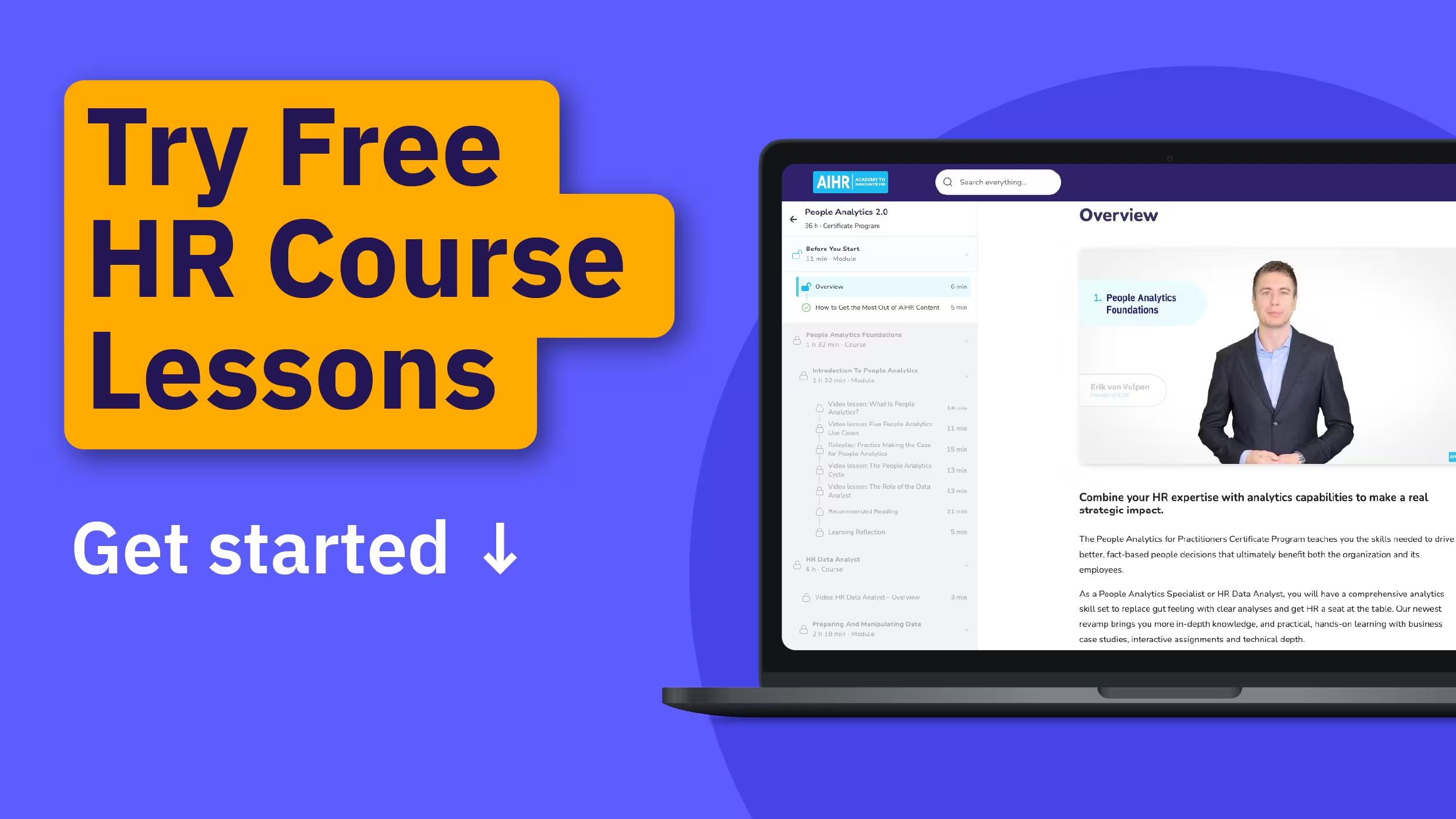
Finding an HR certification that fits your goals, schedule, and experience level is easier when you can explore the learning experience first. A preview helps you decide what to study next with more clarity.
Through AIHR’s Demo Portal, you can explore what HR learning with AIHR looks like:
✅ Preview bite-sized lessons across practical HR topics
✅ Explore guides, templates, and tools you can use at work
✅ Compare learning paths before choosing a certification
✅ Discover AIHR Copilot and resources that support continuous HR development
🎓 Find the certification path that fits your next step.
4 easy HR certifications to consider
Here is a shortlist of options that are often seen as more accessible because they have lower barriers, are beginner-friendly, or offer a realistic starting point.
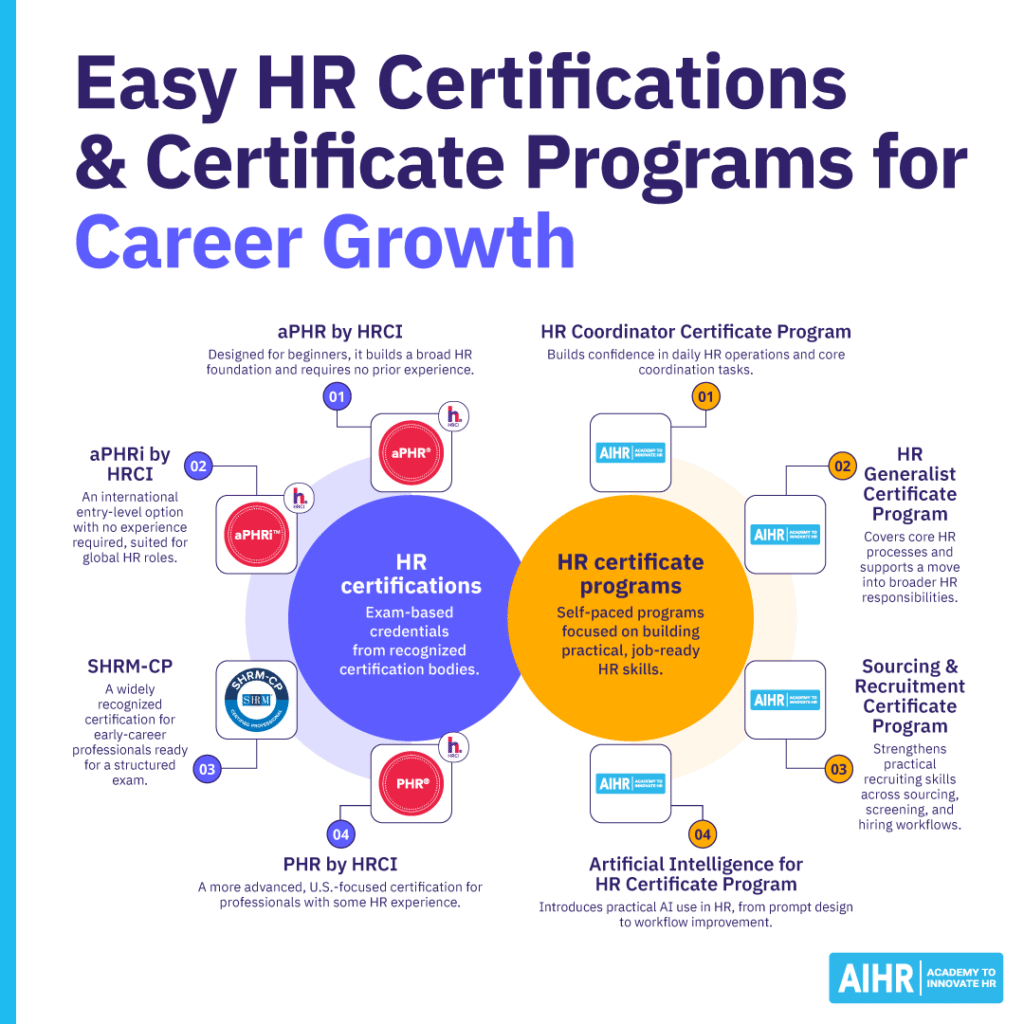
1. aPHR by HRCI
Best for: Beginners with little or no HR experience
The Associate Professional in Human Resources (aPHR) is an entry-level certification for people starting their HR career or exploring the field. It does not require prior HR experience. You only need a high school diploma or equivalent to apply.
The certification focuses on building foundational HR knowledge you can apply in practice. It’s a common starting point for career changers, HR assistants, students, and professionals moving into HR roles.
If you already have hands-on HR experience, you may want to consider a more advanced certification that reflects your level of responsibility.
Choose this if you want a recognized entry-level certification to support your move into HR.
2. aPHRi by HRCI
Best for: International beginners who want a foundational HR credential outside the U.S.
The Associate Professional in Human Resources – International (aPHRi) is an entry-level certification for people starting their HR career or exploring the field. It does not require prior HR experience. You only need a high school diploma or its global equivalent to apply.
The certification helps you build foundational HR knowledge you can apply in roles outside the United States. It’s a strong starting point for career changers, early-career HR professionals, and people managers without formal HR training.
If you plan to work mainly in the U.S., the aPHR may be a better fit. If you already have hands-on HR experience, consider a more advanced certification.
Choose this if you want an entry-level HR certification designed for HR roles outside the U.S.
3. SHRM-CP
Best for: Early-career HR professionals who want a broad, widely recognized certification
SHRM-CP is an exam-based certification for people performing HR or HR-related duties, as well as those pursuing a career in HR. SHRM recommends basic working knowledge of HR.
The exam covers HR knowledge and situational judgment, so it requires structured preparation. This makes it a good fit if you want a broad HR certification and are ready to prepare for a formal exam.
If you want to build practical skills before exam prep, a certificate program may be a better first step.
Choose this if you want a broad HR certification and are ready for a structured exam process.
4. PHR by HRCI
Best for: HR professionals ready for a more tactical, U.S.-focused credential
The Professional in Human Resources (PHR) is designed for HR professionals who implement programs and support day-to-day HR operations. It validates technical and operational HR knowledge, including U.S. laws and regulations.
To qualify, you need professional-level HR experience: at least one year with a master’s degree, two years with a bachelor’s degree, or four years without a degree. If you’re new to HR, an entry-level certification like aPHR or aPHRi will likely be a better starting point.
Choose this if you already have professional HR experience and want a U.S.-focused certification that reflects your operational HR responsibilities.
Below is a quick comparison of the four options above. The table shows who each certification is best for, why it may feel more accessible, and the main trade-off to keep in mind.
aPHR
Beginners in or entering HR
No HR experience required
Entry-level scope
aPHRi
International beginners
No HR experience required
Less useful if you want a U.S.-specific path
SHRM-CP
Broad early-career HR growth
No degree or previous HR experience required to apply
More demanding exam path
PHR
HR professionals with some experience
Strong next-step U.S.-focused credential
Not ideal for complete beginners
HR certificate programs from AIHR
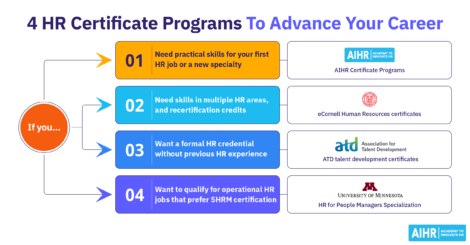
AIHR certificate programs help you build practical HR skills you can apply directly in your work while earning recertification credits.
AIHR is recognized by SHRM to offer Professional Development Credits (PDCs) for SHRM-CP® or SHRM-SCP® recertification activities, and programs also provide recertification credits for HRCI certifications. You can find the full breakdown on AIHR’s accredited HR training page.
HR Coordinator Certificate Program
- Best for: Early-career HR professionals, HR assistants, and new HR coordinators
- What you’ll learn: You’ll build a foundation in HR operations across the employee lifecycle, including HR policies, project management, and communication. The program focuses on helping you run HR processes, manage competing priorities, and communicate effectively with stakeholders.
- Why this program is a strong starting point: The program is built around practical application. You work through real HR scenarios and use tools and frameworks to manage day-to-day HR operations. It’s designed to help you handle core HR responsibilities with structure and clarity.
- What you can apply on the job: You can apply what you learn to recruitment, onboarding, employee lifecycle support, and HR operations. The program includes templates, guides, and checklists that help you run key HR processes more efficiently..
HR Generalist Certificate Program
- Best for: Aspiring or current HR Generalists who want a broader view of HR and need to understand how core HR processes connect to business value.
- What you’ll learn: The program covers how HR processes support the organization, how to build and run an HR function, and how to manage end-to-end people processes such as recruitment and employee engagement. It also includes a capstone project built around a real-world case.
- Why it’s accessible for any HR professional: It gives you a broad view of how the main areas of HR connect. It’s accessible because it helps you build context across the function, which is valuable whether you work in a generalist role or want a stronger understanding of HR as a whole.
- What you can apply on the job: You can apply it to improving HR processes, supporting managers more effectively, setting up more structured people practices, and contributing to a more consistent employee experience across the business.
Sourcing & Recruitment Certificate Program
- Best for: Recruiters, sourcers, and early-career HR professionals who want to build strong hiring skills and become more effective across the recruitment funnel.
- What you’ll learn: You’ll learn how to source and engage passive candidates, screen candidates more effectively, strengthen employer branding, and use recruitment analytics to improve hiring outcomes. The program is positioned as a way to build end-to-end recruitment capability.
- Why it’s accessible for HR professionals: Hiring touches many HR roles, not just recruitment. This program is accessible because it focuses on practical skills and workflows that are easy to connect to real hiring needs, team growth, and workforce planning.
- What you can apply on the job: You can apply it to writing better intake briefs, improving sourcing workflows, screening candidates more consistently, supporting employer brand efforts, and using data to spot bottlenecks in your hiring process.
Artificial Intelligence for HR Certificate Program
- Best for: HR professionals who want to start using AI in practical ways and build confidence with a fast-growing skill area early in their career.
- What you’ll learn: The program covers the AI landscape in HR, generative AI, prompt writing, practical HR use cases, responsible AI adoption, and how to develop and execute an AI strategy for business success.
- Why it’s accessible for HR professionals: AI is becoming relevant across the HR function, from recruitment to employee support and productivity. This program is accessible because it focuses on practical use cases, clear guidance, and responsible adoption rather than technical complexity.
- What you can apply on the job: You can use it to save time on drafting, research, communication, and repetitive tasks, while also improving decision-making and helping your team adopt AI more responsibly.
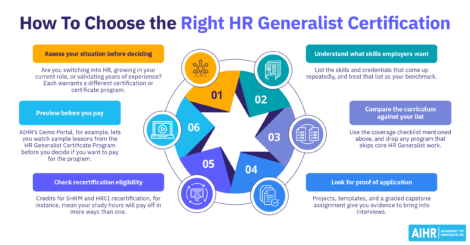
Tips for choosing the right easy HR certification
The right HR certification is not always the one with the lowest barrier to entry. It is the one that fits your current experience, the skill you want to build, and the role you want next. Use these tips to narrow your options and choose a path that supports your career.
Start with the skill you want to build
Before you compare certifications, get specific about what you want to improve. Are you trying to build a broad HR foundation, or do you want to get better at one area like recruiting, HR analytics, compensation, DEIB, or organizational development?
The clearer your goal is, the easier it becomes to choose the right learning path.
Decide whether you need a certification or a certificate program
This is one of the most important choices to make early on. A certification is usually the better fit if you want a formal credential that validates your knowledge and supports your professional credibility. A certificate program may be the better option if you want to build practical skills, test a specialization, or start learning without committing to exam prep.
A simple way to think about it is this:
- Choose a certification if you want a recognized credential
- Choose a certificate program if you want structured, practical skill-building
- Choose based on what will help you most in your current role or next move
Check the official eligibility requirements before you commit
This matters more than most people think. aPHR and aPHRi require no prior HR experience. SHRM-CP does not require previous HR experience either, but SHRM recommends basic HR knowledge. PHR, by contrast, is better suited to professionals who already have hands-on HR experience.
Before you invest time and money, make sure the requirements match where you are right now. A credential may sound accessible at first glance, but still be a poor fit if it expects more experience than you have.
Look for an HR certification online if flexibility matters
Format changes the experience. HRCI offers greater flexibility with year-round application and online proctoring options. Other paths may involve fixed windows, in-person testing, or local association processes.
If you are balancing learning with a full-time job, compare not just the content but also the delivery model. Flexibility can make a big difference in whether you actually complete the program.
Focus on practical value, not just what sounds easiest
The easiest HR certifications to get are not always the most useful. A better question is whether the credential will help you perform better in your current role or prepare you for the one you want next.
That could mean becoming a stronger recruiter, HR generalist, HR business partner, analyst, or compensation specialist. The right choice should move you closer to that goal, not just add another line to your resume.
Next steps
The right next step depends on what you want from your learning. If you want a formal credential, start by comparing beginner-friendly certifications like aPHR, aPHRi, or SHRM-CP based on your experience level and career goals. If your priority is practical skill-building, a certificate program may be the better fit.
For HR professionals who want flexible, self-paced learning they can apply on the job, AIHR’s certificate programs are worth considering. If you want to get a feel for the platform before making a decision, the demo portal offers a useful preview of the learning experience and available resources.
FAQ
For most beginners, the aPHR is one of the easiest HR certifications to get because HRCI requires no prior HR experience and only a high school diploma or equivalent. The aPHRi is similarly accessible for international candidates.
That depends on your goal. aPHR is often the clearest beginner certification. SHRM-CP can also work for beginners who want a broader credential and are comfortable with a more structured exam process.
Some you can prepare for online, but the exam experience varies. HRCI offers online proctoring for aPHR, while SHRM says its certification exam must be taken in person at an authorized Prometric center.
Choose based on your next career move. If you want a broad foundation, start with aPHR or SHRM-CP. If you already have hands-on HR experience and want a more tactical U.S.-focused credential, PHR may be a better fit.
Not always. aPHR, aPHRi, and SHRM-CP do not require previous HR experience to apply. PHR, by contrast, is better suited to professionals who already have hands-on HR experience.
They can be, especially when they match your actual goal. A certification can strengthen credibility and signal commitment. But if your immediate need is to build practical capability, a certificate program may deliver more value faster.