



Recruitment is just the first step in attracting and retaining top talent. A well-structured new hire checklist helps HR teams create a smoother onboarding process, improve new hire productivity, and support long-term retention.
This guide walks you through building a new hire checklist that supports employees from offer acceptance through their first 90 days. You’ll learn how to organize each stage of onboarding, collect the right documents and paperwork, and use our free HR, IT, manager, and training templates to create a checklist that works for your organization.

Contents
What is a new hire checklist?
Why use a new hire checklist?
What should be included in a new hire checklist?
New hire checklist templates
New hire onboarding checklist by phase
New hire onboarding documents and paperwork
How to create an effective new hire checklist
FAQ
Key takeaways
- A new hire checklist helps HR, managers, IT, and payroll coordinate every step of the onboarding process.
- An effective checklist should cover paperwork, IT setup, company policies, benefits, role-specific training, manager check-ins, and 30-60-90 day goals.
- Breaking the checklist into phases helps new hires understand what to expect before day one, during their first week, and throughout their first 90 days.
- New hire paperwork should include employment eligibility, tax, payroll, benefits, policy, and role-specific documents.
- HR teams should review and update their new hire checklist regularly to keep the onboarding process consistent, compliant, and useful.
What is a new hire checklist?
A new hire checklist is a structured list of tasks and documents that HR professionals and managers use to ensure a smooth and efficient onboarding process for new employees. Also known as a new hire onboarding checklist or employee onboarding checklist, it helps ensure each new employee receives the information, tools, training, and support they need to integrate into the company, understand their role, and comply with key policies.
This checklist typically covers essential onboarding activities, including employment forms, IT setup, benefits enrollment, company policies, team introductions, role-specific training, and manager check-ins.

Why use a new hire checklist?
A thorough new hire checklist helps HR create a structured onboarding process that supports new employees from the moment they accept the offer. This is especially important in a business environment where 75% of organizations struggle to fill roles and many companies onboard employees in hybrid or remote settings.
The impact of onboarding is clear:
- According to a Harvard Business Review study, up to 20% of new hire turnover occurs within the first 45 days of employment, often because of poor onboarding and employees feeling unwelcome or unclear about what is expected of them.
- The same research found that organizations with a standardized onboarding process experience 50% higher new-hire retention and 62% higher new-hire productivity.
- O.C. Tanner’s 2025 Global Culture Report found that only 62% of surveyed employees had a positive onboarding experience. Employees with a positive onboarding experience are 11 times more likely to feel they are thriving at work.
- While the average onboarding program lasts 90 days, Gallup notes that it can take new employees 12 months to reach their full performance potential.
A well-defined checklist helps new hires receive the tools, training, information, and support they need to succeed. It also gives HR a structured way to coordinate the organizational, social, and technical parts of onboarding, from paperwork and system access to relationship-building and role clarity.
What should be included in a new hire checklist?
Key components of a new hire checklist often include:
- Completion of employment forms: Such as tax forms like W-4 forms and I-9 forms, direct deposit forms, and employment contracts.
- Welcoming new employees: For example, creating welcome packs and introducing the new hire on internal communication channels.
- Introduction to company policies: Providing access to the employee handbook, code of conduct, and compliance-related materials.
- Technology setup: Ensuring the new hire has access to the necessary software, email accounts, and hardware (computer, phone, etc.).
- Role-specific training: Scheduling initial training sessions and introducing them to relevant systems and processes.
- Orientation and team introduction: Planning meetings with key team members, managers, and department heads.
- Benefits enrollment: Offering guidance on selecting healthcare, retirement, and other benefits.
A well-structured new hire checklist helps complete all the steps systematically, facilitating a positive onboarding experience and enabling new employees to be productive faster.
AIHR’s HR Generalist Certificate Program teaches you to:
✅ Set up HR processes across recruitment, onboarding, performance management, and employee engagement
✅ Create policy frameworks that make HR processes easier to apply consistently
✅ Use the HR Canvas and relevant KPIs to show how HR adds value
✅ Plan, organize, and structure HR work so daily operations run more effectively
💡 Check out the lessons in AIHR’s Demo Portal for a clear idea of what you’ll get.
New hire checklist templates
Effective onboarding takes coordination across HR, IT, managers, and training teams. These checklists help you cover every angle to give new hires a smooth, well-supported start.
You can download the free new hire checklist templates in Word and Excel and customize them to match your organization’s onboarding process.
New hire onboarding checklist for HR
Paperwork, policies, benefits, payroll, and overall onboarding coordination
HR teams
New hire IT checklist
Equipment, software, system access, and security setup
IT and HR
New hire checklist for managers
Team introductions, role expectations, check-ins, and early goals
Managers
New employee training checklist
Company, compliance, systems, and role-specific training
HR and L&D
1. New hire onboarding checklist for HR
Your organization’s new hire onboarding checklist documents your onboarding process and ensures a consistent onboarding experience for all new hires. You can download our new hire checklist template in Word or Excel and customize it based on the steps in your organization’s onboarding process.

2. New hire IT checklist
While all new hires should go through the basic HR new-hire checklist, integrating a new hire into an organization requires collaboration across multiple departments. The IT team, in particular, plays a crucial role in ensuring that an employee has the necessary tools and access to perform their duties.
Below is a comprehensive IT checklist template for HR professionals to organize and manage the tools and address the new-hire needs.

3. New hire checklist for managers
A seamless transition into a new organization benefits the new employee, enhances team dynamics, and contributes to overall business success. As an HR professional, you can work closely with management teams to guide them through the process. Below is a new hire checklist for managers.

4. New employee training checklist
New hires will require introductory training to fully understand the organization’s core values and strategic goals, as well as become familiar with company systems and policies. A new employee training checklist will help you ensure that all new hires get the best start in the company.

New hire onboarding checklist by phase
A new hire onboarding checklist works best when it follows the employee’s journey from offer acceptance through their first 90 days. Breaking the checklist into phases helps HR, managers, IT, and other stakeholders understand what needs to happen, when, and who owns each task.
Here’s how to structure your new hire checklist by phase:
Before day one: Preboarding checklist
The onboarding process begins as soon as the candidate accepts the job offer. This preboarding period is an opportunity to make the new hire feel welcome, informed, and ready for their first day.
At this stage, your checklist should include:
- Sending a welcome email that outlines what to expect on the first day
- Sharing essential information, such as the employee handbook, dress code, parking instructions, office address, or remote work login details
- Providing pre-arrival forms, such as tax documents, direct deposit details, benefits information, and emergency contact forms
- Confirming equipment, software access, email setup, and any tools the employee will need
- Inviting the new hire to connect with the team via a virtual introduction, a welcome message, or a key contact list.
First day checklist
The first day sets the tone for the employee’s experience with the organization. Your checklist should help the new hire feel welcomed, supported, and clear on what will happen next.
Your first day checklist can include:
- Greeting the new hire personally, either in person or virtually
- Giving them an office tour or virtual walkthrough
- Introducing them to their manager, team members, and key stakeholders
- Reviewing the company’s mission, values, culture, and ways of working
- Confirming they have the tools, equipment, email access, and software logins they need
- Explaining the onboarding schedule so they know what to expect in the coming days and weeks.
By the end of the first day, the new hire should feel like part of the team, even if they still have a structured onboarding process ahead.
HR tip
Explain the onboarding process early so the new hire knows what to expect and feels reassured that they will receive support while they settle into the role.
First week checklist
During the first week, the focus shifts from welcome and setup to role clarity, relationship building, and early learning. This phase helps the new hire understand how their role fits into the team and organization.
Your first week checklist should include:
- Scheduling meetings with team members and relevant departments
- Reviewing the job description, key responsibilities, and immediate priorities
- Setting clear expectations for communication, working hours, meetings, and team norms
- Starting role-specific training on tools, systems, processes, and methodologies
- Assigning a buddy, mentor, or main point of contact for day-to-day questions
- Holding an initial check-in to answer questions, gather feedback, and identify any blockers.
First 90 days: 30-60-90 day onboarding plan
An effective onboarding process typically spans at least 90 days, giving the new hire enough time to understand their role, build relationships, contribute to meaningful work, and receive feedback. A structured 30-60-90 day plan helps the employee progress gradually while giving managers clear points to review performance, address challenges, and provide support.
Your 30-60-90 day checklist can include:
- First 30 days: Focus on helping the new hire build foundational knowledge. They should understand the company culture, their role, the tools they will use, and the expectations for their first few months. Set initial performance goals, complete required training, introduce them to cross-functional partners, and schedule a 30-day check-in to answer questions and gather feedback.
- First 60 days: Encourage the new hire to participate more actively in projects and team discussions. Review their progress against initial goals, identify any additional training or support they need, and schedule regular feedback sessions to address challenges early. This phase should help the employee move from learning and observing to contributing with more confidence.
- First 90 days: Conduct a 90-day review to evaluate accomplishments, discuss challenges, and set goals for the next quarter. Use this conversation to confirm whether the employee has the tools, resources, and support they need to keep growing in the role. This is also a good time to discuss longer-term development opportunities, future responsibilities, and feedback on the onboarding process.
Dr. van der Merwe explains why onboarding should be 90 days long
“90 days is long enough for employees to have moved through the initial ‘honeymoon phase,’ where they might not be as objective about their role and the organization yet. This also gives new hires enough time to start building relationships and deliver at least one piece of meaningful work.
At the end of the 90 days, the employee should have achieved 3 things:
1. Made a connection to the organization
2. Understand how they will contribute and;
3. Feel like they are valued.”
New hire onboarding documents and paperwork
Use this new hire paperwork checklist to collect the documents HR needs to set up payroll, benefits, compliance, and employee records correctly. For US employers, the exact documents may vary by state, role, and employment type, but most checklists include:
- Form I-9 to verify employment eligibility
- Form W-4 for federal tax withholding
- State tax withholding forms, where applicable
- Direct deposit authorization
- Emergency contact information
- Benefits enrollment forms
- Employee handbook acknowledgment
- Confidentiality or nondisclosure agreements, where relevant
- Background check authorization, where applicable
- Policy acknowledgments, such as data privacy, anti-harassment, remote work, and time off policies
- Equipment or company property agreements
- State-specific notices or new hire reporting documents.
HR should also confirm when each document must be completed. Some forms need to be finalized before or shortly after the employee’s start date, while others, such as benefits enrollment forms, may have specific deadlines.
For remote or multi-state employees, review the paperwork requirements for the employee’s work location. This helps ensure payroll, tax, benefits, and compliance documents are completed correctly from the start.
How to create an effective new hire checklist
An effective new hire checklist should be practical, easy to follow, and tailored to the role. It should give HR, managers, IT, payroll, and other stakeholders a clear view of what needs to happen before and after the employee starts.
To create a checklist that works, focus on the following steps:
Step 1: Define the purpose of the checklist
Start by deciding what the checklist needs to help you achieve. For example, it may help HR collect paperwork on time, make sure IT setup is complete before day one, standardize the onboarding experience, or support managers in setting clear expectations.
Step 2: Break the checklist into onboarding stages
Organize tasks by when they need to happen, such as before day one, on the first day, during the first week, and throughout the first 90 days. This makes the checklist easier to use and helps each stakeholder understand their role in the process.
Step 3: Assign clear owners
Every task should have an owner. HR may own paperwork, benefits, and policy documents, while IT handles equipment and system access. Managers can own role expectations, team introductions, check-ins, and early performance goals.
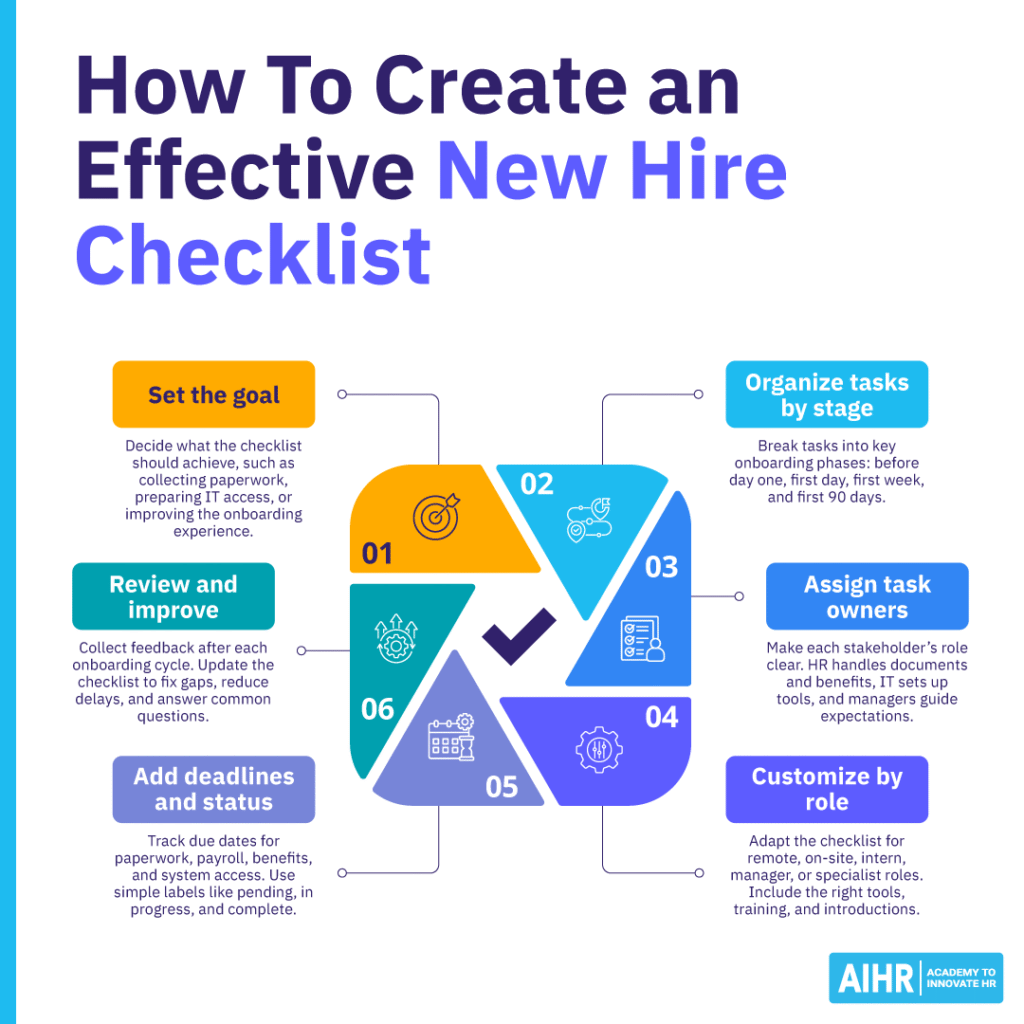
Step 4: Customize it by role and work setup
A checklist for a remote employee may look different from one for an on-site employee. Similarly, a manager, intern, or senior specialist may need different training, tools, introductions, and compliance steps. Build a core checklist, then adapt it by role, location, department, and employment type.
Step 5: Add deadlines and completion status
Include due dates for time-sensitive tasks, such as employment forms, payroll setup, benefits enrollment, and IT access. Add a simple status field so HR and managers can track what is pending, in progress, or completed.
Step 6: Review and improve the checklist regularly
After each onboarding cycle, collect feedback from new hires, managers, and HR stakeholders. Use this feedback to identify missed steps, unclear ownership, repeated questions, or delays. Updating the checklist regularly helps keep the onboarding process consistent, relevant, and useful for future new hires.
Dr. van der Merwe’s onboarding top tips for HR
- Don’t underestimate the value of relationships in the onboarding plan: This helps to create a sense of belonging, gets new hires up to speed quicker, and reinforces positive perceptions.
- Leave room for employees to co-create their 90-day plan: This allows them to commit to mutual goals and creates a greater sense of accountability and achievement.
- Don’t neglect leadership onboarding: The same principles of the 90-day plan apply to leadership onboarding, which can be tailored to reflect their people management and additional deliverables.
- Always make sure that hygiene factors are delivered seamlessly: These are things like building and system access, payroll, parking, and time and attendance. These make a big impact on the overall experience.
- Create mechanisms for feedback from new hires throughout the 90 days: This allows you to monitor the overall experience and address anything that is detracting from the experience, before it becomes a risk.
Next steps
A new employee checklist provides HR with a clear roadmap to guide new hires through each stage of onboarding, from preboarding to their first months in the role. It helps ensure tasks are completed consistently, expectations are clear, and new employees get the support they need to become productive and committed.
To build onboarding processes that work across the wider employee lifecycle, HR professionals need strong generalist skills. AIHR’s HR Generalist Certificate Program helps you build and execute key HR processes, from recruitment and onboarding to payroll, performance management, and employee engagement, while using practical tools and templates to manage day-to-day HR operations.
FAQ
A new hire onboarding checklist is a structured guide that helps HR, managers, IT, and payroll coordinate the onboarding process for a new employee. It outlines what needs to happen from offer acceptance through the first 90 days, so the employee has the documents, tools, training, and support they need to settle into their role.
A new hire checklist should cover everything a new employee needs to start work smoothly and understand their role. This includes key employment documents, payroll and benefits setup, company policies, IT access, equipment, orientation, team introductions, role-specific training, manager check-ins, and early performance goals.
To create a new hire checklist, map the onboarding journey from preboarding to the first 90 days. Then define what needs to happen at each stage, who owns each task, and when it should be completed. Review the checklist regularly with feedback from new hires, managers, and HR stakeholders so it stays practical and up to date.


 POPULAR: 3,687 DOWNLOADS