




Workplace emergencies leave little time to react. If an employee is injured, becomes seriously ill, or cannot respond during a crisis, having the right details on file helps HR act quickly and with more confidence. An employee emergency contact form makes that possible by giving employers immediate access to the information they may need when it matters most.
The need for accurate records is not theoretical. U.S. private industry employers reported 2.5 million nonfatal workplace injuries and illnesses, and the Bureau of Labor Statistics also found that a worker died every 99 minutes from a work-related injury. OSHA notes that emergencies and disasters can happen in any workplace, and that planning in advance helps employers and employees respond more effectively. A clear, up-to-date emergency contact sheet supports that planning by making critical contact details easy to access when they are needed most.
Contents
What is an emergency contact form?
What to include in an employee emergency contact form?
Emergency contact form example
Free emergency contact form template
Best practices for using emergency contact forms
FAQ
Key takeaways
- An employee emergency contact form helps HR respond quickly when an urgent situation happens.
- The form should include accurate contact details, optional medical information, and a clear acknowledgment section.
- HR should collect emergency contact information during onboarding and review it at least once a year.
- Forms should be stored securely, updated regularly, and used as part of a broader emergency preparedness process.
What is an emergency contact form?
An emergency contact form is a document employees complete to tell their employer who should be contacted if an urgent situation happens at work or during work-related travel. In most cases, the form includes the employee’s basic details, the name and contact information of one or more emergency contacts, and any other important notes the employee chooses to share.
An emergency contact form for employees helps HR and managers respond quickly when time matters. For example, if an employee has a medical emergency, is involved in a workplace accident, or can’t be reached during a crisis, the form gives the organization a clear point of contact. It also helps reduce confusion about who to call first and what information is available.
Just as importantly, this form supports duty of care. It gives employers a simple, organized way to keep key contact details on file while giving employees a chance to review and update their information when their circumstances change.

What to include in an employee emergency contact form?
An employee emergency contact form should include the essential information an employer may need to act quickly in an urgent situation. The form should be clear, easy to complete, and limited to details that are genuinely useful in an emergency. Here are the four main sections to include:
Employee information
The first section should capture the employee’s basic identifying details. This helps HR connect the form to the correct employee record and avoid confusion, especially in larger organizations or across multiple worksites. In most cases, this section includes the employee’s full name, job title, department, work phone number, mobile number, and home address. Some employers also add an employee ID number or work location to support recordkeeping.
Emergency contact information
This section lists the person (or people) the employer should contact if something happens to the employee. It typically includes each contact’s full name, relationship to the employee, primary phone number, secondary phone number, and address. Many employers ask for two contacts instead of one, so there is a backup option if the first person cannot be reached. It is also helpful to indicate who should be contacted first.
Medical information, voluntary disclosure
Some emergency contact forms include a short section where employees can voluntarily share medical details that could be relevant in an emergency. This may include allergies, medical conditions that could affect treatment, a preferred hospital, or other emergency notes. Because this is sensitive personal information, it should always be optional and stored securely. Employers should only collect what is necessary and make clear why the information is being requested.
Consent and acknowledgment
The final section should confirm that the employee understands the purpose of the form and that the information provided is accurate. This part usually states that the employer may contact the listed person or people in an emergency and that the employee is responsible for updating the form if their details change. Including this acknowledgment helps set expectations and encourages employees to keep their information current.
An employee emergency contact form is a basic but important part of employment paperwork and day-to-day HR administration.
With the HR Generalist Certificate Program, you’ll learn to:
✅ Set up and manage key HR policies and processes across the employee lifecycle
✅ Strengthen onboarding, employee administration, and core HR operations
✅ Build practical HR knowledge to support compliant and organized people processes
Free emergency contact form template
Using a ready-made template saves time and helps employers collect emergency contact information in a consistent way. An employee emergency contact form also makes it easier for employees to provide the right details and for HR to keep records organized.
Whether you need a printable version for paper files or an editable version for digital use, the template should be clear, practical, and easy to update.
Simple emergency contact form PDF (editable)
A PDF version works well if you want a printable form that can be filled out by hand and stored in a physical file.

Simple emergency contact form Word
A Word version is useful if you want to edit the form, customize it, and reuse it across teams or locations.
Emergency contact form example
An employee emergency contact form usually includes the employee’s basic details, the names of one or two emergency contacts, their relationship to the employee, and their phone numbers. Some employers also add a field for relevant medical information, preferred hospital, or notes about who should be contacted first.
Best practices for using emergency contact forms
To make an employee emergency contact form useful in a real situation, HR needs more than a completed document. The information has to be current, accessible, and handled appropriately. These best practices can help:
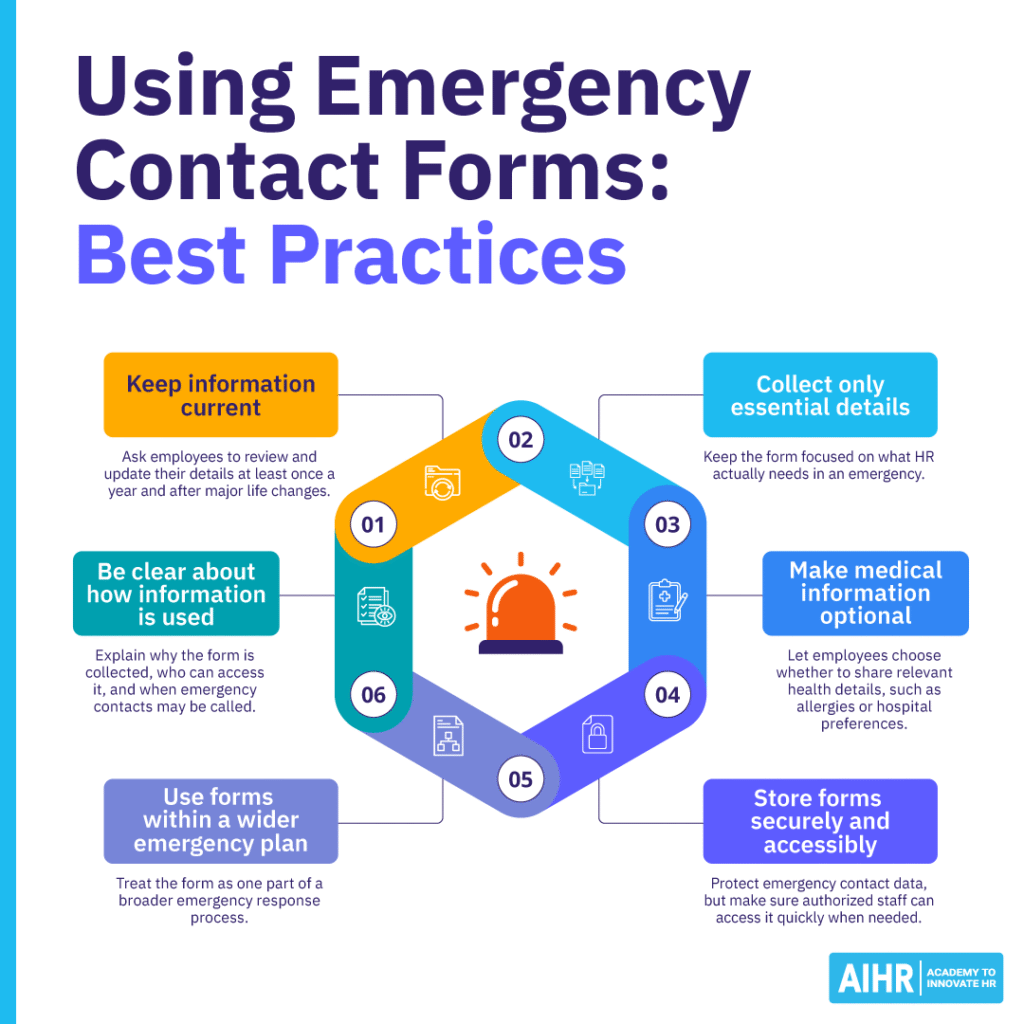
- Keep forms up to date: Ask employees to review and confirm their emergency contact information at least once a year, and also after major life events such as marriage, divorce, relocation, or a change in caregiver arrangements.
- Collect only information you genuinely need: A form should stay practical and focused on emergency response. That reduces confusion for employees and helps HR maintain cleaner records. When medical details are included, keep them limited and relevant.
- Make medical disclosure optional: If you include a field for allergies, medical conditions, or hospital preferences, make clear that employees can choose whether to complete it. This helps employers gather useful information without overreaching into sensitive personal data.
- Store forms securely, but make them easy to access in an emergency: Emergency contact forms should be protected like other confidential employee records, but they also need to be available quickly when an urgent situation happens.
- Use the form as part of a broader emergency process: An emergency contact form works best when it supports a larger emergency action plan.
- Explain when and how the information will be used: Employees should know why HR is collecting the form, who may access it, and when an emergency contact would actually be called. This builds trust and makes employees more likely to provide complete and accurate information.
HR tip
Build emergency contact form reviews into an existing HR workflow, such as onboarding, open enrollment, or annual employee record updates. That is usually easier than asking employees to complete a separate process later.
Legal and privacy considerations for employee emergency contact forms
An employee emergency contact form should be simple, useful, and handled with care. Because the form may contain personal information, HR should be clear about why the data is being collected, who can access it, and when it will be used. This helps employees feel more comfortable sharing the information and supports better recordkeeping practices.
Keep medical information optional
If you include a field for allergies, medical conditions, or hospital preferences, make it optional and keep it limited to information that may genuinely help in an emergency. The EEOC notes that the ADA limits disability-related inquiries and medical examinations of employees, which is why employers should be careful not to collect more medical information than they need.
Store forms securely and limit access
Emergency contact forms should be easy to access during an urgent situation, but not broadly available. HR should store them securely and limit access to authorized employees who may need the information in an emergency.
To sum up
An employee emergency contact form helps HR respond faster, keep records organized, and support employees during urgent situations. While it is a simple document, it plays an important role in emergency preparedness and day-to-day HR operations.
Managing forms like this is part of building strong core HR skills. If you want to develop those practical capabilities further, AIHR’s HR Generalist Certificate Program is a relevant next step.
FAQ
An emergency contact form is a document employees complete to tell their employer who should be contacted if an urgent situation happens at work. It usually includes the employee’s basic details, one or more emergency contacts, and any additional information the employee chooses to provide.
The SB 294 emergency contact form refers to California’s Workplace Know Your Rights Act. Under this law, employers must let employees provide emergency contact information and indicate whether they want that contact notified if they are arrested or detained at work. California’s Labor Commissioner includes this right in its official workplace rights notice.
Employees should review and update their emergency contact forms at least once a year. They should also update them after major life changes, such as marriage, divorce, relocation, or a change in caregiver arrangements. Regular reviews help HR keep records accurate and usable in an emergency.




 POPULAR: 3,687 DOWNLOADS