

When you search for online HR courses with certificates, you’ll find plenty of options, and it’s not always obvious what you’re signing up for.
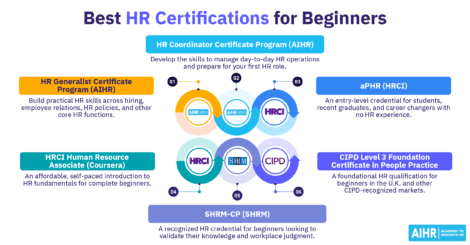
Some hand you a certificate the moment you finish watching the videos. Others, like AIHR’s Certificate Programs, push you to actually build the skills you’ll use on the job. And a few, from bodies like SHRM or HRCI, count toward a formal certification you can put on your résumé.
Pick the wrong one, though, and you’ve lost weeks of study time or money you didn’t need to spend and a certificate that doesn’t deliver on what you really wanted from the HR course. This article explains what each HR certificate offers, what to research before you enroll, and seven online HR courses with certificates to compare.
Contents
Why some HR certificates carry more weight than others
What to check before you enroll in an online HR course
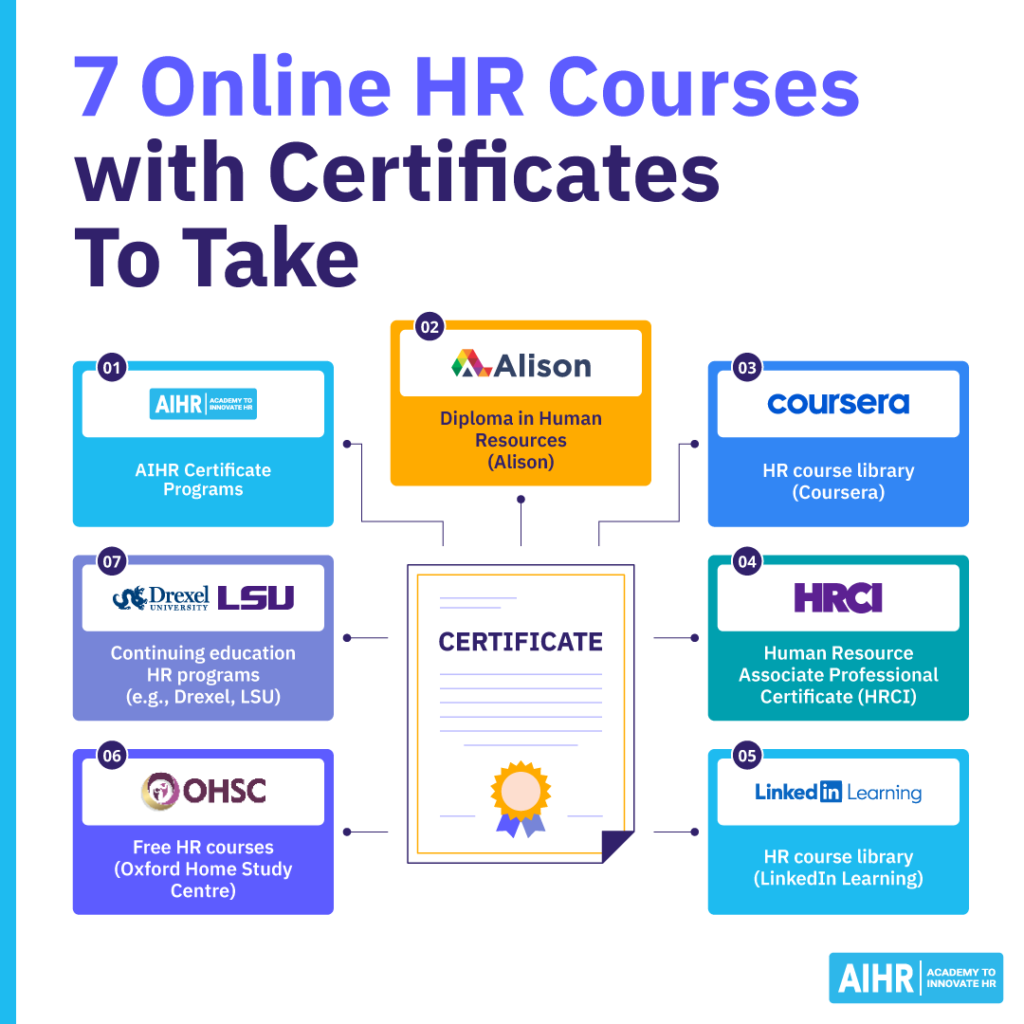
7 online HR courses with certificates to consider
Why some HR certificates carry more weight than others
When you finish a course, the HR certificate you receive can represent more than simply showing that you successfully completed the HR course. So first, consider why you want to take the HR course beyond what’s offered in the program.
Take a Coursera HR certificate on your resume, for instance. Coursera’s audience skews toward people just entering HR or switching into it, so a lot of its free HR courses cover entry-level material rather than the kind of specialized, in-depth training working HR professionals need. That’s fine if you’re starting out, but it won’t carry much weight if what you’re actually after is practical skills for the role you’re in now.
An AIHR Certificate Program combines video lessons, applied assignments, and a graded capstone project, and you earn the certificate only after passing the capstone and a final exam, so the assessment tests whether you can actually apply the skill, not just whether you sat through the lessons.
Once you pass, you get a digital certificate you can add straight to your LinkedIn profile, and all of AIHR’s Certificate Programs also count toward recertification with SHRM and HRCI, with additional recognition from regional bodies like HRPA. AIHR is also recognized by SHRM to offer professional development credits (PDCs) for SHRM-CP or SHRM-SCP recertification activities, so the HR certificate gives you proof that you have built the skill and helps you progress toward a credential you’re already maintaining.
While SHRM’s online HR courses aren’t the same thing as SHRM-CP or SHRM-SCP certification. If you finish an eLearning course or a Specialty Credential in a focused area, like workplace investigations or people analytics, you get a certificate of accomplishment plus a digital badge for that one topic. There are no eligibility criteria to meet first, and it’s built around self-paced coursework and an assessment.
To take the SHRM-CP and SHRM-SCP, you must first meet SHRM’s eligibility criteria for education and experience. To complete the certification, you would need to take an exam that is proctored at a Prometric test center, and, once you’ve passed, you will earn the CP or SCP designation, which you then need to maintain by recertifying every three years.

What to check before you enroll in an online HR course
A little research upfront can save you from choosing a certificate that doesn’t meet your goal.
Who issues it
Look at the organization behind the certificate, not just the course title. A certificate from a course marketplace, university, HR association, or specialist HR training provider will indicate different things. Check whether the issuer is reputable in HR, the certificate name is clear, and you can add it to your LinkedIn profile or your résumé to give it a boost.
Recertification value
If you already have an HR credential, check whether the HR course offers continuing education credits. For example, some courses, like AIHR’s Certificate Programs, count toward PDCs for SHRM-CP or SHRM-SCP recertification. Others may qualify for HRCI, HRPA, or CPHR credits. Look for the exact credit type, number of credits, and any relevant approval details before you enroll.
Format and time commitment
A self-paced video course may be easier to fit around work, while a live cohort may give you more structure and accountability. Project-based learning usually takes more effort, because you’ll need to apply the material. Find out about the weekly workload, deadlines, assessments, and access period, so you know what you’re committing to if you take a certain course.
Cost and refund policy
Check the full cost before you pay. Some platforms let you study for free but charge for the certificate, while others include assessments, projects, templates, and the certificate in one price. Look for extra fees, subscription renewal dates, exam costs, and refund terms. If the course is a bigger investment, confirm if there’s a trial, preview, or money-back guarantee.
Skill-building or exam-prep
Be clear on what the course helps you do. A skill-building course should help you apply a specific HR capability, such as building a compensation structure or analyzing people data. An exam-prep course should align with a certification body’s exam content. The right choice depends on whether you need practical skills for work now, or preparation for a formal credential.
Including it in your résumé or LinkedIn profile
Think about how the certificate would look on your résumé or LinkedIn profile. A named program or recognized credential is more likely to pique a recruiter’s or hiring manager’s interest. Check if the certificate shows the issuer, learning hours, skills covered, and completion date. These details make it easier to connect the course to your next career step.
Choosing an online HR course is an important step in your professional development. Before you enroll, it helps to see how the learning experience supports practical skill-building and continuous growth.
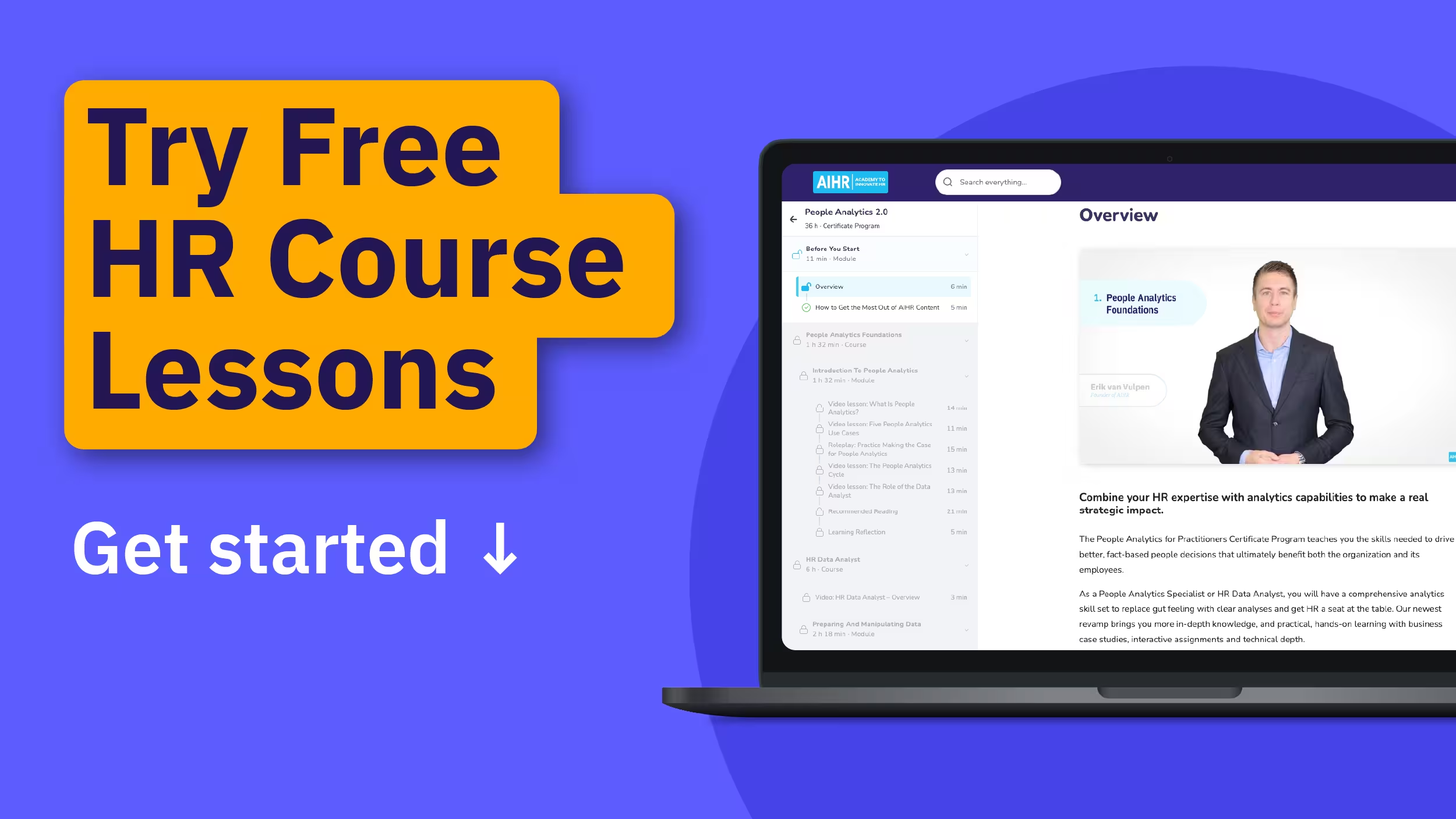
AIHR’s Demo Portal gives you a preview of what learning with AIHR looks like:
✅ Watch sample lessons from AIHR’s HR courses and certificate programs
✅ Explore practical guides, templates, and resources you can apply in your HR work
✅ See how bite-sized online learning fits around your schedule and career goals
✅ Discover learning paths that help you choose the right next step for your HR development
💡 Visit the Demo Portal to explore the platform and find the learning experience that fits your goals.
7 online HR courses with certificates to consider
Once you know what kind of certificate you’re after, you can use this list of eight specific HR courses and HR certificate programs to help you decide which one to choose:
1. AIHR Certificate Programs
- What it offers: Structured, self-paced learning built around real-world case studies and applied exercises, finishing with a capstone project.
- Certification type: Digital certificate, shareable and verifiable on LinkedIn.
- Format: 100% online, self-paced, 12-month access.
- Whom it’s best for: HR professionals building modern, in-demand HR skills. These include core competencies every HR role now needs (business acumen, data literacy, digital agility, and AI fluency), and deeper specialist expertise in domains like AI in HR, HR business partnering, people analytics, and organizational development.
- Counts toward recertification: Yes. AIHR is recognized for PDCs with SHRM, and recertification credits with HRCI, and CPD with CIPD.
- Cost: $1,125 for a single program, or $1,850 a year for Full Academy Access to all 16 certificate programs and 85+ courses, backed by a 60-day money-back guarantee.
- Find out more: AIHR Certificate Programs
2. Diploma in Human Resources (Alison)
- What it offers: Free coursework on HR fundamentals, including recruitment and selection, training and development, performance appraisals, organizational culture, and employee motivation and retention.
- Certification type: Optional diploma or digital certificate, shareable and verifiable on LinkedIn; certificates don’t expire.
- Format: 100% online, self-paced, no deadlines; diploma-level courses run roughly 10 to 20 hours.
- Whom it’s best for: Beginners confirming their interest in HR before spending any money on more extensive training.
- Counts toward recertification: No; Alison isn’t a recognized provider for SHRM, HRCI, or CIPD recertification credits.
- Cost: Free to complete; the digital certificate costs $35 to $37, and the physical certificate $44 to $49, plus shipping.
- Find out more: Diploma in Human Resources
3. HR course library (Coursera)
- What it offers: Foundational and specialized HR courses from university and industry partners, including the University of Minnesota, University of Pennsylvania (Wharton), and Macquarie University.
- Certification type: Course certificate; shareable and verifiable on LinkedIn, but only unlocked on the paid track.
- Format: Self-paced video lectures; audit mode gives free access to most lecture content without the certificate.
- Whom it’s best for: Learners who want to sample a specific HR topic from a recognized university before deciding what to pay for.
- Counts toward recertification: Varies by course; check the individual course pages for confirmation.
- Cost: Free to audit, but obtaining a certificate requires the paid track. Learners can pay $49 to $99 for single courses with a certificate, or subscribe to multi-course professional programs for $39 to $79 a month.
- Find out more: Coursera HR course library
4. Human Resource Associate Professional Certificate (HRCI)
- What it offers: A five-course program aligned with the HRCI aPHR body of knowledge, covering HR fundamentals for beginners.
- Certification type: Coursera Professional Certificate, shareable and verifiable on LinkedIn (not the same as earning the HRCI aPHR certification itself).
- Format: Self-paced, five courses; roughly five to six study hours a week over five months.
- Whom it’s best for: Beginners planning to take the HRCI aPHR exam.
- Counts toward recertification: No; this program prepares first-time candidates for the aPHR but doesn’t maintain an existing certification.
- Cost: Free to enroll and complete; Coursera’s paid track unlocks graded assessments and the certificate, and the aPHR exam itself carries a separate fee (about $400).
- Find out more: HRCI Human Resource Associate Professional Certificate
5. HR course library (LinkedIn Learning)
- What it offers: A large library of short, skill-specific HR courses, from HR foundations to recruiting, employee relations, and HR analytics.
- Certification type: Certificate of completion, shareable and verifiable directly on your LinkedIn profile.
- Format: Self-paced video courses, usually one to three hours each.
- Whom it’s best for: HR professionals building one specific skill quickly, or already certified professionals topping up recertification credits.
- Counts toward recertification: Yes for select courses; LinkedIn Learning is a recognized HRCI Approved Provider for general recertification credits, and select courses also qualify for SHRM PDCs.
- Cost: $39.99 a month or $239.88 a year for individual access; $379.98 per user annually for a team license.
- Find out more: LinkedIn Learning HR course library
6. Free HR courses (Oxford Home Study Centre)
- What it offers: Free, beginner-focused HR courses covering HR management fundamentals, recruitment, and talent acquisition.
- Certification type: Optional CPD Accredited Certificate, or Quality Licence Scheme-endorsed certificate.
- Format: 100% online, self-paced, no deadlines.
- Whom it’s best for: UK-based beginners who want a CPD-recognized certificate without paying to study.
- Counts toward recertification: No; not recognized by SHRM, HRCI, or CIPD for formal recertification credits.
- Cost: Free to complete. You can also get an optional CPD Accredited or Quality Licence Scheme-endorsed certificate for a small fee.
- Find out more: Oxford Home Study Centre HR courses
7. Continuing education HR programs (e.g., Drexel University, LSU)
- What it offers: Structured HR coursework backed by a university’s name. LSU, for instance, bundles seven courses covering C&B, performance management, EEO, talent management, and HR data. Drexel offers a Graduate Certificate in HR Compliance through its Thomas R. Kline School of Law, a post-baccalaureate, non-degree program covering HR compliance, employment law, and risk assessment coursework. It also aligns with SHRM’s HR Curriculum Guidebook.
- Certification type: University-branded certificate of completion (not a verifiable digital badge on Coursera or LinkedIn).
- Format: Self-paced, typically three to five hours per course.
- Who it’s best for: Learners who want academic credibility alongside the course content.
- Counts toward recertification: Not consistently confirmed; check with the specific institution if you already have a relevant HR credential.
- Cost: Varies by institution.
- Find out more: HR programs by Drexel University and LSU.
Next steps
Once you know which certificate you need, the decision gets much easier. Match the course to your goal, confirm what the certificate proves, and check all costs before you pay. Treat free HR courses as a low-risk starting point, not the finish line.
If you’re still deciding, AIHR’s Demo Portal lets you preview lessons from all 16 certificate programs before you commit. You can see the teaching style, workload, and project-based format before choosing a program.