
Should you specialize in HR? In many cases, the answer is yes. But the payoff depends on which specialization you choose, as not all HR specializations offer the same career value. Some place you in a less crowded market with higher pay, while others attract too many candidates, even when the salary looks strong.
AIHR performed an analysis of labor market data in collaboration with Revelio Labs to understand which roles are growing and which skills HR professionals need. This article breaks down where demand is strongest, which HR specializations pay off, and how to start from the experience you already have.
Contents
What does it mean to specialize in HR?
Should you specialize in HR or go broad?
HR specialist roles in demand
Why high pay doesn’t always mean easy-to-land
Why the type of work matters more than the HR job title
3 steps to choose your HR specialization
Key takeaways
- Specializing in HR can give you more bargaining power and higher pay. The strongest option is a specialty where demand outpaces supply.
- HR technology, people analytics, and change management roles have far fewer candidates per opening than broad HR roles.
- A high salary doesn’t always mean a role is easier to land. Some senior HR roles attract hundreds of candidates per opening.
- The strongest path to specialization starts with your current experience. Move sideways into a tighter market, then build the skills you need.
What does it mean to specialize in HR?
To understand what specializing in HR means, you must first distinguish between generalist and specialist roles. An HR Generalist covers several HR areas, such as recruiting, employee relations, compliance, onboarding, and benefits. An HR Specialist, however, focuses on one domain and becomes the go-to expert in that area. Common HR specializations include:
- People analytics
- Learning and development (L&D)
- Compensation and benefits (C&B)
- Organizational development (OD)
- HR technology
- Talent acquisition (TA)
- Change management.
HR specialization means choosing a focus area and building depth in that domain. AIHR’s HR Career Path guide describes this as a domain-driven career path. This differs from a value-driven path, where you grow through broad contributions across several HR functions.
Specialization takes time. You’ll need to build deep knowledge, stay current, and keep improving your skills. HR specialists regularly upskill because their roles change rapidly, especially in technology, analytics, and AI.
Most HR professionals still advance vertically into management roles, but specialization offers another option. It can place you in a less crowded market where your expertise travels across industries. The tradeoff is narrower mobility; if you focus deeply on one area, changing direction later may take more effort.

Should you specialize in HR or go broad?
When you compare generalist to specialist roles in HR using AIHR’s analysis, the answer leans toward specialization. Generalist and senior broad roles attract more candidates per opening compared to specialist roles in analytics, technology, and change management.
The HR Specialist versus HR Generalist debate isn’t just about career preference; the supply-and-demand data show specialists often have more bargaining power and higher median salaries. Along with seniority, the number of people competing for the same role is a key factor in the salary gap between an HR Specialist and an HR Generalist.
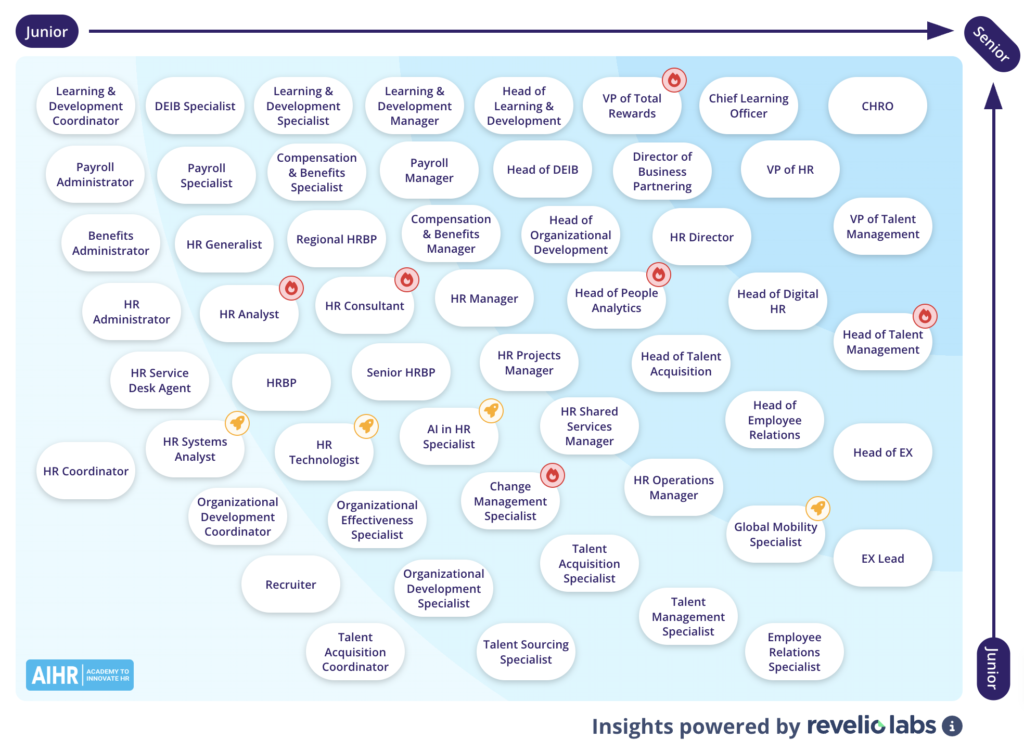
To understand where your role sits, look at the supply-and-demand ratio (SDR) explained in AIHR’s HR career outlook research, which shows the number of available candidates per open role in the labor market. A low SDR means employers have fewer candidates to choose from, which gives you more leverage.
Take the HR Technologist role, for example. It has an SDR of five, meaning there are only five candidates for every open role. A high SDR, on the other hand, means you’re competing with many other candidates. If you’re an HRBP looking for your next role, you may compete against 135 other candidates for the same job posting.
So, what does this mean for your career? Specialization can raise your salary and leverage, but the size of that advantage depends on which specialty you choose.
HR specialist roles in demand
AIHR’s research shows that HR specialist roles with low SDRs have the greatest leverage. These roles are usually tied to technology, analytics, and transformation. Companies are using AI to streamline HR operations and automate manual work, as well as data, to make better workforce decisions. To make this work, they need specialists who understand systems, data, change, and people.
Yet many HR teams are still building these skills. According to Korn Ferry, only 5% of HR teams feel fully prepared to implement AI effectively, while 40% of CHROs say insufficient AI-related knowledge and skills within HR teams are the biggest obstacle. This skills gap in skills is driving demand for specialists. Here are some HR specialist roles with low competition, and the scarcity also shows up in pay:
HR specialist role | Candidates per role | Median salary |
HR Technologist | 5 | $94,866 |
Head of Digital HR | 25 | $150,000 |
Head of People Analytics | 28 | $140,000 |
Change Management Specialist | 35 | $170,500 |
These roles combine high pay with low competition. But not every well-paid HR role works this way. Seniority and strong job titles can still bring a high salary. They don’t always give you a strong negotiating position.
Choosing an HR specialization is easier when you can see how different HR areas connect to the skills you want to build. Use continuous learning to stay adaptable, strengthen your expertise, and plan a career path that fits your goals.
Using AIHR’s Demo Portal, you can decide what to learn next by:
✅ Previewing lessons across different HR specializations
✅ Accessing guides, templates, playbooks, and practical resources
✅ Exploring AIHR Copilot and tools designed to support day-to-day HR work
✅ Identifying which learning path best matches your interests, role, and career goals
🎓 Start exploring the skills that can advance your HR career, using the Demo Portal.
Why high pay doesn’t always mean easy-to-land
A high salary doesn’t always come with strong bargaining power. Some broad, senior HR roles pay well but attract many candidates, weakening your leverage. AIHR’s research shows these high-salary roles also have high SDR:
HR specialist role | Candidates per role |
VP of HR | 757 |
Senior HRBP | 650 |
HR Director | 230 |
HRBP | 135 |
What do these roles have in common? They’re broad, coordination-heavy, and more exposed to software and process automation. Despite their high SDR, demand for HRBP and Senior HRBP roles is falling. Employers need less broad coordination work now, such as routing information, managing processes, and coordinating across teams. Software and specialists now cover that work.
Demand for close advisory work with business leaders has not declined as much. Regional HRBP roles have grown because they sit closer to the business, overseeing people strategy and operations within a specific geography.
These roles do less of the coordination work employers are cutting, focusing on local compliance, business alignment, and stakeholder relationships. Essentially, they handle work that software can’t easily replace, such as reading local culture, navigating country-specific laws, and building trust with business leaders.
Why the type of work matters more than the HR job title
A job title alone no longer tells you how secure a role is. What matters is the type of work you do, and specialized, analytical, and context-heavy work is harder to automate. Use these questions to assess your current role:
- Is your work tied to a specific technical system?
- Does it require judgment that changes by context?
- Would automation need to account for organizational culture?
- Do business leaders rely on your advice to make people decisions?
- Do you use data to diagnose problems or shape workforce plans?
If you answer yes to most of these questions, your role is likely to have stronger staying power.
When you choose an HR specialization, don’t pick a niche just because it sounds current, but look at the work you’re moving toward. Does it match your interests, or build on your skills, and does the market show demand for it? The goal is to advance your career, so you should avoid limiting your options too early.
3 steps to choose your HR specialization
Knowing how to specialize in HR starts with the experience you already have, so you don’t need to start over. In many cases, you can move sideways into a tighter market to help you build momentum on an HR Specialist career path. Here are three steps to choose your HR specialization:
Step 1: Start from your own experience
Specialization becomes easier when you build on what you already do. Most HR professionals spend more time in some functions than others, even in generalist roles. Start by reviewing your daily HR tasks, and determine the following:
- What responsibilities you handle most often
- Which tasks you enjoy most
- Where you’ve already built credibility
- What problems colleagues usually ask you to solve
- Which work feels energizing instead of draining.
For example, you may support payroll by managing attendance data or validating timesheets, which could lead to C&B. If most of your work involves hiring, sourcing, and interviewing, TA may be a natural fit. The best specialization often sits close to work you already know.
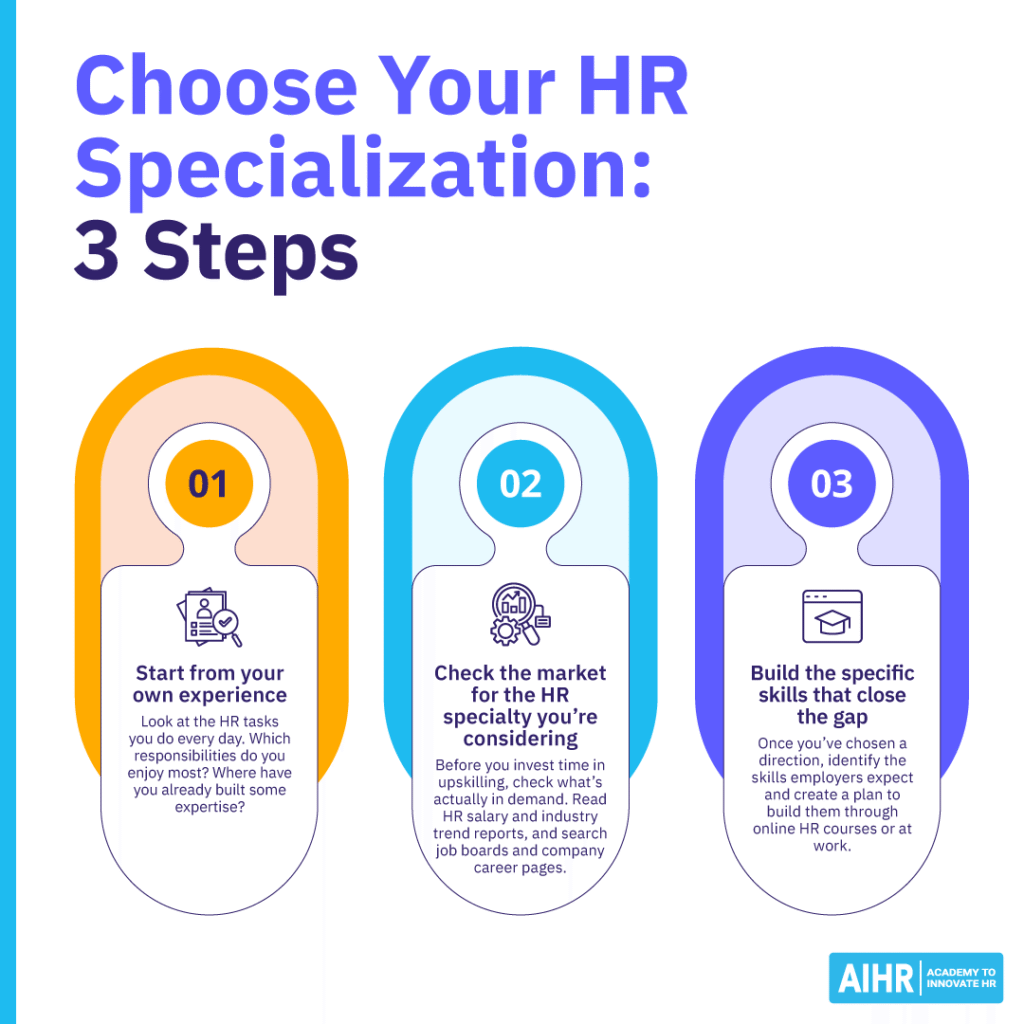
Step 2: Check the market for the HR specialty you’re considering
Not every specialization offers the same opportunities across locations, industries, or company sizes. Before you commit to upskilling, check the market. Start with salary and labor market reports, then review job boards, LinkedIn, Indeed, and company career pages. Pay attention to job posts that include salary ranges.
Look for patterns, such as which titles appear often, which skills employers require most, and which tools or systems they mention. It’s also worth looking at which certifications they prefer, and whether these roles are typical entry-level, mid-level, or senior.
You should also assess how your industry affects specialization. A BambooHR survey found that HR professionals in different industries often follow different paths and build distinct skill sets. In tech, for instance, HR professionals often focus on remote and hybrid workforces, fast hiring, and HR technology. In healthcare, they tend to handle strict compliance, credentialing, and workforce planning for 24/7 operations.
Step 3: Build the specific skills that close the gap
Once you choose a direction, identify the skills employers expect. Then create a focused learning plan. Here are common HR specializations and the skills they often require:
HR specialization | Skills to build |
People analytics | Excel, data visualization, workforce metrics, dashboard reporting |
Compensation and benefits | Salary benchmarking, pay equity analysis, rewards strategy, compensation structures |
Organizational development | Change management, leadership development, learning design, performance management |
HR technology | Human resources information system (HRIS) platforms, system implementation, process automation, data governance |
You can build these skills through online HR courses and HR certificate programs, as well as at work. For instance, you could join a job fair project to learn more about recruitment, or create a simple dashboard using anonymized workforce data to familiarize yourself with analytics.
You don’t need to master everything at once. Focus first on the skills that appear most often in job postings for your target HR specialist career path.
Next steps
Not sure which direction fits you best? Start with AIHR’s free HR Career Map to compare roles by demand, competition, salary, and skill requirements. Once you’ve chosen a path, build the skills that help you move with confidence.
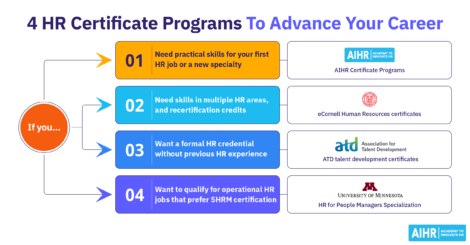
If you’re considering any of the specialties covered in this article, check out the following AIHR Certificate Programs:
- People Analytics Certificate Program: For analytics, reporting, and data-driven HR paths.
- Digital HR 2.0 Certificate Program: For HR technology, automation, and digital transformation paths.
- Learning & Development Certificate Program: For L&D, learning design, and capability-building paths.
- Organizational Development Certificate Program: For organizational development, change, culture, and effectiveness paths.
Pick the path that builds on what you already know, then let market data guide your next skill move.