
Your HR career is not at risk from AI, but parts of it might be.
That is the reality emerging from the data. AI is not replacing HR, but it is changing which roles are in demand, which skills are rewarded, and where career growth is happening. Some HR professionals are moving into tighter, higher-paying markets. Others are facing increasing competition for the same roles.
To understand what is actually shifting, Academy to Innovate HR (AIHR) analyzed seven months of U.S. labor market data, in collaboration with Revelio Labs, covering 54 HR roles, more than 162,000 active job postings, and 3.88 million HR professionals. What emerged is not a story about job loss. It is a story about how value is moving within HR, and why some career paths are becoming more resilient than others.
Key takeaways
- HR roles tied to systems, analytics, and transformation show stronger demand and tighter labor markets.
- Broad generalist and coordination-heavy roles face more competition and weaker demand in this data set.
- AI demand is still rarely stated explicitly in HR job postings, but its impact shows up in task redesign.
- The strongest career moves combine adjacent experience with a clear specialist skill set.
Contents
AI isn’t making HR disappear. It’s changing what’s in demand
Which HR roles are growing, and which are under pressure
AIs’ impact on HR skills
6 career moves worth considering right now
What HR skills should you develop next?
Develop the HR capabilities the market is rewarding
3.88M
HR professionals in the US labor market have very uneven access to opportunity.
There are 3.88 million HR professionals in the U.S. labor market. But access to the 162,000 open roles is far from equal. In some roles, there are five available candidates per vacancy. In others, there are 757. That means two HR professionals can work in the same broad field and face very different market conditions.
AI isn’t making HR disappear. It’s changing what’s in demand
Some HR roles are becoming harder to hire for, are paid more, and are becoming more central to business strategy. Others are losing demand month by month, facing more competition, and becoming more exposed to automation.
In this data set, the dividing line is not seniority alone. It appears that a role is built around specialist, analytical, systems, or transformation-focused work.
To understand where your role sits, focus on one metric: the supply-demand ratio (SDR). This shows how many available candidates there are for each open role in your market.
- A low SDR means employers are competing for you
- A high SDR means you are competing with many others for each opening.
What this means for your career: Your job title alone is no longer enough to judge how secure or valuable your role is. What matters more is the type of work you do every day, and whether that work is becoming more specialized, more analytical, or easier to automate.
Roles where the market works more in your favor
Some of the tightest labor markets in this data are in roles tied to technology, analytics, and transformation:
- HR Technologist: 5 candidates per role
- Head of Digital HR: 25 candidates per role
- Head of People Analytics: 28 candidates per role
- Change Management Specialist: 35 candidates per role
Compared to some of the most oversupplied roles:
- VP of HR: 757 candidates per role
- Senior HRBP: 650 candidates per role
- HR Director: 230 candidates per role
- HRBP: 135 candidates per role
The roles that look most future-oriented are also the ones where employers have the fewest candidates to choose from.
The salary data reinforces this. The tightest markets in this analysis, including HR Tech, People Analytics, and Change Management, carry median salaries from USD 86,000 to USD 130,000. At the same time, some high-paying roles sit in heavily oversupplied markets.
So while salary still matters, it is not a reliable measure of career leverage on its own. A role can pay well and still leave you with weak bargaining power if too many candidates are chasing too few openings.
Use data-backed insights to understand where the HR market is heading and what it means for your career.
🎯 AIHR’s HR Career Map and Certificate Programs will enable you to:
✅ Compare HR roles based on demand, competition, and salary potential
✅ Identify the skills that improve your career opportunities
✅ Plan your next move with a clear, structured approach
Which HR roles are growing, and which are under pressure
Supply-demand ratios show where the market stands today. Demand trajectory shows where it may be going next. These are important indicators because a role may still look stable now, but may weaken over time. Another role may still feel niche today, but could be building momentum quickly.
Look beyond current openings and focus on where employers are increasing investment.
The HR roles gaining ground
Several roles and role families stand out for recent demand growth:
Org. Effectiveness Specialist
L&D Specialist demand growth
Total Rewards family growth
Learning and Development
Five of the seven fastest-growing HR roles in the data set are in Learning and Development or closely related. This suggests that employers are placing more value on capability-building work, which includes not only running learning programs but also helping the business build skills at scale in a fast-changing environment.
The market seems to be sending a clear signal: Reskilling is becoming a strategic priority for organizations.
What does that mean for your career? If you are looking for a more resilient path in HR, capability-building appears to be one of the clearest areas of growth.
Total Rewards
Total Rewards is the other standout area. This role family grew 25.2% in demand, the fastest of any role family in the data. Payroll Administrator demand grew 137.6%, which may reflect rising compliance pressure and pay transparency requirements.
What does that mean for your career? If you are already in rewards, payroll, or adjacent work, this is one of the strongest signals in the data that deeper specialization could pay off.
The HR roles that are losing ground
HRBP roles
The sharpest and most consistent declines appear in the HRBP and senior HR layer:
Org. Effectiveness Specialist
L&D Specialist demand growth
Total Rewards family growth
This matters because the decline does not seem to be about business partnering itself. It seems to be about the more generalized coordination layer inside HR.
These roles often sit between the business and HR systems, manage processes, route information, and provide broad support without a clear specialist edge. That layer is being squeezed from both sides. Better HRIS and workflow tools can handle more routing and process work. At the same time, specialist HR professionals can often provide more precise support in areas like rewards, analytics, digital HR, and change.
Regional HRBP is the notable exception. Its 16.4% demand growth suggests that proximity to the business still matters. Embedded support still has value. Generalized layers above it appear to have less.
AIs’ impact on HR skills
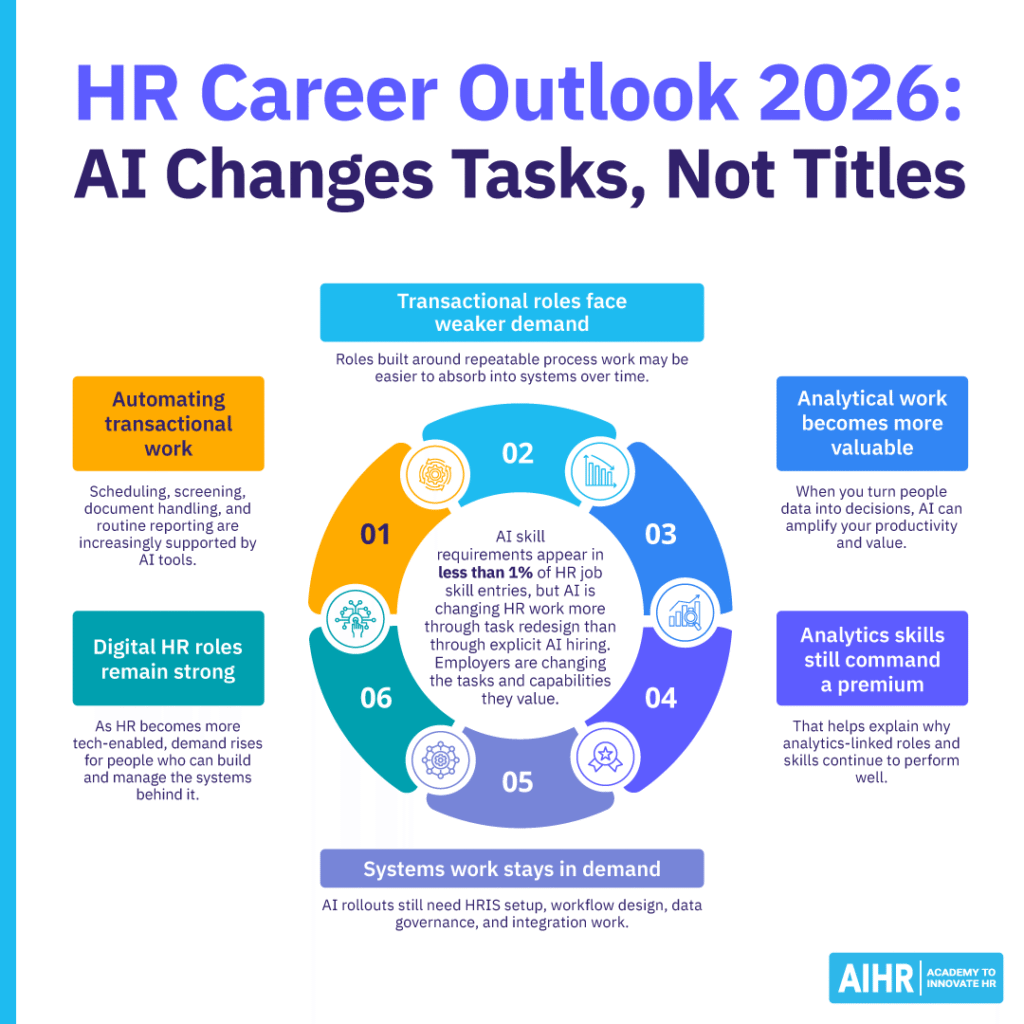
AI skill requirements appear in less than 1% of all HR job skill entries across role families. So the data does not support the idea that every HR professional now needs to become an AI expert.
But that does not mean AI has little impact.
A stronger interpretation is that AI is changing HR work more through task redesign than through explicit AI hiring. While employers are not yet asking everyone to list AI on their resume, they are changing the tasks and capabilities they value.
The data suggests AI is affecting HR in three main ways:
Automating transactional work
Scheduling, screening, document handling, and routine reporting are increasingly supported by AI tools. Roles centered mainly on this kind of repeatable work are showing weaker demand. One example is the HR Service Desk Agent, where demand fell 38.3%.
If most of your value comes from moving information through a process, that work may be easier to absorb into systems over time.
Amplifying analytical work
When HR professionals interpret data and turn it into decisions, AI can increase their productivity and value. That helps explain why analytics-linked roles and skills continue to command a premium.
For example, HR Technologist shows a low SDR of 5, making it one of the tightest labor markets in the data. If you can turn people data into business insight, your work looks more defensible and more valuable.
Creating systems demand
Every AI rollout still needs people who can design the infrastructure behind it. That includes HRIS setup, workflow design, data governance, and integration work.
This appears to be one reason roles tied to digital HR and HR systems continue to perform well, with median salaries in the $86,000 to $130,000 range. As more HR work becomes tech-enabled, demand rises for people who can build, improve, and manage the systems behind it.
The skills that actually get HR professionals hired
Learning and Development is one of the clearest growth areas in HR right now. The skills data from job postings is unusually specific about what employers want.
Instructional design is the clearest L&D skill gap
Instructional Design has a relevance score of 0.916 in L&D postings. That makes it the highest-scoring specialized skill in this role family. If you work in L&D and don’t yet have formal instructional design capability, this appears to be one of the most valuable gaps to close.
Technology fluency also matters. Skills like Learning Management System (LMS) proficiency, digital training, and learning technology now have a relevance score above 0.67. That suggests they are becoming baseline requirements rather than differentiators.
What does that mean for your career? Facilitation experience alone may no longer be enough. Employers increasingly want proof that you can design learning, use digital tools, and connect learning to business needs.
Senior L&D roles reward OD and transformation skills
The career ceiling in L&D rises sharply when you add organizational development and transformation capability.
Three skills stand out, each with its relevance scores:
- Organizational Development: 0.920
- Culture Transformation: 0.860
- Leadership Development: 0.803
These are the skills that separate an L&D Specialist with a median salary of $76,000 from a Head of L&D with a median salary of $114,000. Traditional L&D paths do not always emphasize these capabilities. That may help explain why the market rewards them so strongly.
What does that mean for your career? The path to senior L&D roles appears to depend less on delivering training and more on shaping organizational capability.
6 career moves worth considering right now
These career moves show a strong mix of salary upside, better market positioning, and realistic skill bridges. They are based on patterns across salary, demand growth, and competition levels.
1. HR Generalist to L&D Specialist
Salary uplift: +27%
Median salary: $59,000 to $76,000
The SDR improves from high to medium, indicating a shift from an overcrowded market to a more balanced one. Demand also grew 42.7% in six months.
- Skills to add: Instructional Design, LMS basics, training needs analysis
- Why this move makes sense: HR Generalists often already understand employee pain points and recurring capability gaps. What employers still want to see is proof of learning design skill, not just facilitation experience.
- What this means for your career: This is one of the more accessible ways to move from a crowded role into a growing one without starting over.
2. HR Generalist to HR Systems Analyst
Salary uplift: +44%
Median salary: $59,000 to $86,000
The SDR drops from 117 to 39, shifting from a competitive market to a much tighter one.
- Skills to add: Workday or other HRIS fluency, data analysis, process mapping
- Why this move makes sense: Generalists already understand the workflows these systems support. That gives them a useful foundation. What employers still expect is hands-on systems experience and reporting capability.
- What this means for your career: If you already know how HR processes work, moving into systems can turn familiar experience into a more specialized and more defensible skill set.
3. HRBP to Change Management Specialist
Salary uplift: +65%
Median salary: $79,000 to $130,000
The SDR drops from 135 to 35. Demand grew 21.6% in six months.
- Skills to build: Prosci or ADKAR methodology, transformation delivery, stakeholder management
- Why this move makes sense: HRBPs already work across leaders, resistance points, and business change. The main gap is the formal change methodology and evidence of structured delivery.
- What this means for your career: This is one of the clearest ways to turn broad business-facing experience into a higher-value specialty.
4. HRBP to Compensation and Benefits Manager
Salary uplift: +48%
Median salary: $79,000 to $117,000
The SDR drops from 135 to 33. Total Rewards is also the fastest-growing role family in this data.
- Skills to build: Compensation frameworks, pay equity analysis, market benchmarking.
- Why this move makes sense: Many HRBPs already have some exposure through merit cycles and pay decisions. This shift turns that exposure into a more technical and better-protected specialty.
- What this means for your career: If you want to stay close to business decisions but move into a tighter market, rewards are a strong option.
5. L&D Specialist to Organizational Effectiveness Specialist
Salary uplift: +30%
Median salary: $76,000 to $98,000
This is the fastest-growing role in the data set, with growth of +65.4%. The SDR is 36.
- Skills to build: Organizational development frameworks, process design, Lean or Six Sigma basics, performance analytics.
- Why this move makes sense: Both roles focus on capability. Organizational effectiveness goes further by linking capability-building to operating performance and design.
- What this means for your career: This is a strong move if you want to stay close to learning but take on more strategic, measurable business work.
6. Payroll Specialist to Compensation and Benefits Manager
Salary uplift: +113%
Median salary: $55,000 to $117,000
This is the largest salary jump in the analysis.
- Skills to build: Compensation strategy, incentive design, equity modeling, benefits architecture.
- Why this move makes sense: Payroll professionals already have a strong technical and compliance base. The shift builds on that foundation rather than replacing it.
- What this means for your career: This is not a quick pivot, but it is one of the clearest examples of how a technical HR foundation can lead to a much higher-value specialty.
What HR skills should you develop next?
If you’re in a Generalist or Coordinator role
This is one of the groups under the most pressure in the data, which means waiting may be riskier than upskilling. Start by auditing your HRIS exposure honestly. Can you configure a platform, run reports, and troubleshoot issues? If not, that is a strong place to start.
You should also consider a practical upgrade like Instructional Design or LMS certification. Those are more accessible bridges out of a crowded generalist profile. And don’t ignore basic data capability. Even entry-level confidence with HR metrics and reporting can help you stand out.
The key point is this: role volume is not the same as role safety. HR Generalists may show 8,985 open roles, but there are also 117 candidates per role.
If you’re in an HRBP or HR Director role
You likely already have valuable business-facing experience, but the data suggests broad advisory capability alone is becoming less protective. In this analysis, HRBP sits at an SDR of 135, HR Director at 230, and Senior HRBP at 650.
The market is not rewarding you if you stand still. The strongest response is to pick one hard specialty and build it deeply. That could be rewards, digital HR, people analytics, or transformation delivery.
Among the career moves in this data, HRBP to Change Management Specialist offers one of the strongest combinations of salary growth and improved market position. However, regional HRBP is the exception. Its positive growth suggests that close business proximity still matters.
If you’re in L&D
You are in a promising area, but the skills that help you grow are not always the ones that got you into the field. Start with platform fluency. Learning technology and LMS capability increasingly look like table stakes. Then build measurement capability. Training analysis is one of the highest-scoring skills in L&D postings, and analytics is becoming a clear differentiator.
If you want to move into more senior roles, invest in organizational development and in culture change capabilities. That appears to be where the biggest salary jump happens. This is also one of the clearest examples of AI’s indirect effect on HR. As content creation and information access become easier, the focus shifts toward capability design, adoption, measurement, and change.
If you’re in Talent Acquisition
Your long-term resilience appears to depend less on coordination work and more on analytics, tools, and consultative skills.
TA Coordinator demand fell 11.8%, and the SDR sits at 166. If your work is mostly administrative coordination, this data suggests the transition window is open now. Talent Analytics stands out as a differentiator, with a relevance score of 0.812 in TA postings.
AI-assisted recruitment also matters. With a relevance score of 0.730, it looks increasingly like a baseline expectation. Longer term, one natural move may be into L&D or organizational development, where skills around assessment, capability building, and stakeholder support overlap more than many people assume.
What does that mean for your career? Recruiting work looks more resilient when it becomes more analytical, consultative, and systems-enabled.
One role that stands out
Change Management Specialist has a median salary of $130,328. That combination makes it one of the strongest roles in this analysis for pay, lower competition, and recent momentum. It is also a realistic move for HRBPs and adjacent professionals who are willing to build formal transformation capability.
What does that mean for your career? If you already work close to stakeholders, business change, and adoption challenges, this may be one of the most attractive pivots in the current market.
The bottom line
AI is not ending HR careers. What it is doing is changing how HR work is valued. Less by title alone, and more by the nature of the work itself.
The HR professionals most likely to benefit are not always the most senior. They are the ones who can see where automation is changing task value, build skills in areas that offer leverage, and move before market forces the decision.
Develop the HR capabilities that the market is rewarding
For professionals who want to strengthen their analytics and data storytelling skills, AIHR’s People Analytics Certificate Program is directly relevant. The program teaches HR professionals how to analyze HR data, build dashboards, apply statistical techniques, and turn findings into business recommendations.
If your path is leaning more toward skills development and workforce capability, AIHR’s Learning & Development Certificate Program is also a strong fit. This program focuses on learning design, analytical skills, closing skills gaps, and supporting digital transformation.
If you are still deciding where to go next, AIHR’s HR Career Hub resources and HR Career Map can also help you compare roles, understand skill requirements, and plan a more deliberate move.
The market is shifting fast, but that can work in your favor. The more deliberately you build specialist, measurable, and systems-aware skills, the more resilient your HR career becomes.