

An employee write up form may feel like a routine or uncomfortable part of managing performance. However, how you use it can shape how employees experience fairness and accountability at work. A clear employee write up form helps you document issues consistently and support an objective, unbiased disciplinary process.
When disciplinary action is inconsistent, employees may question decisions or perceive favoritism. A structured and transparent approach helps prevent this. In this article, you’ll learn why an employee write up form matters and get a free template (in printable PDF and Word forms) you can download and customize.
Contents
What is an employee write up?
Why use an employee write up template?
When to conduct an employee write up (and when not to)
What to include in an employee write up form?
Free employee write up form template
How to complete an employee write up form
Employee write up example
Best practices for using employee write up forms
Checklist: Next steps after an employee write up
Key takeaways
- An employee write up form helps document workplace issues fairly and consistently, supporting an objective disciplinary process.
- Using a structured template improves documentation and reinforces company policies across teams.
- A strong write up should include key details like the incident, employee information, and expected improvements.
- When used properly, employee write ups support transparency, fairness, and legal compliance.
- Following best practices helps keep write ups objective, confidential, and focused on improvement.
What is an employee write up?
An employee write up is a formal record of a workplace issue that needs corrective action. It documents cases where an employee falls short of performance or behavior standards or breaks company policy. Its main purpose is not to punish or signal termination, but to clearly record the issue and give the employee a chance to improve.
A write up usually explains what happened, which policy or standard the employee did not meet, what changes are expected, the timeline for improvement, and what may happen if the issue continues. Once completed, the company typically stores it in the employee’s personnel file or HR system as part of the formal employment record, in line with internal recordkeeping practices.
For HR, write ups help ensure consistent, fair, and transparent discipline. You’re responsible for making sure managers document issues accurately and objectively, use evidence, cite the right policies, and respond appropriately to each situation. You also help them frame the employee write ups around clear expectations and improvement.

Why use an employee write up template?
One of the simplest ways to handle the employee write up process correctly is to use a structured template. Here are some reasons to use one:
Consistent documentation
A write up template for work helps standardize how you record incidents across teams and departments. This ensures you capture the same types of information every time, and makes it easier to confirm that your HR team handles similar situations comparably. It can also prevent misunderstandings arising from incomplete or inconsistent documentation.
Accurate information capture
Managers don’t always have experience documenting workplace issues. A template provides guidance on the details to include, such as the incident date, a clear description of the behavior or performance issue, the relevant policy or expectation not met, and the required corrective action. This structure helps keep the write up factual and objective.
Fairness and transparency
A standardized template supports a fair, transparent process. Applying the same format and criteria across the organization shows employees their company addresses issues objectively rather than personally. This consistency helps align disciplinary actions with company policies and ensure similar responses to similar situations.
Compliance and legal protection
Proper documentation is critical, especially if an employee challenges a disciplinary action. A detailed write up provides a clear record of the incident, the expectations communicated to the employee, and the steps taken to address the issue. A template helps documentation demonstrate that the organization has followed its policies in handling each situation.
Progressive discipline support
Employee write ups are typically part of a broader progressive discipline process, not an isolated action. A structured template helps both HR and managers document each step clearly. This can show that the organization has communicated clearly with the employee and given them opportunities to improve before taking more serious disciplinary action.
Learn to lead tough workplace conversations and provide actionable feedback with confidence and empathy. You need effective listening strategies, the ability to adapt your communication style, and conflict management skills.
AIHR’s HR Generalist Certificate Program will help you:
✅ Obtain and use practical tools to prepare for difficult workplace conversations
✅ Apply conversation strategies, manage conflict, and provide feedback effectively
✅ Build trust among others by thoroughly preparing for your conversations
When to conduct an employee write up (and when not to)
An employee write up often follows verbal warnings or informal coaching, but the appropriate step depends on the severity of the issue and the organization’s disciplinary policy. You may recommend a formal employee write up in a number of circumstances:
- If an employee violates company policies or regulations
- If their behavior or performance falls below acceptable standards
- If their actions harm or endanger others in the workplace
- If they’ve misused company resources
- If they’ve repeatedly disregarded instructions or refused to follow established procedures
- If they’ve engaged in employee misconduct, such as theft, harassment, or discrimination
- If their behavior or actions negatively impact the company’s reputation or financial standing.
What a write up at work means, essentially, is formal documentation that may support further disciplinary action, including termination in serious or repeated cases. If this formal process is not necessary, it’s probably better to recommend that a manager take a less serious action, like a verbal warning.
However, if an employee fails to improve their performance or conduct despite repeated verbal warnings, a formal write up may help reinforce the seriousness of the issue. A well-written write up should include clear expectations for improvement so the employee understands how to improve and keep their job.
HR checklist on when to conduct an employee write up
Use the checklist below to help you decide if you should conduct an employee write up:
- ✔ Has the manager or supervisor consulted with HR?
- ✔ Is the action justified?
- ✔ Is it the appropriate next step in accordance with the company’s discipline process?
- ✔ Is it consistent with company policies?
- ✔ Is it compliant with relevant laws and regulations?
- ✔ Is there a recommended remediation action the employee can follow?
HR tip
The timing of an employee write up should ideally be as close as possible to the incident or observed pattern of behavior. This ensures the issue is fresh in both the employee’s and the manager’s minds, making the feedback more effective and meaningful.
Disciplinary action vs. employee write up
An employee write up letter is sometimes called an employee disciplinary action form or a disciplinary write up form. However, disciplinary action is a broader process that includes any measure an employer takes to correct an employee’s behavior or performance. An employee write up is much more specific. Let’s look at the differences:
A broad term referring to multiple measures taken by an employer to correct or punish behavior.
A specific type of disciplinary action for documenting recurring issues, or demonstrating a pattern of behavior. In some cases, it may lead to more severe disciplinary actions, such as suspension or termination.
Can include verbal warnings, written warnings, suspensions, demotions, or even termination.
Is a formal, written document.
Follows a progressive discipline process, where the severity of the action increases with each subsequent incident.
Details an employee’s misconduct or performance issue and the corrective action required.
May be formal or informal, and will not necessarily be documented until required.
Includes a description of the issue, the specific policy or rule that was violated, the consequences of the employee’s actions, and the steps the employee needs to take to improve their behavior or performance.
HR and managers use it to help employees understand the consequences of their actions, improve their performance, and maintain a safe and productive work environment.
Serves as a record of the incident and is placed in the employee’s personnel file.
What to include in an employee write up form
Your disciplinary write up form should outline all the necessary elements a manager must cover in a write up. This includes:
- Date of the incident: State the date on which the incident occurred or was reported. The employee write up should take place as close to the incident date as possible.
- Location of the incident: Record where the incident occurred (e.g., on-site, remote, customer location, or during a virtual meeting). This provides context and may be relevant for workplace safety, conduct, or operational policies.
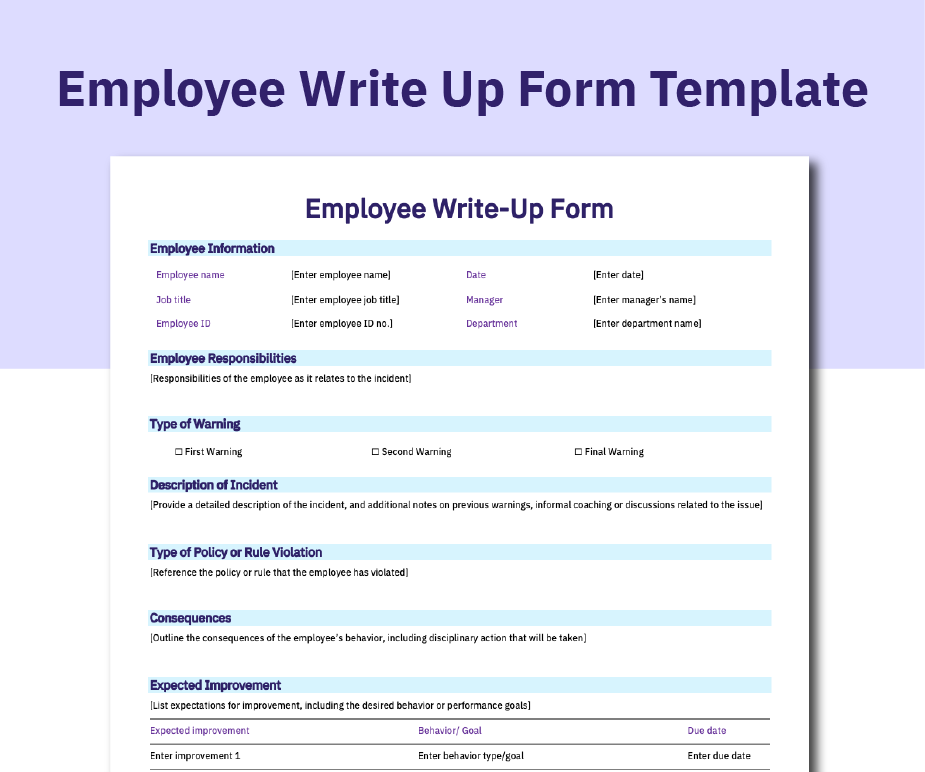
- Employee information: Include the employee’s name, job title, department, and a short summary of their responsibilities, if relevant to the write up.
- Manager or supervisor information: The name and title of the person issuing the write up.
- Details of the incident: Clearly describe the incident, including what happened, when it happened, and who was involved. Stick to the facts.
- Impact of the incident: Briefly describe how the behavior or performance issue has affected the team, workplace operations, customers, safety, or productivity. This helps clarify why you need to address the issue.
- Policy or rule violation: If applicable, reference the specific company policy or rule the employee has violated. Refer to the employee handbook where possible.
- Previous warnings or discussions: Mention any previous verbal warnings, informal coaching, or discussions related to the issue. This indicates that the disciplinary write up is part of the progressive discipline process.
- Consequences: Outline the consequences of the employee’s behavior, including any disciplinary action the company intends to take.
- Corrective support or guidance: Note any guidance, coaching, or resources the company has already provided to help the employee improve. This demonstrates that the company supports performance improvement, not just discipline.
- Expected improvement: List expectations for improvement, including the desired behavior or performance goals, and a timeline for achieving them.
- Employee acknowledgment: Include a space for the employee to sign and date the employee write up, indicating that they’ve read and understood the document. Allow the employee to provide written comments or feedback if they wish.
- Manager or supervisor signature: The manager or supervisor issuing the write up should also sign and date the document.
- HR review and signature: Review, sign, and date the employee write up to ensure compliance with company policies and legal requirements.
- Recordkeeping note: Indicate that you’ll store the completed company write up in the employee’s personnel file or HR system, in accordance with company recordkeeping policies.
- Follow-up review date: Include a date when the manager and employee will review the latter’s progress. This reinforces accountability and ensures the involved parties revisit expectations within a reasonable timeframe.
Free employee write up form template
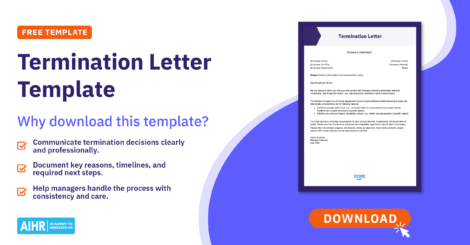
AIHR has a free employee write up form you can download as your formal write up template to help create consistent documentation across your organization. If you need a physical copy, the document is available as a printable employee write up form in PDF and Word.
How to complete a write up form for employees
Here are a few pointers you can share with any manager who needs to know how to write up an employee. You can also use these recommendations to review the write up before signing off on it.
Be clear and concise
Language is important. An employee write up should be factual, so be sure to avoid subjective or emotional language. Use specific examples to describe the incident, but keep the write up concise. Only include relevant information, and don’t make generalizations or assumptions.
Be calm
A manager working on a write up when angry not only exacerbates the issue but also leaves room for error and unprofessionalism. These documents should remain objective. Because they become part of an employee’s record, they may later serve as evidence if the employee challenges a disciplinary decision.
Consider company policies
There should be a valid reason to issue an employee write up. Use company policies to back up any claims, relating the issue to a specific policy if possible. This makes it easier to justify the write up and show that it addresses a policy violation rather than targeting the employee personally.
Be specific
Include any witness statements or other evidence that can support the write up, but ensure these are factual instead of subjective. Be specific about what disciplinary action the company will take, and clearly state what changes in behavior or performance it expects of the employee going forward.
Employee write up example
Below is an employee write up sample you can use as a reference.
Best practices for using company write up forms
Here are nine practices to follow to ensure your organization follows best practices when using employee write up forms.
- Always follow company policies and procedures: Doing so ensures write ups are consistent, compliant with guidelines, and are not issued prematurely or inappropriately.
- Reference company policies: Where applicable, cite the specific policy or rule the employee has violated, and explain the consequences of not adhering to these guidelines.
- Use progressive discipline: Disciplinary write ups should be part of a progressive process that first uses less severe measures, such as verbal warnings or informal coaching. A company should issue written warnings only when previous efforts have not led to improvement.
- Provide clear expectations: Outline the expected behavior or performance improvement, and provide a timeline for meeting these requirements. Provide support, resources, or training to help the employee improve.
- Explain consequences: Clearly communicate the potential consequences of not addressing the issue, including further disciplinary action, up to and including termination.
- Be objective and fair: Treat all employees consistently, regardless of their position, tenure, or personal relationships. Avoid showing favoritism or bias.
- Allow for an employee response: Give the employee an opportunity to share their perspective, ask questions, or raise concerns about the write up. This helps clarify misunderstandings and promote open communication.
- Maintain confidentiality: Keep the write up and related discussions confidential to protect the employee’s privacy, and maintain a professional work environment.
- Document and follow up: Keep a copy of the write up in the employee’s personnel file, and regularly monitor their progress and provide ongoing feedback and support.
HR tip
You may have asked the question: “How many write ups before termination?” The answer is, there is no universal number. It depends on company policy, severity of the situation, employee history, and applicable labor laws. Even if your company uses progressive discipline, serious misconduct (e.g., assault or fraud) may justify immediate termination. Your policy should state when a write up at work may lead to further disciplinary action.
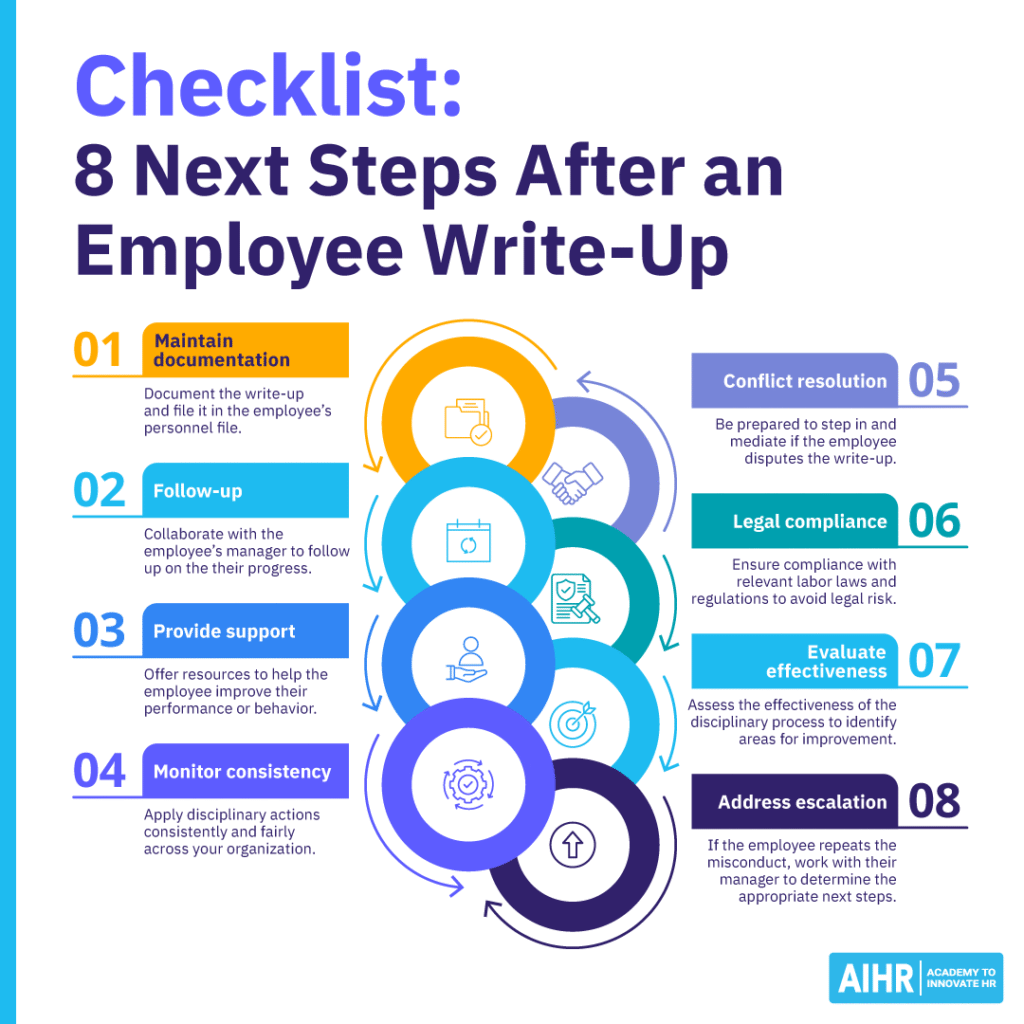
Checklist: Next steps after an employee write up
Use the following checklist to ensure you take the necessary steps after issuing an employee write up:
- ✔ Maintain documentation: Document the write up and file it in the employee’s personnel file to provide evidence in case of disputes or litigation.
- ✔ Follow-up: Together with their manager, use regular check-ins to follow up on the employee’s progress and ensure they’re working towards the outlined improvement goals.
- ✔ Provide support: Offer resources to help the employee improve their performance or behavior. These could be training programs, mentorship, or other forms of support tailored to their needs.
- ✔ Monitor consistency: Apply disciplinary actions, including disciplinary write ups, consistently and fairly across your organization. Regularly review disciplinary records and make policy adjustments if needed.
- ✔ Conflict resolution: Step in to mediate if the employee disputes the write up. Investigate the issue, facilitate communication, and work towards a fair resolution.
- ✔ Legal compliance: Continuously monitor compliance with relevant labor laws and regulations to minimize the risk of legal issues or claims of unfair treatment.
- ✔ Evaluate effectiveness: Assess the disciplinary process, including employee write ups, to identify areas for improvement. For example, if multiple employees regularly receive write ups for similar policy infractions, the problem could lie with the policy instead.
- ✔ Address escalation: If the employee fails to improve despite the write up, work with their manager to determine the appropriate next steps in the disciplinary process. This could include additional company write ups, suspension, demotion, or even termination.
Next steps
Employee write ups work best when you treat them as part of a wider skill set, not just a disciplinary task. You should know how to document issues clearly, apply policy consistently, guide managers through difficult conversations, and support fairness. This way, you can help teams address problems early, set clear expectations, and give staff a chance to improve.
Structured processes and standardized templates provide crucial support, but strong judgment and communication also matter. AIHR’s HR Generalist Certificate Program can help you strengthen those core capabilities by building practical skills in employee relations, policy application, and performance management.