

The Skill Will Matrix is a simple framework that helps managers assess two things: an employee’s ability to perform a task and their motivation to do so. Managers can plot skill and will on a four-quadrant matrix to choose the right approach for each employee, whether that means delegating, guiding, directing, or re-engaging them with the right support.
Used well, the Skill Will Matrix can improve performance management, employee development, and day-to-day leadership decisions. In this guide, you’ll learn what the Skill Will Matrix is, how the four quadrants work, when to use it, and how to apply it with our free templates.
Contents
What is the Skill Will Matrix?
Skill vs. Will: What is the difference?
The four quadrants of the Skill Will Matrix explained
Applications of the Skill Will Matrix
Free Skill Will Matrix templates
How to use a Skill Will Matrix
Fictional case study: New manager hire
FAQ
Download our free Skill Will Matrix template in Excel & PowerPoint:
Key takeaways
- The Skill Will Matrix is a practical tool managers can use to assess an employee’s skill and will for a specific task.
- Skill refers to how capable an employee is of doing the work well, based on their knowledge, experience, and competence.
- Will means how motivated and willing an employee is to do the work.
- The four quadrants are high skill, high will; low skill, high will; low skill, low will; and high skill, low will.
- Managers should use it to adapt their approach and give each employee the right support to improve performance and development.
What is the Skill Will Matrix?
The Skill Will Matrix is a tool that compares the willingness to perform a task with the degree of skill employees have to perform it well. This is plotted on a 2×2 quadrant. Each quadrant indicates how the manager should engage with or manage the employees in that quadrant.
- Quadrant I: High Skill, High Will: This person has the skills and motivation needed to succeed at work.
- Talent management strategy: Delegate tasks to these individuals, allowing them autonomy and the opportunity to lead projects, as they are likely to handle responsibilities effectively.
- Quadrant II: Low Skill, High Will: The employee doesn’t have all the skills they need to perform, but they have the motivation needed to improve.
- Talent management strategy: Guide them by providing training and continuous learning opportunities to develop their skills.
- Quadrant III: Low Skill, Low Will: This worker lacks the skills needed to perform and the motivation to improve their skills.
- Talent management strategy: Direct them with clear, structured tasks and close supervision to ensure compliance and encourage skill development.
- Quadrant IV: High Skill, Low Will: This person has the skills to perform in their role but lacks the motivation to do so.
- Talent management strategy: Excite them by aligning tasks with their interests or career goals and recognizing their achievements to boost engagement.

According to the World of Work, “it is a 2×2 matrix that is often used by managers to assess individual performance. The matrix places’ will’ (willingness, enthusiasm, and self-drive) on the vertical axis and ‘skill’ (core capability) on the horizontal axis. Willingness is related to motivation.”
In short, the Skill Will Model enables managers to determine how to help every employee improve their performance. This, in turn, leads to a motivated, engaged workforce willing and able to help you achieve your business goals and desired results.
As an HR professional, you can teach managers how to use this matrix and what performance management strategies they can work with to engage their employees.
History of the Skill Will Matrix
The Skill Will Matrix was introduced by Max Landsberg in his book The Tao of Coaching, which focused on practical ways to improve leadership through coaching conversations. Drawing from his experience as a partner at McKinsey and other consulting companies, Landsberg developed the matrix as a tool to help managers quickly assess how best to support individual team members.
As we’ve already mentioned, the model maps employees along two axes – skill (competence) and will (motivation) – and suggests that a manager’s approach should vary depending on where someone falls. While Landsberg built on earlier thinking around adaptive leadership and behavioral coaching, his contribution was to package it in a simple, easy-to-apply format that managers could use in day-to-day interactions.
Since its introduction, the Skill and Will Matrix has become a widely used tool in both corporate training and leadership development because of its clarity and versatility.

Skill vs. Will: What is the difference?
‘Skill’ is the competence employees possess to function in their role effectively. People acquire and develop skills through learning and practice. Skills can also be measured in terms of proficiency levels – beginner, intermediate, advanced, and expert.
‘Will’ signifies the degree of motivation employees have to perform a task or function in a role. Several things can impact employees’ level of will – degree of skill, professional aspirations, team and organizational culture, and personal life. It is evident from these lists that managers need to be very engaged with their staff to know what skills their team possesses, the levels of proficiency of each team member, and also understand the motivating drivers that impact their will.
According to ExecVision, “Skill is objective. You have concrete KPIs and best practices to measure against. Will, on the other hand, is more subjective and can only be uncovered through one-to-one conversation and observation.” However, to minimize the subjectivity in determining ‘Will’, a personality assessment, like a Hogan Assessment, can be helpful in determining employees’ ‘bright-side,’ ‘dark-side, and ‘motivations, values, and preferences.’
Depending on where employees are plotted on the matrix based on their level of skill and will, a different performance management style will be used.
The four quadrants of the Skill Will Matrix explained
Let’s take a closer look at the 4 quadrants of the Skill Will Matrix, the characteristics of employees in each quadrant, and the respective management strategies in more detail.
Quadrant I: High Skill, High Will
- Possesses the skill and will to perform
- Seeks new opportunities to grow
- Eager to learn and develop new skills
- High motivation and drive
- High performer and achiever
Talent management strategy: Delegate
An employee in this quadrant needs less of a coach and more of a mentor. Encourage and empower them to adopt a self-coaching approach, but always be available for them if they need advice or guidance.
Quadrant II: Low Skill, High Will
- Has the desire to complete tasks but lacks the skills to do so
- High enthusiasm
- Strong desire to succeed and excel at work
- Tends to be new to a career or job level
Talent management strategy: Guide
Give this employee as many opportunities as possible to develop their skills and encourage them to take managed risks, from which they can learn.
Quadrant III: Low Skill, Low Will
- Lacks the skills and motivation to perform
- May have failed before and be afraid to fail again
- Could be in the wrong role or be a poor fit for the team or organization
- May be reluctant to ask for help.
Talent management strategy: Direct
Working with someone in this quadrant will require the most time and effort. Set clear expectations and deadlines, and closely monitor their progress. Encourage them to reach out for help when they need it.
Quadrant IV: High Skill, Low Will
- Possesses the skills to perform but lacks motivation
- May have reached a plateau
- May have had a recent manager/team change
- In need of a new challenge.
Talent management strategy: Excite
Figure out what motivates this employee, then link this to their role to boost engagement. Work together to reduce anything in their role or working environment that is having a negative impact on their motivation.
AIHR’s Talent Management & Succession Planning Certificate Program helps you to:
✅ Segment talent more effectively by assessing capability, potential, and readiness for development.
✅ Build talent strategies that connect employee growth, retention, and mobility to business priorities.
✅ Identify talent risks and opportunities early through talent reviews and succession planning.
✅ Create a stronger talent experience through engagement, career development, and internal mobility.
💡 Guide employees toward the right next step with practical talent management methods.
Applications of the Skill Will Matrix
Skill Will Matrices help you approach each employee based on their individual needs. They’re especially useful during periods of organizational change, when those needs are most likely to shift. Here’s when a Skill Will Matrix can come in handy:
Employee development and training
Identifying where employees fall on the Skill Will Matrix enables managers to tailor learning and development opportunities that cater to their individual needs. For example, an employee with high will and low skill may find technical training beneficial, while an employee with high skill and low will may benefit from motivational initiatives.
Performance management
The Skill Will Matrix can help managers understand the root cause of performance issues by separating skill and motivational deficiencies. This allows interventions to be more targeted, for example, coaching and skill-building activities for those with low skill or motivation-boosting strategies for those with high skill but low will.
M&A
After an acquisition and merger, a manager may find this useful to better manage and motivate merged team members.
New manager
A new manager is hired from outside the organization to manage a pre-existing team. The manager will find this tool valuable during the first few months of employment to better manage and understand the newly acquired team’s skills and work preferences. This helps prevent early mistakes in choosing the right interaction style and achieving quick wins.
Organizational restructure
There may be more job opportunities in some business units during an organizational restructure, but fewer in others after the restructure. A Skill Will Matrix will help leaders make decisions that support new organizational objectives and retain key employees.
New team members
It takes time to learn the skills, work habits, and learning styles of a new team member. The Skill Will Matrix can give managers a head start in understanding an employee’s strengths, motivations, and preferred styles of communication and leadership.
Better leadership
Using this framework helps managers communicate with and develop their team using the appropriate talent management strategy (Guide, Delegate, Direct, or Excite). These conversations help uncover employees’ hidden strengths, enabling managers to place them in positions where they can flourish.
Agile projects
Selecting members for agile projects can be a challenging and sometimes competitive process. Combined with the Competency Matrix, the Skill Will Matrix can be adapted to help leadership quickly determine the most competent and motivated employees to build agile teams that deliver timely results.

Free Skill Will Matrix templates
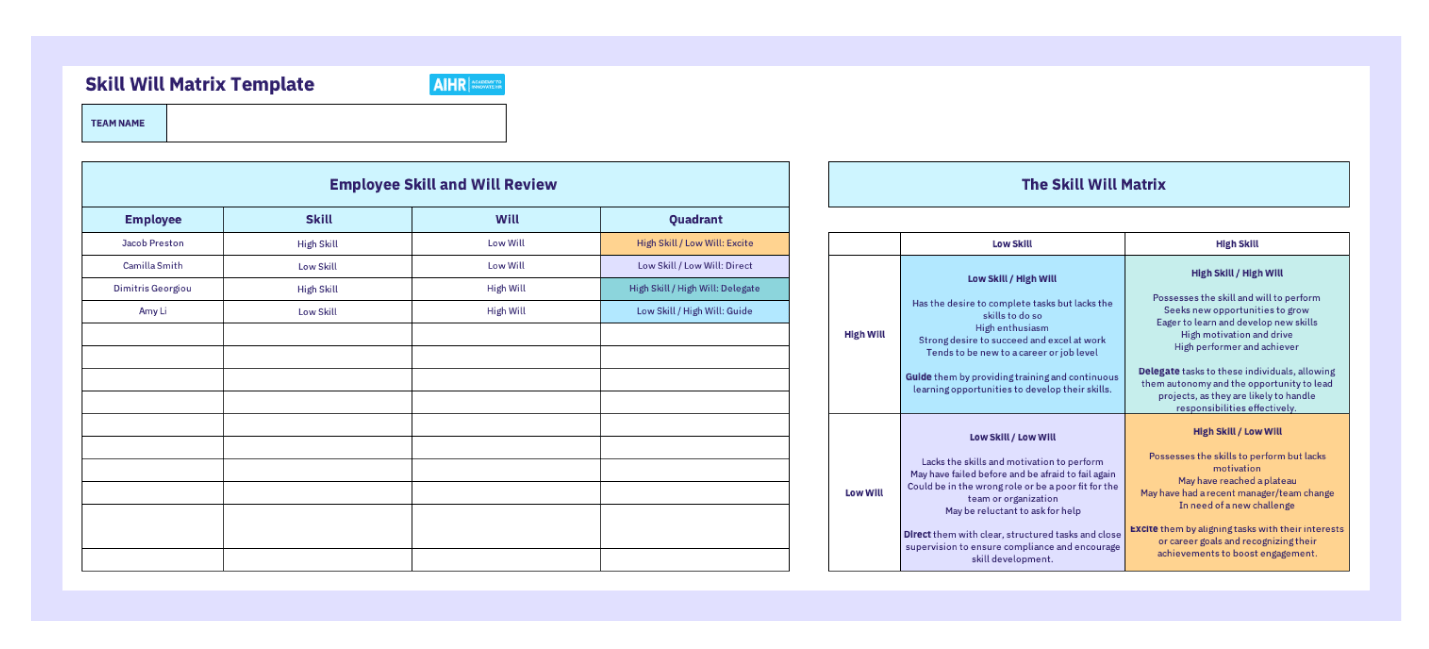
Use this Skill Will Matrix template to quickly map employees based on their level of skill and will, so you can identify the most effective way to support their performance and development.
Skill Will Matrix template: Excel
Use this Excel Skill Will Matrix template to assess employees’ skill and will levels, compare team members consistently, and plan the right management approach for each person.
Skill Will Matrix template: PowerPoint
Use this PowerPoint Skill Will Matrix template to present the employee assessments clearly and discuss development priorities with managers or stakeholders.
How to use a Skill Will Matrix: 6 steps
The Skill Will Matrix helps managers choose the right approach for each employee based on their current level of skill and motivation. It works best when it is used as a practical coaching tool, not as a fixed label. The aim is to understand what support each person needs to perform well and keep developing.
Here’s how HR can enable managers to use the Skill Will Matrix.
Step 1: Assess the employee in a specific context
Train managers to start by focusing on a particular role, task, or responsibility. Skill and will can vary depending on the situation, so it is more useful to assess an employee in relation to a specific area of work than to judge them as a whole.
For example, someone may have high skill and high will when managing employee relations issues, but lower skill or lower will when working with HR analytics or reporting.
Once the manager collects enough information about the individual areas, they’re better positioned to reach a more holistic conclusion about an employee’s skill and will.
Step 2: Gather enough information before placing them on the matrix
Managers should base their assessment on evidence, not assumptions. This means looking at the employee’s recent performance, observing how they approach their work, and using one-on-one conversations to understand what may be influencing their motivation. This is especially important because low will is not always a sign of disengagement. In some cases, it may reflect low confidence, burnout, lack of clarity, or frustration in the role.
A manager can look at:
- The quality and consistency of the employee’s work
- How independently they complete tasks
- Their level of initiative, energy, and follow-through.
Step 3: Place the employee in the quadrant that best fits their current situation
Once the manager has a clear picture of the employee’s skill and will, they can place them in the relevant quadrant. This should be based on the employee’s current situation, not their long-term reputation or past performance alone. The matrix works best when it reflects where the employee is now, because that is what helps the manager choose the right support.
Where useful, managers can also use calibration sessions with peers or HR to discuss their assessments and apply the criteria more consistently across teams. This helps reduce bias and makes the process fairer.
Step 4: Work to adapt the management approach
The real value of the Skill Will Matrix lies in what the manager does next. Employees with high skill and high will usually need autonomy and opportunities to grow. Employees with low skill but high will often benefit from guidance, coaching, and regular feedback. Those with high skill but low will may need a new challenge, stronger recognition, or a conversation about what is affecting their motivation. Employees with low skill and low will typically need clearer direction, closer follow-up, and a more structured plan.
Step 5: Agree on clear next steps with the employee
After identifying the right quadrant, the manager should turn that insight into action. This may include assigning stretch work, creating a development plan, setting short-term performance goals, increasing coaching, or addressing barriers that may be affecting motivation. The more specific the next step, the more useful the matrix becomes.
Step 6: Revisit the matrix regularly
The Skill Will Matrix should not be treated as fixed. Employees move between quadrants as they gain experience, build confidence, face new challenges, or lose motivation. Revisiting the matrix regularly helps managers adjust their support over time and respond before issues become bigger performance problems.
Fictional case study: New manager hire
Daphne recently joined an organization as the HR Manager and is managing a team of 4 employees. Shelly has been on the team for four years as the Recruiter. In her prior role, Shelly was an HR Generalist for four years at another organization. Max is the HR Coordinator. He joined the team 12 months ago, immediately after graduating with a BA in Business Administration. Khris is the Senior HR Generalist, and she has been on the team for six years. Then there is Stellar; she has been the Payroll Officer for 18 months.
After working with and observing the team for about two months, Daphne wants to better understand the team’s capacity and degree of motivation to do their jobs. HR advises her to use the Skill Will Matrix and take the following steps:
- She reviews the team’s performance evaluations over the past three years.
- She solicits feedback from key stakeholders on the team’s performance and each person’s capabilities.
- She reviews each of their Hogan Assessment Results
- She meets with team members individually to discuss the reviews, stakeholder feedback, Hogan Assessment results, and listens as they share their engagement drivers, aspirations, and challenges.
Completing the Skill Will Matrix
After Daphne concluded the above steps, she completed the Skill Will Matrix as illustrated below:
- Khris – Quadrant I: High Skill, High Will
- Stellar – Quadrant II: Low Skill, High Will
- Max – Quadrant III: Low Skill, Low Will
- Shelly – Quadrant IV: High Skill, Low Will
Khris – High Skill and High Will (Delegate): Daphne learned that Khris was a high performer and ambitious, needing little assistance in her work. Khris had applied for the manager role Daphne assumed. However, she didn’t have the managerial experience. Daphne decided she would challenge, nurture, and empower Khris. She assigns Khris as the peer coach and, on certain occasions, allows Khris to shadow her as she manages the team. Daphne realized that as the organization grew, Khris’ experience, motivations, and disposition made her a valuable member of the team and even to her. It would be a massive loss if Khris left the organization.
Shelly – High Skill but Low Will (Excite): Shelly is a potential detractor. Daphne needs to identify why her motivation is so low and find ways to excite and motivate her. What she learns is that Shelly gets bored after she feels she has mastered a task. Shelly has changed jobs/organizations every 3-4 years. Daphne consults with the HR Director, and they both agree that the organization’s growth would soon necessitate HR Business Partners. Shelly would make a strong HR Business Partner given her high competence, experience, and personality profile. They communicated this to Shelly, who was thrilled by the prospect of this new challenge. Daphne began crafting a 12-month HRBP development plan for Shelly.
Stellar – High Will but Low Skill (Guide): She has a good attitude and has developed positive working relationships with the team and staff. However, Stellar needs extra guidance and performance coaching. She is easily distracted and doesn’t pay enough attention to details. This leads to recurring mistakes and complaints from the HR Director. To develop her core skills, Daphne develops a plan of action. She identifies payroll administration training for Stellar to attend. She also spends considerable time sitting with Stellar during the payroll preparation week to provide frequent feedback on the process. Daphne develops a checklist and procedural guidelines with clear rules to help Stellar be more attentive and accurate. These steps not only close Stellar skills’ gaps, but they also improve the employee experience and the HR Department’s image.
Max – Low Will and Low Skill (Direct): Unfortunately, Max is a low performer. Therefore, Daphne provides him with SMART goals and a work plan, and they have weekly check-in meetings. However, during the conversation with Max, prior to completing the Skill Will Matrix, Daphne learns that Max really wants to pursue a career in Marketing & Communications. He pursued the HR Coordinator role to gain work experience, earn an income, and get into the organization. Daphne is privately discussing an exit strategy for Max with the HR Director. Though his role is junior, it is critical to provide HR services to all employees and the HR Department. It is essential to have someone with the right skill and will to consistently provide quality service.
Through this process, Daphne was able to customize her team’s management to address their performance and motivational needs by empowering, motivating, guiding, and directing them.
Over to you
Simply put, the Skill Will Matrix is a valuable framework and a starting point for determining appropriate employee performance coaching techniques. This performance management tool helps you uncover and bridge the skills gaps, utilize your employees’ strengths, and motivate them based on their values and preferences.
If you want to build stronger talent management skills, AIHR’s Talent Management & Succession Planning Certificate Program is a relevant next step. It focuses on helping HR professionals implement talent management and succession planning strategies that support the business and build stronger talent pipelines.
FAQ
The Skill Will Matrix is a management tool that helps managers assess two things: an employee’s ability to perform a task and their motivation to do it. It places skill and will on a four-quadrant matrix, which helps managers decide whether to delegate, guide, direct, or re-engage an employee based on the support they need.
The Skill Will Matrix was introduced by Max Landsberg in The Tao of Coaching. He developed it as a practical framework to help managers adapt their leadership approach based on an employee’s competence and motivation.
A Skill Will Matrix focuses on both competence and motivation to help managers decide how to lead individual employees. A skills matrix focuses on employee capabilities, proficiency levels, or skill gaps across a team. In short, a skills matrix tracks what people can do, while a Skill Will Matrix helps managers decide how to support them.
Yes. The Skill Will Matrix can support employee development by helping managers tailor coaching, training, stretch assignments, and motivation strategies to each employee’s needs. The goal is to help employees move toward high skill and high will over time.