

A CIPD qualification is one of the most recognized ways to prove your HR expertise, and it takes a real commitment of time and money. That investment earns you recognition, mainly in the U.K. and in markets like Ireland, the Middle East, and parts of Asia, where the CIPD is the established professional body. Before you commit, it pays to know what you are signing up for, so the question becomes: do you pursue a formal HR qualification, build practical skills another way, or do both?
This guide answers that. It covers what a CIPD qualification is, the three levels, the cost in the U.K., how to decide, and, where practical, accredited courses such as AIHR’s fit alongside it.
Contents
What is a CIPD qualification?
The three CIPD qualification levels, and who each is for
CIPD qualification cost
Is a CIPD qualification worth it?
Building the skills behind a CIPD qualification: AIHR certificate programs
Your next step
FAQ
Key takeaways
- The CIPD offers three qualification levels: Foundation Certificate (Level 3), Associate Diploma (Level 5), and Advanced Diploma (Level 7), each built for a different career stage.
- U.K. course fees run from about £1,300 at Level 3 to £7,000 at Level 7, set by the study center rather than the CIPD, plus separate CIPD membership costs.
- A CIPD qualification pays off most in the U.K. and other CIPD-recognized markets, when you want a credential recognized across employers and borders, and when you are aiming for Chartered status.
- CIPD membership requires ongoing learning each year (Continuing Professional Development, or CPD), so CPD-accredited online courses, including AIHR’s certificate programs, help you build applied skills and stay current after you qualify.
What is a CIPD qualification?
A CIPD qualification is a formal HR or learning and development (L&D) qualification awarded by the Chartered Institute of Personnel and Development, the U.K.’s professional body for the people profession. The CIPD acts as the awarding body. It sets the syllabus and the criteria your work is marked against, then issues your certificate at the end. Study centers and universities deliver the teaching and mark your assignments, and the CIPD moderates a sample of that marking to keep standards consistent across providers.
You earn the qualification through coursework rather than exams. Each qualification is built from a set of units, the individual modules that make up your course, and you complete most units by submitting a written assignment that applies what you learned to a real workplace situation. A few units use practical tasks instead, such as running a recruitment interview or facilitating a training session. There are no traditional exams, even at the most advanced level.
Each qualification aligns to the CIPD Profession Map, the framework that defines the knowledge and behaviors expected of people professionals at each career stage. Completing a qualification also opens a route to professional membership, which lets you use designations such as Assoc CIPD or Chartered MCIPD after your name. Employers across the U.K. and many international markets treat CIPD membership as a signal of professional credibility, and some list it as a requirement for HR roles.
In short, a CIPD qualification combines structured study, a recognized credential, and a path into a professional body. That mix is why employers respect it, and also why it requires substantial commitment.
CIPD membership and continuing professional development (CPD)
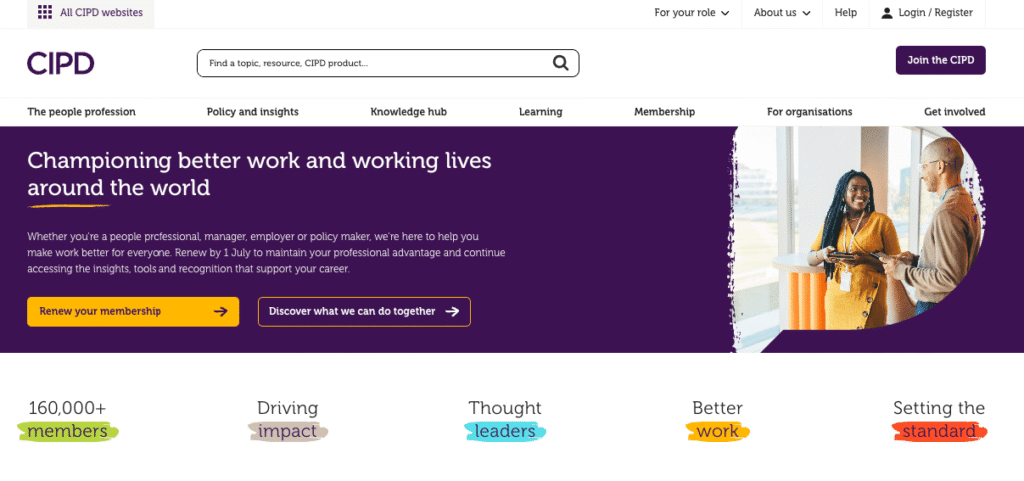
Passing a qualification opens a route to CIPD membership, which lets you use designations such as Assoc CIPD or Chartered MCIPD and signals your credibility to employers, some of whom require it for HR roles. Membership also brings practical benefits, including digital badges, a global community of 160,000+ people professionals, and CIPD learning courses with discounts on more.
The CIPD qualification itself is a one-time credential. Once you pass, it does not expire, and you never retake or renew it. This sets CIPD apart from credentials like the PHR or SHRM-CP certifications popular in the U.S., which expire and need recertifying every few years.
However, CIPD membership is the recurring part: you pay an annual fee to keep it active, and you maintain it through ongoing continuing professional development (CPD). So the certificate is yours for good, while the professional status that sits on top of it is something you renew each year.
CPD is broader than formal study: it counts learning from courses, reading, podcasts, and events, alongside the development that happens in the flow of work. The CIPD frames it as a four-stage cycle: you identify what to learn, do the learning, reflect on and record it, then apply and share it at work.
The approach is outputs-based, so it weighs the impact of your learning over any fixed hour count, though the CIPD recommends around 30 hours of planned learning a year and audits a sample of members. To stay current, you need a reliable source of relevant learning.
The three CIPD qualification levels, and who each is for
The CIPD offers three qualification levels: Foundation Certificate, Associate Diploma, and Advanced Diploma. In England and Northern Ireland, they sit at Regulated Qualifications Framework (RQF) Levels 3, 5, and 7. Here is how they break down:
Foundation Certificate in People Practice (Level 3)
This is the entry point for people new to HR or L&D, or those in a support role who want to move up. It covers the operational basics across HR and L&D and leads to Foundation membership. Most learners complete the required coursework in around eight to 12 months. Think of it as the firmest starting block if you are early in your career or switching into the profession.
Associate Diploma (Level 5)
Level 5 is CIPD’s mid-level qualification, available in People Management (HR) or Organisational Learning and Development (L&D). It suits practitioners with some experience who want to deepen their knowledge and progress toward more senior roles. Completing it leads to Associate membership and the Assoc CIPD designation. This level explores areas such as recruitment, talent management, employment law, and the external factors that shape HR activity, and it typically takes around 12 to 18 months.
Advanced Diploma (Level 7)
The most advanced CIPD qualification is comparable to postgraduate study and is offered in Strategic People Management or Strategic Learning and Development. It targets senior professionals who set strategy and lead change. It is also the heaviest commitment, usually taking around 18 to 24 months. A Level 7 Diploma, combined with the right experience, opens the route to Chartered Member status (Chartered MCIPD), one of the highest forms of professional recognition in HR.
How to choose your starting level
You do not always have to begin at Level 3. Use your experience and goals to guide you:
- New to HR or in a junior support role: start at Level 3 to build a solid base.
- A few years of HR experience, aiming for a manager or business partner role: Level 5 usually fits best.
- Senior practitioner moving into strategy or consulting, or aiming for Chartered status: Level 7 is the target.
One common misconception trips people up. A higher level is not a longer version of a lower one. Each level assumes a different starting point and prepares you for a different stage of work, so picking the right entry point counts for more than rushing to the top.
CIPD qualification cost
CIPD qualification cost varies because the study centers that deliver the HR courses set their own fees. The CIPD awards the qualification, while each center decides what to charge. Price depends on the level, the provider, the delivery format, and how much tutor support and resources you get. As a general rule, the higher the level, the more you invest.
Based on figures the CIPD shares, U.K. fees fall roughly into these bands:
- Level 3 Foundation Certificate: about £1,300 to £2,300.
- Level 5 Associate Diploma: typically between the Level 3 and Level 7 ranges, often in the low thousands, around £1600 – £3600.
- Level 7 Advanced Diploma: about £3,000 to £7,000.
Delivery format affects price and flexibility. Many study centers now offer CIPD courses online, with some delivering 100% online and self-paced study, and others blending digital materials with live virtual workshops. CIPD courses online give you the most flexibility to fit study around a full-time job, which helps if you are self-funding or studying outside work hours. Always confirm exactly what a fee includes before you enroll, since tutor access, resits, and learning materials are not always bundled in.
On top of course fees, you pay to join and stay in the CIPD. A one-off joining fee of £40 applies when you first become a member, then you pay an annual membership fee based on your grade. The main annual rates are:
- Student membership: £118
- Foundation or Associate membership: £199
- Chartered Member: £231
- Chartered Fellow: £261
The CIPD membership year runs from July to June, and U.K. taxpayers can often claim tax relief on the fee. Budget for the one-off joining fee and the recurring annual cost alongside your course fees.
Is a CIPD qualification worth it?
The honest answer depends on where you work, what role you want, and how you learn best. A CIPD qualification delivers clear value in several situations:
- You work in the U.K., Ireland, the Middle East, or other markets where CIPD is well known. Recognition is strongest where the brand is established, and some employers expect membership.
- You want a formal, portable credential. A regulated qualification plus a professional designation travels well between employers and signals a recognized standard.
- You are aiming for Chartered status or senior strategic roles. The Level 7 route plus Chartered membership commands real respect at that level.
- You value structured study and assessment. The qualification gives you a defined syllabus, deadlines, and external validation.
A CIPD certification may be less essential in other cases. If you work in a market where CIPD recognition is limited, if your immediate need is a specific applied skill rather than a credential, or if your budget and time are tight right now, the full diploma route may not be the fastest path to impact.
The qualification proves a standard of knowledge. On its own, it does not guarantee that you can apply that knowledge to a live problem at work. Keep that gap between credential and applied capability in mind as you decide.
Building the skills behind a CIPD qualification: AIHR certificate programs
A CIPD qualification proves you understand HR to a recognized standard, but the qualification is only the start. To keep your CIPD membership and professional standing active, you have to keep learning and developing your practice every year.
That ongoing development, your CPD, only counts for as much as you can apply at work, which makes a steady, relevant source of learning something you need year after year, not a one-off.
That is where AIHR comes in.
What is AIHR?
AIHR (Academy to Innovate HR) is an online HR education platform that helps HR professionals build practical, future-proof skills through self-paced certificate programs and courses. It is also an excellent way to maintain your continuing professional development (CPD) after you qualify, because the learning you complete keeps your CIPD membership and professional standing active. It suits HR professionals at any career stage who want to specialize in a particular area, close a skill gap, or stay current as HR evolves.
For CIPD members, there is a clear link between AIHR and your CPD. AIHR’s courses are CPD-accredited by The CPD Certification Service (CPD UK), an independent body that reviews a course against a recognized CPD standard. The CIPD takes an outputs-based approach to CPD, so you can record a wide range of learning, and accreditation is not a requirement. What it adds is assurance: a CPD-accredited AIHR course comes with verified quality and a defined number of CPD hours, which makes it straightforward to record and evidence as part of the development you are expected to maintain as a CIPD member.
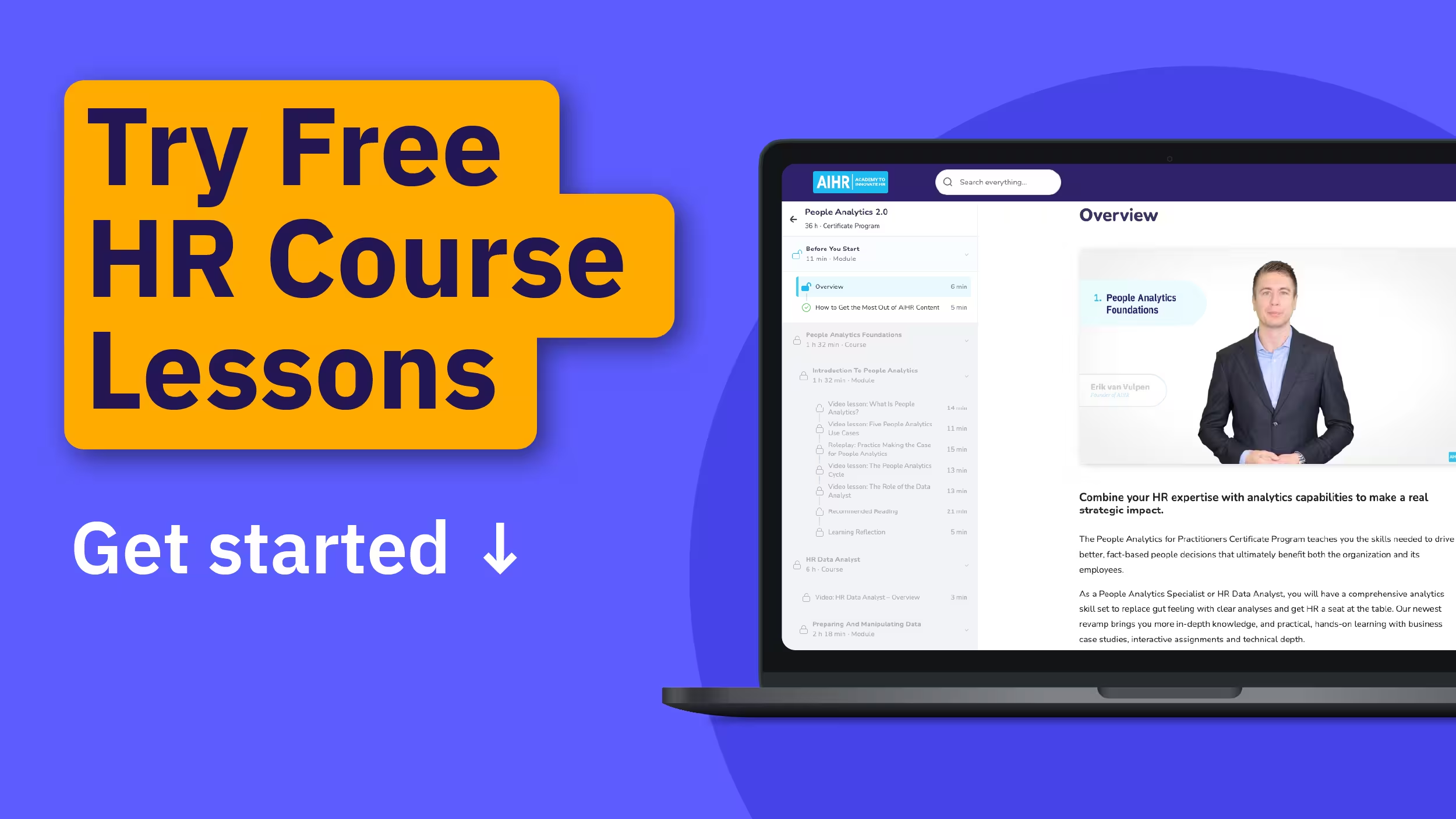
The AIHR Demo Portal gives you a free preview of practical lessons, templates, and resources, so you can see how the learning works before you commit.
What AIHR offers
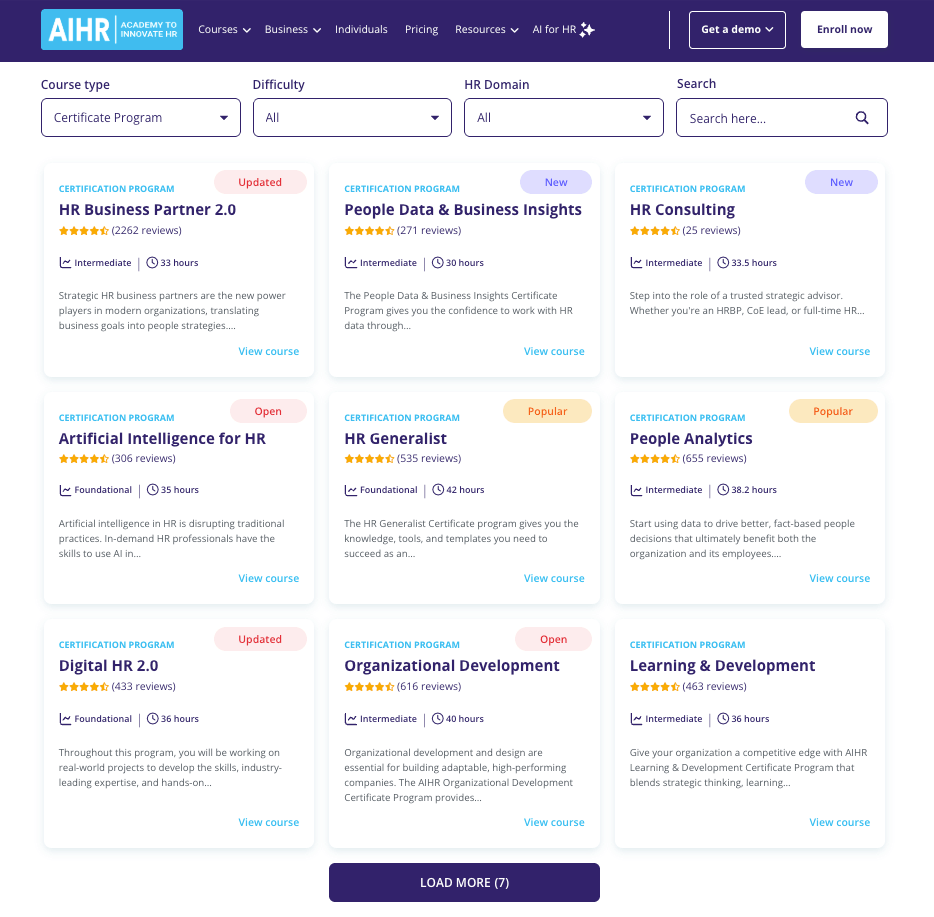
AIHR offers 16 certificate programs and 85+ courses across every major HR domain, including HR business partnering, AI in HR, people analytics, talent management, organizational development, learning and development, and compensation and benefits. The programs are online and self-paced, and most take around 30 to 40 hours, so you can work through them around your job.
Courses follow the T-Shaped HR Competency Model and a Tell-Show-Do-Apply method, so you work through real scenarios and complete tasks you can take straight into your role. Full Academy Access also includes:
- A resource library of templates, frameworks, and tools you can use at work
- AIHR Copilot, an AI assistant trained on HR content
- Personalized Learning Journeys that map a path based on your skill gaps and goals
- Weekly live events and a global community of 25,000+ HR professionals.
AIHR’s recognition extends beyond the CPD accreditation: its certificate programs are eligible for SHRM Professional Development Credits (PDCs) and HRCI recertification credits, with further recognition from bodies including HRPA, CPHR, and ATD.
AIHR pricing
Certificate Program | Full Academy Access | Team License | |
About the membership | Focused access to one AIHR certificate program so you can build expertise in a specific HR domain. | Full access to AIHR’s learning library for ongoing development across multiple HR domains. | Full AIHR Academy access for teams, with added support for team-wide development and visibility. |
Pricing | $1,125 / year | $1,850 / year | From $2,990 / year |
Core features | • Fully online, self-paced learning • Recertification credits • Expert community and support • Digital certificate | Everything in Certificate Program Membership plus: • 85+ courses and mini-courses • Resource Library with 300+ downloadable templates and resources • AIHR Copilot • Weekly webinars with HR experts • Soft Skills Hub • Personal coaching | Everything in Full Academy Access plus: • Team reporting and analytics • Dedicated Learning Consultant (from 15 users) |
Access period | 12 months | 12 months | 12 months |
Money-back guarantee | 30 days | 60 days | 60 days |
Best for | HR professionals who want to go deep in a particular specialization or close a clear skill gap. | HR professionals who want continuous learning, broader career development, and more flexibility. | HR teams that want to build skills together in a structured way. |
Your next step
A CIPD qualification remains a strong, well-recognized way to formalize your HR expertise, especially in markets where employers value the credential and for professionals aiming at strategic or Chartered roles. Weigh the cost, the time, and the recognition value in your specific market before you commit, and pick the level that matches where you are now.
Whichever route you choose, keep building applied skills alongside the credential. If you are deciding your next step, look at the CIPD level that fits your career stage, and explore CPD-accredited online certificate programs you can use to grow your capability and keep your membership current.
FAQ
U.K. fees depend on the level and the study center. Expect roughly £1,300 to £2,300 for the Level 3 Foundation Certificate and £3,000 to £7,000 for the Level 7 Advanced Diploma, plus separate CIPD membership fees.
Yes. Many study centers deliver CIPD courses online, some fully online and self-paced, others blending digital materials with live virtual workshops. Online study suits professionals who want to fit a qualification around full-time work. Once you qualify, CPD-accredited online courses such as AIHR’s let you keep your CPD and CIPD membership current at your own pace.
Most learners finish the Level 3 Foundation Certificate in eight to 12 months, the Level 5 Associate Diploma in 12 to 18 months, and the Level 7 Advanced Diploma in 18 to 24 months, depending on study pace and format.
CIPD qualifications are recognized worldwide and respected by many multinational employers. Recognition is strongest in the U.K., where the CIPD has the most presence, and also in Ireland, the Middle East, and parts of Asia.
AIHR’s courses are CPD-accredited by The CPD Certification Service (CPD UK), so CIPD members can submit them as CPD activity toward their continuous development. AIHR does not award CIPD qualifications itself; it provides CPD-accredited learning that the CIPD recognizes for CPD purposes.