

The People and Culture function in HR is becoming increasingly prominent as employee expectations continue to shift. The boundaries between the professional and personal are often blurred, and companies are investing in environments that prioritize employee wellbeing, stimulate creativity, and encourage innovation.
A strong company culture is crucial for anchoring people to business success. Gallup believes organizational culture is “a force multiplier” for the most important outcomes and can be a powerful differentiator for a company. Yet only 21% of U.S. employees strongly agree they feel connected to their organization’s culture.
The rise of the People and Culture department gives HR an opportunity to connect people practices more closely with how employees work, grow, and contribute. In this article, we’ll explain what People and Culture means, how it differs from traditional HR, and how organizations can build a function that supports employees and the business.
Contents
What is People and Culture?
People and Culture vs. HR: What are the differences?
What does the People and Culture department do?
The role of the People and Culture team
How to build a People and Culture department
People and Culture strategies for HR professionals
3 company examples of successful People and Culture teams and practices
FAQ
What is People and Culture?
People and Culture is a new name for HR that represents a major paradigm shift. The traditional HR department primarily handles administrative tasks, while People and Culture takes a holistic approach to managing an organization’s workforce.
This approach emphasizes the link between fostering a positive work environment and employee wellbeing for high-performance outcomes. As such, more organizations are prioritizing People and Culture to create a workplace where employees feel valued, engaged, and empowered to contribute their best.
The shift goes beyond rebranding and optics. It signifies a deeper commitment to human-centric business operations, where people come first. Kimberly Samon, who works with companies as a Chief People Officer and Senior People Strategist through her consultancy KSL Advisors, describes the difference this way: the term “human resources” implies “it’s like a widget, that it’s a thing”.
By contrast, she says, using the word “people” is more intimate and signals a sense of relationship and community. It reflects how a company values its people within the overall context of organizational success.

People and Culture vs. HR: What are the differences?
While a People and Culture department includes traditional HR functions, it’s important to note that it goes beyond those responsibilities by creating positive employee experiences and a strong company culture.
It also places far greater emphasis on achieving organizational goals and improving performance through a happier, more engaged workforce.
Focus
Mostly transactional and administrative tasks include payroll, ensuring labor law compliance, and employee record maintenance
Creating a positive employee experience, fostering a strong company culture, and aligning people strategies with business objectives
Primary functions
- Recruitment and onboarding
- Compensation and benefits
- Performance management
- Employee relations
- Labor law compliance and record-keeping
All core HR functions, plus:
- Employee development and learning
- Organizational culture and engagement
- DEIB
- Employee wellbeing
- People analytics
- Employer branding
Approach
Typically reactive, often responding to issues as they arise.
More proactive and strategic, anticipating future needs and trends
Leadership role
Often seen as operational and administrative
Serves as a strategic advisor, influencing business decisions and driving organizational change
Business objectives
Supporting core HR functions and ensuring compliance
Contributing to overall business success by aligning people strategies with organizational goals
Culture
Often siloed within the organization, with a focus on internal operations
Collaborative and integrated with other departments, acting as a strategic business partner
Employee engagement
Traditionally viewed as a secondary concern
Central to the function, with a focus on building a high-performance culture
Metrics
Typically focused on efficiency metrics such as time to fill roles, turnover rate, and cost per hire
Emphasizes people-centric metrics such as employee satisfaction, engagement, retention, and performance outcomes
What does the People and Culture department do?
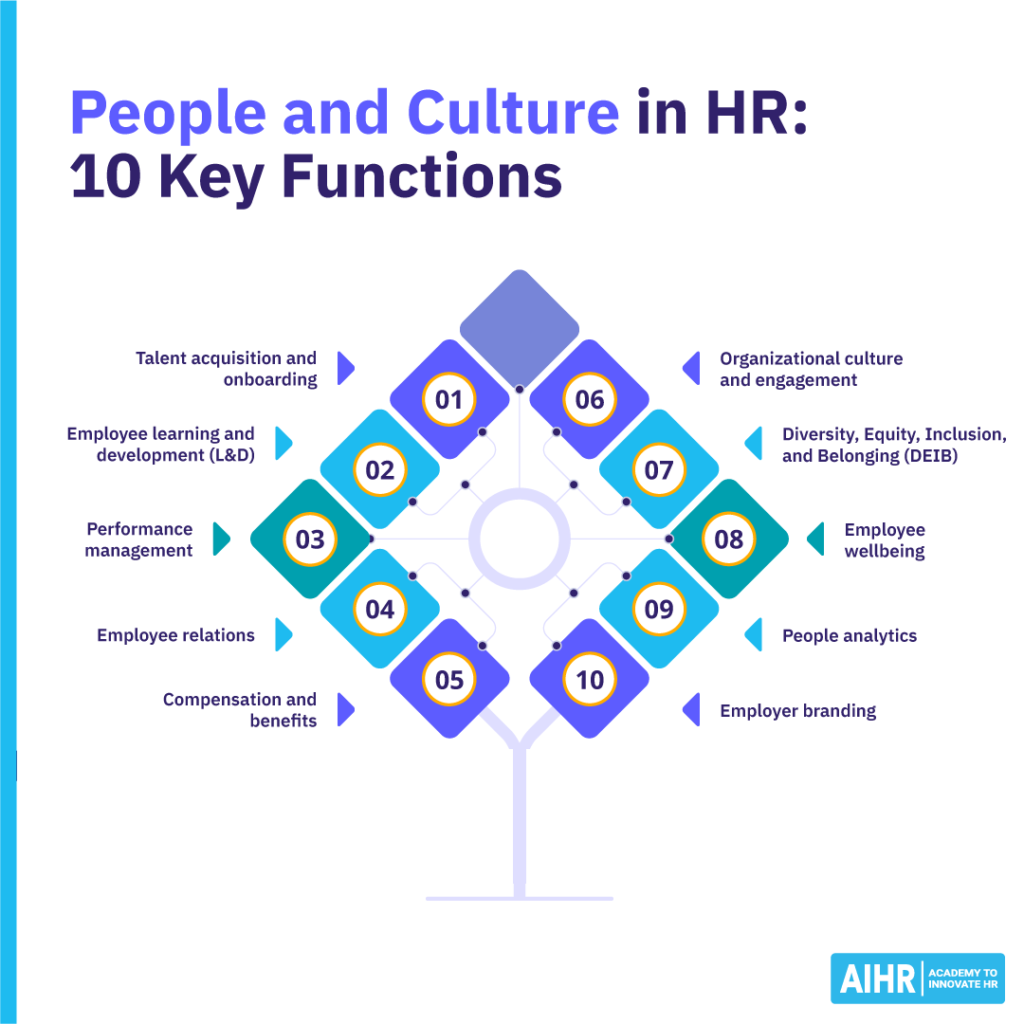
The People and Culture department owns every stage of the employee journey, from attracting talent to building the culture people stay for. It also aligns those people strategies with the wider business, which is where traditional HR often falls short.
According to Orion Talent CEO Sarah Peiker, “The primary reason many businesses are converting their HR practices into People and Culture is a wide disconnect between business strategy, long-term goals, and how HR works.”
“HR is a necessary part of any business but has not traditionally been viewed as a deeply integrated, strategic function of business operations—an interesting truth considering its influence.”
To close that gap, People and Culture departments take on the following functions:
- Talent acquisition and onboarding: Attracting, hiring, and integrating A-grade employees into the organization.
- Employee development and learning: Empowering employees at all levels to grow, develop new skills, and take their careers to the next level.
- Performance management: Setting goals with various business units, providing feedback to managers and employees, and evaluating employee performance on an ongoing basis.
- Employee relations: Managing employee concerns, conflicts, and grievances to maintain a positive work environment.
- Compensation and benefits: Developing and managing attractive compensation and benefits packages (including financial and non-financial incentives) to reward your employees competitively.
- Organizational culture and engagement: Establishing a vibrant and collaborative organizational culture that boosts employee satisfaction and engagement.
- DEIB: Creating a workplace where every team member feels valued and respected and where different perspectives are not only welcomed but celebrated.
- Employee wellbeing: Showing your dedication to the physical, mental, and emotional health of your employees by providing support through various programs and initiatives.
- People analytics: Using data to drive strategic decision-making and measuring the impact of People and Culture initiatives.
- Employer branding: Building a strong employer reputation by encouraging employee advocacy to attract top talent.
The role of the People and Culture team
The People and Culture team turns the department’s priorities into practical programs, habits, and support for employees and managers. Its work touches how people join the organization, communicate, receive feedback, develop their skills, and stay connected to the company’s purpose.
Lynda Gratton, Professor of Management Practice at London Business School, says, “Putting your people at the heart of your firm’s business and people strategy will help your organization thrive. This means defining and implementing a culture and processes that promote energy and human potential.”
Your People and Culture team shapes company culture and influences how employees feel and perform. They do this by boosting morale through recognition programs, wellness initiatives, and social events, and by driving engagement through transparent communication and effective feedback mechanisms.
A strong team also helps employees stay resilient through change by promoting adaptability, experimentation, and learning from setbacks. And it strengthens employer branding through storytelling that helps the organization stand out as an employer of choice in a competitive hiring market.
Common roles in a People and Culture team
People and Culture roles sit on a ladder that runs from strategic leadership to hands-on execution. Job titles vary a lot by company size, so the same work can carry different names from one organization to the next. Most teams build around four levels.
People and Culture leadership
At the top sits the senior leader who owns the function. The title shifts with company size. Large enterprises tend to use Chief People and Culture Officer or VP of People and Culture. Mid-sized companies more often use Director of People and Culture or Head of People and Culture.
The scope stays the same across all four titles. This leader sets the people strategy, aligns it with business goals, and holds accountability for culture, engagement, and talent outcomes at the highest level. Because the role anchors the whole department, we cover its responsibilities in detail in the next section.
People and Culture Manager
A People and Culture Manager runs the day-to-day work of the function and turns strategy into action. In many small and mid-sized companies, this is the most senior people role.
The manager owns programs across engagement, wellbeing, performance, and development, and supports line managers as they lead their teams. On any given week, that can mean running an engagement survey, improving the onboarding experience, coaching a manager through a difficult conversation, updating a policy, or reviewing people metrics to catch a retention risk early.
Put simply, leadership sets the direction, and the manager makes it happen on the ground.
People and Culture Generalist
A People and Culture Generalist handles a broad range of people tasks instead of specializing in one area. The role typically spans recruitment support, onboarding, employee relations, basic people data, and culture initiatives.
Generalists are common on smaller teams, where one person covers many responsibilities at once. The role works much like an HR Generalist, with a sharper focus on employee experience and culture. It’s also a strong foundation for moving into either a manager or a specialist track later on.
People and Culture Specialist and Coordinator
A People and Culture Specialist focuses on one area of the function in depth. Common specialisms include talent acquisition, employee engagement, learning and development, DEIB, employee wellbeing, and people analytics. These roles tend to appear on larger teams that can divide the work.
A People and Culture Coordinator sits a step below, supporting one of those specialisms with the scheduling, administration, and follow-through that keep programs running. For many HR professionals, it’s the entry point into a People and Culture career.
A strong People and Culture function helps shape employees’ experiences of work, leadership, values, and belonging. To do this well, HR needs to understand how culture works and how to guide it intentionally.
Preview selected lessons from Organizational Culture course to see how to:
✅ Understand what organizational culture is and why it matters
✅ Shape a culture that reflects your organization’s values and goals
✅ Align leadership behaviors with the culture you want to build
✅ Support culture change with practical tools and frameworks
💡 Check out the lessons in AIHR’s Demo Portal for a clear idea of what you’ll get.
How to build a People and Culture department
Rebecca Christianson, CEO of Thriving People Consulting, says, “Employee experience is treating your employees like important customers by ensuring their experiences at work are human-centered, use the latest digital technologies, and are personalized, compelling, and memorable.”
To achieve this, companies need dedicated People and Culture roles. Assigning these responsibilities to general HR staff often results in diluted focus, neglecting critical areas like employee engagement. For example, an HR Generalist juggling payroll and engagement initiatives will likely prioritize urgent payroll matters. This leaves less time and attention for cultivating a positive workplace culture.
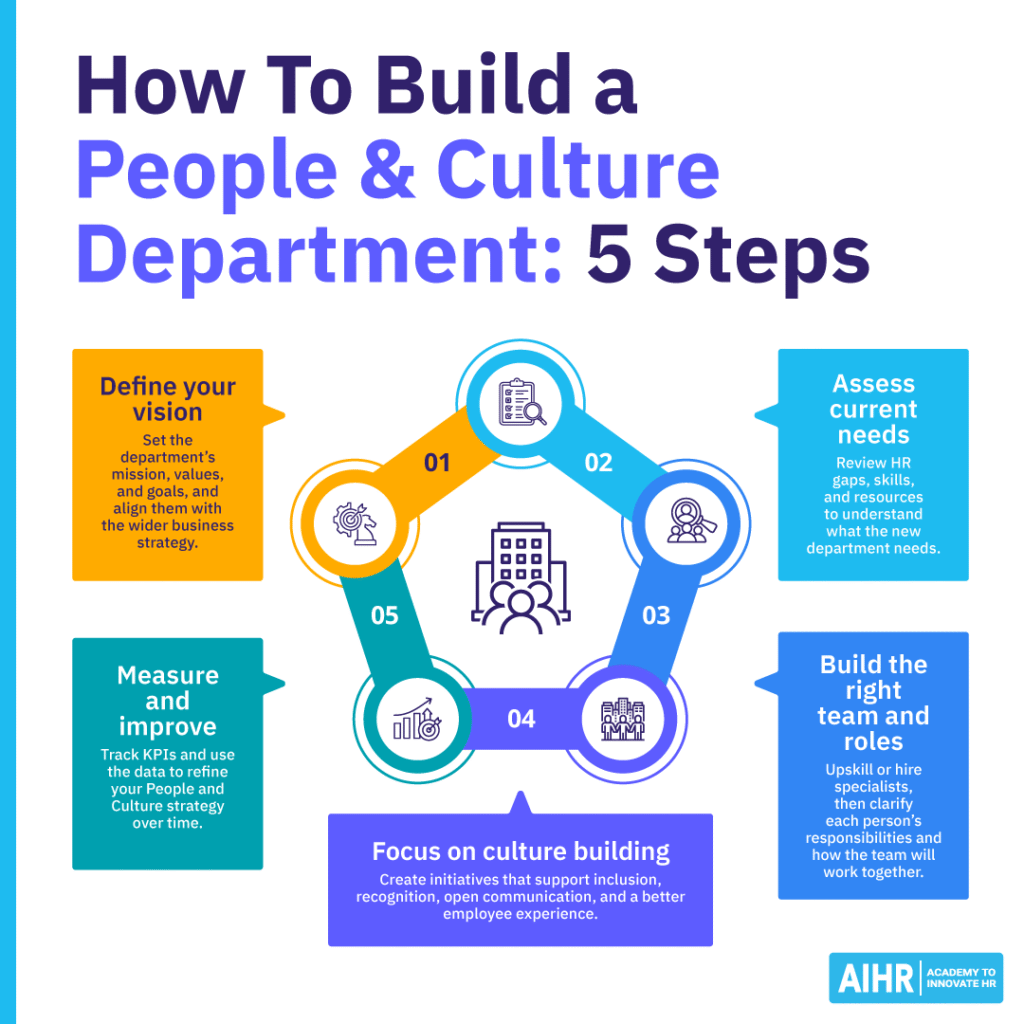
When you create specialized roles, every aspect of People and Culture gets the focus, expertise, and time it deserves. Here are five steps to build your new department:
- Define your vision: Clearly articulate your new department’s mission, values, and goals. Make sure your blueprint is aligned with the overall business strategy.
- Conduct a needs assessment: Evaluate your organization’s current HR functions, identify gaps, and determine the resources and skills you’ll need to plug them and build your new department.
- Build a high-performance team: Upskill existing HR staff and/or recruit new candidates to create a team with a diverse skill set. Consider roles such as:
- Talent Acquisition Specialist/Onboarding Specialist: Experts at attracting, hiring, and onboarding top-class talent.
- Employee Engagement Manager: Responsible for driving initiatives that fuel employee satisfaction and retention.
- Learning and Development (L&D) Coordinator: Tasked with implementing ongoing employee growth and improvement at all levels through training programs, mentorship, and coaching.
- Diversity and Inclusion Officer: Responsible for promoting an inclusive workplace culture.
- Wellbeing Coordinator: The organization’s champions of employee physical, mental, and emotional health and wellbeing.
- People Analytics Specialist: Responsible for monitoring and leveraging data to assess employee engagement, performance, and other key metrics for informed and strategic decision-making.
- Redefine roles and responsibilities: Clearly outline the new team’s roles and responsibilities to ensure clear collaboration and maximum efficiency.
- Focus on culture building: Implement initiatives to create a supportive, inclusive work environment, such as employee recognition programs and open communication channels. Determine how to support and sustain these initiatives long-term.
- Measure and evaluate: Establish key performance indicators (KPIs) to track the department’s success and make informed, data-driven adjustments.
People and Culture strategies for HR professionals
A strong People and Culture strategy turns your cultural priorities into concrete action. Here are five strategies you can use to develop yours:
1. Cultivate a diverse and inclusive workforce
DEIB forms the foundation of an organizational culture that includes and respects all employees. As an HR professional, you should focus on implementing policies and programs that promote DEIB at all organizational levels.
Steps to take:
- Develop DEIB policies: Create clear policies that outline your organization’s commitment to diversity and inclusion.
- Practice diverse hiring: Implement strategies to ensure diverse candidate pools and fair, inclusive hiring practices.
- Establish employee resource groups (ERGs): Support the formation of ERGs to foster a sense of community and belonging among employees from various backgrounds.
- Implement inclusive leadership training: Equip all your leaders with the necessary hard and soft skills to create inclusive environments.
- Adopt a data-driven approach: Track DEIB metrics to measure progress and identify areas for improvement.
2. Foster employee wellbeing and engagement
To foster a high-performance culture, you must prioritize employee wellbeing. Focus on initiatives that boost employee satisfaction, engagement, happiness, and overall wellbeing.
Steps to take:
- Distribute regular employee feedback surveys: Gather employee feedback regularly to pinpoint areas for improvement and measure the impact of your wellbeing initiatives.
- Implement flexible work arrangements: Investigate options like remote work, flexible hours, and compressed work weeks.
- Provide mental health support: Give employees access to mental health resources and promote open conversations about mental wellbeing.
- Introduce wellness programs: Launch wellness initiatives such as fitness challenges, nutrition workshops, and stress management programs.
- Regularly recognize and reward top performers: Celebrate employee achievements and contributions with a recognition and reward program.
3. Build a leading employer brand
The stronger your employer brand, the greater your ability to attract and retain top talent. That’s why, as an HR professional, you should develop strategies to position your organization as your industry’s employer of choice.
Steps to take:
- Define your employer value proposition (EVP): Clearly articulate the unique value your company offers its employees.
- Engage in employee advocacy: Encourage employees to share their positive experiences about the company, in writing or on video.
- Maintain an active social media presence: Use storytelling on social media platforms to showcase your company culture and values.
- Roll out employee referral programs: Incentivize employees to refer qualified candidates for vacancies, either with monetary or non-monetary rewards.
- Optimize candidate experience: Create a positive experience for job applicants and new hires, starting from their very first engagement with you.
4. Drive organizational agility and change
You must be responsive and agile to support organizational changes effectively. That’s why it’s crucial to prioritize strategies that build a resilient workforce in your HR department and across your organization.
Steps to take:
- Implement effective change management: Implement strategies to minimize resistance and maximize employee buy-in ahead of major organizational changes.
- Upskilling and reskilling: Invest in employee development to build future-ready skills and ensure your organization keeps pace with innovation.
- Create agile work environments: Foster a culture of courageous experimentation and innovation.
- Ensure effective communication: Maintain open and transparent communication throughout change initiatives.
- Incorporate employee feedback: Involve your employees in the change process and incorporate their input.
5. Hire for attitude, develop skills
Focus on finding candidates who align with your company’s culture and values instead of relying solely on technical skills and qualifications. Invest in training and development to equip employees with any skills they may lack.
Steps to take:
- Conduct behavioral-based interviews: Don’t focus solely on qualifications and expertise. Assess candidates’ attitudes, values, and work ethic.
- Assess cultural fit: Evaluate how well candidates align with the company culture.
- Analyze skills gaps: Identify skills deficiencies and develop your training programs accordingly.
- Ensure ongoing development: Provide opportunities for your employees to learn new skills and advance their careers.
3 company examples of successful People and Culture teams and practices
Example 1: Cisco Systems
Cisco has appeared on Fortune’s 100 Best Companies to Work For in the U.S. for more than 25 years running, and it ranked among the top three in 2025. The company credits much of this to what it calls its “conscious culture,” a people-first environment built on collaboration, wellbeing, and mutual support rather than internal competition.
Cisco keeps evolving that culture for the AI era. Its Teaming With AI program encourages employees across the business to experiment with generative AI tools in their daily work, backed by training that stresses ethical use and critical thinking. It’s a clear example of a People and Culture function helping employees adapt to change rather than leaving them to face it alone.
Example 2: HubSpot
HubSpot treats culture as a product it actively builds and improves, captured in its widely read Culture Code, a living document it has revised dozens of times since 2013. The document sets out the company’s HEART values: humble, empathetic, adaptable, remarkable, and transparent.
The company backs those values with heavy investment in learning and growth, including the Learn@HubSpot platform, tuition reimbursement, and an application-based mini-MBA program. That focus on development has earned HubSpot repeated recognition for its culture from Glassdoor, Great Place to Work, Comparably, and Fortune.
Example 3: Netflix
Netflix built its reputation on a culture of “freedom and responsibility,” which its updated culture memo now frames as “people over process.” Rather than detailed rules, the company trusts employees to use good judgment. Its vacation policy is essentially “take vacation,” and its expense policy is five words: “act in Netflix’s best interests.”
Netflix also runs no traditional annual performance reviews, relying instead on frequent, candid feedback and a “keeper test” that keeps talent density high. The approach is demanding and openly not for everyone, but it has become one of the most studied culture models in business, showing how clear values and high trust can replace heavy processes.
The bottom line
People and Culture is more than a new name for HR. It reflects a real shift in how the function creates value, moving from administration and compliance toward shaping the experiences, culture, and growth that keep people engaged and the business performing.
That shift is only going to accelerate. As employee expectations keep rising and AI reshapes how work gets done, the organizations that win will be the ones that treat culture and people strategy as a business priority, not an afterthought. Whether you’re renaming an existing team or building the function from the ground up, the steps in this article give you a practical starting point: define your vision, assess your needs, build the right team, invest in culture, and measure what matters.
If you want to explore how to build those skills in practice, you can visit the AIHR Demo Portal to preview lessons and resources from AIHR’s Certificate Programs.
FAQ
People and Culture is a modern approach to HR that focuses on shaping the employee experience, strengthening company culture, and aligning people practices with business goals. It still covers core HR work like hiring and compensation, but places far more emphasis on engagement, wellbeing, inclusion, and how it feels to work at the organization.
The name change reflects a shift away from treating employees as administrative resources and toward putting their experience and wellbeing at the center of business strategy. “People and Culture” signals a more human, relationship-focused approach, where culture and engagement actively drive performance rather than sitting on the sidelines of the business.
A People and Culture team turns the department’s priorities into practical programs for employees and managers. It shapes company culture, drives engagement through recognition and feedback, supports learning and development, helps people stay resilient through change, and strengthens employer branding to help the organization attract and retain talent.