

An HR SWOT analysis enables the HR team to gain a clear view of internal and external factors impacting your operations. A thorough analysis of strengths, weaknesses, opportunities, and threats will prepare you to create effective HR strategies.
Contents
What is a SWOT analysis?
Why should HR perform a SWOT analysis?
How HR can conduct a SWOT analysis
HR SWOT analysis examples
Tips for conducting a SWOT analysis
4 alternatives to SWOT analysis for HR
Free HR SWOT analysis presentation template
What is a SWOT analysis?
SWOT stands for:
- Strengths,
- Weaknesses,
- Opportunities, and;
- Threats.
Strengths and weaknesses are internal factors within the organization that can be controlled. Opportunities and threats are external factors outside the organization that are beyond the control of HR.

Why should HR perform a SWOT analysis?
HR is responsible for all workforce-related activities in the organization. Its role is to recruit, develop, and support employees who help the company reach its objectives.
To ensure the HR department aligns with the organization, HR leaders should participate in high-level discussions with the company’s top management. This will enable HR to understand the company’s strategic direction to better prepare and equip the workforce to meet its needs.
A SWOT analysis for the HR department allows for discovering internal and external factors affecting Human Resources at your organization, so the team can create long-term strategies focusing on workforce planning and development.
You can perform a SWOT analysis to measure your organization’s competencies on individual and department levels. Employees and teams can identify, for example, the skills they currently possess and those abilities that they lack. Once you have gathered all the information, you’ll know the existing strengths and weaknesses and formulate plans to acquire skills or employees that are unavailable but needed in the long term.

The benefits of a SWOT analysis for HR
A SWOT analysis empowers you to analyze internal and external factors that play a significant role in HR functions and goals.
Knowing your strengths will aid you in creating your long-term and short-term goals. Learning your weaknesses allows you to resolve shortcomings or improve certain areas. Opportunities provide a glimpse of your department’s next direction. Threats can warn you of potential problems and risks in the future.
A SWOT analysis can help the HR department decide what areas are strong and declining so resources can be allocated appropriately. It is recommended that HR leaders conduct a SWOT analysis twice a year to check how the workforce requirements have changed throughout a period and how to respond to these changes.
Creating value from an HR SWOT analysis requires strong strategic judgment and structured problem-solving. Develop your consulting skills to help you connect findings to priorities, recommendations, and measurable action.
AIHR’s HR Consulting Certificate Program has the strategic tools you need to:
✅ Apply SWOT analysis, scenario planning, and organizational diagnosis to HR challenges
✅ Connect people priorities with broader business strategy
✅ Assess and improve HR operating models and service delivery
✅ Use KPIs, OKRs, and scorecards to track strategic progress and demonstrate HR value
💡 Explore the AIHR Demo Portal for lesson previews and a first look at what learning with AIHR is like.
How HR can conduct a SWOT analysis

1. Identify your strengths
Strengths refer to assets that can support your HR strategy and function. They are the internal factors within the HR department that can help direct the organization to its goals.
Some questions to consider to identify your strengths:
- What achievements has HR made?
- What makes HR different from the HR departments of other organizations?
- What makes the HR department great? For example, having access to HR tools or niche/specialized skills.
2. Know your weaknesses
Weaknesses are internal factors that serve as a ‘liability’ that could negatively affect the organization.
Some questions to consider to know your weaknesses:
- What areas in HR are you currently underperforming?
- What internal factors make it difficult for HR to achieve its goals?
- What resources are you lacking within your HR department ( people, technology, resources)?
Strengthen your HR function from the inside out
An HR SWOT analysis is just the beginning. Your team needs the skills and support to act on what the analysis reveals – building on strengths, addressing weaknesses and threats, and seizing opportunities.
With AIHR for Business, you can enable your HR team to:
✅ Capitalize on opportunities with up-to-date capabilities in people analytics, strategy, and AI for HR
✅ Build a resilient, future-ready HR function aligned with business needs
✅ Support continuous development through expert-led, self-paced learning
🎯 Equip your HR team to move from insight to impact — every day!
3. Uncover your opportunities
Opportunities are external factors that could lead the HR department to grow. It could mean the company is aiming to expand lines of services or branch out to new locations, which means additional HR support. If the company desires to gain an advantage in a new market, it may require an additional workforce or training current employees to gain new skills to launch new services.
Some questions to keep in mind when uncovering your opportunities:
- What external resources can you use to achieve your HR goals?
- Which HR technology will be in demand in the future?
- What HR tools or technology that the company can procure or use so HR can do its job more efficiently?
- How do stakeholders view the HR department?
4. Identify your threats
Threats to an HR department are the external factors that affect an organization negatively.
Some questions to think about when identifying your threats:
- Will automation perform tasks that the HR team used to do?
- How do your target candidates or the HR industry view your organization?
- Do HR teams of other companies have a certain edge over yours?
HR SWOT analysis examples
1. Conducting a comprehensive HR SWOT analysis for the organization
Here are some examples of strengths, weaknesses, opportunities, and threats that often come up in an HR SWOT analysis:
1. Strengths
Strong employer branding
Strong employer branding is necessary if you want to stand out in the job market and attract top-notch candidates. Think of Google and Apple as the model type of organizations that receive thousands of applications every day.
Having a recognizable employer brand is not only good for your reputation but also helps in reducing your recruitment costs. You don’t have to spend too much money on job advertising or hiring a staffing agency because you naturally attract candidates.
Competitive compensation package
A report by Willis Tower Watson revealed that 73% of employers said the competitive job market is the top reason for increasing salaries. And 46% of these employers will increase their pay budget as a way of helping their staff cope with inflation.
A competitive pay package has a significant impact on employee satisfaction. Employees who feel well compensated for their work are more likely to stay motivated and even go the extra mile in performing their job to help achieve company goals. If HR can give generous remuneration to employees, it can also boost their morale and reduce turnover.
2. Weaknesses
Limited resources
HR’s primary function is to support the company’s workforce. From hiring and onboarding to exit interviews, their job is to ensure that the employees are well taken care of during their employment: good working conditions, fair pay, and opportunities to grow and develop professionally.
Inadequate resources will limit its operation. For example, a restricted recruitment budget could prolong the hiring process. Existing team members will feel tired and demotivated because of the additional workload. Or failure to hit productivity targets due to understaffing. Either way, it ultimately limits business performance.
High employee turnover
Employee turnover rate accounts for the number of people leaving the company for a certain period. A high turnover rate means the company fails to retain its staff for a long time. It takes work to satisfy and retain employees. There are plenty of factors why people resign: low pay, mismanagement, poor company culture, and lack of career growth.
When you have a high turnover rate, you lose high performers to your competitors, possibly risking your competitive advantage. Employee engagement declines. Business operations are halted. Important business decisions are postponed due to the need for more employees.
3. Opportunities
Investing in HR tech
Investing in HR technology can accelerate HR operations by automating and streamlining repetitive tasks like candidate screening, onboarding, payroll, timekeeping, and creating and maintaining employee records. HR automation can save time by freeing your personnel to focus on more critical or complex HR functions. It can also make HR processes more transparent, efficient, and consistent.
HR tech also uses AI, so you can also use it for more complex functions like VR/AR. For example, you can use VR to train employees on using new equipment. Or, during recruitment, you can use VR to walk people through your office and give them a glimpse of your workspace or company culture.
Changing HR policies
Changing work practices have resulted in new HR policies that allow employees to do their jobs well. The ever-evolving technology and ‘new normal’ brought new ways to maximize workers’ productivity while increasing satisfaction.
For example, many tech companies offer remote/hybrid work arrangements. Prodoscore, a leader in employee visibility software, reported a 47% increase in work productivity from their remote employees. For many individuals, remote work is attractive because it affords them a work-life balance. They have more time to spend with their families, self-care, or pursue hobbies. Moreover, work-from-home employees save an average of 40 minutes daily from commuting and money spent buying lunch out during office breaks.
4. Threats
Tight labor market
If competitors hire employees for specific roles, a war for talent rages. Especially in a labor market where job vacancies are plentiful and available talent is scarce. A Korn Ferry report found that by 2030, more than 85 million jobs could go unfilled because there may not be sufficient skilled people to fill them. If left unchecked, talent shortage could result in about $8.5 trillion in unrealized annual revenues by 2030.
HR should develop strategies to lure and retain top talent. Offering attractive compensation packages or flexible work is popular among IT professionals in an industry constantly experiencing tight competition. Otherwise, you risk losing your staff to other organizations that offer better pay or work conditions.
Data privacy
With the growing number of companies using cloud computing to store business data, HR data security is more crucial now than ever.
The HR team must be able to reassure their staff that their personal data – social security numbers, bank information – is secure. Otherwise, the employer will face the consequences of failing to protect employee details with penalties, lawsuits, and a tarnished reputation.

2. Conducting a SWOT analysis for HR projects
As mentioned, SWOT analysis is also applicable to HR projects. It is also designed to evaluate almost anything, whether long-term or short-term initiatives.
HR projects could range from designing recruitment processes for interns and apprentices, implementing team-bonding activities to executing an employee referral program.
Here’s how to conduct a SWOT analysis for HR projects:
| Strengths | Weaknesses |
| – What are the benefits of putting up this HR project? – What advantages do we have in the department/organization to make this project successful? – What makes this project unique compared to other existing projects within the company or HR projects of other organizations? | – What are the perceived weaknesses when planning and implementing this project? – What resources are essential to actualizing this project that the HR department doesn’t have? – What are potential internal obstacles (from other departments) when implementing this project? |
| Opportunities | Threats |
| – Does this project have the opportunity to help other HR processes? – Can this particular project be replicated in another HR project? – Can this project be replicated in other departments? | – What external factors can hinder this HR project? – What are your competitors doing that can hinder your HR project? – Is there legislation or regulation that could affect your HR project? |
It’s important to note that SWOT analysis for HR projects should also involve other stakeholders so the HR team can get an honest view of its performance and the perception it creates within the company versus what they see from the outside.
3. Skills gap SWOT analysis
Here’s an example of questions to consider when conducting an employee skills gap SWOT analysis:
| Strengths | Weaknesses |
| – What current skills does the company possess that helps in achieving business objectives? – What are the benefits of acquiring these skills? | – What skills are lacking that can prevent the company from achieving its goals? – Which areas of the business are currently underperforming? |
| Opportunities | Threats |
| – What tools and technologies are available to advance the skill sets of employees? – Does the company have skilled individuals to mentor less-skilled employees? – Will other training methods work to upskill employees, like shadowing or on-the-job training? | – Does the lack of skills cause the company to lose market share or customers? – Will automation replace the existing skills of employees? |
Tips for conducting a SWOT analysis
An effective SWOT analysis requires collecting the right data and using it to make the right HR decisions. Here are tips for conducting a SWOT analysis in HR:
- Identify the key stakeholders: The employees, management, the industry, and the community all contribute to pinpointing, and analyzing factors in each category (strengths, weaknesses, opportunities, and threats), so it’s important to get the input of each sector.
- Schedule a brainstorming session with each stakeholder to uncover strengths and weaknesses that affect other stakeholders and the organization as a whole. Brainstorming brings in new perspectives and insights that won’t possibly happen when the meeting is only within the HR team. Perform research to gather data about opportunities and threats. Avoid guesswork by backing up your research with figures, graphs, or pictures wherever possible
- Since SWOT analysis will become the basis for your HR strategies, important KPIs should be set and measured to back up your findings. Examples of KPIs are turnover rate, time to hire, etc.
- Create your SWOT analysis. List all the factors collected from stakeholders and arrange them in the order of importance: from the most important to the least important. Prioritized factors that will bring in the most profits for the business, which consequently allows you to support other factors.
- Create action plans to determine which and if:
- You can capitalize on your strengths to create opportunities in the market
- You can use your strengths and opportunities to remove weaknesses and threats
- You can reduce threats in relation to weaknesses
- Keep the list in a location where all stakeholders have access. Review it from time to time so that priorities are addressed first. Evaluate to check if things and situations surrounding the factor have changed, so the action plans are adjusted accordingly.
4 alternative analysis tools to SWOT for HR
While a SWOT analysis gives you a clear snapshot of where HR stands today, it won’t answer every strategic question. These four analysis tools can complement your SWOT or replace it when you need to turn findings into action, scan the wider business environment, or test whether your people practices give you a lasting edge,
1. TOWS Matrix
Management professor Heinz Weihrich introduced the TOWS Matrix in 1982 in the journal Long Range Planning as a way to match internal factors with external ones, so that a list of observations becomes a set of strategies.
Instead of leaving your SWOT as four separate lists, you pair each internal factor with an external one to create four types of strategies:
- SO (strengths-opportunities): Use your strengths to go after your best opportunities.
- WO (weaknesses-opportunities): Close internal gaps that stop you from acting on an opportunity.
- ST (strengths-threats): Use your strengths to reduce the impact of external threats.
- WT (weaknesses-threats): Limit your exposure where internal weaknesses meet external threats.
HR example: Your SWOT shows a strong internal learning program (strength) and growing demand for data skills in your industry (opportunity). An SO strategy would be an upskilling pathway that moves existing employees into data roles, so you don’t have to compete for scarce external hires. If the same SWOT also flags high frontline turnover (weakness) and a tight labor market (threat), a WT strategy could combine stay interviews with a pay review for those roles.
When to use it: After you finish a SWOT analysis and need to move from diagnosis to a prioritized action plan.
2. SOAR Framework
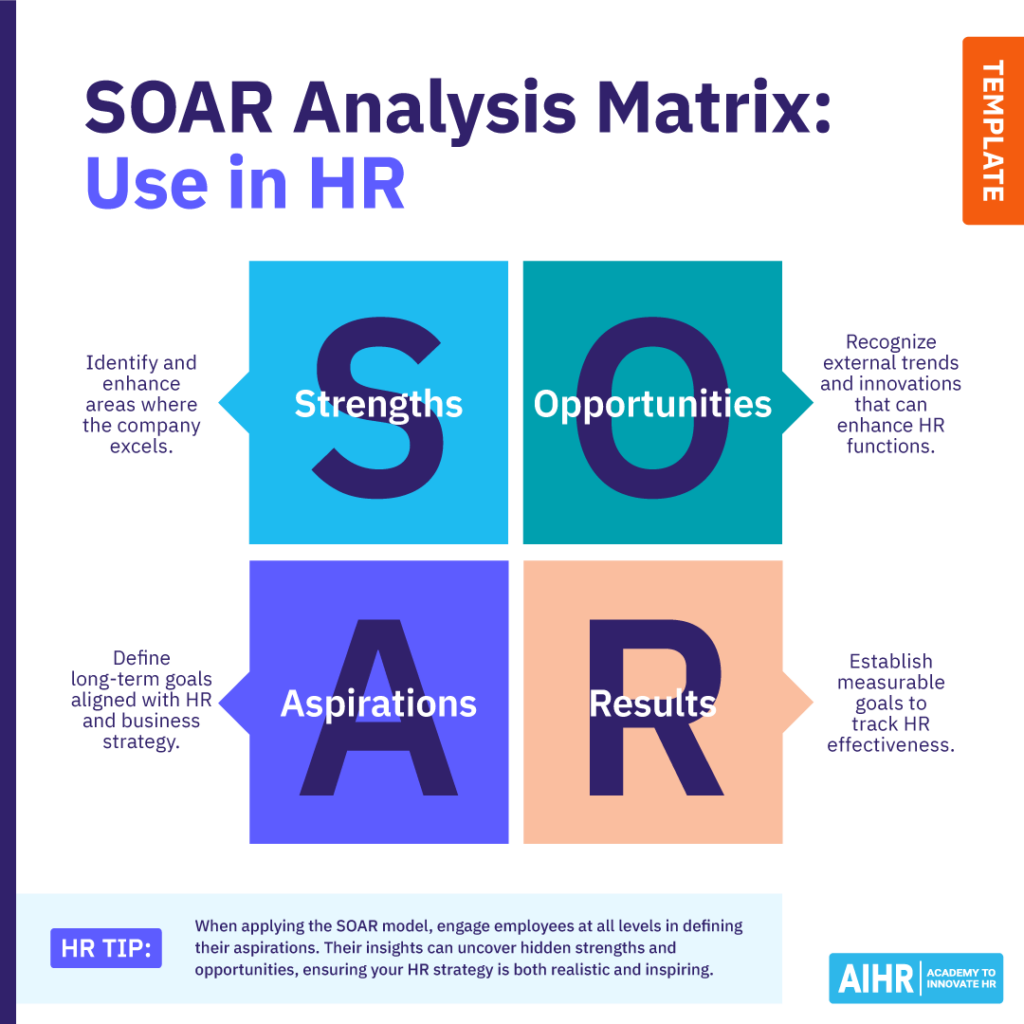
SOAR stands for Strengths, Opportunities, Aspirations and Results. Jacqueline Stavros, David Cooperrider and D. Lynn Kelley introduced it in 2003 as a strengths-based approach to strategic planning. It’s rooted in Appreciative Inquiry, a change method that starts from what already works in an organization rather than from what’s broken.
Where SWOT spends half its time on weaknesses and threats, SOAR keeps the focus on where you want to go:
- Strengths: Identify and build on the areas where your organization excels.
- Opportunities: Recognize external trends and innovations that could improve your HR functions.
- Aspirations: Define long-term goals that align with your HR and business strategy.
- Results: Set measurable goals so you can track HR’s effectiveness.
HR example: Your engagement survey shows that employees trust their managers (strength), and leadership wants to expand internal mobility (opportunity). Your aspiration might be to fill more open roles with internal candidates. The results you’d track could include the internal fill rate and time to fill for those roles.
When to use it: When you need buy-in for a new HR strategy or change initiative. Because SOAR asks employees at all levels to help define the aspirations, it often surfaces strengths and opportunities that leadership missed. SOAR doesn’t explicitly look at weaknesses or threats, though, so pair it with a risk review before you commit budget. For a step-by-step guide, use our free SOAR analysis template.
3. PESTEL Analysis
A PESTEL analysis looks at six external factors that affect your organization: Political, Economic, Social, Technological, Environmental and Legal. You’ll also see it called PESTLE, which covers the same six factors in a different order. It traces back to Francis Aguilar, who described an environmental scanning approach called ETPS in his 1967 book Scanning the Business Environment.
The opportunities and threats in a SWOT analysis can feel broad. PESTEL gives the external side of your analysis a structure, so you don’t miss a factor that could reshape your workforce:
- Political: Government policy changes, such as a minimum wage increase that means adjusting pay structures and staffing budgets.
- Economic: Economic growth or recession, which can drive anything from aggressive hiring to hiring freezes and layoffs.
- Social: Demographic shifts, such as an aging workforce that calls for succession planning and knowledge transfer.
- Technological: AI and automation, which change job roles and create reskilling needs.
- Environmental: Sustainability commitments, such as cutting the company’s carbon footprint through remote work options.
- Legal: Employment and data protection laws, such as the GDPR’s rules on how you store and process employee data.
When to use it: Before you start a SWOT, or as part of strategic workforce planning. Run a PESTEL first, and the results feed straight into the opportunities and threats in your SWOT. Because external conditions change quickly, repeat it regularly, and keep it focused on the factors that affect your people decisions, so the analysis doesn’t stall under too much data. Our PESTLE analysis templates and guide walk you through each step.
4. VRIO Framework
The VRIO framework helps you work out which of your internal resources give you a real competitive advantage. Management professor Jay Barney first proposed it in 1991 as VRIN (value, rarity, imitability and non-substitutability), and it became VRIO in 1995. It asks four questions about each resource:
- Valuable: Does the resource help you seize opportunities or counter threats?
- Rare: Do few competitors have it?
- Inimitable: Is it hard for competitors to acquire or substitute?
- Organization: Is your organization set up to make full use of it?
Each answer moves the resource up a ladder. A resource that isn’t valuable puts you at a competitive disadvantage. A valuable but common one gives you parity, and a valuable, rare one that’s easy to copy only gives you a temporary advantage. You get a sustained competitive advantage when a resource clears all four tests. When a resource is valuable, rare and hard to copy but your organization isn’t set up to use it, the advantage stays unexploited.
HR example: Leaders often name “our people” as their greatest strength, but VRIO pushes you to be more specific. Say you run an internal leadership program that fills most of your senior roles. Ask whether it reduces the cost and risk of external leadership hires (valuable), whether competitors have anything similar (rare), and whether it depends on a culture and coaching network that took years to build (inimitable). Then check whether your promotion and succession planning processes actually draw on it (organization).
When to use it: When you decide where to invest your HR budget, or when you need to show leadership which people practices set your organization apart. For a deeper walkthrough, see our guide to resource analysis using the VRIO framework.
Which analysis tool should you use?
| Tool / Framework | Focus | Key question | Best for |
|---|---|---|---|
| SWOT | Internal and external | Where do we stand today? | A balanced snapshot of HR’s current position |
| TOWS | Internal and external | What should we do about it? | Turning SWOT findings into strategies |
| SOAR | Internal and external, future-focused | Where do we want to go? | Engaging stakeholders and building buy-in for change |
| PESTEL | External | What’s changing around us? | Scanning the environment for workforce planning |
| VRIO | Internal | Which resources give us a lasting edge? | Testing whether your strengths are true differentiators |
You’ll often get the best results by combining them. A PESTEL analysis feeds the external side of your SWOT, VRIO tests whether your listed strengths hold up, and TOWS turns the finished SWOT into an action plan.
Free HR SWOT analysis presentation template
It’s important to present your HR SWOT analysis findings to organizational leadership in a straightforward and easy-to-digest format. A presentation template can help you organize key insights, highlight priority areas, and support strategic conversations with a clear overview that makes your message more impactful. This way, leadership can quickly grasp where HR stands and what actions might be needed.


Key takeaways
- An HR SWOT analysis enables the HR team to get a clear view of internal and external factors.
- Strengths and weaknesses are internal factors within the organization that can be controlled.
- Opportunities and threats are external factors outside the organization that are beyond the control of HR.
- A thorough analysis of strengths, weaknesses, opportunities, and threats will prepare the HR team to create effective strategies.