
When is the right time to switch to the HR operating model of the future? The answer will differ per organization, but the current standard, the HR Business Partner Model, already dates back to the 1990s. However, the arrival and quick evolution of AI and automation in HR and the broader business, and the expanding scope of HR call for an urgent reevaluation and overhaul of the existing system.
In this article, we discuss the future HR operating model, the different signs that may indicate it’s time for a new HR operating model design, and how to transition to a future-ready model.
Contents
What is the HR operating model of the future?
Does your HR operating model need to change?
How to transition to a future-ready HR operating model

What is the HR operating model of the future?
The HR operating model of the future is any HR operating model designed around what your organization will need from HR in the next three to five years. It aligns HR’s structure, services, technology, and skills with your business strategy, your workforce, and the role AI will play in your work.
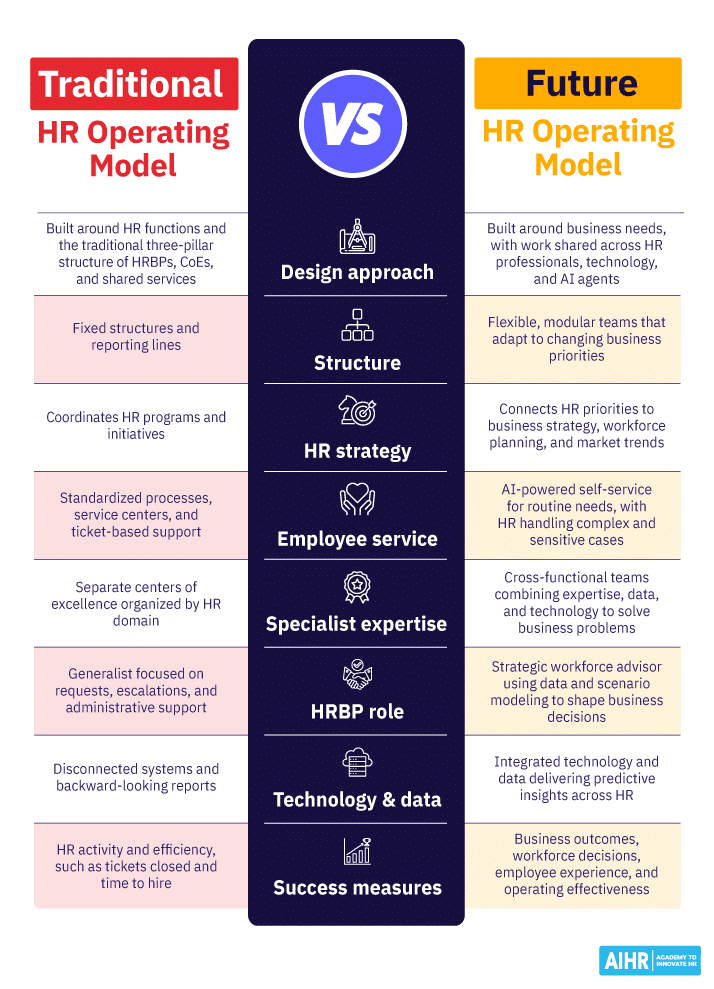
Today’s HR operating model is reaching its limits; AI is often hard to embed, and business needs keep changing. AIHR describes three challenges of how HR operates at the moment:
- Roles have evolved faster than responsibilities: While 64% of HR organizations have changed their operating model over the past two years, only 19% report a clear division of responsibilities between centers of expertise (CoEs), HRBPs, and shared services. As a result, strategic and operational work remain mixed across roles.
- Strategic roles absorb administrative overflow: As a consequence of the previous point, HRBPs often end up with administrative work and coordination that was never designed into their role to begin with.
- AI amplifies operating model problems: AI magnifies existing coordination and accountability gaps rather than resolving them.
In other words, most current HR operating models have reached the end of their life cycle, and it is time to move towards a different, future-ready model. Let’s look at an example of what such a future HR operating model could look like.
Example: AIHR’s AI-first HR operating model
AI impacts current operating models by changing, among other things, how HR handles administrative work, collaborates, and makes decisions.
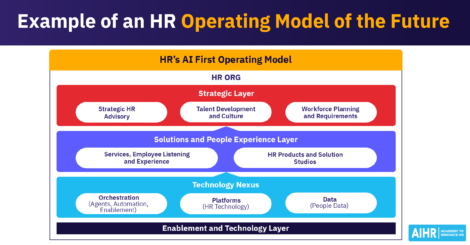
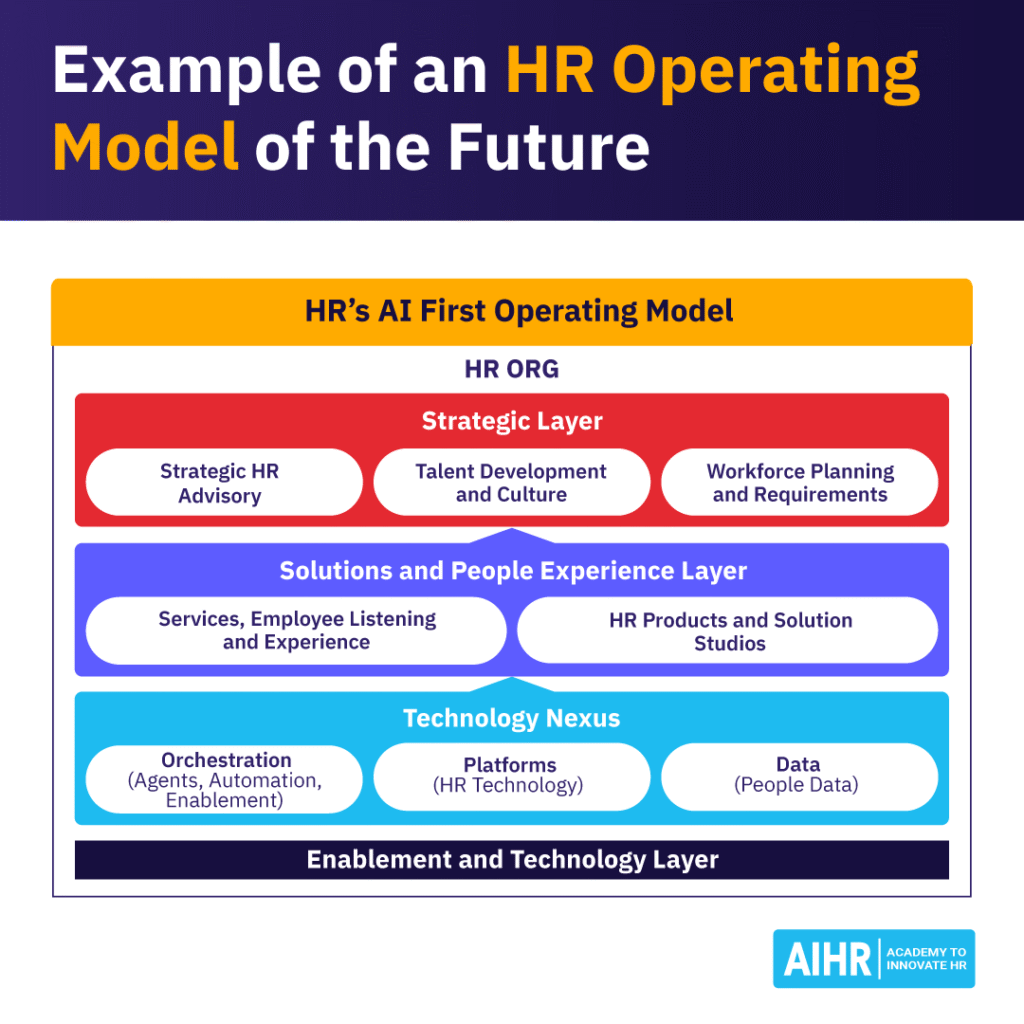
Through our advisory work at AIHR, we’re seeing that AI is most effective when it is an integral part of the operating model rather than an added layer on top of the existing model. That’s why many organizations are now redesigning their operating model around AI, and one option they can choose as a blueprint is AIHR’s AI-first operating model.
This high-impact HR operating model combines strategy, experience, and technology into one coherent system through three integrated layers:
- The strategic layer: This layer defines HR’s long-term direction and ensures that HR’s priorities and initiatives align with the organization’s goals.
- The solutions and people experience layer: The second layer of this HR operating model design turns strategy into actual services, experiences for employees, and HR solutions.
- The enablement and technology layers: This final layer forms the basis of the entire model. At its core sits the technology nexus, connecting HR systems, automation, and data into a single, seamless environment.
Together, these three layers create a future-ready HR operating model built for an AI-first world.
This model isn’t the only option organizations have; AIHR’s capability-driven HR operating model, for example, is another approach they can consider.
Does your HR operating model need to change?
When your HR function isn’t delivering the results the business expects, it’s easy to point to the usual suspects: skills gaps in the HR team, too little budget or headcount, or outdated HR technology. These issues are often symptoms of a deeper problem: an operating model that no longer fits what the business needs from HR.
The table below provides examples of signs that your operating model needs to evolve. Use it to quickly diagnose the situation in your own organization.
Business partners act as process coordinators
Most of their week goes to approvals, escalations, and admin follow-ups.
Ask three business partners what share of last month went to advisory and strategic work.
HR’s AI pilots stall
Usage of HR’s AI tools drops after launch, and HR staff and employees fall back on old workflows, emails, and tickets.
Track the tool’s monthly usage since launch and check whether emails and tickets to HR have climbed back up.
Silos exist within the HR function
Teams (e.g., CoEs, HRBPs) aren’t collaborating or sharing information, but operate in isolation. They may even focus on different outcomes.
Ask various departments how they feel the HR function operates. Also ask your CoEs and HRBPs what goals they are working towards.
A lack of ownership within the HR function
People don’t know who owns certain decisions (e.g., the CoE, HRBP, line manager, etc.), causing slow responses and work being done twice.
Organize a quick team meeting and ask people who they believe has ownership of various areas. Ask business leaders how satisfied they are with HR’s service.
The business strategy has shifted, but HR’s structure hasn’t
HR’s teams, roles, and budget still sit where they did before the shift, so new strategic priorities get little dedicated HR support.
List the business’s top three strategic priorities and check how much of HR’s headcount and budget supports each one.
How to transition to a future-ready HR operating model
Transition into the HR operating model of the future doesn’t happen from one day to the next. For most organizations, this changeover period means that they’ll run old and new structures side by side for a while – and that they should plan for that hybrid period from the start.
Here are some practical steps to consider:
1. Define what the business will need from HR
Review your organization’s business strategy for the next three to five years and identify where AI will change how work gets done. Answer these two questions:
- How diverse is our current workforce in terms of roles, locations, and ways of working?
- How broad does our HR offering need to be to meet the company’s future business needs?
Design this part solely around future needs.
The next step is to take stock of the current pain points and what the business needs from HR to ease those and answer the following questions:
- Which of these do we believe will remain an issue going forward (e.g., three to five years from now)?
- What does our HR offering need to include to address these ‘timeless’ issues?
Draw up a needs statement based on your inventory of both the organization’s future needs and persistent current needs.
2. Assess your current model against those needs
Compare your current services, channels, roles, data, and technology against the needs statement, using the signs in the table above as a starting point.
For example, if HR’s AI pilots stall, check whether the tools were added to existing workflows without changing who does what. Your future model then needs to define where AI handles the work and where HR professionals take over. Or, if the business strategy has shifted but HR’s structure hasn’t, compare where HR’s headcount and budget sit today with the priorities in your needs statement, and identify which roles, teams, or services need to move.
Gather input from business leaders and employees to get a more complete picture. Use these conversations to agree on what success will look like in business terms, such as critical roles filled faster, lower turnover in key teams, or strategic projects staffed with the right skills on time. Record where you stand today on each measure so you can track the impact of your new operating model.
3. Design your target model
Decide how the new model needs to be organized and the role of technology in it. For example, AIHR’s previously mentioned AI-first model could be the starting point for your own redesign. As pointed out earlier, this model connects strategy, experience, and technology through three integrated layers, with the enablement and technology layer forming the foundation of the entire operating model.
The briefly mentioned capability-driven model provides another option and configuration. This operating model revolves around four core capabilities:
- HR strategy: Aligning HR priorities with the business strategy and objectives.
- Channels: Methods HR employs to reach its target audience (i.e., advisory, face-to-face, service centers, or self-service).
- Products and Solutions: Designing and delivering the HR products and solutions that are implemented via the channels mentioned in the previous point.
- HR Technology and Data: The entire (HR) technology architecture and infrastructure, as well as the application, governance, structuring, and management of data.
The four key capabilities of this model can be organized in different ways so that they best meet the specific needs of your business. These variants determine how the capabilities interact, how the model delivers value, and how it is operationalized.
Once you’ve decided what your new HR operating model will look like, map out how the various roles within the existing HR function will change.
4. Assess your readiness for change
Conduct a change readiness assessment to see where your function stands before the transition. Look at areas such as leadership support, your HR team’s skills, culture, and the capacity to absorb change. The assessment will reveal things like resistance points, cultural hurdles, communication blind spots, and skills gaps. Then you can address the areas with the lowest readiness first.
5. Develop the transition plan
Treat the transition as a project and build an HR project plan for it. Break the transition into phases with clear milestones, such as new roles going live in the first business unit. Use a RACI chart to define who leads, decides, and supports each part of the transition, such as role changes, technology updates, and communication.
Continue by setting the budget and resources for each phase. Make sure you also reserve the budget and resources HR needs to keep meeting the business’s current needs, as defined in step 1, while the transition runs.
6. Build the technology and data foundation
Put in place the technology your target model depends on. In an AI-first model, this foundation sits at the core of the design and connects three elements: the platforms HR and employees use every day, the people data that feeds insights, and the AI agents and automated workflows that tie them together.
Start with the people data your AI agents and analytics will draw on, such as employee records, skills profiles, performance and pay data, and HR service requests. Agree on who owns each source, fix quality issues, and set rules for how AI may use employee data.
The next step would be to review your current tools and decide what to keep, integrate, or retire. Work with your IT team and an external expert, if needed, to merge them into one integrated HR tech stack. Define where AI agents can act on their own and where an HR professional reviews the outcome.
7. Lead the change
Use the readiness results from step 4 to decide where change support is needed most. Often, that’s the HR team itself: a new operating model changes HR roles more than any others, and HR has to adapt while it guides the rest of the organization through the transition. Strong HR change management helps you do both.
Explain what is changing and why, and what it means for business leaders, managers, employees, and the HR team. Address resistance early, and keep communication going and transparent throughout the entire process.
8. Build the competencies the new model requires
Map the skills each new role in your future operating model needs and compare them with your HR team’s current skills. Aim to build T-shaped profiles, where HR professionals combine deep expertise in one HR area with broad skills that apply across roles, such as business acumen, technology, and AI fluency.
You can also consider conducting an HR skills assessment to understand whether your team is equipped to meet the challenges that come with the transition to a future operating model. Take stock of the team’s change management skills as well, since HR will lead the transition for the rest of the organization.
To close the gaps, your team needs targeted training, and there are several ways to provide it. AIHR’s HR Boot Camps upskill a cohort of HR professionals in less than four months, so your team progresses at a similar pace and reaches learning milestones together. If team members need different skills for their new roles, an AIHR Team License lets you assign each person a development path with the specific training they should complete. Team members can also explore any other AIHR training to build skills on their own initiative.
Case study
When a global insurance organization with 4,500 employees set out to move to a more integrated HR operating model, its HR function was still fragmented across business units, with inconsistent capabilities and ways of working. AIHR helped the organization define the capabilities the new model required, build a shared capability framework, and create role-based learning journeys for four HR personas, refined through continuous reassessment and later expanded into AI fluency. The result was a connected HR function, a stronger strategic partnership with the business, and $1.6 million in efficiency gains.
9. Measure progress and adjust
Track progress against the success measures you agreed on in step 2, such as how quickly critical roles are filled or whether strategic projects get the right skills on time, and compare the results with your baseline.
Monitor how the model itself performs as well: the share of business partner time spent on advisory work, the share of routine requests resolved through self-service or AI agents, and HR technology adoption. Repeat the quick checks from the signs table to see whether the original problems have eased. Where results lag, find the cause and adjust the design, roles, or support before you scale the model further.
A final word
The right HR operating model aligns HR’s structure, services, technology, and skills with your organization’s business strategy, workforce, and the role AI plays in the ensemble. It can meet the business’s future needs and, if not, quickly adapt to provide the necessary support.
You don’t need to redesign everything at once. Start with the area where the gap between what the business needs and what HR delivers is widest, prove the new way of working there, and build from that. Each step makes HR better equipped to support the business as its needs change.