
Human Resources (HR) has evolved from a mainly administrative function into a strategic partner that helps organizations attract, develop, and retain talent. As the scope of HR work expands, so do the profession’s expectations.
That’s one reason many employers are struggling to hire for HR roles. In a recent Robert Half survey, 59% of HR leaders said it was harder to find skilled HR talent than it was a year ago.
So, what does HR do in practice, and what responsibilities matter most? This article breaks down 14 essential HR responsibilities, as well as the HR roles that typically own them.
Contents
The roles and responsibilities of an HR professional
HR responsibilities overview per role
Developing future-proof HR skills

The roles and responsibilities of an HR professional
HR professionals are responsible for managing an organization’s most valuable asset: its employees. The role has expanded beyond administration to include a broad set of responsibilities that support both business performance and employee success.
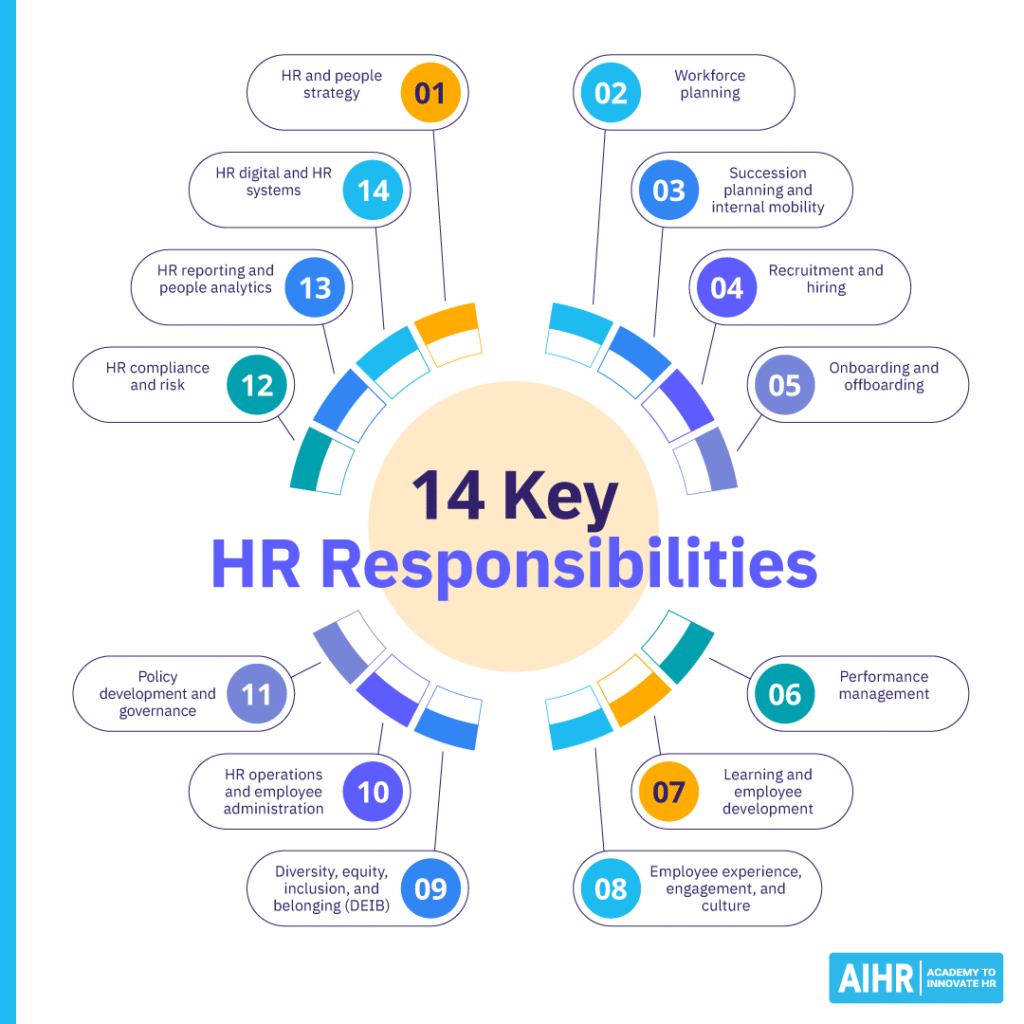
We have outlined 14 essential HR responsibilities, and shown what each one looks like in practice. For every responsibility, you will find a set of day-to-day tasks that HR professionals typically manage, from shaping people strategy and ensuring compliance to building strong processes across the employee life cycle.
1. HR and people strategy
HR develops and executes people strategies that support business goals. This includes tracking what’s working, what’s not, and what needs to change.
Day-to-day responsibilities
- Review current HR practices to identify gaps and improvement areas
- Build an implementation plan with milestones and timelines
- Assign ownership across the HR team and key stakeholders
- Partner with leaders to understand team priorities and workforce needs
- Align HR priorities with business goals and performance targets
- Use people data (retention, engagement, turnover) and stakeholder feedback to evaluate progress
- Update policies, programs, and processes to improve impact.
2. Workforce planning
HR works hand-in-hand with business leaders to assess current and future staffing needs and create plans that ensure the right people are in the right places to meet goals.
Day-to-day responsibilities
- Assess workforce skills and capacity by conducting a gap analysis
- Interface with leaders to forecast future needs based on business strategy
- Develop and monitor action plans for meeting needs, such as targeted recruitment, restructuring, or upskilling
- Monitor employee turnover, staff approaching retirement, and external economic trends that could impact the workforce.
3. Succession planning and internal mobility
HR helps organizations prepare for the future by identifying and developing a pipeline of capable leaders.
Day-to-day responsibilities
- Use structured criteria to identify critical roles based on business impact, urgency of potential vacancy, replacement difficulty, and talent availability
- Evaluate internal candidates’ skills, competencies, and potential to determine readiness for key positions using assessments and performance data
- Create tailored growth plans and timelines, including training, mentoring, and stretch assignments, to prepare successors
- Track candidate readiness through regular reviews and update growth plans as needed
- Stay in touch with leadership to report succession planning progress and urge internal mobility.
4. Recruitment and hiring
HR manages recruitment practices that attract a diverse, highly qualified candidate pool and help the organization hire a skilled workforce that supports its success.
Day-to-day responsibilities
- Write clear job descriptions and job postings
- Source candidates through outreach, referrals, and talent pipelines
- Define selection criteria and structured evaluation methods
- Manage applicant tracking systems and recruiting data
- Screen candidates and coordinate interviews
- Support offer decisions and negotiate employment terms
- Ensure the process is fair, transparent, and legally compliant.
Build confidence across core HR responsibilities
Develop the skills you need to confidently handle day-to-day HR responsibilities while building a more strategic, business-aligned HR function.
🎓 The HR Generalist Certificate Program helps you:
✅ Understand key HR processes, from recruitment to payroll, and from performance management to employee engagement
✅ Translate business needs into practical HR priorities, plans, and stakeholder-ready communication
✅ Navigate challenging conversations with more structure, confidence, and consistency
5. Onboarding and offboarding
HR makes sure new hires integrate well into the organization and supports a smooth transition when employees leave.
Day-to-day responsibilities
- Build onboarding programs that manage new employee paperwork, equipment setup, training, and cultural integration
- Run orientation sessions and explain key policies and expectations
- Set up buddies or mentors and schedule 30-, 60-, and 90-day check-ins
- Conduct exit interviews and cultivate positive alumni relationships
- Manage final pay and benefits changes, collect company property, and deactivate system access
- Support knowledge transfer and handovers to the remaining team.
6. Performance management
HR establishes effective processes for ongoing performance management that support employee growth and productivity, while helping the organization meet its goals.
Day-to-day responsibilities
- Design and roll out goal-setting frameworks based on criteria aligned with business objectives
- Execute appraisals and rating processes, including tracking progress through metrics
- Provide ongoing performance management coaching and constructive input
- Help managers and employees create individualized development plans for skill gaps
- Administer performance improvement plans for corrective action
- Identify high-performing employees for rewards and leadership potential.
7. Learning and employee development
HR builds L&D programs that improve skills, performance, and career growth. This supports business agility and employee engagement.
Day-to-day responsibilities
- Define the competencies needed for current roles and future priorities
- Identify skills gaps through assessments, surveys, and performance reviews
- Developing learning plans to address needs, including job-specific learning, soft-skills instruction, and professional development options
- Coordinate mentoring and coaching programs to support individual growth plans
- Track L&D participation and effectiveness via metrics (e.g., completion rates, post-training performance, and skill improvement scores)
- Interpret business needs, feedback, and employee career goals to make updates that keep learning programs relevant.
8. Employee experience, engagement, and culture
HR is central to shaping employee experience, engagement, and culture by designing supportive processes across the employee life cycle and partnering with leaders to embed practices that foster motivation, belonging, and retention.
Day-to-day responsibilities
- Administer feedback mechanisms (e.g., pulse surveys, stay interviews) to give employees a voice, measure sentiment, and address pain points
- Advocate for the employee perspective in leadership decisions
- Organize team-building activities and manage employee wellbeing and recognition programs
- Incorporate organizational culture and values into policy development, hiring, and recognition
- Analyze metrics that reflect employee sentiment (e.g., eNPS, EEI, turnover, and absenteeism rates) to uncover underlying issues
- Propose new work models, such as flexible work arrangements, to increase agility, resilience, and innovation.
9. Diversity, equity, inclusion, and belonging (DEIB)
HR champions diversity, equity, inclusion, and belonging (DEIB) through strategies that build a diverse workforce and create an environment where all employees can thrive.
Day-to-day responsibilities
- Implement and uphold anti-discrimination policies and practices
- Develop and maintain equitable compensation and promotion frameworks
- Attract underrepresented talent through diverse sourcing channels, blind resume screening, and structured interviews
- Partner with leaders to integrate DEIB into organizational strategy
- Establish employee resource groups
- Measure inclusion and belonging through employee surveys and act on the results.
10. HR operations and employee administration
HR keeps essential HR processes running smoothly across the employee life cycle, with a strong focus on accuracy, service, and compliance.
Day-to-day responsibilities
- Ensure accurate and timely benefit administration and payroll processing
- Maintain accurate employee records, protecting the confidentiality of sensitive information
- Manage employee relations issues, collaborating with managers to mediate disputes and propose conflict resolutions
- Support employee wellbeing by creating a safe and productive work environment and establishing policies and programs that foster physical and mental health.
11. Policy development and governance
HR oversees the development, implementation, enforcement, and updating of people-related policies to ensure they align with legal requirements and business needs.
Day-to-day responsibilities
- Gather input through legal review and stakeholder conversations
- Draft clear policies that define purpose, scope, responsibilities, steps, and consequences
- Roll out policies through manager enablement, training, and internal communications
- Apply policies consistently and monitor adherence
- Review policies regularly and update them based on legal changes, business shifts, and employee feedback.
12. HR compliance and risk
HR helps the organization follow employment laws and internal policies. It also reduces risk by identifying issues early and handling sensitive cases consistently.
Day-to-day responsibilities
- Keep HR policies and processes current with relevant laws and regulations, and communicate changes quickly
- Coach managers on compliant hiring, performance documentation, disciplinary action, and terminations
- Run routine checks on HR processes (payroll, contract templates, right-to-work checks, mandatory training, record-keeping)
- Manage employee relations issues with a risk mindset (grievances, investigations, sensitive complaints) and document thoroughly
- Monitor risk signals such as turnover hot spots, repeated manager concerns, and complaint patterns
- Maintain accurate records and decision trails to support audits and reporting.
13. HR reporting and people analytics
HR collects, analyzes, and interprets workforce data to produce reports and actionable insights that support strategic decision-making.
Day-to-day responsibilities
- Collect accurate employee data from HR systems, ensuring data integrity through audits and compliance with privacy rules
- Analyze data to identify correlations, trends, and actionable insights
- Develop forecasts and recommendations for talent strategies based on the data
- Create dashboards, recurring reports, and ad hoc analyses for stakeholders
- Collaborate with HR teams, IT, and leaders to align reports with business goals and present insights in a way that supports decision-making
- Design visual tools to communicate findings clearly.
14. Digital HR and HR systems
HR leads the selection, implementation, integration, and optimization of digital HR tools and systems, including the HRIS, to improve data management and analytics, increase efficiency, and strengthen the employee experience.
Day-to-day responsibilities
- Select and deploy HR technologies and integrate them with the existing IT infrastructure
- Develop training programs for digital rollouts and monitor adoption rates
- Communicate the benefits of new systems to reduce resistance
- Support upskilling for digital tool use and build a culture that adopts new technology
- Maintain data quality in systems and conduct audits for compliance.
HR responsibilities overview per role
Next, we’ll examine an HR responsibilities list within five key roles. As duties in these broad and adaptable positions vary by company size and industry, this is a generalized overview.
HR Manager responsibilities
An HR Manager is a mid- to senior-level role responsible for overseeing the organization’s HR department.
- Lead the HR team: Manage, coach, and develop HR staff while keeping daily HR operations running smoothly.
- Run performance management: Lead the full performance cycle, including reviews, goal setting, feedback, and performance improvement.
- Handle employee relations: Resolve conflicts, manage grievances, and apply fair, consistent disciplinary processes.
- Drive learning and development: Identify training needs and support employee growth through reskilling and upskilling.
- Oversee compensation and benefits: Administer pay and benefits programs and coordinate payroll and benefits processes.
- Support recruitment and workforce planning: Partner with managers on staffing plans and support hiring and onboarding.
- Own policies and compliance: Create and update HR policies and help the organization meet labor and regulatory requirements.
- Contribute to HR strategy: Align HR initiatives with business goals and help shape people-focused plans and programs.
- Build engagement and wellbeing: Support culture, engagement activities, and wellbeing and inclusion initiatives.
HR Business Partner responsibilities
An HR Business Partner is a mid-level strategic role that serves as a link between HR and leaders or senior managers within a department, business unit, or geographic location.
- Ensure the organization has the right roles and talent in place: Use structured strategic and succession planning to clarify business strategy and priorities, assess the current workforce, forecast talent needs and gaps, and design and prioritize talent strategies.
- Prepare the workforce for the future: Identify reskilling and upskilling needs and partner with L&D to align training programs accordingly.
- Consult with and advise leadership about HR matters: Hold recurring meetings with business leaders and guide people-related decisions and policies.
- Build a workforce that keeps the organization competitive: Support managers with performance management and collaborate across HR teams to deliver effective recruitment, compensation, and benefits, and reward and recognition strategies.
- Champion company culture and employee experience: Advise on culture-related initiatives, implement HRM interventions that support a healthy work environment, and support conflict resolution and positive employee relations.
HR Generalist responsibilities
An HR Generalist is a versatile, mid-level role that acts as the main HR contact and handles a wide range of responsibilities across the employee life cycle.
- Conduct recruiting and onboarding: Coordinate candidate outreach, screening, and interviewing, as well as new-hire paperwork and acclimatization.
- Handle administrative and support duties: Maintain employee records and digital HR systems, and respond to employee questions about HR functions.
- Oversee benefits administration: Manage administrative tasks and questions related to employee benefits, such as healthcare and wellbeing, paid time off, retirement plans, and other perks.
- Manage employee relations: Work with employees and managers to address performance issues, investigate wrongdoing or safety concerns, run exit interviews, and follow the correct processes for offboarding and terminations.
- Deliver internal communication: Ensure staff receive clear, timely updates on changes, announcements, and company news across relevant communication channels.
HR tip
Based on Robert Half research, the four HR roles companies are most likely to hire for this year are HR Coordinator, HR Generalist, HR Manager, and Recruiter.
HR Director responsibilities
An HR Director is a senior-level role responsible for overseeing all aspects of the HR function while balancing workforce and organizational needs.
- Lead the HR team and operations: Mentor and develop staff to meet departmental goals, and oversee daily HR operations to support clear ownership of duties and smooth execution across HR.
- Align HR initiatives with company strategy: Partner with senior leadership to understand organizational goals and identify how HR strategies, policies, and activities can support them.
- Manage the HR budget: Allocate funds efficiently, prioritizing initiatives that directly support organizational goals.
- Monitor HR metrics to evaluate and improve performance: Define a clear KPI framework, track results, and review trends with leaders to turn data into practical decisions and actions.
- Oversee HR compliance: Confirm that people-related policies and practices follow relevant employment laws and that internal guidelines are applied consistently.
- Maintain strong employee relations: Advise managers on employee relations and performance management, and provide channels for employees to share feedback and be heard.
HR Coordinator responsibilities
An HR Coordinator is an entry-level role that reports to the HR Director and supports day-to-day activities across HR functions.
- Support recruitment and onboarding: Help with sourcing and interviewing candidates, preparing offer letters and contracts, and supporting onboarding.
- Handle HR administrative tasks: Enter and update employee records in the HRIS, respond to internal and external questions, and help coordinate and prepare materials for other HR tasks.
- Coordinate reports and audits: Use digital HR systems to generate HR activity reports and support audit programs, then suggest improvements based on the data.
- Organize benefits administration details: Understand benefit plan offerings, answer employee questions, maintain relationships with external benefit providers, and communicate on behalf of the company and employees.
- Support HR leadership: Provide support to the HR Manager or Director across communications, policy, and initiative development, special projects, and related work.
If you’d like to learn more about HR job responsibilities, check out our HR Career Hub. You’ll find articles and hands-on resources to help map out an HR career path.
Developing future-proof HR skills
As organizations adapt to new technology and ways of working, HR professionals must stay up to date and build skills that can keep pace with emerging trends and technologies. It’s no longer just about recruitment and rewards; HR needs to understand analytics, data, and new technologies to help drive business success. A simple way to pinpoint where to focus is to look at how you score across core HR competencies and highlight areas to develop.
These future-proof HR skills include, among others, AI fluency, people analytics, digital literacy, and change management. Building capability in these areas helps HR professionals use technology to automate processes, spot trends and opportunities through data analysis, and align HR practices with the wider business strategy.
Developing future-proof HR skills won’t just benefit the organization, but also you, the HR professional. As you build these skills, you can open up more opportunities for career growth and advancement and become more valuable to the business. If you want a clear starting point, AIHR’s T-Shaped HR Assessment can help you identify your strengths and the skill areas to focus on next.
To sum up
The 14 essential responsibilities of HR lay the groundwork for a thriving organization. By prioritizing talent development and wellbeing while supporting business objectives, HR shows how investing in people helps power an organization.