
Knowing how to support mental health in the workplace is becoming increasingly important. The World Health Organization (WHO) estimates that 12 billion working days are lost each year to depression and anxiety, equalling roughly US$1 trillion in lost productivity.
Adding another wellbeing program won’t change these numbers. To tackle the underlying problems, HR must focus on how jobs are designed, how managers respond, and how long it takes team members in distress to reach proper care.
In this article, you’ll learn more about mental health support at work, how to implement and measure it, and use cases of companies leading the charge.
Contents
Why HR should support mental health in the workplace
What mental health support in the workplace actually involves
How to support mental health in the workplace: 7 steps
Real-world mental health initiatives in the workplace
How to measure your mental health support efforts
Why HR should support mental health in the workplace
The WHO estimated that 16% of working-age adults live with a mental disorder at any given time. On a team of 20, that could mean around three employees managing one right now. The same research identified workplace conditions that could increase mental health risks, including excessive workloads, low job control, job insecurity, discrimination, and unsafe working environments.
The good news is that if work is contributing to poor mental health, HR can help address some of the causes. This would start with practical changes to workload, scheduling, working conditions, and job design.

Presenteeism, or silent burnout, is harder to spot. Spring Health’s 2026 Workplace Mental Health Annual Report found that 40% of employees who’ve experienced burnout report presenteeism (being physically but not mentally present). They may still show up for work but struggle to stay focused or productive. As a result, the first warning sign may be a missed deadline, not a sick leave request.
Mental health leave is also increasing. 61% of HR leaders say mental health leave rose over the past year, and 16% of them saw requests increase by at least 25%. These absences can put significant pressure on teams, particularly in specialist roles where there’s limited cover.
Mental health coverage now affects hiring and retention. 69% of employees say mental health benefits are very or extremely important when deciding whether to accept or stay in a job. However, 34% either don’t have this coverage or aren’t sure whether they do. The first issue is benefits design, and the second is communication, both of which HR can address.
Supporting mental health at work calls for thoughtful policies, effective communication, and a supportive employee experience. Consider continuous learning to help you develop the practical skills to approach these responsibilities with greater care and consistency.
With AIHR’s Full Academy Access, you can learn to:
✅ Design HR policies and employee practices that support people throughout the employee life cycle
✅ Navigate sensitive conversations via active listening, communication, and conflict management techniques
✅ Create more inclusive employee experiences, and workplace cultures where people can thrive
✅ Connect wellbeing initiatives with wider HR priorities (e.g., engagement, rewards, and culture)
💡 You can also explore the AIHR Demo Portal to preview Certificate Program lessons and browse practical resources.
What mental health support in the workplace actually involves
Mental health support in the workplace includes the policies, benefits, and working conditions an employer puts in place to protect employees’ mental health and help them access care when they need it.
It covers how you reduce mental health risks, what happens when someone begins to struggle, and how you support employees who need professional treatment, workplace adjustments, or time away from work. Here’s what a comprehensive HR approach should cover:
- Prevention through job and workload design: Look at how roles are structured, staffed, and scheduled. This includes workload allocation, realistic deadlines, role clarity, and how much control employees have over their work.
- Early support through managers and peers: Decide how your organization will respond when an employee’s behavior, motivation, or performance noticeably changes. Managers or trained peer supporters should know how to check in, while employees should feel able to say, “I’m struggling this week,” without worrying about the impact on their careers.
- Clinical access through health plan coverage and Employee Assistance Programs (EAPs): Review how quickly staff can reach a qualified professional and what support they’ll receive once they do. Check session limits, whether enough providers are accepting new patients, how long employees wait for a first appointment, and what they must pay once their covered sessions run out.
- Return to work: Create a clear process for employees returning from leave or recovering from a difficult period. This might include adjusted hours, temporary changes to duties, phased returns, and a documented process for requesting support.
Perks aren’t support
95% of HR and benefits professionals say workplace mental health matters to their company’s strategy this year. Wellness programs, nutritious food options, and annual mental health awareness campaigns can all have value, but they aren’t substitutes for meaningful mental health support.
Wellbeing perks are nice to have, but won’t reduce an excessive workload, prepare a manager for a difficult conversation, or help an employee get professional care when they need it.
How to support mental health in the workplace: 7 steps
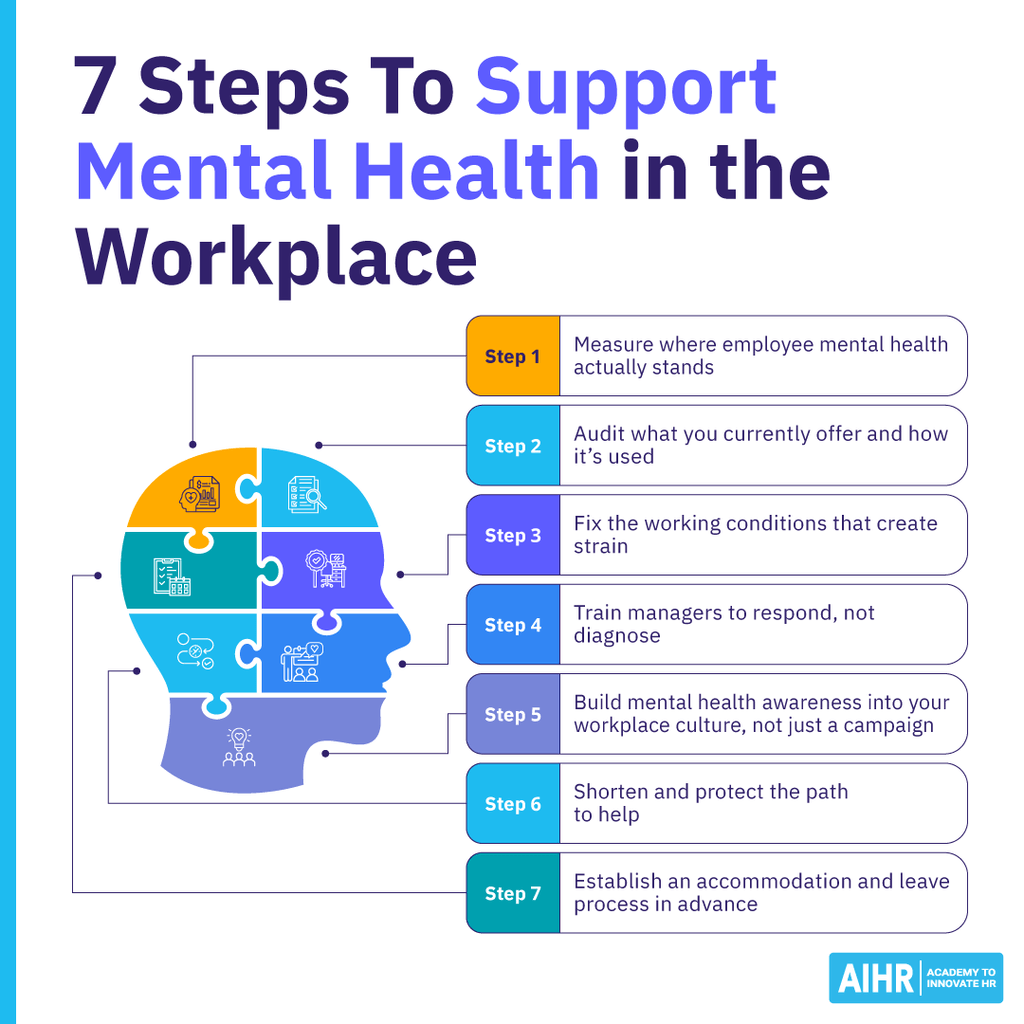
Here are seven steps you can take to support mental health in your workplace:
Step 1: Measure where employee mental health actually stands
You’ll make better decisions when you base your mental health strategy on evidence rather than assumptions. Use these four data points to establish a baseline:
- A validated wellbeing or psychosocial risk survey
- EAP and behavioral health utilization rates
- Absence and short-term disability data
- Recurring themes from exit interviews.
Three of these datasets may already be available at little or no additional cost. Your provider can supply utilization reports, absence data should already sit in your HRIS, and your HR team likely has exit interview records. This makes a validated psychosocial risk survey the main item that may require extra budget.
At the same time, don’t treat engagement scores as a measure of mental health. Engagement tells you how employees feel about their work, not necessarily how well they’re coping with it. A team can have strong engagement scores, while some members are running on empty. Ask people directly how they’re coping, instead of trying to infer it from unrelated metrics.
HR tip
Look for gaps between what employees report and what HR assumes. For example, Spring Health found that sleep issues were the challenge employees named most often, while only 21% of HR leaders considered them a top concern.
Step 2: Audit what you currently offer and how it’s used
Before introducing new initiatives, take stock of the support you already provide. Create an inventory of your EAP, behavioral health coverage, leave options, and eligibility rules, employee resource groups, peer support networks, and manager training. For each one, record who can use it, how they access it, and what it costs employees.
Next, look at usage. Add whatever data you have on utilization rates, attendance, training completion, and support requests. You’ll end up with the following categories:
- Support you don’t offer
- Support you offer that employees use
- Support you offer that employees rarely or never use
HR tip
Pay close attention to the third group. An unused EAP and no EAP at all may look similar in your reports, but they require very different responses. If employees know support exists but don’t use it, investigate whether access, awareness, or trust is the problem before adding another program.
Step 3: Fix the working conditions that create strain
HR can influence many common sources of workplace strain. These include workload allocation, schedule flexibility, role clarity, expectations around after-hours contact, and how teams handle conflict.
For example, an engineer who’s on call every second week may be woken by alerts far more often than someone in an eight-person rotation, reducing the time they have to rest and recover. Expanding the rotation or adjusting the schedule can give employees a longer recovery window without introducing another wellbeing initiative.
Remember that a support program can’t compensate for a job that repeatedly makes people unwell. If several employees have burned out in the same role within 18 months, look closely at the role itself rather than treating each case as an individual problem.
Step 4: Train managers to respond, not diagnose
Managers are often the first people to notice when an employee’s behavior changes. That makes them an important part of your mental health strategy, and the WHO guidelines on mental health at work specifically recommend manager training.
This can also help you make the case for investing in training because manager education is one of the workplace interventions the WHO directly recommends. Your manager training should cover these three areas:
- Noticing a change: A normally reliable employee starts missing deadlines, or someone who regularly contributes in meetings becomes unusually quiet. Managers should recognize these changes without trying to diagnose what’s causing them, as that’s the role of a qualified mental health professional.
- Opening the conversation: Managers should talk about what they’ve observed rather than asking about a specific condition. “You’ve seemed stretched the last few weeks. How are you doing?” opens the conversation without making assumptions. “Do you have anxiety?” doesn’t.
- Pointing employees to the right help: Managers should know where to direct employees for support and have the relevant contact details readily available. Employees shouldn’t have to wait while their manager searches for the information.
HR tip
Training doesn’t make a manager a clinician. Their job is to notice changes, start a conversation, listen, and connect employees with the appropriate support. They shouldn’t try to assess or diagnose a mental health condition.
Step 5: Build mental health awareness into your workplace culture, not just a campaign
Mental Health Awareness Week reaches employees once a year. Burnout can build for months, and the point when someone feels ready to ask for help probably won’t line up with an annual campaign.
Instead, include mental health in the workplace conversations that already happen throughout the year. Onboarding, one-on-one meetings, benefits enrollment, and return-to-work conversations all provide natural opportunities to remind employees about support and check how they’re doing.
HR tip
A regular question such as “Is anything getting in your way this week?” or “How are you feeling about your deadlines?” can come up around 50 times a year in weekly one-on-ones. This makes mental health part of everyday management, as opposed to being confined to an annual campaign.
Step 6: Shorten and protect the path to help
Make the route to professional support easy to measure and improve. Count how many clicks or calls it takes to reach someone, track the wait for a first appointment, and check whether employees have to disclose anything to their manager before using a benefit.
The last point is especially important. If employees have to speak to their line manager before accessing an EAP, they may no longer see the service as confidential and, as such, may avoid using it altogether.
HR tip
You can often remove this kind of friction. In one study, employees at a home building company received emails with a button that logged them directly into the EAP portal. Over the course of a year, 22% used the service at least once, compared with a national benchmark of approximately 5%.
Step 7: Establish an accommodation and leave process in advance
Don’t wait until an employee needs an accommodation or mental health leave to work out how the process should function. Your policies should state who receives and handles requests, what documentation employees do and don’t need to provide, how long the process should take, and who needs what information.
HR tip
This is general guidance. Accommodation and leave requirements vary by jurisdiction, so review your policies with qualified employment counsel before finalizing them.
Real-world mental health initiatives in the workplace
Here are six real-life examples of mental health initiatives that could give you useful ideas to apply in your workplace:
AIHR: Unlimited psychological support with no approval step
AIHR gives every employee free, unlimited access to psychologists and coaches in several languages through the OpenUp platform. Employees don’t need approval from a manager or HR before booking an appointment.
The company also offers Trust Days for times when work or personal life becomes too demanding, as well as access to an in-house organizational psychologist, with whom employees can speak confidentially about issues affecting them at work.
HR takeaway: Every approval step can also become a disclosure step. Giving employees direct access to support lets them seek help without first having to tell their manager or HR that they need it.
Accenture: Peer support at scale
Accenture’s Mental Health Ally network includes more than 8,900 trained employees who provide peer support and connect colleagues with professional help. Allies identify themselves openly, helping normalize conversations about mental health.
Their training covers how to recognize warning signs, start a conversation, and direct someone to appropriate support. The network works alongside a central wellbeing hub for employees and their dependents, which includes a chatbot that helps people find the support that best fits their needs.
HR takeaway: The more support you offer, the harder it can become for employees to navigate their options. Accenture addresses this by giving employees both human and digital ways to find the right resource.
Etsy: Coverage that includes the household
Etsy offers 20 free therapy or mental health coaching sessions a year to employees and their eligible family members, alongside fully employer-paid medical premiums.
HR takeaway: Mental health doesn’t stop at the workplace. Extending support to family members can help address personal and household pressures that may also affect employees at work.
Levi Strauss & Co.: Replacing the EAP outright
On World Mental Health Day 2023, Levi Strauss extended its Lyra Health benefit to every employee worldwide and their household family members. The package provides 16 free therapy sessions a year with local mental health professionals, along with unlimited legal, financial, and caregiver support, self-care tools, and 24/7 access.
HR takeaway: Financial pressure, legal problems, and caregiving responsibilities can all contribute to stress. Supporting employees on these issues, alongside therapy, can help them address some of the underlying causes of strain.
SAP: A wellbeing metric tied to executive pay
SAP tracks a Business Health Culture Index, which measures how well the working environment supports employee health and long-term employability. The index scored 81% last year, and SAP added it to the long-term incentive plan for Executive Board compensation that same year.
HR takeaway: Linking a wellbeing measure to executive incentives gives leaders a clear reason to pay attention to it, and makes employee health part of broader business accountability.
Unilever: A peer network built over five years
Since 2020, Unilever has trained close to 4,000 colleagues as Mental Health Champions, creating a peer-support network across its global workforce. Champions work within teams, instead of one central function, and offer employees a non-judgmental space to talk. They also direct them to resources, such as the company’s EAPs.
HR takeaway: Global organizations should adapt their approach to local cultures and attitudes toward mental health. A distributed peer network can help normalize these conversations across different countries and teams.
How to measure your mental health support efforts
The right measures can show you where your mental health support is breaking down, not simply whether employees are struggling:
- EAP or behavioral health utilization: Track how many employees use your EAP or other behavioral health services over time. An increase can be positive if it means more employees know about the service, trust it, and can access it easily.
- Time to a first appointment: Track how long employees wait between asking for help and meeting with a professional. Your EAP provider should hold this data, so consider making it part of your reporting requirements.
- Absence and short-term disability days: Use the data already available in your HRIS to monitor whether mental health-related strain is contributing to longer or more frequent absences.
- Manager training completion and confidence: Completion rates tell you who attended training, but not whether managers feel able to apply what they learned. Follow up a few months later with a short confidence assessment.
- A repeated wellbeing or psychosocial risk survey: Ask the same validated questions at regular intervals so you can track changes over time rather than relying on one-off results.
- Exit interview themes: Ask departing employees directly about workload, manager support, whether they knew what mental health resources were available, and whether they used them. This can help you identify when workplace strain contributed to someone’s decision to leave.
- Post-exit survey responses: Employees may be more open about their experience in an anonymous survey sent a few weeks after they leave than they were during a face-to-face exit interview. Use these responses to identify recurring issues you may not hear about while people are still employed.
Next steps
Supporting mental health at work means looking beyond standalone wellbeing initiatives. Start with the conditions employees work in, remove unnecessary barriers to getting help, equip managers to respond appropriately, and measure whether your approach is actually working.
Building these capabilities requires HR skills, ranging from psychosocial risk assessment to designing supportive leave. AIHR’s Workplace Health and Wellbeing course teaches you how to address issues like burnout, workplace loneliness, and stress. You can also advance your HR career with industry-leading HR training through Full Academy Access, which gives you access to 16+ AIHR certificate programs.