
HR analytics courses can help you build one of the most useful skill sets in HR: turning workforce data into better people decisions. But HR analytics courses vary widely in depth, price, tools, and credibility, so the best option depends on your role and goals.
This guide shows you what to look for, compares 10 strong options, and explains how to choose a course you’ll finish and use at work.
Contents
Why HR analytics skills matter for your career
What to look for in an HR analytics course
10 best HR analytics courses to consider
How to choose the right HR analytics course for you
Key takeaways
- The best HR analytics courses combine HR-specific case work with practice in tools like Excel, Power BI, R, or Python.
- Short foundational courses can help you test your interest before committing to a certificate program.
- Comprehensive programs with projects, dashboards, and assessments can build stronger job-ready skills.
- Your best choice depends on your skill level, target role, learning format, budget, and recertification needs.
Why HR analytics skills matter for your career
HR analytics is no longer a niche skill. HR Analysts, People Analytics Specialists, HRBPs, and HR Managers all need to use workforce data to guide business decisions. You don’t need to become a data scientist to benefit from these skills, but you need to understand what the data shows, ask better questions, and connect HR metrics to business outcomes.
For example, you may need to explain why turnover is rising in one department, why time to hire is slowing, or which engagement scores need action first. Strong HR analytics skills help you move from reporting numbers to shaping decisions.
That’s why HR professionals choose to take an HR analytics course, from short online classes to full certificate programs. The right course helps you build confidence with data, tools, and stakeholder conversations.
However, each course covers different areas of HR analytics. Some focus on concepts, while others teach you how to clean data, build dashboards, run statistical analysis, or present findings to leaders. To choose well, you should match the course to your current role’s needs and your next career step.

What to look for in an HR analytics course
Before you choose an HR analytics certification or course, check which areas if covers:
- HR context, not just general analytics: General courses can teach the basics, but may not cover HR data, workforce metrics, or real HR decisions. Look for courses that use HR examples like turnover, engagement, hiring, compensation, workforce planning, and performance. This makes it easier to apply what you learn at work.
- Hands-on tools: A strong course should give you practice, not just theory. Look for tools like Excel, Power BI, Tableau, R, or Python. You don’t need all of them at once; for many HR roles, Excel and Power BI are a practical starting point.
- Projects and case studies: Projects help you move from understanding concepts to using them. Case studies, capstone projects, and realistic datasets help you build skills you can show in interviews, performance reviews, or internal mobility conversations.
- Recognition and recertification value: If you hold a SHRM, HRCI, CIPD, HRPA, or CPHR credential, check if the course offers recertification credits. This helps if you want the same learning to support your credential renewal.
- Format and time commitment: Self-paced courses work well if you need flexibility, while instructor-led courses can offer structure, deadlines, and peer discussion. Be realistic about your schedule to ensure you maximize the course’s value by finishing it.
- Cost versus depth: Free or low-cost HR analytics courses can help you explore the basics. Paid programs usually offer more structure, assessments, projects, and stronger credential value. But before you pay, check the syllabus to make sure the course covers the skills you actually need.
The right people analytics certificate program should help you analyze workforce data, build dashboards, and communicate findings in a way that supports better people decisions.
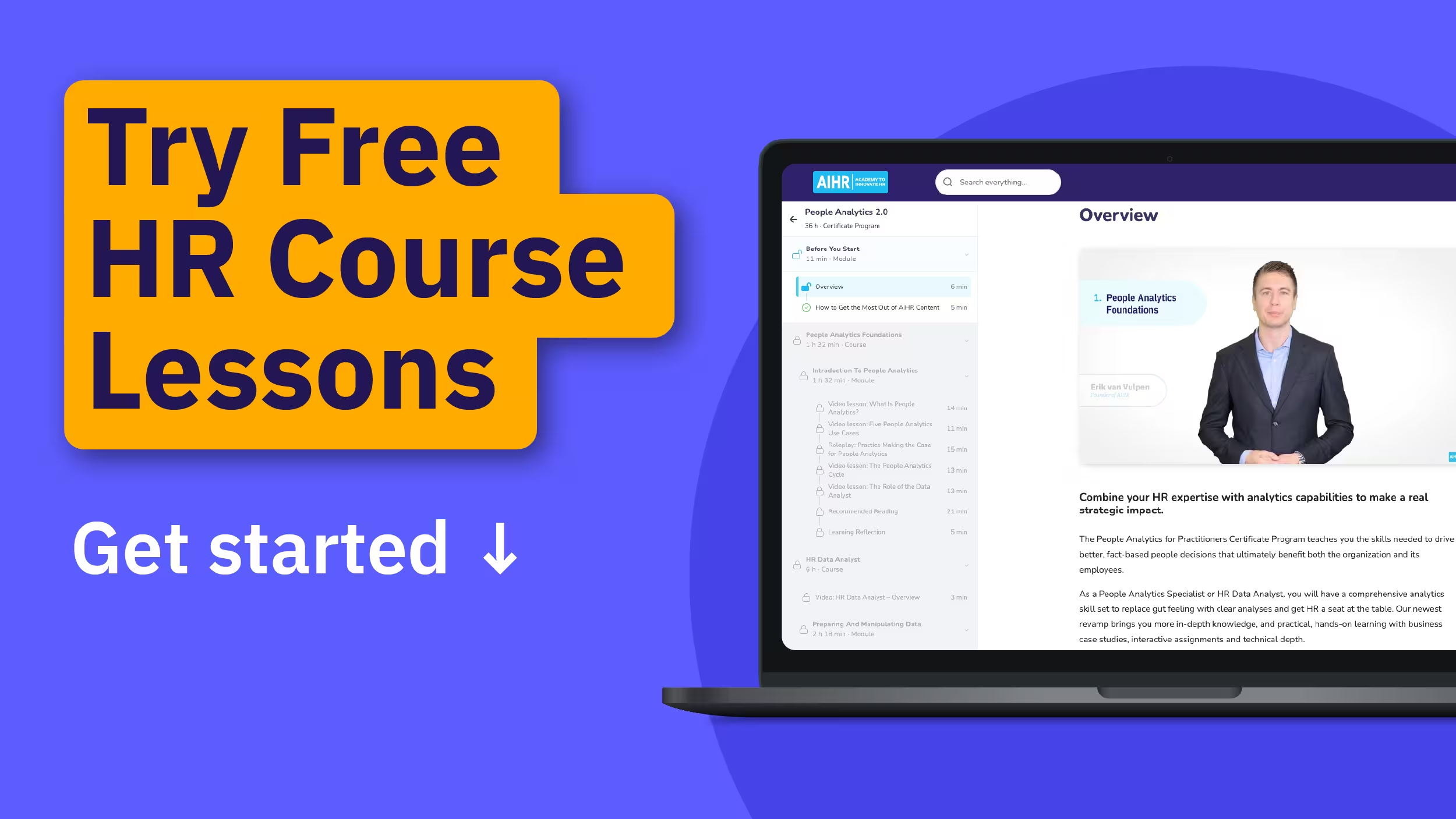
AIHR’s People Analytics Certificate Program will teach you how to:
✅ Apply the full people analytics cycle to solve real HR and business challenges
✅ Prepare, analyze, and visualize Human Resources data using Excel
✅ Build interactive HR dashboards and reports in Microsoft Power BI
✅ Use statistical analysis to test hypotheses and make evidence-based recommendations
Take a look at the syllabus to see everything covered in the certificate program.
10 best HR analytics courses to consider
We’ve categorized the various types of courses so you can easily find the right course to fit your current skill level and next step.
Foundational HR analytics courses
These courses work well if you’re interested in analytics but aren’t ready for a full certificate program.
1. Essentials of HR Analytics (eCornell)
eCornell’s Essentials of HR Analytics is a short, instructor-led course that focuses on Excel and HR data. It’s a good fit if you want a structured introduction before investing in a larger program.
- Best for: HR professionals new to analytics who want a guided introduction.
- What it covers: Analytical questions, HR data sources, basic HR data analysis in Excel, data visualization, and presenting findings.
- Format and length: Online and instructor-led. The course runs for two weeks and takes three to five hours of study per week.
- Cost: $1,199
- What you’ll be able to do: Approach HR data more clearly and join data conversations with more confidence
2. Wharton People Analytics (Coursera)
Offered by the University of Pennsylvania, Wharton’s People Analytics course introduces the core ideas behind people analytics. You don’t need a technical background to start.
- Best for: Learners who want a conceptual foundation from a recognized business school.
- What it covers: People analytics in performance evaluation, staffing, collaboration, talent management, compensation, and organizational decision-making.
- Format and length: Self-paced, with four modules. Coursera lists it as one week of study at about 10 hours per week.
- Cost: Coursera subscription pricing varies by market and plan.
- What you’ll be able to do: Explain how HR can use data more strategically and discuss core people analytics concepts with leaders.
Comprehensive HR analytics certificate programs
These programs are stronger options if you want a credential that shows deeper skill development.
3. People Analytics Certificate Program (AIHR)
AIHR’s People Analytics Certificate Program is a practical, HR-focused program for professionals who want to build end-to-end analytics skills. It covers Excel, Power BI, statistics, and real-world case work.
- Best for: HR professionals who want to move into people analytics or build a stronger strategic HR skill set.
- What it covers: People analytics foundations, HR data analysis, AI tutorials for people analytics, Power BI dashboards, statistics in Excel, and a final project.
- Format and length: Online and self-paced. The program includes 43.3 hours of learning, with 12 months of access.
- Cost: $1,125 for the standalone certificate program, or as part of Full Academy Access for $1,850.
- What you’ll be able to do: Analyze HR data, build dashboards, complete a real-world project, and present insights that support better workforce decisions.
4. People Analytics Specialty Credential (SHRM)
SHRM’s People Analytics Specialty Credential focuses on the concepts, metrics, and communication skills HR professionals need to use people data more effectively.
- Best for: HR professionals, especially in the U.S., who want a recognized credential from an established HR body.
- What it covers: Data foundations, HR metrics, insight application, and data storytelling.
- Format and length: The package includes learning content and an online knowledge assessment. SHRM’s support page lists a 30-question assessment.
- Cost: $1,855 for SHRM members and $2,205 for nonmembers.
- What you’ll be able to do: Use HR data to explain workforce issues, interpret metrics, and recommend practical actions.
5. People Analytics Accredited Program (CIPD)
CIPD’s People Analytics Accredited Program is designed for people professionals who want to run people analytics projects from start to finish.
- Best for: HR professionals in the U.K. and Europe who already have some analytics knowledge and want to go deeper.
- What it covers: People analytics projects, stakeholder presentations, HR strategy, metrics, key performance indicators (KPIs), and statistical models.
- Format and length: Online and self-directed. The program takes 50 to 70 hours and should be completed within 12 months.
- Cost: £1,846 (excluding VAT).
- What you’ll be able to do: Lead a people analytics project and use its findings to influence organizational decisions.
6. HR Analytics Certificate (eCornell)
eCornell’s HR Analytics Certificate is a four-course certificate program. It covers the full HR analytics process, from sourcing data to measuring the return on investment (ROI) of HR initiatives.
- Best for: HR associates, managers, directors, analysts, and senior HR leaders who want a recognized university certificate.
- What it covers: Data sourcing, analysis, visualization, predictive modeling, and the business impact of HR initiatives.
- Format and length: Online and instructor-led. The program takes about two months, with three to five hours of study per week.
- Cost: $3,900
- What you’ll be able to do: Analyze HR issues across hiring, retention, engagement, and workforce diversity, then connect findings to business value.
7. People Analytics for HR (HCI)
HCI’s People Analytics for HR (PAHR) helps HR practitioners use people data with more rigor. It’s built for HR professionals who want better analytical skills without becoming data specialists.
- Best for: HR leaders and practitioners who want a structured credential with a practical HR focus.
- What it covers: HCI’s people analytics model, talent metrics, data quality, distributions, correlation versus causation, basic regression, and evidence-based recommendations.
- Format and length: Instructor-led, with virtual and in-person options. The program ends with a multiple-choice exam.
- Cost: $1,596 with Premium or Corporate Membership and $1,995 for non-members.
- What you’ll be able to do: Test talent hypotheses, interpret people data, and make stronger recommendations to stakeholders.
Skill-specific HR data analytics courses (build a focused capability)
These courses work well if you want to build a focused skill, such as Excel analysis, performance measurement, or R.
8. People Data & Business Insights Certificate Program (AIHR)
AIHR’s People Data & Business Insights Certificate Program helps you turn HR metrics into business insight. It’s a practical option if you want to build confidence with data before moving into advanced analytics.
- Best for: HR professionals who want to work with people data through a business-first lens.
- What it covers: Data and AI literacy, HR metrics, HR analytics frameworks, Excel dashboards, Power BI dashboards, and storytelling with data.
- Format and length: Online and self-paced. The program includes 34 hours of learning and 12 months of access.
- Cost: $1,125 for the standalone certificate program, or included in Full Academy Access.
- What you’ll be able to do: Translate workforce data into clear, business-focused recommendations and present them with confidence.
9. Data Analysis for Improving Organizational Performance (HRCI)
HRCI’s Data Analysis for Improving Organizational Performance certification is an intermediate course that strengthens how you measure performance and choose the right metrics to solve business problems.
- Best for: Intermediate HR professionals who want to improve how they use performance measures.
- What it covers: Key performance indicators, the Balanced Scorecard, Employee Net Promoter Score (eNPS), assessments, and the link between data and strategy.
- Format and length: Online and on-demand, with 180 days of access after purchase.
- Cost: $129
- What you’ll be able to do: Choose stronger performance measures, explain trade-offs, and link data more clearly to organizational strategy.
10. R Data Science in R online course (AIHR)
AIHR’s HR Data Science in R online course helps HR professionals use R for predictive people analytics. R is a programming language often used for statistical analysis and data visualization.
- Best for: HR professionals who are ready to move beyond Excel and into predictive analytics.
- What it covers: Data management, data exploration, data visualization, and HR case studies in R. The course also covers turnover and engagement analysis.
- Format and length: Online and self-paced. The course includes six modules and 16 hours of learning.
- Cost: Part of the People Analytics Certificate Program; $1,125 for the standalone certificate program, or included in Full Academy Access for $1,850.
- What you’ll be able to do: Use R to analyze HR data, build predictive models, and work on analytics problems that Excel can’t handle easily.
How to choose the right HR analytics course for you
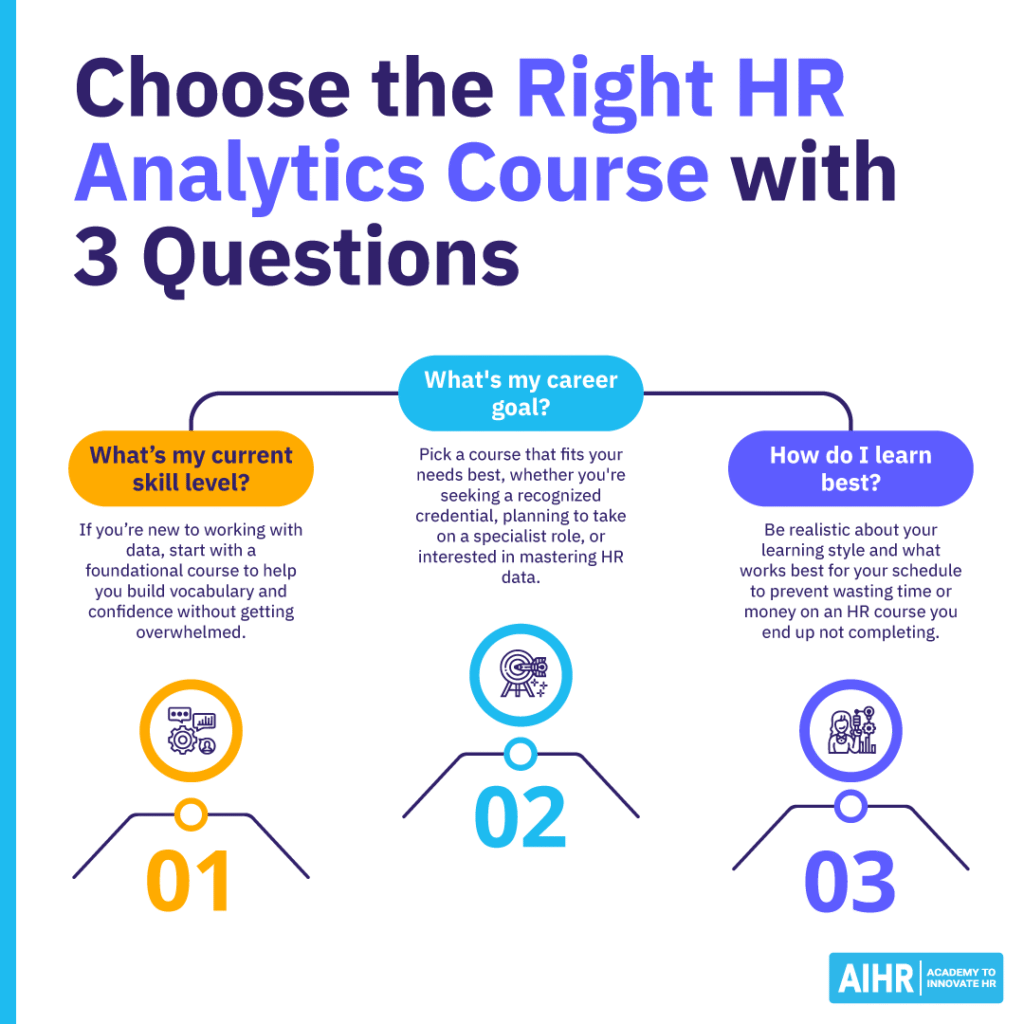
The best HR analytics course is the one that fits your needs. Ask yourself these three questions to narrow down your options:
1. What’s my current skill level?
If you’re new to working with data, start with a basic course like Cornell’s Essentials of HR Analytics or Wharton’s People Analytics. These will help you build vocabulary and confidence without feeling overwhelmed. If you already know Excel and basic HR metrics, you can move on to a comprehensive certification like AIHR’s People Analytics Certificate Program or CIPD’s People Analytics Accredited Programme.
2. What’s my career goal?
If you want a recognized credential in the US, SHRM’s People Analytics Specialty Credential is a good option. If you aim to become a People Analytics specialist, look for courses with lots of project work, like AIHR’s People Analytics Certificate, eCornell’s HR Analytics Certificate, or the CIPD program. If your goal is to be a more data-savvy HR Generalist or HR Business Partner, a focused program like AIHR’s People Data & Business Insights Certificate may be all you need.
3. How do I learn best?
Self-paced courses are good for busy HR professionals who need to fit study around work. Instructor-led courses are better if you want accountability and live discussion. Be realistic; a course you finish is more valuable than a bigger course you never complete.
After you answer these three questions, you’ll usually have a shortlist of two or three courses, making your final choice much easier.
Next steps
Choosing the best HR analytics course is more about finding a program that matches your skill level, target role, and learning style than about rankings. Use the criteria and groupings above to create a shortlist of two or three options. Read each syllabus, see what tools and projects are included, and look for free previews if available.
If you want a comprehensive program, AIHR’s People Analytics Certificate Program gives you a structured way to build a full set of HR analytics skills. You’ll learn everything from cleaning HR data and running statistical analysis in Excel to building Power BI dashboards and making recommendations based on your insights.
FAQ
HR analytics can be a strong career choice if you like using data to solve people and business problems. It involves HR, data analysis, and strategic decision-making, making it valuable as organizations increasingly rely on evidence-based HR. While HR analytics is not tracked as a standalone occupation by the U.S. Bureau of Labor Statistics, related areas show positive signals: data scientist employment is projected to grow 34% from 2024 to 2034, and HR specialist employment is projected to grow 6% over the same period.
HR analytics requires a mix of technical, analytical, HR, and communication skills. You must understand core HR processes, work with clean and reliable data, analyze trends, build dashboards, and translate findings into practical recommendations for stakeholders. Useful technical skills include statistics, Excel or spreadsheet modeling, data visualization, HRIS reporting, and basic knowledge of tools such as SQL, Power BI, Tableau, or Python. Just as important are business acumen, problem-solving, data storytelling, and the ability to explain insights to nontechnical audiences.