

Culture and employee retention are closely connected, because employees experience culture every day. When turnover rises, culture and employee retention deserve a closer look. Gallup found that only 20% of U.S. employees feel strongly connected to their organization’s culture, and those who do are 47% less likely to be looking for another job.
Managers shape daily experiences, while leaders influence trust and fairness. Recognition, growth, autonomy, and psychological safety also affect an employee’s decision to build a future with your organization. This article details the connection between culture and retention, and how you can improve your company culture to increase employee retention.
Contents
How company culture and employee retention are connected
How culture affects engagement and retention
8 warning signs your culture is hurting retention
5 culture factors that keep employees from leaving
How to fix a culture that hurts retention in 3 steps
What to track to know if culture changes have improved retention
How company culture and employee retention are connected
Company culture refers to the norms, behaviors, expectations, and unwritten rules employees observe at work. It includes what leaders reward, what managers accept, and how people make decisions when policies don’t give clear direction.
A lagging indicator shows the effects of problems after they’ve built up, and employee retention can be a lagging indicator of cultural health. Employees rarely leave because of “culture” as one isolated issue, but after repeated negative experiences. Over time, those experiences can indicate that the organization isn’t a good place to grow or do their best work.
Recent Gallup research reinforces this connection. Employees who feel strongly connected to their organization’s culture are 4.3 times as likely to be engaged, and 47% less likely to be looking for another job.
A retention-supporting culture doesn’t mean keeping everyone happy all the time. However, it means clear and consistent expectations, trusted managers, development opportunities, input into decisions, and fair treatment for all employees.
A culture that drives turnover, on the other hand, typically sees employees being subjected to inconsistent management, limited development opportunities, weak recognition, unclear expectations, poor communication, or low trust. As an HR professional, you have the power to observe, measure, and improve culture to increase employee retention.

How culture affects engagement and retention
Company culture affects employee engagement through employees’ daily experiences. Think of it as a domino effect: culture shapes the daily work experience, which influences engagement, which then affects how much energy employees invest in their work, and how long they see themselves staying at the company.
Disengagement also appears long before an employee resigns. In fact, employee engagement has been falling, with research finding that global employee engagement has fallen to a dismal 20%. In the U.S. and Canada, only 31% of employees reported feeling engaged at work.
Gallup’s research also connects strong engagement with lower turnover. Highly engaged teams have 51% less turnover in low-turnover organizations, and 21% less turnover in high-turnover organizations. So, what should you look for? Start with these factors:
- Manager relationships: Employees experience culture largely through their direct managers. Strong managers provide clarity, listen, support open communication, give useful feedback, and encourage development.
- Recognition: Employees need to know their work matters. Recognition in the form of timely, specific acknowledgment or a monetary reward can reinforce the contributions and behaviors your organization values.
- Autonomy and psychological safety: Employees contribute more freely when they can make appropriate decisions and speak up safely. Psychological safety means they can raise concerns, ask questions, and admit mistakes without fearing unfair consequences.
Your company’s engagement data can serve as an early warning system for retention risk. If engagement drops sharply in one team, don’t wait for exit interviews to find out what the problems are. Investigating them immediately can help retain key talent, saving your organization the added time and cost of having to hire often to keep up with high turnover.
A strong culture can improve employee engagement and retention. Build the skills you need to connect culture with talent development, mobility, and retention as an essential part of building a sustainable talent strategy.
AIHR’s Talent Management & Succession Planning Certificate Program will help you:
✅ Design an organizational culture that supports business goals and creates a positive talent experience
✅ Identify and address flight risk to retain critical talent and protect business continuity
✅ Use career management and internal mobility practices to keep employees engaged for the long term
✅ Build a strategic talent management approach that connects employee experience and succession planning
💡 Explore the AIHR Demo Portal to preview lessons and see what learning with AIHR looks like.
8 warning signs your culture is hurting retention
Culture and retention problems rarely appear overnight. You can often spot warning signs before turnover becomes the headline. Watch for:
- Increased turnover in specific roles or teams
- Repeated exit interview themes about managers, growth, workload, or the work environment
- Falling internal referral rates
- Declining engagement scores
- Engagement declines under specific managers
- Lower internal mobility
- More requests for transfers
- Employees expressing uncertainty about career progression.
The pattern can be as useful as the individual number. For instance, a company-wide decline may point to a broader organizational problem, while a turnover spike under one manager may indicate a more local management issue. As a first step, try pulling turnover data by manager and employee tenure, then compare it with engagement scores and exit interview themes.
Next, determine if you see a concentration of risk in a specific team or department, or under one manager. For example, one team might have higher turnover, lower engagement, and repeated complaints about management. This warrants investigation into any repeated issues that may be causing these patterns.
5 culture factors that keep employees from leaving
A strong organizational culture and retention strategy doesn’t require a long list of perks. Instead, focus on experiences that build trust and help employees see a future with your organization.
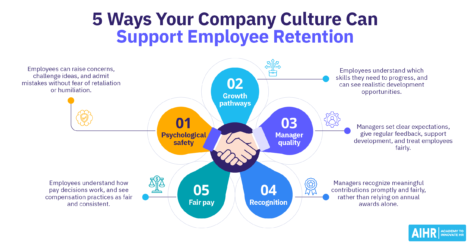
1. Psychological safety
What it looks like: Employees can raise concerns, challenge ideas, and admit mistakes without fear of retaliation or humiliation.
How to measure it: Ask employees about speaking up, trust, and how safe they feel disagreeing with their manager.
Primary owner: Managers, with support from HR and leadership.
2. Growth pathways
What it looks like: Employees understand what skills they need to progress, and can see realistic development opportunities.
How to measure it: Track internal mobility, promotions, development participation, and employee views on career opportunities.
Primary owner: Managers and HR.
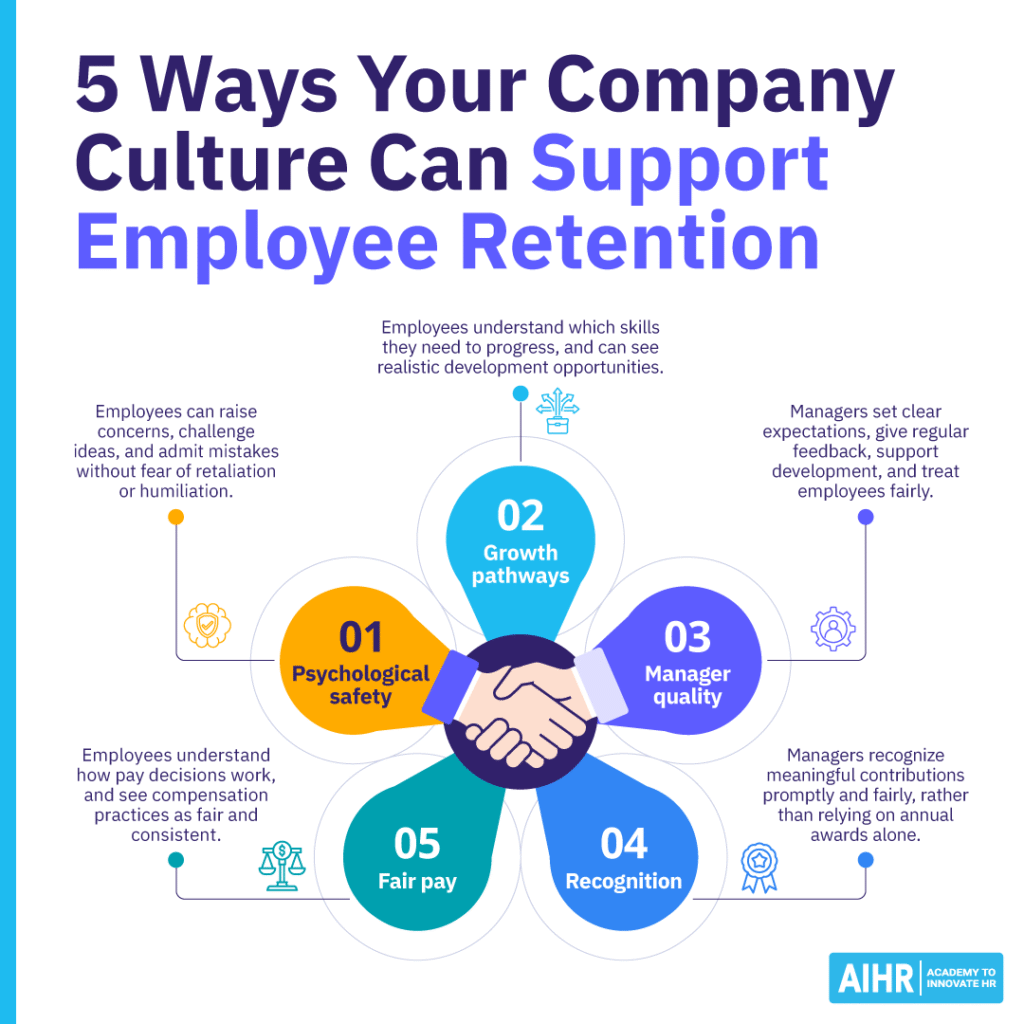
3. Manager quality
What it looks like: Managers set clear expectations, give regular feedback, support development, and treat employees fairly.
How to measure it: Compare engagement and retention by manager, and use manager effectiveness surveys and upward feedback when appropriate.
Primary owner: People managers and senior leadership.
4. Recognition
What it looks like: Managers recognize meaningful contributions promptly and fairly, rather than relying on annual awards alone.
How to measure it: Track recognition participation. Ask employees if managers acknowledge their contributions.
Primary owner: Managers, with HR providing tools and guidance.
5. Fair pay
What it looks like: Employees understand how pay decisions work, and see compensation practices as fair and consistent.
How HR can measure it: Review pay equity, market benchmarks, promotion outcomes, and employee views on pay fairness.
Primary owner: HR and leadership.
These areas also highlight the misconception that perks make for a strong company culture. However, while perks like free food or a game room can support culture, organizations still require a high level of trust, autonomy, growth, recognition, and fairness to create a positive company culture that encourages retention.
How to fix a culture that hurts retention in 3 steps
If your data points to a culture and retention problem, don’t try to fix everything at once. Instead, use this simple three-step process:
Step 1: Diagnose
Start with the evidence: review engagement surveys, turnover by team and manager, stay interviews, exit interviews, internal mobility, and employee feedback. Be sure to look for patterns instead of isolated complaints.
For example, suppose one department has 18% annual turnover while the company average is 9%, and its engagement scores are significantly lower than those of other departments. At the same time, staff repeatedly mention limited growth opportunities. This gives you a clear problem to solve, as well as specific avenues for investigation to get to the root of the issue.
Step 2: Prioritize
Choose one or two areas with the biggest gaps. For instance, if employees consistently report weak manager support, start there. If, however, career growth is the main issue, focus on your organization’s approach to talent development and internal mobility opportunities. Don’t launch a broad culture transformation before you know what needs to change.
Step 3: Pilot and measure
Test any proposed and approved changes with one team before expanding it to the rest of the company. For example, you could introduce structured stay interviews for a team with high turnover. Managers can ask what keeps employees engaged, what could cause them to leave, and what kind of support would improve their emplyoee experience.
HR could also help redesign manager one-on-ones. Give managers a simple structure that covers priorities, obstacles, development, recognition, and employee concerns to help them collect useful information on the issues employees face and how to resolve them.
These changes focus on everyday manager habits, making them practical to test before you invest in a larger culture program. Most importantly, culture change isn’t a one-time HR initiative. Managers must reinforce culture through everyday habits and fair, consistent treatment of employees. Essentially, HR should provide the structure and tools, and leaders and managers should reinforce the right behaviors daily
What to track to know if culture changes have improved retention
You can’t manage culture through anecdotes alone, so set a simple measurement framework before you launch an intervention. Start with a baseline, and track the following metrics:
- Retention rate: Compare retention across teams, managers, roles, and tenure groups.
- Engagement trends: Look at changes over time instead of relying on one survey.
- Stay and exit interview themes: Code recurring themes, so you can see how employee concerns change.
- Internal mobility: Track promotions, transfers, and movement into new roles.
- Manager-level patterns: Identify teams where engagement or retention differs significantly from the company average.
Your baseline gives you something concrete to compare with future results. For instance, if a team reports low confidence in career growth, you could introduce career conversations, manager training, and clearer career advancement pathways.
Six months later, if you see increased growth-related engagement and internal mobility, you know exactly what worked (and what didn’t), which gives you a good foundation to help solve similar problems in future.
You also don’t need to survey employees constantly. A practical rhythm could include an annual engagement survey and quarterly pulse surveys, and you can also review stay and exit interview themes throughout the year. Be sure to keep survey questions consistent enough to identify trends, then segment results by team, manager, tenure, and other relevant groups.
Next steps
Culture and employee retention improve when you act on employee experience data promptly. Start where turnover and engagement problems overlap, then address the manager behaviors, growth opportunities, recognition practices, or fairness issues behind those patterns. Choose one meaningful problem, test a practical solution, and measure the result.
Building these skills can help you make stronger talent and retention decisions throughout your HR career. To help you do so, check out AIHR’s Talent Management & Succession Planning Certificate Program, which covers flight risk, employee retention, internal mobility, and organizational culture analysis.