
The (predictive) workforce analytics market is projected to more than triple to $11.2 billion by 2035. As organizations spend more on AI-enabled workforce planning, HR leaders face a sharper question: How will that investment improve cost, capacity, skills availability, and business performance?
The ROI of AI in strategic workforce planning depends on how well HR connects AI use cases to measurable outcomes. Stronger forecasts, skills insights, and scenario models can support better decisions, but only when leaders set clear baselines, track the right metrics, and act on what the data shows.
This article looks at how AI is changing workforce planning and what HR leaders can do to maximize the ROI of AI in this process.
Contents
What is AI in workforce planning?
Where AI creates ROI in strategic workforce planning
How to measure the ROI of AI in strategic workforce planning
AI in workforce planning case studies
6 steps to maximize the ROI of AI in strategic workforce planning
HR leader’s checklist for proving ROI of AI in strategic workforce planning
Key takeaways
- The ROI of AI in strategic workforce planning comes from measurable improvements in cost, capacity, skills availability, speed, and risk reduction.
- High-value AI use cases include critical skills forecasting, attrition prediction, internal mobility, capacity planning, and scenario modeling.
- Real-world examples show strong results: Deloitte uses AI to redesign roles, and IBM uses AI skills mapping to uncover hidden talent and improve workforce allocation.
- To prove ROI, HR should set baselines, define success metrics, pilot focused use cases, and track outcomes before scaling.
What is AI in workforce planning?
AI in workforce planning enables organizations to automate the continual process of ensuring they have the employees, knowledge, and skills they need to meet (future) business demands.
Traditional workforce planning approaches often require HR and finance teams to combine spreadsheets, pull data from various systems, and run manual analyses for weeks. AI tools automatically collect data from your ATS, HRIS, and L&D platforms (as well as external labor market sources), enabling your teams to replace static spreadsheets with dynamic, continuously updated workforce models.
AI-driven workforce planning uses AI and data analytics to identify skills gaps, predict movement, forecast talent needs, and model different staffing scenarios. The goal is to have a workforce with the right size, shape, cost, and agility to meet the organization’s current and future business demands in real time.
The ROI of AI in strategic workforce planning is the measurable value your organization gains from using AI to make better workforce decisions. This value can show up as:
- Lower hiring costs
- Fewer vacancy days
- Reduced overtime
- Faster redeployment
- Better retention in critical roles
- More skills availability
- Better alignment between workforce supply and business demand.

Where AI creates ROI in strategic workforce planning
AI can support many parts of workforce planning. The highest ROI usually comes from use cases where better insight leads to faster, more cost-effective HR decisions. For example:
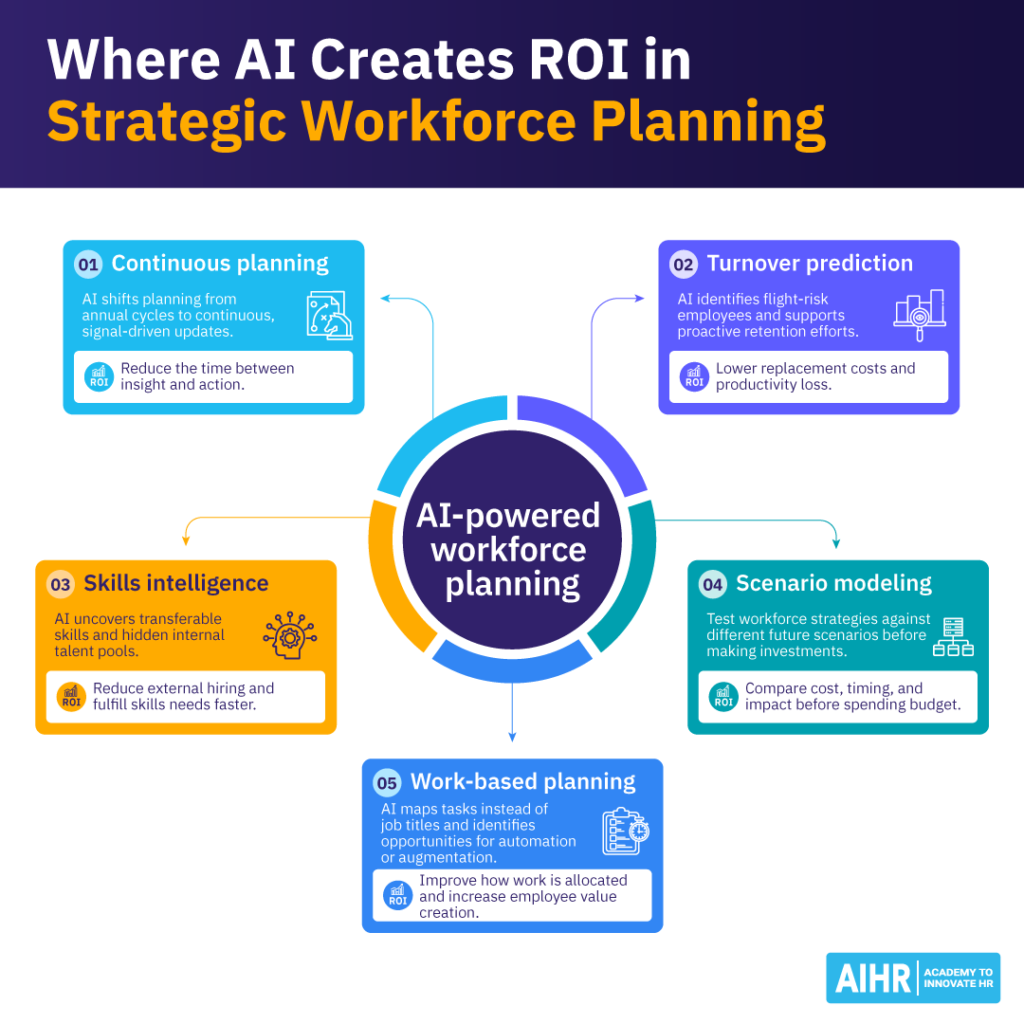
AI shifts planning from annual cycles to continuous, signal-driven updates
AI systems are able to process an infinite amount of (internal) data and external signals in real-time. This helps HR update plans when demand, turnover, skills, or labor market conditions shift. The ROI comes from reducing the time between insight and action. HR can correct course sooner rather than waiting for the next planning cycle.
Turnover prediction reduces replacement costs
AI tools are able to identify patterns across various data sets and generate predictive insights from them, enabling HR leaders and managers to take action, for instance, to prevent flight-risk employees in critical roles from leaving. If those actions reduce regrettable turnover, the business avoids replacement costs and lost productivity.
Skills intelligence improves internal mobility
AI technology can gather employees’ skill profiles and identify transferable capabilities, thereby uncovering hidden talent pools already within the organization. The ROI comes from reducing unnecessary external hiring. When HR can find talent internally, the organization can fill roles faster and lower hiring costs.
Scenario modeling lets you stress-test workforce strategies against multiple futures
Certain AI tools include scenario-planning features, allowing you to model ‘what if’ scenarios. Considering various scenarios before they occur enables you to create the capacity to adapt and respond to change and mitigate risks. Example ‘what if’ questions could be:
- How will the upcoming labor legislation change regarding the impact of outsourcing firms on our workforce?
- What if we automate 22% of repetitive tasks in our customer support teams?
- How will current retirement patterns affect our organization’s critical skills and roles?
Leaders can compare the cost, timing, and impact of each option before spending the budget.
AI moves planning from job-based to work-based, mapping tasks rather than titles
AI tools can dissect a role into different tasks and activities, indicating which can, for example, be easily automated, augmented, or executed by AI. This shifts traditional workforce planning from job-based to work-based, potentially opening additional talent pools. This improves ROI by giving HR a clearer view of how work should change, which tasks can shift to AI, and where employees can create more value.
How to measure the ROI of AI in strategic workforce planning
Once you know where AI can create value, define how you’ll measure it. The clearest ROI measures compare your baseline before implementation with the results after a pilot or rollout.
Here are examples to get you started:
Continuous workforce planning
Forecast accuracy, planning cycle length, days critical roles remain unfilled
Better forecast accuracy, shorter planning cycles, fewer urgent hiring needs
Attrition prediction
Turnover in critical roles, replacement cost, vacancy days
Lower regrettable turnover, lower replacement costs, fewer vacancy days
Scenario modeling
Time to reach workforce decisions, cost variance, risk exposure
Faster decisions, clearer budget trade-offs, lower workforce risk
Work-based planning
Process cost, duplicated tasks, time spent on manual work
More time spent on higher-value work, fewer duplicated tasks, clearer reskilling needs
AI in workforce planning case studies
Let’s explore what AI in workforce planning can look like in real-world organizational realities. The examples below show how AI can support workforce design, skills visibility, redeployment, and talent allocation.
Deloitte: Using AI to redesign roles around value
Deloitte Australia uses strategic workforce planning to connect long-term workforce scenarios with near-term business decisions. They start the process with “workforce choices,” such as the skills, size, and shape of the workforce they need for the future.
This approach looks three to five years ahead, then translates that view into practical actions for the next 12 to 18 months. Those actions may include recruitment priorities, reskilling initiatives, redeployment, or structural changes.
AI plays a key role in helping Deloitte understand how work itself is changing. The organization uses a “work analyzer” tool to break roles into tasks and activities. The tool identifies which tasks are repeatable, which ones AI can perform, and what percentage of a role could be augmented or replaced.
This gives HR a factual basis for workforce design discussions, such as:
- If 25% of a role can be automated, what higher-value tasks should then flow to that level to keep the role purposeful?
- If it turns out that disruption is mainly concentrated in a particular job family, should we start redeployment or reskilling there first?
- What’s the impact on early career employees – are we training new hires for tasks that soon no longer exist?
ROI takeaway: AI creates value when it turns workforce planning into specific investment choices. Instead of reacting to skills gaps or role disruption after they happen, HR can use AI insights to decide where to hire, reskill, redeploy, or redesign work before costs rise.
HR teams need the skills to identify valuable use cases, apply AI responsibly, and connect AI initiatives to business outcomes to get ROI from AI in HR.
With AIHR’s AI for HR Boot Camp, your team will:
✅ Identify high-impact AI use cases across HR
✅ Use generative AI tools to improve analysis, planning, and decision support
✅ Apply AI responsibly with a clear understanding of ethics, privacy, and risk
✅ Build an AI strategy that aligns adoption with people and business goals
🎯 Help your HR team move from AI experimentation to measurable impact.
Healthcare network: Using skills data to redeploy talent
A regional healthcare network, including fourteen hospitals and various outpatient facilities, faced a massive workforce challenge during COVID-19. Certain of its departments saw an overwhelming demand, while others experienced a big drop in patient volume.
The organization decided to use its recently implemented AI skills mapping workforce planning solution to identify transferable capabilities across its workforce of 23,000 people. The tool analyzed certifications, clinical competencies, soft skills, and volunteer experiences to find hidden talent pools.
For example, physical therapists skilled in respiratory rehabilitation were matched with COVID recovery programs, and administrative staff with previous EMT training were offered the possibility to support emergency departments.
The results show how powerful skills-based agility can be:
- The healthcare network saved an estimated $31 million in temporary staffing costs
- The organization managed to redeploy 2,847 employees into new roles within three weeks and was able to keep 97% of its workforce
- Employee satisfaction increased as people appreciated being utilized rather than sent on unpaid leave
- Patient care metrics stayed stable despite the operational turmoil.
ROI takeaway: Skills visibility can create real value during demand shocks. HR can redeploy people faster, reduce temporary staffing costs, and protect workforce continuity.
IBM: Using AI skills mapping to identify hidden talent
Another example of what AI in workforce planning can look like in practice comes from IBM. The organization’s AI system gathered the skill profiles of all 350,000 employees and achieved astonishing accuracy: 80% of IBM employees validated their AI-generated skill profiles as 100% correct.
The technology also surfaces so-called non-obvious talent, such as an employee in one department who has the skills suited for a critical role elsewhere. As such, AI helps the company position people where they add the most value, benefiting both the business and the individual’s career development.
ROI takeaway: Skills mapping can improve workforce allocation. HR can reduce external hiring, support career growth, and place employees where they create more value.
6 steps to maximize the ROI of AI in strategic workforce planning
Below is a practical, five-step framework HR leaders can use to launch or scale AI workforce planning initiatives in their organizations. Here’s how you can start maximizing the ROI of your AI workforce planning initiatives:
Step 1: Define specific business questions
Always make sure you’re clear on what business question AI should answer and that it’s tied to the business strategy before selecting any tool. Examples may be:
- Which workforce risks could threaten our business goals?
- Where do we expect our company’s growth to come from in the next 12 to 24 months?
- Which skills will be mission-critical for us?
This helps HR avoid AI projects that produce interesting insights but limited business value.
Step 2: Set a baseline before the AI pilot
You can’t prove ROI without a starting point.
Before launching an AI workforce planning pilot, capture current performance. Useful baseline metrics include:
- Forecast accuracy
- Time to fill
- Vacancy days for critical roles
- Contractor spend
- Overtime costs
- Internal fill rate
- Turnover in critical roles
- Participation in reskilling programs
- Time to productivity.
For example, if your pilot focuses on attrition prediction, measure current turnover and replacement costs first. Then compare pilot outcomes against that baseline.
Also, keep in mind that reliable AI-powered strategic workforce planning requires consistent, clean data. Assess your main data sources and consolidate them into a unified, clean data layer. Examples of core data sources include HRIS and ATS data, performance management data, payroll, financial, and operational data.
Step 3: Pilot high-impact use cases
To maximize the ROI of AI in strategic workforce planning, pick one or two areas where AI can make an immediate impact based on the questions defined in step 1. Think, for instance, of:
- Forecasting demand for critical skills.
- Attrition prediction for crucial roles.
- Capacity planning for a particular function, plant, or region.
Avoid piloting too many use cases at once. This makes ROI harder to measure and can overwhelm HR teams.
Step 4: Select compatible tools
Ideally, you want to choose a tool that integrates with your existing HRIS and other platforms to avoid creating new data silos. Other factors to keep in mind when selecting AI tools are:
- Do they have scenario planning options?
- What bias mitigation capabilities do they offer?
- Do they provide intuitive user dashboards?
A tool that looks impressive in a demo may still fail if managers do not trust or use it.
Step 5: Measure and iterate
Measure your pilot outcomes against the baseline metrics you set in Step 2.
For example, if your pilot focused on vacancy days in critical roles, compare vacancy days before and after the pilot. If your pilot focused on internal mobility, measure changes in external hiring costs and internal fill rate.
Then decide what to do next:
- Scale the use case if the value is clear.
- Adjust the model if results are promising but inconsistent.
- Stop the use case if it does not improve workforce decisions.
This helps HR avoid sunk costs. It also builds credibility with Finance, Operations, and senior leadership.
Step 6: Build AI workforce planning capabilities in your HR team
AI tools can generate forecasts, scenarios, and recommendations, but HR teams still need the skills to interpret those outputs and translate them into workforce decisions. Upskilling your HR team in people analytics, strategic workforce planning, AI fluency, and scenario planning helps ensure AI insights lead to action.
Organizations that invest in these capabilities are often better positioned to identify high-value use cases, challenge assumptions, and connect workforce decisions to business outcomes.
To get started, use AIHR’s HR Leader’s Guide to Building AI Competencies to assess your team’s current AI skills, plan targeted development, and access ready-to-use templates to start building AI capability in HR.
HR leader’s checklist for proving ROI of AI in strategic workforce planning
Use this checklist to keep ROI at the center of your AI workforce planning work.
- Define the workforce planning problem before selecting a tool
- Link each AI use case to a business outcome
- Set baseline metrics before the pilot
- Start with one or two high-value use cases
- Include Finance, Operations, IT, Legal, and business leaders early
- Standardize workforce data before implementation
- Build workforce planning, people analytics, and AI fluency capabilities across your HR team
- Train HR and managers to interpret AI outputs
- Monitor bias, privacy, and model performance
- Compare pilot results against baseline metrics
- Scale only when the business value is clear.
Over to you
The ROI of AI in strategic workforce planning comes from better workforce decisions, not AI adoption alone.
HR leaders need to connect every use case to measurable outcomes. These may include lower hiring costs, fewer days of critical roles remaining unfilled, faster redeployment, stronger skills coverage, and reduced workforce risk.
Start small. Define the business problem, set a baseline, pilot a high-value use case, and measure the impact before scaling. This helps HR build credibility with the business and turn AI workforce planning into a measurable source of strategic value.
To sustain that value, HR teams need the right skills. They must understand workforce analytics, AI governance, scenario planning, and business metrics well enough to challenge outputs and guide better decisions.