

Whether you’re just stepping into the world of HR or exploring your next move, understanding the wide range of job titles for human resources can give you a clearer picture of where you are now and where you might want to go. The field offers far more variety than many people realize, and each role comes with its own responsibilities, growth opportunities, and skill requirements.
In this article, we will describe some of the most common HR job titles, including what each role involves and the latest salary ranges. Salary data is powered by Revelio Labs, a provider of workforce and labor market analytics.
Contents
What is HR?
Job titles for Human Resources by hierarchy
– Entry-level HR job titles
– Mid-career job titles
– Senior-level HR job titles
– Executive HR job titles
– Trending HR job titles
– Emerging HR job titles
Determine your HR career path

What is HR?
The Human Resources department enables an organization to succeed by taking care of its most valuable asset, its people. HR professionals are involved in recruitment, performance management, learning and development, and much more. Because these responsibilities are so broad, organizations rely on a well-defined Human Resources job titles hierarchy to clarify functions and guide workforce planning.
HR continues to grow rapidly, with the global HR management market expected to reach approximately 60.5 billion dollars by 2030 and projected to nearly double in size over the coming years. This reflects increasing demand for HR expertise, tools, and services as organizations invest more in workforce support and HR technology.
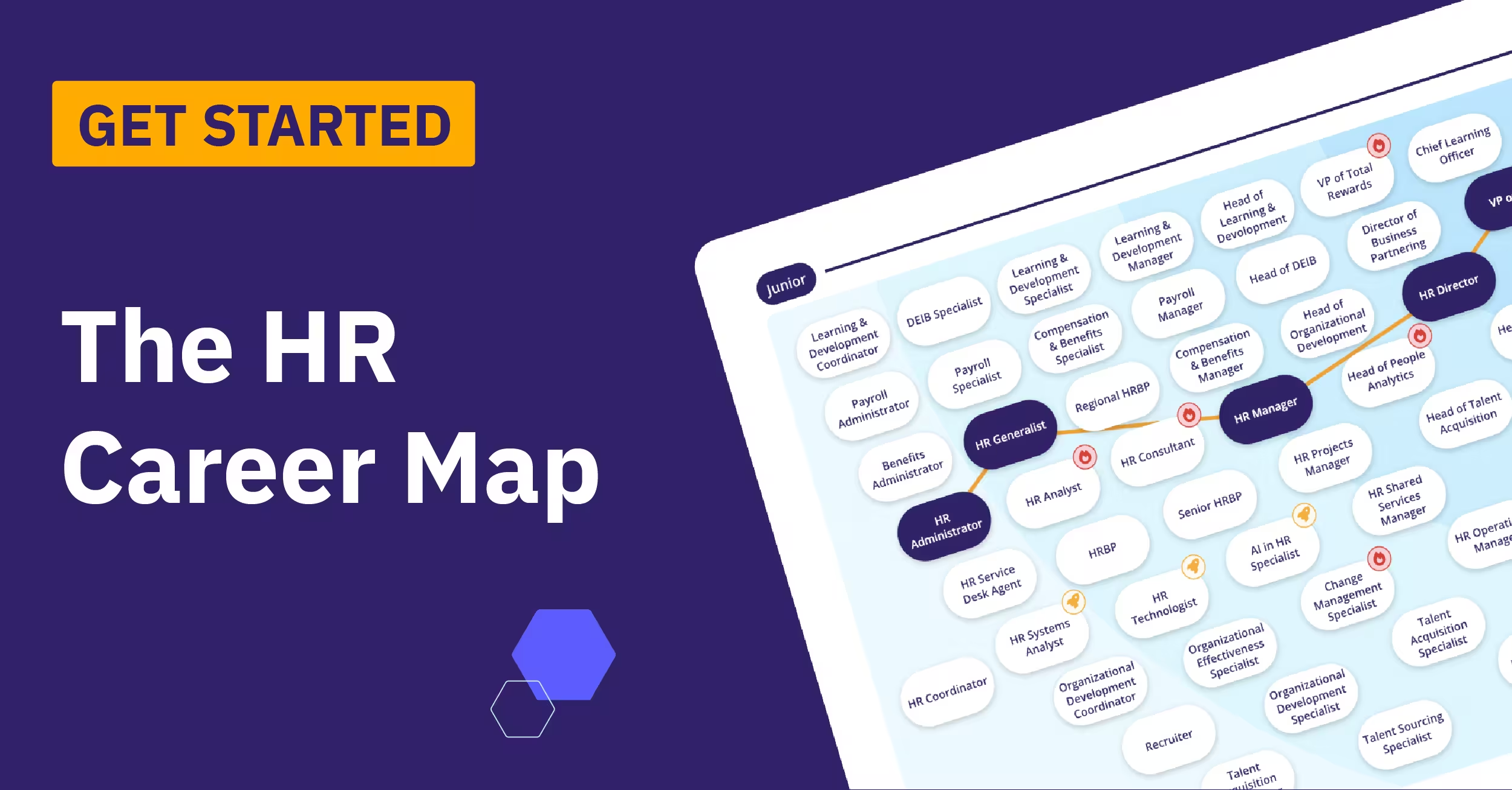
With the field evolving in this way, there are plenty of opportunities for anyone looking to advance their HR career further. Below, we summarize some common and fast-growing hr roles. The various HR job titles are far-ranging, and there are multiple career paths you can explore as you advance in HR. If you want to start mapping out your future, take a look at our HR Career Map.
Job titles for Human Resources by hierarchy
Most HR teams organize their roles into a clear structure, allowing responsibilities to be shared effectively and ensuring employees understand how their work fits into the broader function. Companies typically group positions into a few main tiers, such as:
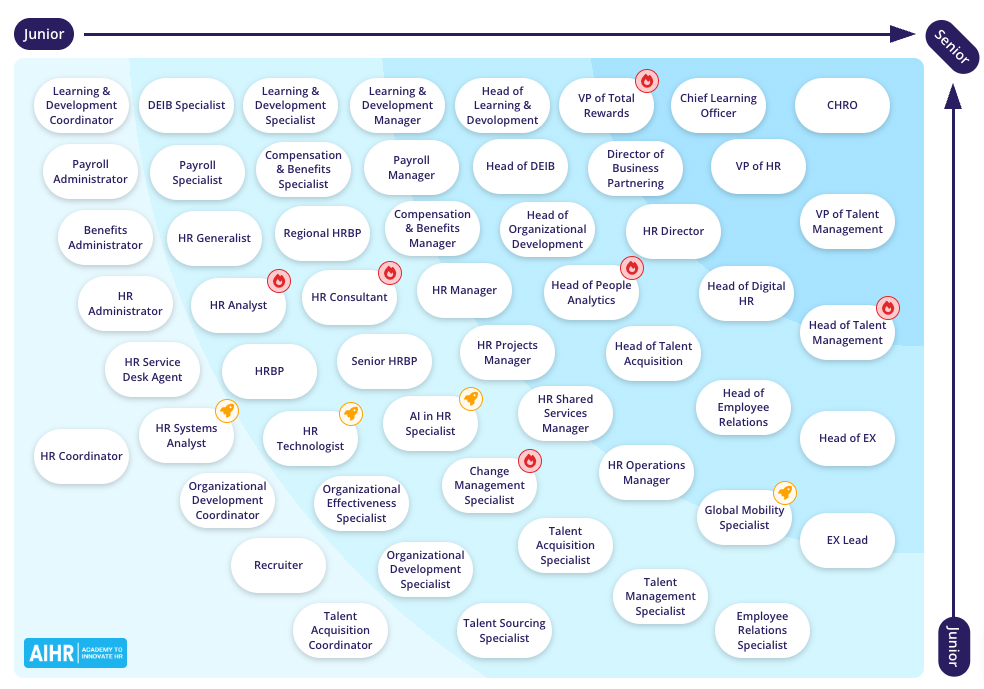
You may also come across trending and emerging HR job titles as the field continues to evolve. Based on our data provided by Revelio Labs, the AIHR HR Career Map indicates ‘hot’ in-demand roles and emerging job titles you can explore. Let’s unpack each tier and provide you with estimated salary data on each role within these tiers. Visit the AIHR HR Career Map for more up-to-date salary data.
Entry-level HR job titles
These roles are great starting points for building foundational HR skills and gaining hands-on experience across administrative and support functions. Many people pursuing jobs in human resources begin at this level before exploring areas of specialization.
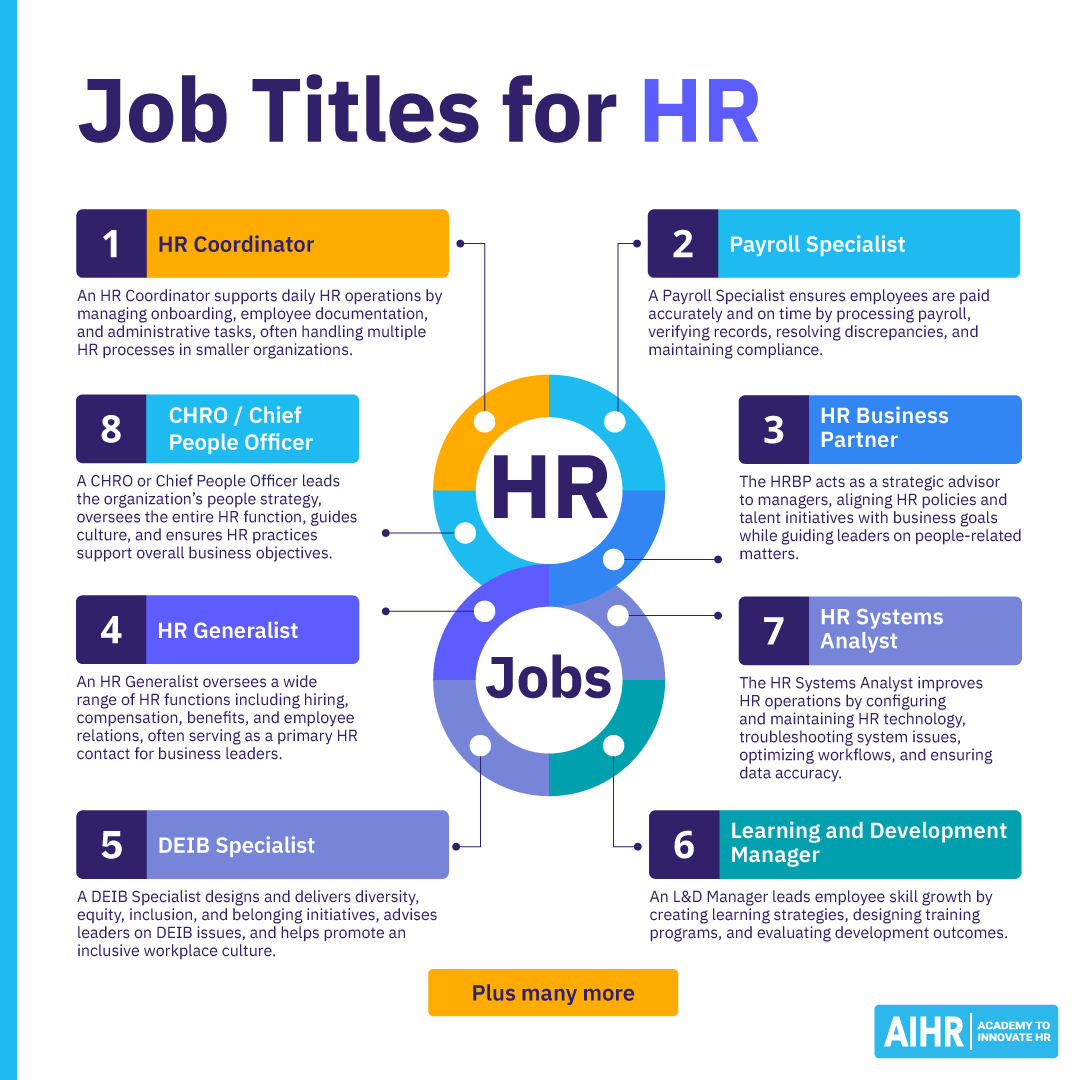
1. HR Coordinator
Job description
The HR Coordinator may manage the entire employee life cycle in small to medium-sized companies. In larger organizations, the HR Coordinator is more specialized, focusing on specific areas of HR such as recruitment, benefits administration, or employee relations. This role requires excellent communication skills, attention to detail, and the ability to multitask and prioritize tasks effectively.
Salary range
The HR Coordinator’s salary range typically falls between $48,000 and $60,000 per year.
How to become an HR Coordinator
You may need a bachelor’s degree in Human Resources, Business Administration, or a related field. However, more and more employers are considering candidates with equivalent experience or education instead of a degree.
Additionally, certifications in Human Resources, such as a Learning and Development Certificate Program or an Organizational Development Certificate Program, will be very beneficial for demonstrating your HR knowledge and expertise.
2. HR Service Desk Agent
Job description
An HR Service Desk Agent acts as the first point of contact for employee HR queries. They provide guidance on common questions, troubleshoot issues, and escalate more complex cases to the appropriate HR team members. This role focuses on delivering quick, accurate support while maintaining a positive employee experience. To succeed, HR Service Desk Agents need strong interpersonal skills, the ability to stay organized, and the comfort level working with HR systems and ticketing platforms.
Salary range
The typical salary range for an HR Service Desk Agent falls between $51,000 and $72,000, depending on experience, industry, and company size.
How to become an HR Service Desk Agent
A Bachelor’s degree in Human Resources, Business Administration, or a related field is commonly preferred; however, entry-level candidates with customer service or administrative experience are also frequently considered. Training programs that build HR foundations or digital HR skills, such as AIHR’s HR Coordinator Certificate Program, can help strengthen your qualifications and prepare you for this support-focused role.
Did you know?
Many HR roles now require continuous upskilling, not just experience. AIHR’s accredited HR training programs are eligible for recertification credits with leading professional bodies, including SHRM, HRCI, HRPA, and CPHR. This means you can grow into new HR roles or specializations while keeping your professional certifications active.
3. Talent Acquisition Coordinator
Job description
A Talent Acquisition Coordinator supports the recruitment process by managing the administrative and logistical tasks that keep hiring workflows on track. Typical responsibilities include scheduling interviews, coordinating communication with candidates, preparing job postings, maintaining applicant data in the ATS, and supporting pre-employment activities such as assessments or reference checks.
Success in this role requires strong organizational and communication skills, attention to detail, and the ability to manage multiple priorities while ensuring a seamless and professional candidate experience.
Salary range
The salary for a Talent Acquisition Coordinator typically ranges between $56,000 and $75,000, depending on experience, location, and company size.
How to become a Talent Acquisition Coordinator
Most employers prefer candidates with a Bachelor’s degree in Human Resources, Business Administration, or a related field, although equivalent experience in administration, customer service, or recruiting support is often accepted. You can strengthen your profile through HR or talent acquisition-focused programs, such as AIHR’s Talent Acquisition Certificate Program, which helps build hands-on recruiting skills and foundational HR knowledge.
4. Organizational Development Coordinator
Job description
An Organizational Development Coordinator supports the planning and execution of organizational development programs by managing communication, logistics, and day-to-day coordination. This role helps ensure that initiatives designed to improve culture, processes, or performance run smoothly. Strong communication skills, attention to detail, and the ability to collaborate across teams are essential for success in this position.
Salary range
Organizational Development Coordinators typically earn between $59,000 and $77,000, depending on experience, industry, and organizational size.
How to become an Organizational Development Coordinator
Most employers look for a Bachelor’s degree in Human Resources, Organizational Psychology, Business, or a related field. Experience supporting projects or HR programs is also helpful. To deepen your skills in this area, you can consider AIHR’s Organizational Development Certificate Program, which introduces key frameworks and tools used in OD work.
Exploring HR job titles helps you see the range of directions your career can take. Explore continuous learning to build practical expertise, adapt as your responsibilities change, and become a more well-rounded HR professional.
With AIHR’s Full Academy Access, you can:
✅ Explore learning across a wide range of HR disciplines and career paths
✅ Develop practical skills that support both your current role and future ambitions
✅ Access Certificate Programs, templates, guides, and other ready-to-use resources
✅ Keep your HR knowledge current as workplace priorities and practices evolve
🚀 Explore Full Academy Access to find the learning path that supports your next career move.
Mid-career HR job titles
Mid-level positions offer more responsibility, including opportunities to specialize or support the business more strategically. These HR positions often require deeper expertise and comfort working cross-functionally.
5. Payroll Specialist
Job description
A Payroll Specialist processes and audits payroll to ensure employees are paid accurately and on time, while maintaining compliance with legal and company requirements. This role manages payroll records, verifies timesheets, resolves discrepancies, and supports employees with payroll-related questions. Strong attention to detail, confidentiality, and comfort working with payroll systems are key to succeeding in this role.
Salary range
Payroll Specialists typically earn between $56,000 and $71,000, depending on experience, industry, and organizational size.
How to become a Payroll Specialist
Most organizations look for a Bachelor’s degree in Human Resources, Accounting, Business, or a related field. Experience working with payroll systems or HR operations is highly beneficial. To further build your expertise, you can consider AIHR’s Compensation & Benefits Certificate Program, which strengthens your understanding of rewards, compliance, and pay-related processes.
6. HR Business Partner
Job description
The HR Business Partner (HRBP) is the strategic liaison between HR and the business. They work directly with line managers to help the organization hit its strategic goals. They also consult the company on implementing HR policies, practices, and processes.
This role requires business acumen, strategic thinking, change management, and talent management skills. A successful HRBP also needs to be a great communicator and collaborator and be adept at building relationships.
Salary range
The salary of an HRBP ranges from $81,000 to $95,000.
How to become an HR Business Partner
You will usually need a Bachelor’s or a Master’s in an HR-related field, Organizational Studies, or Business Management. You can also consider getting an HR Business Partner certification to stand out from other candidates.
7. HR Generalist
Job description
The HR Generalist typically works in a growing company and is responsible for various HR functions such as hiring, compensation and benefits, and HR administration.
In an HR business partnering model, the HR Generalist assists HRBPs in partnering with executives. Where there are no HRBPs, the HR Generalist works directly with business leaders and takes on greater ownership. To excel in this role, they must have excellent business acumen, be data-driven, advocate for employees, have risk management skills, and understand labor relations.
Salary range
The HR Generalist’s salary typically falls between $60,000 and $75,000.
How to become an HR Generalist
You will need a Bachelor’s degree in Human Resources, Business Administration, or a related field. However, in place of formal education, organizations are also looking at candidates with equivalent experience and certifications, such as AIHR’s HR Generalist Certificate Program.
8. DEIB Specialist
Job description
A DEIB Specialist designs and delivers programs, training, and initiatives that strengthen diversity, equity, inclusion, and belonging across the organization. This role focuses on promoting a respectful, inclusive, and equitable work environment by supporting policy development, advising leaders on DEIB topics, and driving culture and wellbeing initiatives. Strong interpersonal skills, cultural awareness, problem-solving ability, and a deep commitment to ethical practices are key to success in this position.
Salary range
The typical salary range for a DEIB Specialist falls between $100,000 and $193,000, depending on experience, industry, and organizational size.
How to become a DEIB Specialist
Most employers look for a Bachelor’s degree in Human Resources, Business Administration, Social Sciences, or a related field. Some organizations may prefer or require a Master’s degree for this role. Completing targeted DEIB training programs, such as AIHR’s Diversity, Equity, Inclusion & Belonging Certificate Program, can further strengthen your expertise and prepare you to lead DEIB-focused initiatives effectively.
Senior-level HR job titles
Senior roles involve leading teams or major HR functions and require strong business understanding, decision-making skills, and the ability to drive organizational impact.
9. HR Manager
Job description
The HR Manager is someone who leads and directs the functions of the HR department. The HR Manager is also called the Senior HR Business Partner at larger organizations.
The work of an HR Manager includes hiring and onboarding new employees, creating and enforcing company policies, and developing training programs. An HR Manager will need domain expertise in HR, along with soft skills such as critical and strategic thinking, business acumen, leadership skills, and problem-solving ability.
Salary range
The average salary of an HR Manager ranges from $97,000 to $131,000.
How to become an HR Manager
A Bachelor’s degree in Human Resources or related fields is often the standard requirement for this role. You will also need to have proven experience in HR management.
To increase your HRM knowledge and expertise, you can sign up for certificate programs like AIHR’s HR Manager Certificate Program or HR Business Partner 2.0 Program.
10. Learning & Development Manager
Job description
The Learning and Development (L&D) Manager oversees the training and professional development of all the employees in an organization.
The work of an L&D Manager includes developing and implementing learning strategies, designing various training programs, assessing training success, and managing the development of the HR team. Beyond L&D expertise, this role requires excellent communication skills, business acumen, interpersonal skills, and technological proficiency.
Salary range
The annual salary of an L&D manager is between $88,000 and $115,000.
How to become an L&D Manager
Most organizations will require a Bachelor’s in HR, psychology, education, business, or a related field. Certification is not a must-have for this role, but it is an excellent way to show your expertise. For example, you can consider AIHR’s Learning and Development Certificate Program.
11. Head of Digital HR
Job description
The Head of Digital HR is responsible for designing, implementing, and adopting digital HR platforms and solutions. They drive HR’s digital transformation to improve HR processes and employee experiences and provide the business with new digital solutions to achieve its goals.
This role requires strong digital expertise and in-depth knowledge of HR. The Head of Digital HR must also have good communication and leadership skills, and excellent business acumen.
Salary range
The Head of Digital HR is usually paid between $128,000 and $217,000.
How to become a Head of Digital HR
To take on this role, you will need a Bachelor’s or Master’s in Digital Marketing, Information Technology, Human Resources Management, or a related field. You will also need experience leading digital projects, managing teams, and implementing digital strategies.
You can also consider enrolling in programs such as AIHR’s HR Manager Certificate Program or Digital HR 2.0 Certificate Program to increase your expertise and strengthen your profile.
Did you know?
Many HR professionals have their AIHR membership fully or partly sponsored by their employer, even without a formal training budget. With a simple business case, professional development costs can often be expensed.
12. Head of Employee Relations
Job description
The Head of Employee Relations oversees workplace issues, employee concerns, and labor relations to maintain a fair, compliant, and productive environment. This role develops employee relations strategies, guides managers through sensitive cases, ensures legal compliance, and supports a positive workplace culture. Strong interpersonal skills, judgment, and the ability to manage complex situations are essential in this position.
Salary range
The salary for a Head of Employee Relations typically ranges between $105,000 and $196,000, depending on experience, industry, and organizational size.
How to become a Head of Employee Relations
Most organizations look for a Bachelor’s or Master’s degree in Human Resources, Business, Organizational Psychology, or a related field, along with extensive experience handling employee relations, investigations, and compliance. To further develop the skills needed for this senior role, you can consider AIHR’s HR Generalist Certificate Program, which strengthens core HR capabilities relevant to employee relations and organizational culture.
Executive HR job titles
Executive positions sit at the top of the HR function, shaping people strategy, influencing business outcomes, and guiding the overall employee experience.
13. Chief Learning Officer
Job description
The Chief Learning Officer (CLO) leads the organization’s learning strategy and oversees leadership development initiatives. This role focuses on building future-ready skills, strengthening internal mobility, and ensuring employees have access to meaningful development opportunities. The CLO shapes learning culture, aligns development programs with business goals, and partners with senior leaders to support organizational growth and capability building.
Salary range
Chief Learning Officers typically earn between $150,000 and $220,000, depending on company size, industry, and experience level.
How to become a Chief Learning Officer
Organizations typically look for candidates with a Bachelor’s or Master’s degree in Human Resources, Education, Organizational Psychology, Business Management, or a related field. You will also need extensive experience in Learning and Development, often 10 or more years, with several of those spent in a senior leadership role overseeing L&D strategy or large-scale development initiatives.
Many Chief Learning Officers also pursue advanced HR or L&D certifications to strengthen their strategic capabilities. You can consider programs such as AIHR’s Learning & Development Certificate Program to deepen your expertise and expand your leadership skill set.
14. VP of HR
Job description
The VP of HR leads the HR function across regions or departments, ensuring that HR strategies align with broader business objectives. This role focuses on developing scalable, compliant, and high-impact HR practices that balance global consistency with local needs.
The VP of HR partners closely with senior leaders, oversees major HR initiatives, and drives continuous improvement across talent, culture, and operational areas. Strong strategic thinking, leadership skills, and the ability to navigate complex organizational environments are essential in this position.
Salary range
The typical salary range for a VP of HR falls between $123,000 and $207,000, depending on experience, industry, and organizational size.
How to become a VP of HR
Most organizations look for a Bachelor’s or Master’s degree in Human Resources, Business Administration, or a related field. Candidates typically require extensive HR experience, often spanning 10 or more years, including several years in senior leadership roles that oversee multiple HR functions or business units. Professional development through advanced training programs, such as AIHR’s HR Management course or Mini MBA for HR, can be valuable for strengthening strategic and leadership capabilities required for this position.
15. CHRO (Chief People Officer)
Job description
The CHRO, or Chief People Officer, is an organization’s HR and culture leader. They are an executive team member known by other names, such as Chief of Talent or Culture, or VP of HR.
Their responsibilities include:
- Leading the strategic function of HR as a department
- Ensures the HR strategy aligns with the business strategy
- Champion an inclusive and welcoming organizational culture.
The CHRO requires business acumen, data literacy, digital proficiency, and people advocacy. They also need leadership skills, problem-solving ability, and emotional intelligence.
Salary range
The annual salary of a CHRO falls between $223,000 and $269,000.
How to become a CHRO
Most organizations look for a Bachelor’s or Master’s degree in HR, Business, or a related field, along with 15 or more years of HR experience, including time in senior leadership roles. Many aspiring CHROs also strengthen their strategic skills through advanced programs like AIHR’s HR Management course or Mini MBA for HR.
Trending HR job titles
These roles are becoming increasingly common as organizations prioritize data, employee experience, and strategic HR capabilities.
16. HR Analyst
Job description
An HR Analyst collects, analyzes, and reports HR data to provide recommendations to senior management on people-related issues. They also assist HR leadership in staffing issues or facilitating the implementation of new initiatives.
To succeed, they need to have data analysis skills and proficiency with MS Excel. They should also be familiar with HRIS systems and tools, such as Tableau, Power BI, and SAP. Additionally, an HR Analyst must possess soft skills such as business acumen, effective communication, consulting skills, relationship management, and specialized HR expertise.
Salary range
An HR Analyst can expect to earn between $96,000 and $128,000.
How to become an HR Analyst
You will usually need a background in HRM or industrial and organizational psychology. Companies will also look for candidates with backgrounds in economics, statistics, or analytics.
Beyond formal education, you can consider increasing your data analysis expertise by enrolling in courses and programs, such as AIHR’s People Analytics Certificate Program or People Data & Business Insights Certificate Program.
17. HR Consultant
Job description
An HR Consultant provides expert guidance on HR policies, organizational changes, and compliance to help departments operate more effectively. This role typically supports leaders by offering insights on workforce planning, employee relations, and process improvements. Strong communication skills, analytical thinking, and the ability to effectively advise stakeholders at various levels of the organization are essential to success in this position.
Salary range
HR Consultants typically earn between $123,000 and $158,000, depending on experience, industry, and organizational size.
How to become an HR Consultant
Most organizations look for a Bachelor’s or Master’s degree in Human Resources, Business, or a related field, along with several years of experience in HR roles such as HR Generalist, HRBP, or HR Manager. To further strengthen your consulting and advisory skills, you can consider AIHR’s HR Consulting Skills mini course, which helps build the capabilities needed to influence stakeholders and drive effective HR solutions.
18. Change Management Specialist
Job description
A Change Management Specialist supports organizational transformation by coordinating communication, training, and readiness activities. Their work helps employees understand upcoming changes, prepares teams for new processes or systems, and ensures that transitions happen smoothly. To succeed in this role, you need strong interpersonal skills, the ability to clearly explain complex changes, and a solid understanding of how change affects people and culture.
Salary range
Change Management Specialists typically earn between $134,000 and $207,000, depending on experience, industry, and company size.
How to become a Change Management Specialist
Most employers look for a Bachelor’s degree in Human Resources, Organizational Development, Business, or a related field. Experience in project coordination, communication, or HR is often helpful.
You can also build your expertise through targeted training programs such as AIHR’s Organizational Development Certificate Program or Digital Change Management online course, which provide practical tools for guiding successful transformation initiatives.
19. VP of Total Rewards
Job description
The VP of Total Rewards leads the development and management of compensation, benefits, and reward strategies that attract, motivate, and retain talent. This role ensures programs remain competitive and consistent across regions while supporting employee satisfaction and organizational goals. The VP of Total Rewards partners with senior leadership to design scalable reward frameworks and uses data to guide decisions around pay, performance, and recognition.
Salary range
The typical salary range for a VP of Total Rewards falls between $197,000 and $262,000, depending on company size, industry, and experience level.
How to become a VP of Total Rewards
Most organizations look for a Bachelor’s or Master’s degree in Human Resources, Business, Finance, or a related field, along with extensive experience in compensation and benefits. To deepen your expertise and stay current with reward strategy best practices, you can consider AIHR’s Compensation & Benefits Certificate Program.
Emerging HR job titles
Emerging roles reflect the rapid evolution of technology and analytics in HR, focusing on new skills and areas that didn’t exist a few years ago.
20. HR Systems Analyst
Job description
An HR Systems Analyst supports the configuration, maintenance, and reporting of HR technology to improve operational efficiency and decision-making. This role helps streamline HR processes by troubleshooting system issues, optimizing workflows, and ensuring data accuracy across platforms. Strong analytical skills, problem-solving ability, and comfort working with digital tools are essential for succeeding in this position.
Salary range
HR Systems Analysts typically earn between $87,000 and $113,000, depending on experience, industry, and organizational size.
How to become an HR Systems Analyst
Most organizations look for a Bachelor’s degree in Human Resources, Information Systems, Business, or a related field. Experience working with HRIS platforms or HR data is highly valued. To develop the technical and analytical skills needed for this role, you can consider AIHR’s Digital HR 2.0 Certificate Program, which strengthens knowledge of HR systems and digital transformation.
21. HR Technologist
Job description
An HR Technologist oversees the configuration, implementation, and optimization of HR systems to ensure they are efficient, user-friendly, and aligned with business needs. This role acts as the bridge between HR and technology, helping teams adopt digital tools, troubleshoot system issues, and improve HR processes through automation and data-driven insights. Strong analytical skills, problem-solving ability, and comfort working with HR tech platforms are essential for success in this position.
Salary range
HR Technologists typically earn between $92,000 and $115,000, depending on experience, industry, and company size.
How to become an HR Technologist
Most employers look for a Bachelor’s degree in Human Resources, Information Systems, Business, or a related field. Experience working with HR systems, data, or digital tools is highly valued. You can also build your expertise through specialized training programs such as AIHR’s Digital HR 2.0 Certificate Program or Automation in HR, which strengthen your ability to implement and manage modern HR technologies.
22. AI in HR Specialist
Job description
An AI in HR Specialist drives innovation by implementing AI tools and technologies that enhance the employee experience, streamline HR processes, and support informed talent decisions. This role involves identifying opportunities to automate tasks, enhancing data-driven insights, and helping HR teams adopt AI in a responsible and effective way. Strong analytical skills, digital aptitude, and the ability to effectively communicate technical concepts to non-technical audiences are essential.
Salary range
AI in HR Specialists typically earn between $92,000 and $115,000, depending on experience, industry, and organizational size.
How to become an AI in HR Specialist
Most organizations look for a Bachelor’s degree in Human Resources, Business, Data Science, or a related field, along with experience working with HR technology or analytics. You can strengthen your skills through specialized training, such as AIHR’s Artificial Intelligence for HR course or the Gen AI Prompt Design for HR mini course, both of which help build practical capabilities for applying AI within HR.
Did you know?
AI skills are quickly becoming a must-have in HR roles. AIHR’s Artificial Intelligence for HR certificate program helps you build in-demand skills like prompt engineering, generative AI use, and practical AI application for everyday HR work.
23. Global Mobility Specialist
Job description
A Global Mobility Specialist facilitates employee movement across countries and regions by coordinating relocation support, immigration processes, and international benefits. This role helps employees transition smoothly into new locations and ensures compliance with global mobility policies. Strong communication skills, cultural awareness, and the ability to manage complex logistical details are essential in this position.
Salary range
Global Mobility Specialists typically earn between $89,000 and $122,000, depending on experience, industry, and organizational size.
How to become a Global Mobility Specialist
Most organizations look for a Bachelor’s degree in Human Resources, Business Administration, or a related field, along with experience in HR, relocation support, or international assignments. To expand your expertise, you can consider programs such as AIHR’s Strategic Talent Acquisition Certificate Program, which helps build skills in supporting international talent needs and workforce planning.
Determine your HR career path
Knowing HR job titles is only the beginning. The next step is mapping out your HR career path. There are numerous career paths to consider for achieving your personal and professional goals. Careers nowadays are no longer just a series of stepping stones leading up to the highest point of success. Each role you take on is a meaningful experience that helps you develop your knowledge and skills.
This means the modern HR professional needs to have more than just in-depth knowledge of HR specialization. To succeed, you must also understand how the business operates, analyze data, be proficient with technology, and advocate for your employees.
Given how fast technology develops, it’s only a matter of time before more repetitive and less complex jobs will be automated. Although this might sound like a bleak prediction for the future of HR jobs, this also brings with it great opportunities to gain new competencies and move into more strategic roles.
This requires you to be intentional about mapping your career path, which depends on your ambitions, interests, and skills. AIHR has developed a handy HR Career Map tool to help you identify the skills you need to gain and the roles you need to take on to achieve your goal. The HR Career Map gives you a clear visual overview of how HR roles connect, what skills sit within each pathway, and the different directions you can grow in throughout your career.
Over to you
As HR continues to evolve, so do the roles and career paths available within the field. Understanding how responsibilities, skills, and job titles are shifting helps create a clearer view of the possibilities ahead. With the landscape expanding into new areas and specialties, there is more room than ever to build a career that aligns with individual strengths and long-term aspirations.