

HR skills are the mix of interpersonal, strategic, analytical, and technical abilities professionals need to manage people effectively and support business goals. From communication and conflict resolution to HR reporting, compliance, and strategic thinking, these skills help HR teams hire better, support employees, and guide organizational decisions.
In this guide, we cover the most important HR skills for today’s workplace, provide a practical list of HR skills by topic and role, and explain how to build them over time.
Contents
What are HR skills?
Why is AI changing HR skills?
The priority HR skills you need to develop right now
The comprehensive list of HR skills
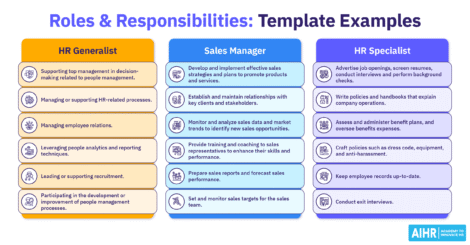
Top HR skills by role
Which HR skills should you put on a resume?
How to develop your HR skills
HR skills gap analysis template
Future HR skills
FAQ
Key takeaways
- HR skills combine interpersonal, strategic, analytical, and technical abilities that help professionals support employees and business goals.
- The most important HR skills include communication, coaching, HR technology proficiency, data analysis, compliance knowledge, and business acumen.
- The HR skills you need most depend on your role, but building a broad, practical skill set will make you more effective.
- You can develop HR skills through certifications, on-the-job experience, mentoring, networking, and continuous learning.
What are HR skills?
HR skills are the abilities professionals need to manage people, support employees, and help the organization achieve its goals. They include a mix of interpersonal, strategic, analytical, and technical capabilities, from communication and conflict resolution to workforce planning, HR reporting, and policy knowledge.
These skills matter because HR roles rarely focus on just one area. An HR professional may need to advise managers, address employee concerns, interpret workforce data, support hiring, and maintain compliance, often at the same time. That is why success in HR depends on building a well-rounded skill set rather than relying on a single strength.

Why is AI changing HR skills?
AI is changing HR skills because it’s changing where HR work creates the most value. AIHR’s analysis of U.S. HR labor market data from Revelio Labs reviewed more than 162,000 active job postings across 54 HR roles. The data shows that AI is not removing HR work across the board, but rather changing which tasks need human judgment, business context, and technical understanding.
At first glance, AI may seem less visible in HR job postings than expected. Explicit AI skill requirements appear in less than 1% of all HR job skill entries. But that doesn’t mean AI’s impact is small, just that it shows up in task redesign more than in job titles that mention AI directly.
The data points to three main shifts:
- AI is automating transactional work: AI tools can support routine tasks like scheduling, screening, document handling, and basic reporting. Demand for the HR Service Desk Agent role, for example, fell 38.3% in the data set.
- AI is increasing the value of analytical work: HR professionals who can turn data into decisions are becoming more valuable. HR Technologist has one of the tightest labor markets in the data, with only five candidates per open role.
- AI is creating demand for HR systems expertise: AI rollouts need HRIS setup, workflow design, data governance, and tool integration. Roles linked to digital HR and HR systems continue to perform well, with median salaries between $86,000 and $130,000.
The priority HR skills you need to develop right now
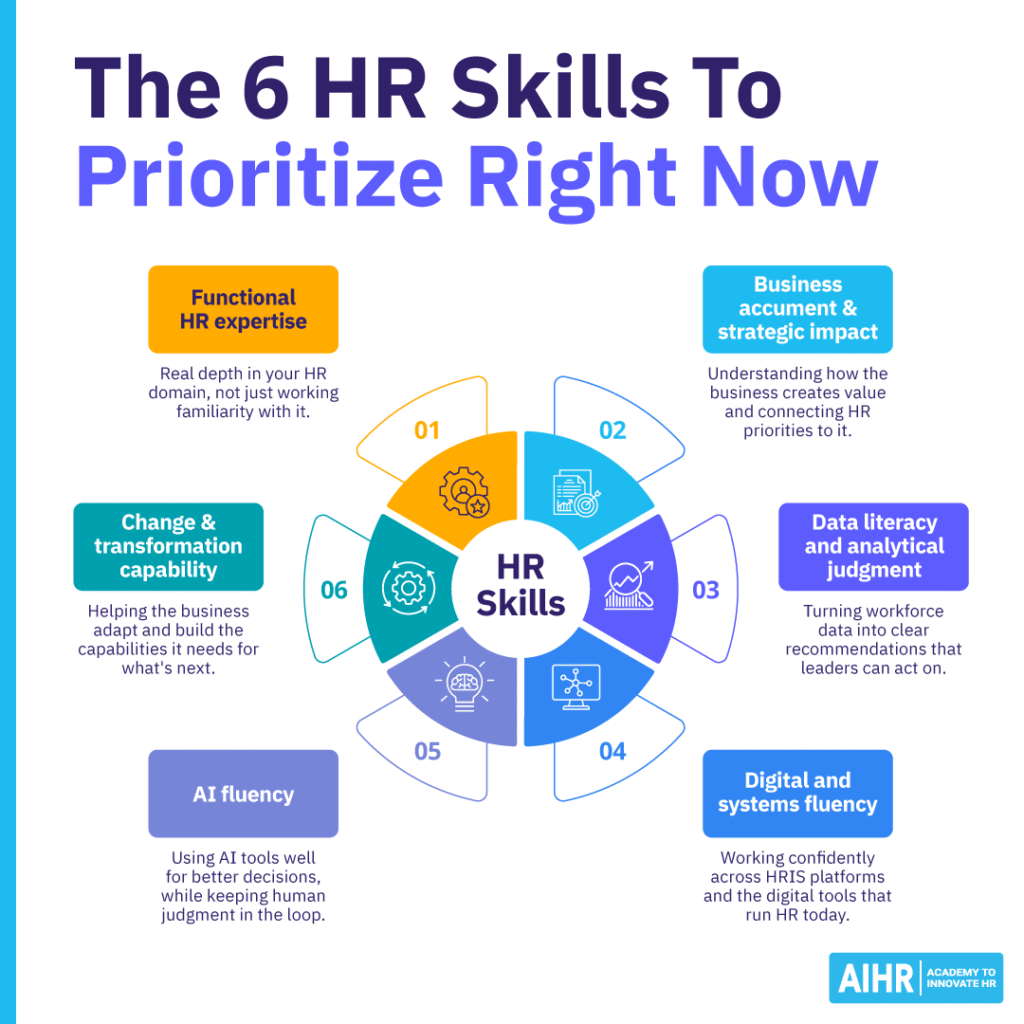
As routine work gets automated, six HR capabilities are becoming the ones that matter most:
- Functional HR expertise: Deep knowledge of your HR domain, whether that’s talent acquisition, L&D, or total rewards, applied at a higher level than before.
- Business acumen and strategic insight: Understanding how your organization creates value and connecting HR priorities directly to it.
- Data literacy and analytical judgment: Turning workforce data into clear, evidence-based recommendations that leaders can act on.
- Digital and systems fluency: Working confidently across HRIS platforms, workflows, and the digital tools that now run most HR processes.
- AI fluency: Using AI tools responsibly to improve HR decisions, without losing sight of human judgment and ethical use.
- Change and transformation capability: Helping the business, and your own HR function, adapt and build the right capabilities for the future as roles, tools, and ways of working shift.
These skills build on each other. Traditional HR expertise isn’t going away; it just needs to operate at a higher level, paired with the newer capabilities above.
AIHR’s T-Shaped HR Competency Model works on the same principle: six core competencies (Business Acumen, Data Literacy, Digital Agility, AI Fluency, People Advocacy, and Execution Excellence) that every HR professional should build, plus deeper expertise in one or more specialist areas.
For a closer look at which HR roles and skills the market is rewarding right now, including salary data and specific career moves, see AIHR’s HR Career Outlook.
The comprehensive list of HR skills
1. Communication skills
Communication is one of the most frequently mentioned skills in HR job postings and one of the most important HR soft skills. Communicating effectively is essential in Human Resource Management because the HR professional is the link between the business and the employee, representing both parties.
You are a source of information for employees, and being able to efficiently handle their questions and complaints is key to success in most HR jobs.
Communicating with stakeholders, the CEO, managers, and employees, at different levels of authority and influence, requires different language and tone. This is why the ability to connect well with all kinds of people and leave a professional and positive impression is an essential skill for HR professionals.
Communicating both formally and informally in different ways (such as verbal and written, both in-person and online) is critical.
Another communication skill that is becoming more critical for HR teams is storytelling. As data plays an increasingly important role in all aspects of the business, HR professionals must be able to translate data into clear, compelling, and impactful stories tailored to different stakeholder audiences.
“So much interaction is riddled by poor communication. This is an important competency so that you know that what you are communicating is landing with the other person because you are thoughtful not only about the word selection but also about the context to deliver the information.”
– Susie Tomenchok, Executive Coach and facilitator at Syndeo Institute at the Cable Center
2. Administrative skills
Although the form of administration is changing as technology and HR automation are harnessed, administrative tasks remain a major part of the HR role.
These duties include handling employee leave, absence, absence files, the inflow and outflow of employees, payroll, benefits, and more. Therefore, being an administrative expert can be a huge benefit for any ambitious HR professional.
Traditional HR responsibilities still sought after
Our “State of HR Upskilling” report reveals that despite an increasing number of HR job postings requiring data and digital skills, communication and administrative skills are still overrepresented in these job ads.
However, to enable organizational growth, businesses need HR professionals to excel in leadership, management, and training-related competencies.
3. HR Management knowledge and expertise
Previous work experience or educational background in Human Resource Management or Industrial and Organizational Psychology is very helpful in an HR professional role. HRM knowledge underpins many of the other HR skills and competencies. It helps in understanding recruitment, selection, absence procedures, data reporting, and more.
An educational background in psychology or HR Management also enables you to develop the soft skills that improve your communication and coaching abilities.
4. HR strategy creation & execution
HR professionals need to adopt a strategic mindset. Even if you are not (yet) at a level where HR strategy creation is among your responsibilities, you still need to be able to understand the strategic intent and translate that into an execution plan.
The ability to interpret and implement an HR strategy that effectively supports the overarching organizational strategy helps HR professionals make more impact within their organization and strengthen HR’s role as a strategic partner.
“In an ever-evolving business landscape, the ability to think strategically is paramount. This involves envisioning the future, identifying opportunities and risks, making informed decisions, and inspiring others to move towards a shared goal.”
– Tara Furiani, “Not the HR Lady” keynote speaker and consultant.
5. Managing priorities
No matter how valuable or important a project or an HR initiative is, there is a significant chance that your stakeholders will have a wide variety of opinions, priorities, and motives.
Being able to manage conflicting ideas and priorities across stakeholder groups and navigate this complexity will help you avoid potential project pitfalls and get the information and support you need to make your project a success.

6. Proactivity
HR professionals connect the employer and the employee. In such a role, proactivity can help you in spotting potential problems before they happen or escalate. Proactive and strategic HRM helps to plan and align the core HR tasks in a way that offers the most value to the business.
Proactive Human Resource Management is always preferred to reactive HRM.
Furthermore, to be proactive as an HR professional, you must stay informed about current and emerging trends across not only HR but also technology and work culture. Additionally, Human Resources skills training should be a continuous part of your career development.
7. Advising
One of the key HR skills is being a credible and trustworthy advisor to different stakeholders, and strong HR leadership skills help build the influence needed to do this well. You need to be able to effectively advise employees, line managers, and senior managers on personnel issues.
These issues can be operational, for example, creating a reintegration plan for an employee or helping a senior manager with the formulation of an email to the department. More tactical issues are the organization of and advising in restructuring efforts. Strategic advice involves the alignment of HR practices to align more with the business.
But it’s not just what you advise your stakeholders; it’s how you advise them. To establish yourself as a trustworthy advisor, you need to continuously communicate and interact in a way that builds trust and strengthens your reputation as a credible practitioner. This is where excellent communication skills become invaluable.
8. Coaching
Coaching skills enhance the ability to develop employees, guiding them toward reaching their full potential and aligning their skills with the company’s objectives.
These skills also help HR professionals navigate activities and situations like training and development, onboarding new employees, reintegration, conflict resolution, and assisting frontline managers with people issues.
Coaching skills are most often developed on the job or in external coaching training, and they are also among the key leadership competencies.
Master these 18 HR skills and turn them into practical, job-ready expertise to boost your HR function, and make yourself indispensable.
AIHR’s HR Generalist Certificate Program, will teach you to:
✅ Create end-to-end HR process, from recruitment to employee engagement
✅ Get hands on by developing your own strategic HR function
✅ Create unique competitive advantages for your organization
✅ Implement a successful policy framework and create a unique employer brand
9. Recruitment and selection
A PWC report found that 58% of HR leaders surveyed believe finding, attracting, and retaining talent is their top challenge. Therefore, finding qualified candidates, selecting the best, and determining if there’s a match between the candidate, the company (culture), and the manager is one of the most important HR tasks.
That’s why developing recruiting skills like relationship building, negotiation, and collaboration is vital for HR professionals.
A substantial part of recruitment and selection is interviewing candidates, so active listening is also indispensable. What’s more, you also need to ensure that the recruitment and selection process is fair and does not discriminate based on age, gender, ethnicity, or anything else.
10. Employee experience expertise
Employee experience is a top priority for 47% of HR leaders. Over 80% of employers believe that positive employee experience drives employee engagement, wellbeing, productivity, and talent attraction and retention.
HR professionals with employee experience expertise are able to use human-centric design thinking to put the employee at the center of the workplace design process. This involves, for example, creating employee surveys and acting on feedback, promoting diversity, equity, inclusion, and belonging, developing a recognition and rewards program, and making employee satisfaction and wellbeing a priority.
They understand the full employee life cycle: the entire relationship between employees and the organization, from recruitment to becoming alumni. Thanks to this, they are able to create exceptional employee experiences that help attract and retain the talent organizations need to succeed in today’s ever-changing world.
11. HR technology proficiency
Surveys show that 80% of small US businesses already use HR software or are planning to use it in the near future. Moreover, 54% of companies with over 500 employees are increasing HR technology spending by 24% on average.
New technologies, including ChatGPT, Virtual and Augmented Reality, and the rise of the Internet of Things (IoT), are shaping HR models worldwide. For example, the Vehicles for Change program uses augmented reality to train new mechanics, Deloitte offers virtual tours to new hires, and virtual job fairs are growing in popularity.
Therefore, a strong command of technology is essential for Human Resources professionals, as HR technical skills now play a central role in effective HR practice. While you do not need to be an IT or data expert, being aware of and skilled in the use of the array of tools and systems available will help you work more effectively and efficiently. This is particularly relevant in organizations with international or remote/hybrid teams.
HR professionals also need to familiarize themselves with a specific kind of tech: the Human Resource Information System (HRIS). Most information regarding hiring, performance evaluation, payroll, rewards, employee benefits, and other areas is registered in one or more HRIS systems. It is essential that HR skills training includes guidance on HRIS navigation and how to understand and interpret the data stored there.
Large organizations usually have standard providers like SAP (with SuccessFactors) or Oracle. Smaller companies often work with smaller providers. Knowledge of an HRIS is a prerequisite for most senior HR jobs and one of the top technical skills HR professionals need today.
12. Analytical and data-driven skills
HR and business leaders use people analytics to identify high-potential employees, analyze benefits, achieve fair pay and incentives, and project future talent needs. In fact, it’s unsurprising that data is now viewed as more expensive than oil.
Skills related to data-driven working and analytics have emerged rapidly in the last five years. 92% of HR professionals are planning to use people analytics to drive their HR strategy. HR professionals must learn to leverage the power of data analytics to make better, evidence-based decisions.
The competencies of an HR practitioner include the ability to understand key HR metrics, such as employee turnover, absenteeism, engagement, and retention. This can involve the use of complex predictive analytics on HR data, or the much simpler use of data, for example, by an Excel analysis.
13. HR reporting skills
As people analytics grows in importance, demand for HR reporting skills is increasing, too. These skills include the ability to create, read, and interpret HR reports using data from different HRIS systems.
HR professionals with strong HR reporting skills are not only able to understand and interpret data, but they are also able to turn it into compelling messages using storytelling and demonstrate business impact.
When you are able to effectively report on key metrics, you are better able to advise managers and employees, create improved people policies, and make more evidence-based decisions.
14. Commercial awareness
Commercial awareness is the ability to understand how the business makes money. Only when you understand your organization’s commercial priorities can you properly support these with tailored HR strategies and tactics, ensuring that HR adds demonstrable value to the organization.
You can illustrate this added value using the HR Value Chain. This is a three-step process that starts with HRM activities, followed by HRM outcomes and organizational objectives. It reveals how HR activities contribute to organizational goals, such as making a profit.
15. Cultural awareness and sensitivity
This HR skill depends on the specifics of the organization. Especially in larger multinational companies, cultural awareness and sensitivity is a must, because when you’re communicating with managers and employees in different countries, you need to be aware of intercultural differences.
These differences will impact how you try to hire, retain, and promote people and navigate employee relations.
For example, practices for managing and retaining people can vary widely across cultures. In India, it is common to get a promotion every single year, while in the Western world, this happens on average every 3-5 years. Similarly, it is not uncommon for Chinese workers to travel to their birthplace for the Chinese New Year and never return to the factory where they were working because they are now working somewhere else, without letting you know.
There are also communication differences concerning evaluating people. Israelis, Russians, and the Dutch are very direct, whereas Japanese and Southeast Asian countries are much more indirect. Using the wrong communication style may result in your message not being perceived as important, or risk offending people from more indirect cultures.
16. Wellbeing expertise
HR professionals have a crucial role to play in ensuring that employees remain happy, healthy, and productive.
According to McKinsey, workplace stress adversely affects productivity, drives up voluntary turnover, and costs US employers nearly $200 billion every year in healthcare costs. Meanwhile, 95% of HR managers believe that burnout is sabotaging their workforce, and 77% of workers claim they have experienced burnout at their current job.
But of those who work at companies that support wellbeing initiatives, 89% are likely to recommend their organization as a good place to work. As the impact of employee wellbeing becomes clearer, employee wellbeing is growing in importance for organizations.
17. Active listening
HR professionals who are skilled in active listening are able to attentively listen to others without prejudice or judgment and create a safe space for others to share.
Active listening goes hand in hand with empathy. “In a work setting, empathy is the ability to see situations from the perspective of all stakeholders. This includes internal employees, shareholders, the communities in which they operate, and even the geopolitical environment,” says leadership development and career coach Diane Gallo.
Without strong active listening skills, navigating potentially sensitive matters relating to DEI&B will be more challenging, and it will be harder to effectively coach employees and fellow HR professionals.
18. Teamwork
As an HR professional, you’re expected to work alongside your colleagues in the HR department, with managers and leaders, and also employees in the organization.
Internal collaboration that actively aligns HR activities benefits both the organization and HR. Being a team player also fosters greater collaboration, innovation, morale, and satisfaction within the organization and encourages others to work together.
Top HR skills by role
While all HR professionals need a strong foundation in communication, organization, and people management, the most important skills for HR vary by role and level of seniority.
HR Manager skills
An HR Manager is a mid-level role that oversees core people processes, supports managers, and helps align HR priorities with business needs.
- Lead employee relations, performance management, and day-to-day people operations with strong communication, coaching, and conflict resolution skills.
- Partner with managers on hiring, team development, and policy implementation, using sound judgment and stakeholder management.
- Balance operational delivery with strategic input by combining HR expertise with decision-making and business acumen.
HR Administrator skills
An HR Administrator is an operational support role focused on keeping HR processes accurate, organized, and compliant.
- Maintain employee records, contracts, and documentation with strong attention to detail, confidentiality, and administrative accuracy.
- Support onboarding, offboarding, and routine HR processes through organization, time management, and process discipline.
- Work effectively with HR systems and internal stakeholders by using clear communication and solid HRIS skills.
HR Director skills
An HR Director is a senior leadership role responsible for setting HR direction and ensuring people strategy supports business goals.
- Shape workforce strategy, organizational priorities, and HR plans through leadership, business acumen, and strategic thinking.
- Advise senior leaders on talent, culture, and change by using influence, judgment, and strong stakeholder management.
- Lead the HR function effectively by combining people leadership with decision-making, planning, and data-informed thinking.
HR Recruiter skills
A Recruiter is a specialist role focused on attracting, assessing, and hiring the right talent for the organization.
- Source, engage, and assess candidates using strong communication, active listening, and interviewing skills.
- Manage hiring processes and candidate pipelines through organization, responsiveness, and ATS proficiency.
- Partner with hiring managers to improve hiring decisions by combining relationship-building with sound candidate evaluation.
HR Coordinator skills
An HR Coordinator is a support role that helps manage and coordinate multiple HR activities across the employee lifecycle.
- Coordinate recruitment, onboarding, scheduling, and employee administration with strong organization and multitasking skills.
- Keep HR activity running smoothly by using attention to detail, follow-through, and process coordination.
- Support employees, managers, and the HR team through teamwork, communication, and a proactive approach.
Which HR skills should you put on a resume?
When adding HR skills to your resume, focus on the capabilities that are most relevant to the specific role you’re applying for. A long generic list is usually less effective than a shorter set of targeted skills that match the job description.
Common Human Resources skills to include on a resume include communication, employee relations, recruitment and selection, onboarding, performance management, HRIS proficiency, compliance knowledge, conflict resolution, stakeholder management, and HR reporting. The right mix will depend on the role. For example, an HR Generalist resume might emphasize employee relations, administration, and compliance, while an HR Manager resume may place more weight on leadership, coaching, strategy, and decision-making.
It’s also important to show these skills through examples in your work experience. Instead of only listing “recruitment” or “HR reporting” in a skills section, show how you applied them by describing outcomes, responsibilities, or improvements you delivered.

How to develop your HR skills
There are many ways in which HR professionals can develop their skills, advance in their careers, and provide more value to their organization. Here’s what you can do to develop your HR skills:
- Getting professional certifications: Online HR certification programs can help you expand your knowledge and skill set so that you can stay ahead of your peers and stand out when applying for jobs. You won’t just learn new skills, but you’ll also gain valuable credentials. Many of these HR courses can be completed at your own pace and fit in around existing study or a job.
- Networking and professional groups: Regularly attending industry HR events and joining online and social media HR groups (like the AIHR community) can help you connect with peers, ask questions, share knowledge, and learn from collective experiences.
- Mentoring and coaching: A seasoned HR professional can serve as a great mentor or coach, offering guidance, advice, and wisdom to help you navigate your career, make difficult decisions, and develop the most important HR skills. You could find a mentor within your organization or through a professional network. Many people are happy to share their knowledge and experience with younger professionals in the industry.
- Continuous learning: Staying updated on best practices and policy changes, emerging trends, and building future HR skills are great examples of continuous learning that you should take note of. You can incorporate learning into your day-to-day work and regularly read blogs, industry publications, research papers, and HR newsletters. You can also join professional HR associations to expand on your knowledge of the HR domain.
- On-the-job training: Look for opportunities to work on HR projects and assignments that stretch your skills and get you out of your comfort zone. Collaborate with experienced HR professionals within your organization, learn from their expertise, and actively participate in new and existing HR initiatives.
You can use the HR skills gap analysis template to identify your strongest skills, spot priority gaps, and decide where to invest your time and energy next.

Future HR skills
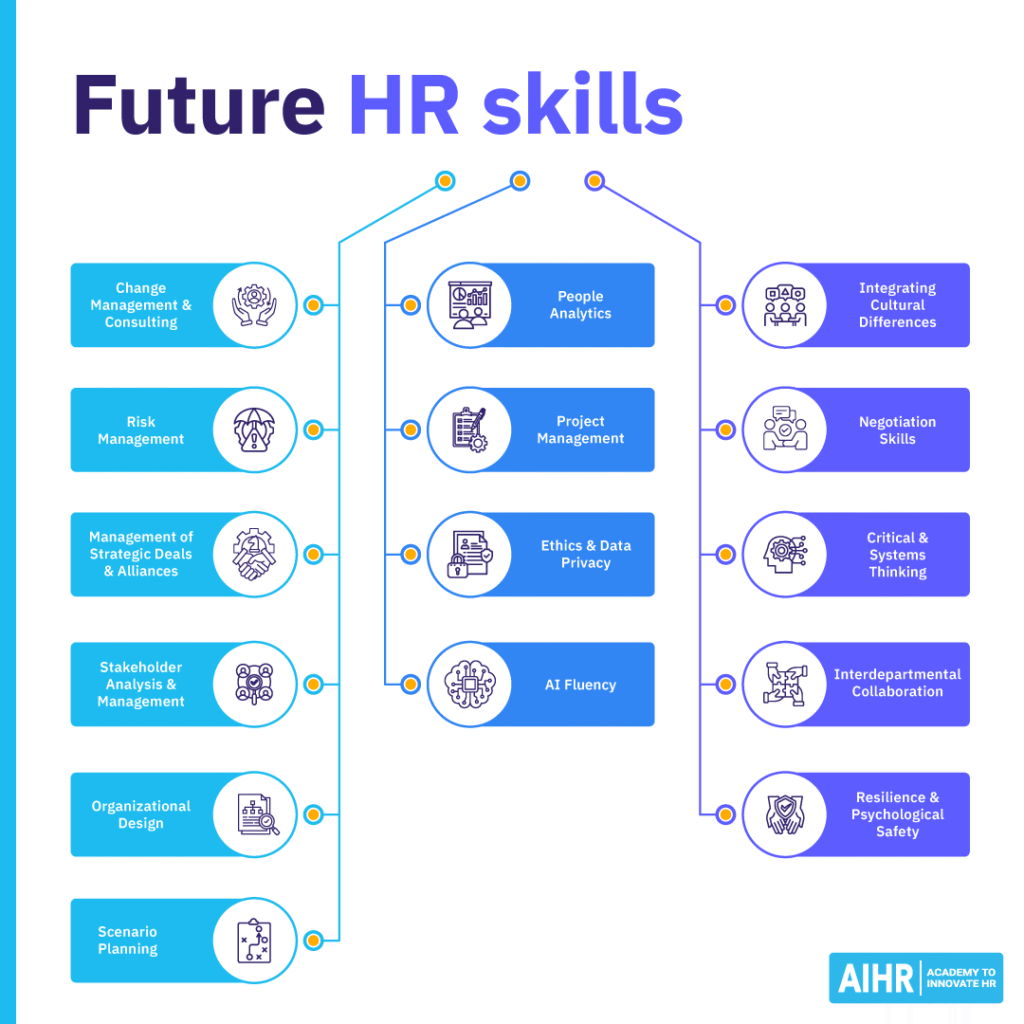
The changing world of work is pushing HR into a more strategic, data-driven, and future-focused role. While core HR capabilities remain essential, professionals also need to build skills that help them respond to change, guide the business, and support long-term workforce success.
Future HR skills that are becoming increasingly important include:
- Change management and consulting
- Risk management
- Management of strategic deals & alliances
- Stakeholder analysis & management
- Organizational design
- Scenario planning
- People analytics
- Project management
- Ethics and data privacy
- AI fluency
- Stakeholder management
- Cross-cultural collaboration
- Negotiation skills
- Critical and systems thinking
- Interdepartmental collaboration
- Resilience and psychological safety
Wrapping up
Developing key HR skills is essential for anyone who wants to grow their impact, advance their career, and add more value to both employees and the business.
Because HR roles demand such a broad skill set, from communication and stakeholder management to HR operations, policy design, and strategic thinking, structured learning can help accelerate that growth. AIHR’s HR Generalist Certificate Program is designed to build exactly these capabilities, helping professionals strengthen core HR processes, improve communication, navigate scaling challenges, and become more confident strategic partners.
FAQ
HR professionals need a mix of HR-specific, interpersonal, strategic, and technical skills to manage people effectively and support business goals. These include communication, administrative skills, HR strategy, coaching, data literacy, commercial awareness, and HR technology proficiency.
HR soft skills are interpersonal abilities that help professionals work effectively with employees, managers, and other stakeholders. These include communication, empathy, active listening, conflict resolution, teamwork, and emotional intelligence.
Some of the most in-demand HR skills today include digital and HR tech proficiency, data analysis, HR reporting, strategic workforce planning, diversity and inclusion expertise, and strong communication skills. Employers are also looking for HR professionals who can use data to support decision-making and align people practices with business priorities.
You can improve your HR skills through a combination of structured learning and hands-on experience. Professional certifications, mentoring, networking, on-the-job training, and continuous learning can all help you build stronger HR capabilities and stay current with changes in the profession.
Core HR activities include workforce planning, recruitment and selection, onboarding, performance management, learning and development, compensation and benefits, employee relations, and wellbeing support. Together, these activities help organizations attract, develop, and retain talent.