



Understanding the difference between onboarding and orientation helps you build a smoother, more complete new hire experience.
Contents
Onboarding vs orientation: Key differences you should know
A quick summary of orientation vs onboarding
Why the difference between onboarding and orientation matters
Get AIHR’s onboarding vs orientation PDF
Onboarding vs orientation: Key differences you should know
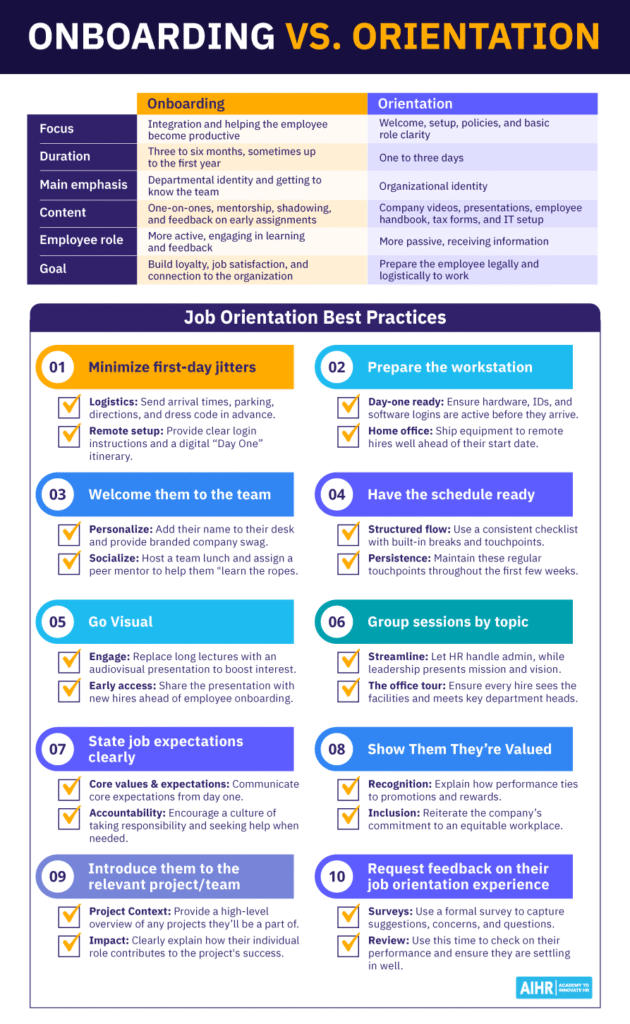
Onboarding vs orientation comes down to scope, timing, and purpose.
- Orientation is the short, structured introduction that helps a new hire get ready for work.
- Onboarding is the broader process of helping them settle in, build confidence, and become productive over time.
In most organizations, job orientation, or new employee orientation, happens first. It often covers the basics a new hire needs on day one, such as company policies, paperwork, IT access, workplace rules, and a first introduction to the team. It is usually completed in one day or over the first few days.
Employee onboarding takes longer. It can last several weeks or months, depending on the role and organization. It focuses on role clarity, team integration, learning, manager support, feedback, and early performance. In other words, orientation helps employees get started, while onboarding helps them succeed.
A simple way to explain it is this: orientation is one part of onboarding, not a replacement for it.
That distinction matters because the two processes support different outcomes. Orientation prepares people for their first days at work. Onboarding helps them adjust, contribute, and feel connected to the organization.

A quick summary of orientation vs onboarding
Area | Training needs assessment | Training needs analysis |
Main focus | Identifies current training or performance gaps | Finds the root cause of those gaps |
Key question | What skills or knowledge are missing? | Why is the gap happening, and can training fix it? |
Scope | Broader and often used to collect initial data | More diagnostic and focused on causes, priorities, and solutions |
Outcome | A list of training needs | Clear recommendations for training and non-training actions |
Example | Customer service scores are low, so employees may need support | Employees know the process, but outdated systems slow response times |
Why the difference between onboarding and orientation matters
Separating employee onboarding from orientation is important because it helps you build a better new hire experience and assign the right responsibilities at the right time. These two processes also require different ownership.
Here’s why:
- Avoiding the idea that onboarding ends on day one: When orientation and onboarding blur together, organizations may assume the new hire experience is complete after the first day. That can lead to support stopping too early, before the employee has fully settled into the role.
- Making responsibilities easier to manage: A clear distinction helps HR, managers, and teams understand what they each need to own. This reduces confusion, prevents overlap, and makes it less likely that important steps will be missed.
- Giving new hires support beyond first-day admin: Forms, policies, and introductions are important, but they are only the starting point. New hires also need guidance, feedback, and role-specific support to build confidence and start contributing effectively.
- Building a more realistic new hire journey: Separating orientation from onboarding helps you plan the employee experience more effectively. It makes it easier to decide what should happen right away and what should continue over the following weeks or months.
- Spotting gaps in the process: Clear stages make it easier to see whether the problem is with first-day setup or longer-term integration.
- Creating a smoother employee experience: New hires are more likely to feel supported when each stage has a clear purpose. A structured process helps them understand what to expect, where to go for help, and how they will be supported over time.
How to use AIHR’s onboarding vs orientation PDF
Use this PDF as a quick reference to align your employee onboarding and orientation process:
- Align on definitions: Use the comparison to explain the difference between onboarding and orientation to managers and stakeholders.
- Review your orientation process: Check whether your new hire orientation covers key first-day tasks, like setup, introductions, and expectations.
- Clarify responsibilities: Split ownership between HR and managers to avoid overlap or missed steps.
- Improve consistency: Use it as a checklist to standardize orientation across teams.
- Support planning: Share it before a new hire starts to ensure everyone is prepared.
FAQ
Orientation is the first step in the new hire process. It usually covers basics like policies, paperwork, and workplace logistics. Onboarding is the broader process of helping employees settle into their role, team, and organization over time.
No. Orientation and onboarding are related, but they are not the same. Orientation is one part of onboarding.
Orientation usually comes first. It typically happens on day one or during the first few days, while onboarding continues after that over the following weeks or months.




 POPULAR: 3,687 DOWNLOADS