
A people analytics certification can be worth it if it helps you build practical skills you can use in your role, so choosing the right certification is important.
This article explains when a people analytics certification makes sense, what options exist, and how to choose the right path for your goals.
Contents
What is a people analytics certification?
Is a people analytics certification worth it?
How a people analytics certification can help you grow in your career
Who can benefit from a people analytics certification or training?
Best people analytics certification and certificate options
Certification vs. certificate program: which matters more?
When a certificate program may be better for you
How to choose the right people analytics learning path

Key takeaways
- A people analytics certification can support career growth when it builds practical data and decision-making skills
- Certifications, certificate programs, and courses serve different purposes and are not interchangeable
- If your goal is recognition, a formal certification may help. If your goal is capability, a certificate program or course may be more useful
- The best option improves how you work with data and make decisions in your current role
What is a people analytics certification?
A people analytics certification refers to a structured HR learning program or credential focused on using data to improve workforce decisions.
You’ll typically find three main types of options:
- Certifications validate knowledge, often through an assessment, and are usually linked to recognized professional bodies
- Certificate programs focus on structured learning and award a certificate of completion
- Courses are typically shorter and focus on specific skills or tools
All three can help you build people analytics capability. The right choice depends on your goal: Do you want to signal expertise, build practical skills, or explore the field?
Is a people analytics certification worth it?
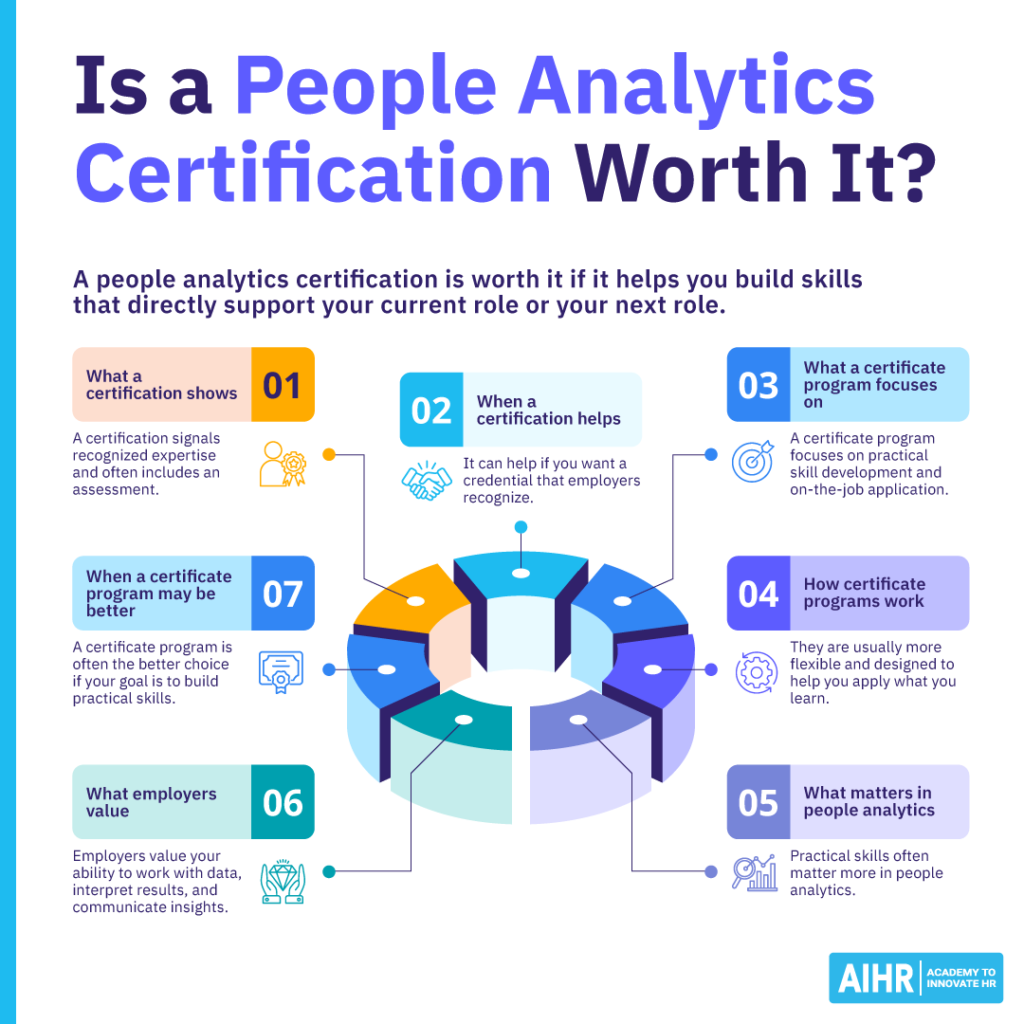
A people analytics certification is worth it if it helps you build skills that directly support your current role or your next role.
People analytics is the practice of using employee data to support better HR and business decisions. This includes areas like hiring, performance, retention, and workforce planning.
As an HR professional, you’re increasingly expected to use data to support decisions. This means you need to:
- Understand key HR metrics (for example, turnover rate or time to hire)
- Interpret trends in workforce data
- Translate data into clear business insights.
The return on investment depends on what you gain from the learning experience. For example, a credential could help you show your credibility in the field, but may not change your career path if it doesn’t improve how you work. While a certificate program that helps you apply analytics in real HR scenarios could have a more immediate impact within your role.
For example, you might learn how to define and track key HR metrics, analyze turnover patterns and present insights to stakeholders clearly. These are skills you can apply immediately in your role.
How a people analytics certification can help you grow in your career
A strong learning path helps you move from reporting data to influencing decisions. One of the main benefits is developing data literacy. This means understanding which metrics matter, how to interpret trends, and how to connect data to business outcomes. For HR professionals, this often involves shifting from descriptive reporting to more strategic analysis.
Another benefit is improving how you communicate insights. People analytics is not just about working with data. You also need to explain what the data means and what actions should follow.
This is especially important if you work as an HR business partner or in a leadership role. A certification or certificate program can also help you build confidence with tools and frameworks used in analytics work. Over time, this can open up opportunities in more analytical or specialized roles.
Who can benefit from a people analytics certification or training?
You’re likely to benefit if you want to become more data-driven in your HR role.
This includes HR professionals who are:
- HR Business Partners
- HR Generalists
- HR Specialists who support decision-making with data.
If you’re transitioning into a people analytics role, an HR certification or HR training can help you build both technical understanding and business application skills. If you already work in analytics, you might pursue a certification to formalize your knowledge or expand into areas such as predictive analytics or workforce planning.
Best people analytics certification and certificate options
There are several types of certificate programs available, and each serves a different purpose.
1. SHRM People Analytics Specialty Credential
SHRM offers a People Analytics Specialty Credential designed to help HR professionals apply data in workforce decision-making.
What it covers
- Applying people analytics to HR and business decisions
- Interpreting workforce and HR data
- Using metrics to inform talent decisions
- Communicating insights to stakeholders.
Who it’s best for: This option suits HR professionals who want a credential from a recognized HR body and want to build foundational analytics capability. It’s particularly relevant if your organization values SHRM credentials.
2. People Analytics for HR (PAHR) Certification – HCI
HCI’s People Analytics for HR certification focuses on building analytical capability for HR professionals.
What it covers
- Using data to solve HR and business problems
- Interpreting HR data
- Connecting analytics to business outcomes
- Applying analytics to workforce decisions.
Who it’s best for: This certification suits HR professionals who want structured, HR-focused analytics training and need to connect data to business decisions. It’s especially relevant for HR business partners and HR leaders.
3. University certificate programs (e.g., NYU, Wharton)
Universities such as NYU and Wharton offer certificate programs in people analytics.
What these typically cover
- Data analysis in a workforce context
- Workforce insights and measurement
- Organizational research and analytics concepts
- Data-driven decision-making.
Who it’s best for: These programs suit professionals who want a more in-depth and structured learning experience with a stronger theoretical foundation. They can support a transition into specialized analytics roles.
4. AIHR People Analytics Certificate Program
AIHR’s People Analytics Certificate Program focuses on building practical analytics skills through online, self-paced learning.
What it covers
- Data literacy for HR professionals
- Defining and using HR metrics
- Creating and interpreting HR dashboards
- Translating data into business insights.
Who it’s best for: This HR certificate program suits HR professionals who want to build job-relevant analytics skills and apply them directly. It’s especially useful if you need to work with data but are not in a dedicated analytics role.
Certification vs. certificate program: which matters more?
Understanding the difference between a certification and a certificate program will help you choose the better option for your specific career goals.
A certification signals recognized expertise and often includes an assessment. It can help if you want a credential that employers recognize. A certificate program focuses on practical skill development and on-the-job application. It’s usually more flexible and designed to help you apply what you learn.
In people analytics, practical skills often matter more. Employers value your ability to work with data, interpret results, and communicate insights.
When a certificate program may be better for you
A certificate program is often the better choice if your goal is to build practical skills. This is especially true if you are new to people analytics or need to apply analytics in your current role.
In these cases, learning how to work with real HR data matters more than gaining a credential. For example, you may need to build HR dashboards, analyze employee data, or present insights to stakeholders. A program focused on application helps you develop these capabilities faster.
How to choose the right people analytics learning path
The right choice depends on your goal. If your goal is recognition or meeting job requirements, a formal certification may help. However, if your goal is to improve how you use data in your role, a certificate program or course could be a better fit.
Focus on your immediate needs:
- If your next role requires you to have a formal certification, then pursue a certification
- If you work with data regularly, choose programs with strong practical application
- If you’re exploring a move into people analytics, choose a program that builds a solid foundation.
Next steps
The right next step depends on what you want your learning to achieve. If your priority is a recognized credential, compare formal certifications and how employers view them. If your goal is to improve how you use data, focus on practical learning.
For many HR professionals, building capability first is the most effective approach. This means learning how to work with real HR data, generate insights, and support business decisions.
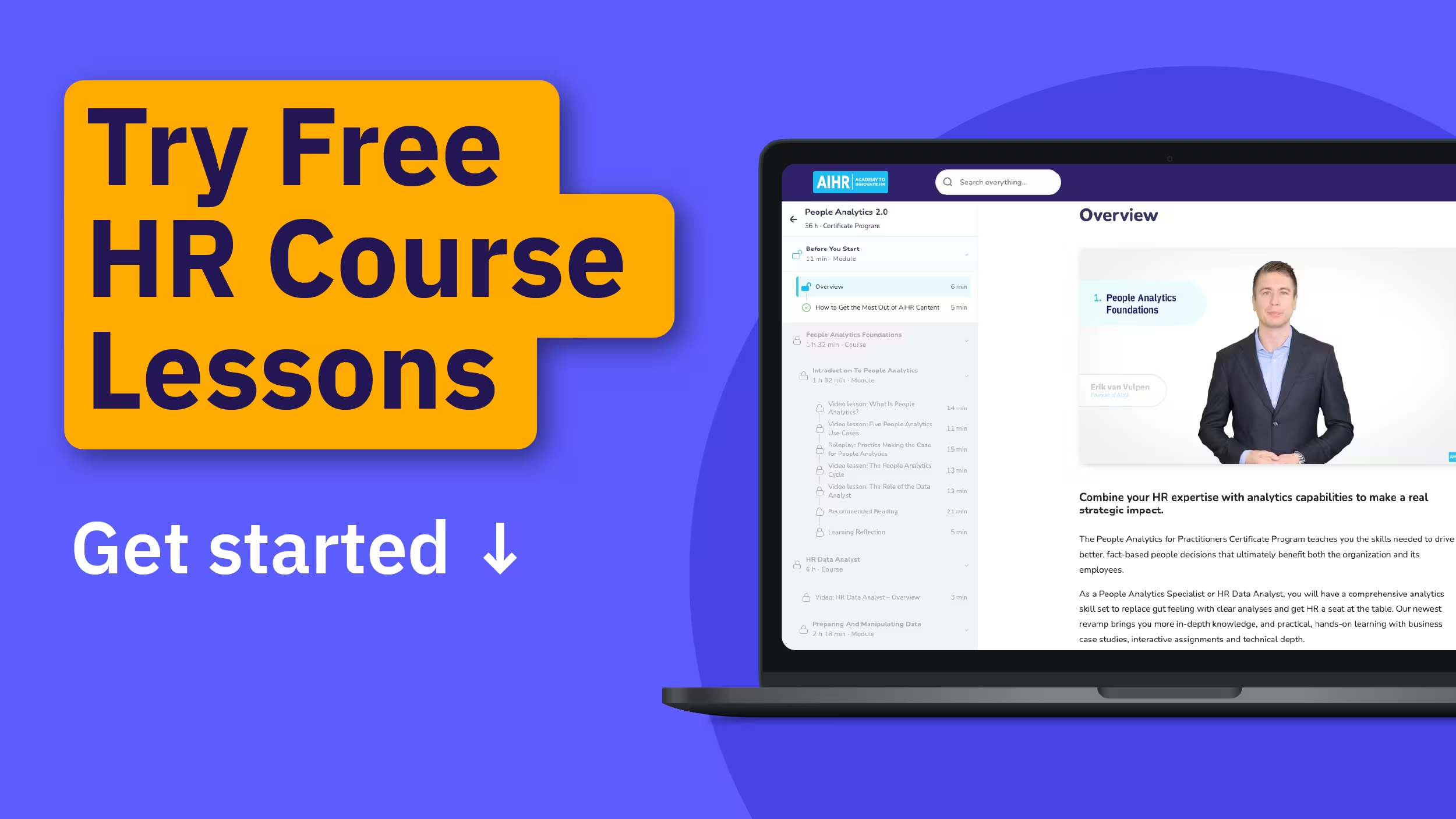
Developing these skills is an important step in becoming a more data-driven HR professional. If you want structured support, AIHR’s People Analytics Certificate Program can help you build practical analytics skills and apply them directly in your role.
FAQ
The best option depends on your goal. Certifications from SHRM or HCI can support recognition, while certificate programs like AIHR’s help build practical skills you can immediately apply in your role.
No. People analytics roles require relevant skills and experience. Certification is one way to build that capability.
Yes. Many certificate programs and courses like AIHR’s are designed for online learning.
Key skills include data literacy, understanding HR metrics, basic data analysis, and communicating insights to stakeholders.
A certification validates knowledge and may include an assessment. A course or certificate program focuses on learning and skill development.