

Ask enough HR leaders what makes the function effective, and the same themes start to surface. We’ve seen this firsthand on HR Dialogues, AIHR’s podcast for HR leaders. Across 50+ episodes, we’ve spoken with HR leaders, academics, and practitioners about the challenges facing the HR profession.
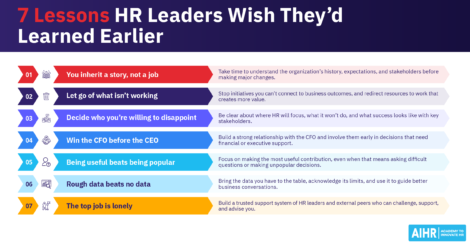
In this article, we bring together seven lessons our guests return to again and again, and what they mean for how you lead HR. Together, they offer a useful starting point for building or refining your HR strategy.
Contents
The changing role and demands on HR leaders
Lesson 1: You inherit a story, not a job
Lesson 2: Let go of what isn’t working
Lesson 3: Decide who you are willing to disappoint
Lesson 4: Win the CFO before you win the CEO
Lesson 5: Being useful is better than being popular
Lesson 6: Rough data beats no data
Lesson 7: The top job is lonely, and you need a community

The changing role and demands on HR leaders
Thirty years ago, few companies had a CHRO. The senior HR leader usually focused on personnel administration and rarely shaped business strategy. Today, many CHROs report directly to the CEO and help steer major business decisions. With the rise of AI, the role is expanding again as CHROs take on a broader enterprise leadership mandate.
For the strongest HR leaders, the seat-at-the-table debate is over. As Alexis Crimaldi, then HRBP lead at TikTok, put it on episode 14 of HR Dialogues: “Not only do you have a seat at the table: you’ve booked the room for the table to sit in and invited the people that came.”
That level of influence doesn’t come automatically. Many CHROs inherit an HR reputation they had little part in shaping. Some organizations still see HR as a cost center or, worse, a necessary evil that handles personnel administration.
The problem is not that the CHROs are failing at what they’re asked to do… The problem is that what they are asked to do no longer constitutes the work that actually matters.

The CFO role made a similar shift about 40 years ago, from backward-looking chief accountant to a forward-looking commercial voice. Yet, Finance did not wait to be invited to fulfill this new role. They took the mandate for themselves, and today most CFOs find themselves in the inner circle of the C-suite.
HR leaders have the same opportunity. Getting there starts with the same move Finance made: claiming the mandate.
“I think more agency can and should be taken by more HR leaders.”

“Waiting to be invited, waiting to have the title, waiting for that elusive chair.” Her answer is blunt. “Pull up your own damn chair.”

So how do HR leaders claim that mandate? Across dozens of HR Dialogues discussions, our guests have shared seven lessons that help HR leaders exercise their authority, secure the right mandate, and position themselves for strategic impact.
Lesson 1: You inherit a story, not a job
Every new HR leader inherits a history. Before you take a single action, people already have expectations about what HR should do and what the CHRO is there for.
Author’s perspective
I learned this in my first executive meeting as a new HR leader with my new boss, a seasoned CEO. I expected to be asked about strategy, risk, and my thoughts for the future. Instead, my CEO made it clear, between the lines, that my role was to keep issues off his table. I had walked in as the leader I wanted to be and ignored the organization I had joined, including a team still processing a predecessor’s sudden, conflict-laden exit.
Those expectations rarely match the role a new HR leader has in mind, and they won’t shift on their own.
Many times, there are preconceptions of what HR is, and we forget to recalibrate the whole organization and our stakeholders on what to expect of us.

The instinct is to prove your value quickly, implement a new operating model, make sweeping changes to the team, and bring your trusted allies into the organization. Most of HR Dialogues guests warned against this approach and rather recommended taking the time first to learn the organization, build the trust capital required to disrupt effectively down the line, and play a longer-term game.
A former CEO once gave another piece of advice that stuck: “You are not allowed to change anything for six months. Come in, and just listen, before you act.”
What this means for HR leaders: Treat your first months as a listening mandate, not a launch. Recontract with key stakeholders one by one. Ask what the story is up to now before you decide what story you want to write in the next chapter of HR in the organization.
Lesson 2: Let go of what isn’t working
Once you understand the story, the temptation is to add to it. A better start is often to let go of what isn’t working: programs that have always been there and absorbed years of investment, yet do not deliver business value.
Kaushik Srinivasan, CEO of KAN Associates, former CHRO, and co-author of The Worth of Work, offered a clear challenge on Episode 50 of HR Dialogues: “Kill one program this quarter. The ones you cannot prove that work. Keeping things that you cannot justify is how the function loses credibility.”
Author’s perspective
I experienced this firsthand. As CHRO, I kept some initiatives running because they had been part of my previous portfolio. My new vantage point showed they weren’t helping the business succeed, but stopping them felt like admitting failure.
I had to make the difficult decision as CHRO to “kill our Executive People Pack.” It was beautiful, almost 60 slides of HR metrics that nobody in the Business Exco team cared about. We cut it back to a quarterly two-pager, which later became a dashboard. The leadership team received it far better, and it showed HR’s value in terms that matched business priorities.
Amri B. Johnson, founder of Inclusion Wins, pointed out how familiar this pattern is: “HR cultures generally have died death by a thousand platitudes multiple times in organizational life… We want unambiguous prioritization.”
The same lack of discipline shows up in how HR adopts AI. AIHR’s research across 334 HR teams found that only 30% report a clear purpose, defined value, and prioritized use cases for AI, yet 82% of HR professionals are using AI in some way. This symptom shows that HR often measures the wrong things, focuses on the effort that has gone into the work, and doesn’t take a clear view of the business impact of its initiatives.
Someone senior announces, ‘We have to do AI,’ licenses get bought, and the metric of success is simply use.

Eryn Peters, co-founder of the AI Maturity Index, put it simply: “More usage is not necessarily better.”
What this means for HR leaders: Pick one initiative you can’t link to a business outcome and stop it. Then tell the executive team where the freed-up budget and time will go. That makes the trade-off visible and shows the judgment behind it. Executives measure HR by its impact on the business, so every program you keep should pass that test.
Lesson 3: Decide who you are willing to disappoint
Stopping programs means someone will be unhappy. That’s why one piece of advice for new CHROs stands out: “Decide who you are going to disappoint in your first six to twelve months.” A mandate that tries to protect everything protects nothing. You can’t be everything to everyone, and trying usually means you end up mattering to no one.
Saying no is not refusing to help. It is choosing where you play, then earning the right to redraw the lines. AIHR’s HR effectiveness research across more than 2,000 HR teams shows why focus and boundaries are key. While 76% of HR leaders consider their HR strategy a strength, only 56% feel able to demonstrate measurable strategic impact, and most say they don’t have enough resources to deliver everything on the strategic map.
Many HR functions fall into the same trap: they never make strategic choices about what they won’t do. HR teams are resilient and find ways to get things done. That habit served the function well in the past, but it’s no longer sustainable.
Avoiding those choices doesn’t mean they go unmade. As Sakshi Bansal, founder of Project Leap, said on Episode 20: “Leaders are making decisions every day on what they’re going to tolerate and what they’re going to celebrate.” The question is whether HR makes those decisions deliberately.
Author’s perspective
I ask many CHROs what their value proposition is, and I usually get an answer: the entire HR catalog of services and activities. My follow-up question is usually: what is going to make you famous here if you can only invest in three capabilities? Then why are we spending time on the other things that don’t matter?
What this means for HR leaders: Be explicit about where HR plays and where it does not. Make it explicit to your critical stakeholders and contract with them on what HR performance and success look like.
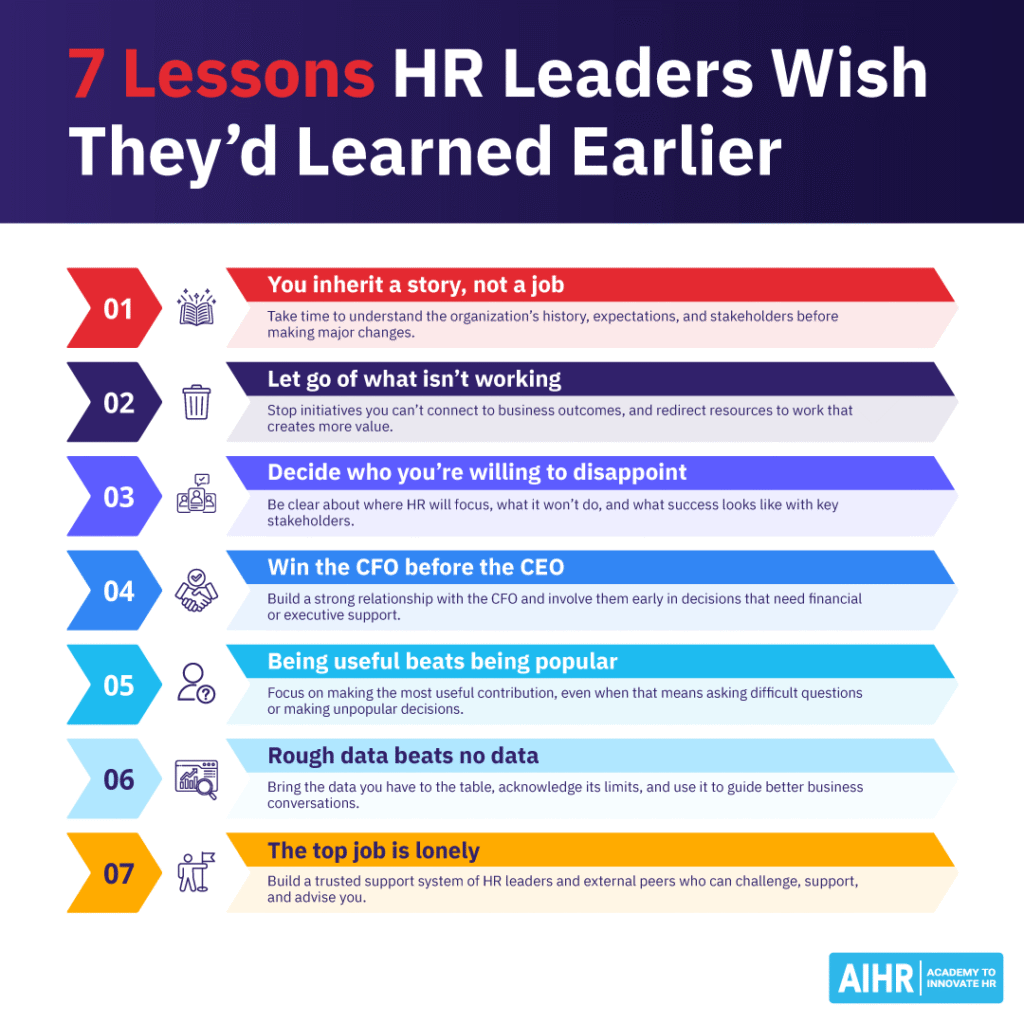
Lesson 4: Win the CFO before you win the CEO
Most HR leaders pour their political capital into their relationship with the CEO. Kaushik Srinivasan makes a sharper case for starting with the CFO.
The CEO gives you the mandate, whereas the CFO gives you the language. And the language here is power.

Professor Xavier Baeten of Vlerick Business School described the CFO’s view of HR spend on Episode 3, one of the earliest HR Dialogues conversations: “You spend my money, but I do see that nobody is motivated by it.”
Winning the CFO over means translating HR’s work into the financial terms they use to judge it. Debra Bradford, HR executive and consultant, said on Episode 26: “My ability to take a soft initiative that isn’t very obvious on the cost or the savings and turn that into financial numbers that mean something to the financial mindset of leaders makes a huge difference.”
Andrew Bartlow put it more bluntly: “A trap is falling into this environment of being an order taker and staying in your lane or using the words, ‘I’m not a numbers person.’ Please do not self-sabotage like that.” Amy Lavoie, VP of People Science at Culture Amp, closed the loop on Episode 49: “Be bold as an HR practitioner, be unapologetic, speak the language of the business.”
Author’s perspective
I made this mistake, and in my first HR leadership role, I never took the time to get the CFO on my side. And this was evident not only in budget decisions, but also in the fact that he had the ear of the CEO, which made my relationship with the CEO increasingly complex.
The CFO’s support matters well beyond budgets. CFOs shape how other executives see HR, and without their backing, many HR initiatives never get off the ground.
That influence wasn’t handed to CFOs either. As Kaushik Srinivasan put it: “Nobody handed the CFO the strategic authority. The function built itself.” HR can build its authority the same way, starting with the relationship that gives it the language of the business.
What this means for HR leaders: Spend time with the CFO, and bring them along on the HR journey. Ask for their views and opinions early, and pre-wire them before big executive decisions.
We discussed what the CHRO of the future will look like with Kaushik Srinivasan, CEO of KAN Associates. Watch the full HR Dialogues episode below:
Lesson 5: Being useful is better than being popular
HR spent decades optimizing for approachability: the friendly face, the culture ambassador, and the people advocate positioning led many HR professionals to mistake our role as being the “nice people” in the office. Those traits serve us well in some situations, but not for the person holding the enterprise people risk mandate at executive HR levels.
Stop being the most popular person in the organization and start being the most useful one. It’s okay to make the right people uncomfortable by asking the right kind of questions.
Claire Bonenfant, who led a culture transformation at SThree France, said it plainly on Episode 10: “You won’t please everybody, and you are not here to make friends. You know, sometimes, you will make an unpopular decision.” Dr. Karen Bridbord, psychologist and Chief Talent Officer, named the cost of avoiding that on Episode 38: “I’ve seen businesses go underwater as well, because people were too afraid to hold others accountable.” As Alex Suchman of Barometer XP reminded us on Episode 46, “Hard conversations are necessary at work.”
Balancing this is a tightrope. On the one hand, it is about alignment and ensuring HR focuses on the right matters, but on the other hand, you also need to own your space as an executive.
Author’s perspective
When I moved into executive leadership roles, I struggled with this, as I always saw myself as being a “nice guy, and “being approachable,” and I quickly learned that now that I was the decision-maker, many people tried to take advantage of that. There are ways to balance being nice with being assertive, by being tough and fair and earning respect along the way.
What this means for HR leaders: On your next big decision, ask what the most useful contribution would be, not the most welcome one. Also, to reflect on which stakeholders are taking advantage of you, and where you need to be more assertive and create distance.
Lesson 6: Rough data beats no data
Usefulness depends on insight, and too many HR leaders wait for the perfect dashboard before sharing any.
Author’s perspective
I remember my first real risk conversation as a CHRO. The chief risk officer asked which people’s risks belonged on the scorecard, and I realized we had the signal all along. It was buried in engagement data we had never framed as a business risk or dared to bring to the executive table, because we could not guarantee its accuracy.
Loes de Boer of DL Network Analytics made the point in Episode 7: “With even’not so many data, ‘you can do a lot, but you have to ask for the right data.” Dayana Falcon described what happens when we wait, on Episode 28: “I see it a lot in HR. They want everything to be perfect. By the time it’s ready for launch, the business has moved on.”
The biggest, worst thing a leader can do is not make a decision.

Rough does not mean careless. Jan Laurijssen of SD Worx warned on Episode 24, “If you just ask the data anything, they will tell you anything.” HR leaders need to be more confident and courageous in bringing data to the executive table, while being clear about which questions they’re trying to answer.
That confidence has a solid foundation. HR is a recognized scientific field, with proven, validated models on retention, turnover, workforce patterns, and engagement. Yet HR professionals often treat these models as less relevant than those in other disciplines, such as marketing.
What this means for HR leaders: Bring the data you have to the table. Admit if it is not the full picture, but phrase it around the hypotheses you’re trying to explore and use it to guide the conversation.
Lesson 7: The top job is lonely, and you need a community
Every lesson so far asks more of the HR leader. Carrying all of that can make the role demanding and, often, isolating.
Author’s perspective
The CHRO role is lonely, and if you don’t define what success and meaning look like for you in it, others will define it for you.
Many HR leaders have described the same experience. Ryan Hopkins, author of 52 Weeks of Wellbeing, said on Episode 42: “I’ve worked in HR, I’ve worked with many HR functional organizations. It’s a lonely place that can feel quite siloed a lot of the time.” Avinash Kohli, co-founder of intalent.ai, added on Episode 37 that when HR carries strategy alone, “it can be a very lonely place to be.”
HR needs a community, and HR leaders even more so. A trusted few people you can reach out to when you need to debrief, where you need to sense check your ideas and directions, and above all, feel comfortable enough to be yourself without judgment. Many CHROs walk this path alone, and it is not sustainable. HR looks after the well-being and experience of everyone else, yet often neglects its own and that of the wider HR team.
How many times do you see an organization struggling to deliver a great experience for employees, and then you focus on the HR team, and they’re having a terrible experience.

Linda Mthenjane, CHRO, clinical psychologist, and founder of The Space Between Us, has long described HR business partners as the organization’s “first responders,” absorbing everyone else’s strain. Michelle Fields, the former VP of HR at AIHR, gave the practical answer on Episode 39: “HR sees sometimes too much… Check in on yourself first.”
What this means for HR: Build your support system into the role. Develop an HR leadership team strong enough to share the load, so you can delegate and get honest input. Then find peers outside the company who know the job and can say, “We went through the same thing, and here is what we did.”
Final words
Across more than 50 episodes of HR Dialogues, one message keeps coming through: this is a promising time to work in HR. These seven lessons, drawn from the experiences of HR leaders and experts, can help you make the most of it.
The leaders who thrive take ownership of their role early. They build what the moment demands: the mandate, the language, the boundaries, and the circle around them.
The HR leader’s role will keep changing. The real question is whether HR leaders shape that change or let it shape them.