
In 2027, using AI will no longer set organizations apart. Nearly every business will have it, but few will have proof that it’s paying off and improving performance, quality, or decision-making. The divide between widespread AI use and measurable value will become one of the defining tensions of 2027, with HR at its center.
How will organizations redesign work as AI takes on more of it? Who will capture the knowledge experienced employees carry? And how will people build careers if traditional entry-level work starts to disappear?
Leaders and workplace practices have always shaped trust. Now, AI-enabled systems are becoming part of that equation too. The CHRO’s chair will move closer to the table where AI, productivity, and workforce investment decisions get made, as their workforce implications become harder to separate from the business decisions themselves. The market will put a premium on HR professionals who can shape how the organization runs, but discount those who coordinate its existing processes.
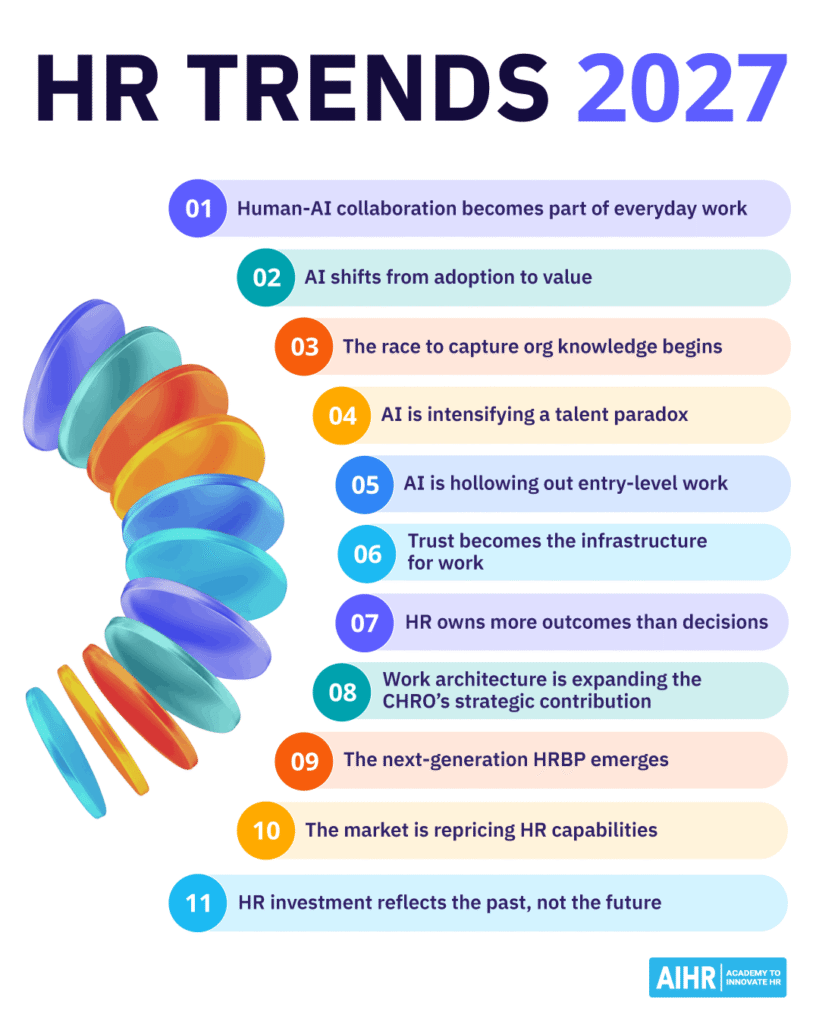
All of these changes will converge in 2027, reshaping the workforce, the business, and HR itself. At AIHR, we’ve identified 11 trends that will define the year.
Contents
1. Human-AI collaboration becomes part of everyday work
2. AI shifts from adoption to value
3. The race to capture organizational knowledge begins
4. AI is intensifying a talent paradox
5. AI is hollowing out entry-level work
6. Trust becomes the infrastructure for work
7. HR owns more outcomes than decisions
8. Work architecture is expanding the CHRO’s strategic contribution
9. The next-generation HRBP emerges
10. The market is repricing HR capabilities
11. HR investment reflects the past, not the future
1. Human-AI collaboration becomes part of everyday work
The first wave of workplace AI focused on tools that helped people complete individual tasks. Now, AI systems and agents are moving into the workflow itself, taking on more execution while human work shifts toward providing context, exercising judgment, validating outputs, and handling exceptions. Rather than people using AI as a tool, humans and AI are increasingly contributing to different parts of the same work. According to McKinsey Global Institute’s research, today’s technologies have the potential to automate more than half of current U.S. work hours, with people, agents, and robots increasingly complementing each other in carrying out the work.
That new division of work also changes what oversight and accountability look like. As AI agents gain more autonomy, organizations have to determine where human review is still needed, when people should step in, and who remains accountable for the outcome. The World Economic Forum points to autonomy as a key factor: the more independently an AI agent can act, the more its evaluation and oversight need to adapt.
Yet organizational redesign is lagging behind the technology. McKinsey’s State of AI research found that only 21% of organizations using generative AI have fundamentally redesigned at least some workflows, even though workflow redesign shows the strongest link to measurable financial impact. That leaves many organizations introducing AI into work without yet changing the workflows, roles, and oversight around how humans and AI contribute to it.
→ Bottom line: AI is becoming part of the workforce, changing how organizations divide work between human and artificial intelligence. That requires redesigning roles, workflows, oversight, and accountability around what each does best.
HR actions to take
- Map where AI already recommends, triggers, or executes work inside your HR team, and name explicitly who verifies it, who handles exceptions, and who owns the outcome.
- Look at where employee time is going after AI adoption, rather than only what it saved. New verification and oversight work is often the uncounted cost of automation.
- Build workforce planning that accounts for digital labor alongside human headcount, so decisions about capacity and hiring reflect the work AI is already doing rather than only who is on payroll.
2. AI shifts from adoption to value
With AI adoption now widespread, organizations are entering a harder phase: turning AI use into measurable business value. According to KPMG’s Global AI Pulse, 95% of organizations with annual revenues of at least $100M have an AI strategy, and nearly 40% are scaling AI or driving enterprise-wide adoption. Yet only 8% report established return on investment. The challenge is increasingly to show that those gains translate into better performance at scale.
Part of the difficulty is that the metrics organizations reach for first, like usage rates, number of use cases, and hours saved, describe activity and adoption rather than outcomes. Value comes from what the organization can do differently because AI has freed capacity, whether that means improving decisions, service, quality, or taking on higher-value work.
Individual experience compounds the confusion further. Glean’s Work AI Index found that 87% of digital workers use AI regularly and 75% feel more productive because of it, yet only 13% believe their organization is performing significantly better because of AI. The result is a widening gap between the productivity people experience individually and the performance organizations can see collectively.
Some of that gap is absorbed by work that conventional productivity measures may miss. Workday’s research found that nearly 40% of reported AI time savings are lost again to checking and correcting AI outputs. And the conditions around AI use matter at least as much as the people using it. Microsoft’s 2026 Work Trend Index found that organizational factors such as culture, manager support, and talent practices account for more than twice the reported AI impact of individual effort alone. Together, the findings suggest that widespread use and individual productivity gains are not enough to produce organizational value.
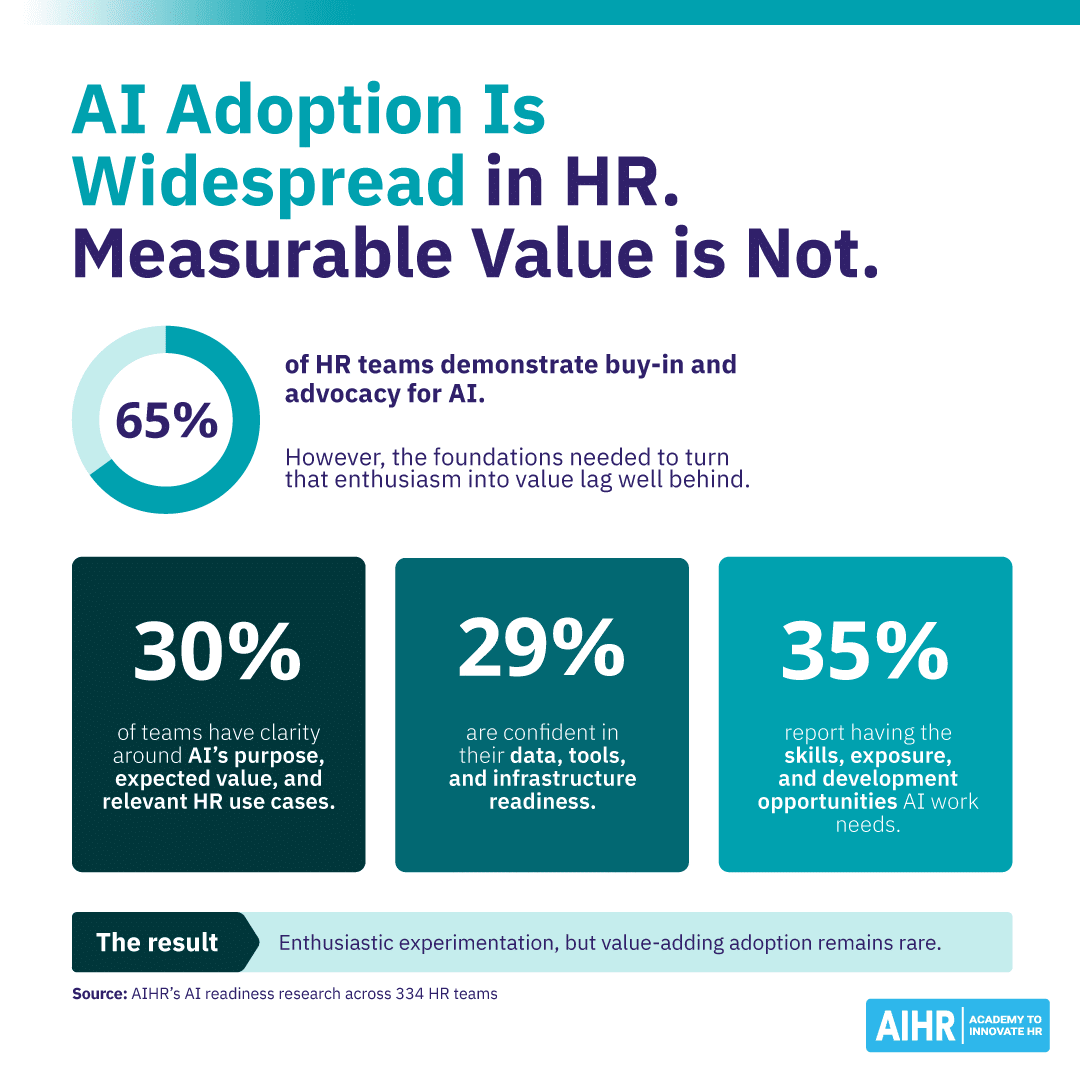
HR shows the same disconnect between AI enthusiasm and the foundations needed to turn it into value. AIHR’s AI readiness research across 334 HR teams found that while 65% demonstrate buy-in and advocacy for AI, only 30% have clarity around its purpose, expected value, and relevant use cases. Just 29% report confidence in their data, tools, and infrastructure readiness, and 35% in the skills, exposure, and development opportunities needed to support AI in daily work. In other words, enthusiasm is already widespread, but clarity about what AI should deliver and the capability to deliver it remain much less developed.
→ Bottom line: AI’s value comes from what organizations can do differently because of the capacity AI creates, not simply from how widely it is used or how much time it saves. Organizations need to deliberately redirect that capacity and measure whether the change improves performance, quality, decisions, or other business outcomes.
HR actions to take
- Track how teams use the capacity AI frees up, not only how many hours they save. Follow whether that time is redirected into higher-value work, absorbed by new tasks, or lost to rework and verification.
- Define the workforce outcomes that would show AI is creating value. Measure changes in quality, workload, capability, service, and productivity so success is not reduced to usage rates or efficiency alone.
- Measure AI value together with Finance and business leaders. Set the baseline, the outcomes to track, and how you will judge whether AI contributed to the change, with HR supplying the workforce data needed to make that assessment credible.
3. The race to capture organizational knowledge begins
As powerful AI models become available to everyone, the differentiation will come from what organizations can teach those models about their own business, including accumulated expertise, history, and unwritten judgment. The Financial Times points out that general-purpose AI models struggle with tasks depending on organization-specific knowledge, especially when that knowledge exists in people’s experience rather than formal documentation.
Evidence is emerging that models adapted to an organization’s own knowledge outperform general-purpose models on specific tasks. Microsoft reported that an AI model customized for McKinsey’s work performed better than GPT-5.5 on tested tasks, at around one-tenth of the cost. Gartner expects this shift toward specialization to accelerate, predicting that by 2027, organizations will use small, task-specific models at least three times as much as general-purpose LLMs. As models become easier to customize, the organization’s own data, processes, and institutional knowledge play a larger role in determining how useful AI can be.
Experienced employees know why a process really works the way it does, which exceptions matter, why a past initiative failed, or when the formal procedure should not be followed to the letter. AI gives organizations a new reason to surface that knowledge: once they’re able to capture it, they can embed it into systems and workflows instead of leaving it with individual employees.
The first challenge is capturing expertise that often sits in people’s heads rather than in formal documentation. Then comes trust: organizations want employees to share knowledge built up over years, while employees may wonder what happens to their own role once they do.
The pressure is reinforced by a changing talent market. AIHR’s Talent Operating Model Gap research shows that rapidly changing skill requirements, tighter immigration policies, and demographic shifts are making external talent harder to secure. That makes retaining employees who hold critical institutional knowledge a form of risk mitigation: once they leave, organizations may not be able to replace either their capability or their accumulated context easily from the external market. It also increases the value of moving expertise across roles, teams, and generations rather than leaving it with individual employees.
Retention and knowledge management, therefore, become two sides of the same problem. HR needs to help organizations keep critical expertise where possible while building mechanisms that allow that knowledge to circulate and remain accessible when employees eventually move or leave.
→ Bottom line: As AI access becomes widespread, proprietary organizational knowledge, especially the tacit kind held by experienced employees, is becoming a genuine source of advantage. Organizations need to protect that advantage by retaining critical knowledge holders and making their expertise transferable, with enough trust for employees to share what they know.
HR actions to take
- Identify where critical tacit knowledge is concentrated in a small number of people, and treat losing that knowledge as a business risk rather than only a staffing gap.
- Strengthen the mechanisms that already move knowledge between people, including mentoring, structured handovers, and internal mobility, instead of creating a separate knowledge-capture process.
- Be explicit with employees about why their expertise is being captured and what it means for their own role, since knowledge sharing depends on people trusting what happens to it next.
4. AI is intensifying a talent paradox
Getting value from AI-enabled work depends on people knowing what to ask of AI, when to challenge it, and how to apply its output in context. These human capabilities include judgment, problem framing, contextual understanding, and critical thinking. At the same time, AI also takes over some of this work through which people traditionally developed those capabilities, including analyzing information, weighing options, forming recommendations, and working through mistakes themselves. That’s why organizations need to think deliberately about how people will continue building these capabilities as more of that work shifts to AI.
Job requirements are already shifting in that direction. PwC’s 2026 AI Jobs Barometer found that new tasks emerging in the most AI-exposed roles are 2.5 times more likely to rely on human-intensive capabilities such as judgment, creativity, empathy, and leadership. BCG’s research among 70 C-suite leaders shows the other side of the paradox. While executives rank these kinds of capabilities among the most critical to long-term performance, half say they are seeing de-skilling in their organizations, referring to a gradual erosion of human capability as people offload more of their thinking to AI. At scale, that becomes an organizational risk, not simply an individual skills issue.
This changes what capability development needs to look like in AI-enabled work. Employees can use AI throughout a task while still taking responsibility for framing the problem, questioning assumptions, making key judgment calls, explaining why they accept or reject an output, and learning from the result. More than 60% of the leaders BCG surveyed expect de-skilling to become a material threat within three to five years. Organizations need to build these opportunities into everyday work if they want human capability to keep developing as AI use grows.
Those human capabilities become even more important as jobs and skill requirements change. They fall into a category known as durable skills: capabilities that retain their value across roles and as tools, technologies, and job requirements evolve. Judgment, problem framing, and critical thinking are transferable across tools and roles, helping people adapt even as technical knowledge and role-specific skills become outdated.
AIHR’s Talent Operating Model Gap research found that 33% of the skills in the average job changed across just four years. BCG estimates that AI will substantially reshape 50% to 55% of U.S. jobs within three years. Many people will remain in similar roles, but what organizations expect them to contribute will change. Durable human capabilities help people keep learning, adjust to new demands, and apply their expertise as the technical requirements of their jobs evolve.
Organizations should not assume they can hire those capabilities when needed. Mercer’s Global Talent Trends 2026 research found that 54% of C-suite leaders identify talent scarcity as the top force influencing their people plans. That makes development across the existing workforce increasingly important. Organizations need people to keep strengthening durable human capabilities while learning to work effectively with AI, since external hiring alone will not fill every capability gap as jobs change.
→ Bottom line: AI is making human judgment and critical thinking more valuable while also taking over some of the cognitive work that helps people develop them. Organizations will need to protect and build these capabilities across the existing workforce as they redesign work around AI.
HR actions to take
- Assess how well employees can apply judgment, problem framing, critical thinking, and contextual understanding in AI-enabled work, and target development where needed.
- Protect space for people to exercise judgment directly, rather than only reviewing AI output, since these capabilities weaken without regular use just as much as they grow through it.
- Use some of the capacity AI frees up for higher-skill work and development, giving employees more opportunities to solve complex problems, make decisions, and build expertise.
5. AI is hollowing out entry-level work
AI is shrinking the amount of entry-level work organizations need, and a large share of young workers are exposed to that shift. Research from the World Economic Forum and PwC finds that 37% of young workers globally are already in occupations with medium to high exposure to AI-driven task change. Stanford Digital Economy Lab found that employment among 22- to 25-year-olds in highly AI-exposed occupations has fallen relative to less-exposed occupations, with fewer young workers being hired into those roles.
Part of the reason lies in the work junior employees typically do. Drafting documents, reviewing files, compiling information, debugging code, and other structured tasks are relatively easy to delegate to AI because they follow established processes and can be checked against known standards. More experienced roles can contain just as much AI-exposed work. However, once AI handles parts of the execution, other responsibilities, like judgment, accountability, stakeholder ownership, and the need to verify the output, remain. Take routine execution out of many junior roles, and there may be much less left to hire for.
The remaining junior jobs are changing too. A 2026 study of U.S. job postings found that employers are responding to generative AI both by changing which roles they hire for and by redesigning the tasks within them. PwC’s analysis of 2.4 million U.S. entry-level postings found that highly AI-exposed roles are seven times more likely to require capabilities traditionally associated with experienced employees, including strategic decision-making, stakeholder management, and team leadership. Organizations are reducing some of the foundational work while expecting junior employees to arrive ready for work that previously came later in a career.
The same pattern is visible within HR. AIHR’s U.S. labor data analysis found that demand for HR Administrators, a common entry point into HR, fell nearly 30%. That narrows one of the pathways through which early-career HR professionals learn how the function operates, build business acumen, and develop judgment.
The broader problem is developmental. Entry-level work has traditionally given people repeated, low-stakes practice: analyzing information, spotting exceptions, making mistakes, receiving feedback, and watching experienced colleagues make decisions. Remote and distributed work, flatter structures, and stretched managers can compound the problem by reducing observation, coaching, and informal learning.
As entry-level work narrows across functions, employers will need to recreate those developmental experiences more deliberately rather than assume people will acquire them naturally as they progress.
→ Bottom line: AI is hollowing out entry-level work by removing many of the tasks that once made up junior roles, while raising the experience bar for the roles that remain. That leaves fewer ways into the workforce and a weaker path for building future experienced talent.
HR actions to take
- Identify which formative tasks AI has taken over in junior roles, and replace the learning those tasks provided through deliberate practice, coaching, or higher-skill assignments.
- Review how the bar for entry-level roles is changing, and make sure experience requirements, responsibilities, and pay rise together rather than expecting senior-level contribution on junior terms.
- Monitor the early-career talent pipeline, including junior hiring and progression into mid-level roles, so shrinking entry points do not become capability gaps years later.
6. Trust becomes the infrastructure for work
Organizational trust has always been shaped by how leaders behave and how organizations treat people. What is changing is that employees increasingly experience organizational decisions through AI and data-driven systems. Because those systems influence how work is assigned, monitored, evaluated, and rewarded, they now play a bigger role in whether employees see the organization as fair, transparent, and accountable.
Recent research points to trust becoming more system-dependent. The Association for Business Psychology’s 2026 evidence review describes trust as more conditional, uneven, and dependent on how organizational systems operate. Systems that treat similar cases consistently, have transparent decision logic, and allow employees to question outcomes can strengthen trust over time. AI raises the stakes because employees may not be able to see which data influenced a decision, how the system reached that decision, or who is accountable when it gets something wrong.
AI also gives organizations greater visibility into employee activity, collaboration, and performance. This can provide workforce intelligence that identifies workload risks and opportunities, but also risks turning into workforce surveillance when organizations collect unnecessary data and make consequential judgments without enough context. Even an accurate AI system must meet a legitimacy test around what data is collected, who is accountable for its outputs, and whether employees can challenge the decisions it shapes.
Deloitte’s research on trust in AI suggests that trust affects how confidently organizations can scale AI: employees who trust their employer may be more willing to flag problems and course-correct when risks emerge. Catalyst’s research shows why the design of those systems matters. AI can scale the structures and practices already embedded in an organization, reinforcing inequities when access, oversight, and governance are weak. Although 61% of organizations report having a responsible AI policy, only 21% of leaders say their organization is adopting AI in ways that minimize negative impacts on employees, and fewer than half say those policies address equity or inclusion.
Despite the workforce impact of these systems, HR still does not consistently shape how organizations govern them. SHRM’s 2026 State of AI in HR report found that 52% of organizations do not involve HR directly or through a cross-functional structure in setting overall AI strategy, with legal and compliance functions more commonly leading governance. That means decisions about workplace AI may be made without enough input on how those systems affect employees. As AI shapes more everyday workplace decisions, organizations will build or erode trust through the fairness, transparency, and accountability employees experience in those systems.
→ Bottom line: As AI influences more workplace decisions, organizations have to extend the same standards of fairness, transparency, and accountability that build trust to the technology and systems they introduce and govern.
HR actions to take
- Draw a clear, working boundary between workforce intelligence and workforce surveillance, and test existing systems against it rather than assuming good intent is enough.
- Give HR a defined role in AI governance when systems affect employees, including reviewing workforce risks, fairness, and employee impact before rollout.
- Provide employees with a clear way to question or appeal a consequential AI-influenced decision, since the ability to challenge an outcome does as much for legitimacy as the accuracy of the system itself.
7. HR owns more outcomes than decisions
HR is now expected to help deliver outcomes such as AI adoption, workforce productivity, critical capability, transformation, and organizational resilience. Those outcomes depend on decisions spread across the business: technology choices, investment levels, operating-model decisions, and business priorities all shape what HR can ultimately deliver. That creates a mismatch when HR is held accountable for an outcome it can only partly control. HR does not need to own every decision behind the outcome, but responsibility for delivering it has to be shared across the functions that shape it.
BCG and the World Federation of People Management Associations’ 2026 survey of more than 7,000 leaders found 65% see HR as a key business enabler, while 51% cited administrative workload as the main barrier to greater strategic contribution. The expectations are already high, but the capacity, authority, and infrastructure supporting them have not necessarily kept pace.
The first gap is one of timing and mandate. HR may be tasked with reskilling the workforce and driving adoption only after the technology, investment level, and automation targets have already been set. When HR enters after key decisions are already made, it has to deliver workforce outcomes within constraints it did not help shape. That makes it important to clarify what HR is accountable for, where it can influence decisions, and where responsibility needs to be shared.
The second gap is alignment on what HR is expected to contribute. HR and the business don’t always agree on what success looks like. CIPD’s survey of over 1,000 U.K. HR professionals found 60% believed their function made a valued strategic contribution, but only 49% said they could measure that contribution. HR, therefore, needs to agree with the business upfront on what it is expected to contribute to an enterprise outcome and what evidence will demonstrate that contribution.
The third gap is HR capability. HR’s mandate is expanding into workforce intelligence, organization design, transformation, and commercial decision support faster than the function is building depth in those areas. AIHR’s Future-Ready HR Skills research found that only 50% of teams believe they have the right skills to deliver impact. Business acumen, data literacy, and digital agility remain among the weakest areas, with commercial fluency lagging even among experienced HR professionals. That leaves HR accountable for increasingly complex outcomes while important parts of its capability base are still catching up.
These issues become more significant when they occur together. A CHRO may be accountable for productivity gains from AI even when HR had little input into the original target, lacks agreed measures of success, and does not yet have the capability to assess or deliver what is expected. Shared accountability works better when HR’s role in decisions is clear, success measures are agreed upfront, and the function has the capabilities to deliver its part.
→ Bottom line: HR’s accountability is expanding faster than its control over key decisions, clarity on success, and capability to deliver. Closing that gap requires shared ownership of outcomes, agreed measures of success, and the capability to meet them.
HR actions to take
- For any major shared outcome HR is accountable for, map out explicitly which decisions HR can make, which it can only influence, and where authority sits elsewhere, so accountability lines up with actual control.
- Agree with business leaders in advance what evidence will count as HR’s contribution to a given outcome, translating HR-level measures into the terms the business is already using to evaluate success.
- Identify which enterprise capabilities HR already has and where the gaps are. Build missing capability through direct involvement in transformation work and real workforce decisions, with training supporting that experience.
8. Work architecture is expanding the CHRO’s strategic contribution
CHROs are being drawn earlier into decisions about AI investment, enterprise technology, automation, M&A, and organization design. These choices have always affected people and work, but their workforce implications are becoming harder to separate from the decision itself. With AI in particular, choices about where and how to deploy the technology determine which tasks change, what capabilities the organization needs, and how roles and accountability are redesigned. This creates a more specific role for the CHRO: helping the business translate technology and strategic choices into changes in work, roles, and the organization.
The workforce perspective then comes in earlier, before the technology or operating decision is fully set. AIHR describes this as a dual role of HR: helping the enterprise redesign work in an AI-driven environment while transforming the HR function itself.
The shift is already measurable. Spencer Stuart’s 2026 survey of 101 European HR executives found 43% of CHRO roles now carry responsibilities beyond the traditional remit, extending into business strategy, technology, and capital allocation, and 37% of current CHROs entered the role from outside HR entirely. But a wider scope also brings greater pressure. CHROs with expanded responsibilities had an average tenure of 3.4 years, compared with 4.6 years for those without them.
A growing part of the CHRO’s contribution lies in helping the business redesign work around technology. Deloitte’s research shows that in one European telecommunications company, adding an AI “expert” to customer service without changing roles or workflows increased productivity by 5%. Redesigning the workflows, handoffs, escalation paths, and training around human-AI interaction increased productivity by 30%. More broadly, Deloitte found that organizations prioritizing work design were twice as likely to exceed their AI ROI expectations.
Yet businesses do not consistently involve HR in that work. Helios HR found that only 17% of mid-market organizations included HR as a strategic partner in AI initiatives, compared with 72% of organizations reporting successful AI strategies.
The opportunity is not for CHROs to own AI or technology strategy, but to bring work and organization design expertise into those decisions early enough to shape how the change is implemented. That means helping the business redesign roles, workflows, decision rights, and capability needs as technology changes the work itself. Organization design is not new to HR; what is changing is how frequently major business transformations now depend on it.
→ Bottom line: The CHRO’s contribution to business transformation is expanding as technology increasingly creates work and organization design challenges. That gives HR a clearer role in shaping how change affects roles, capabilities, accountability, and performance.
HR actions to take
- Build the habit of engaging in major technology, M&A, or operating-model decision-making processes while options are still open, rather than waiting to be looped in once a plan is set.
- Bring a concrete workforce case to these conversations, covering which roles change, what capacity gets created, and what risk that shift carries, rather than a general appeal for a “seat at the table.”
- Identify where HR lacks the capabilities enterprise work requires, then combine targeted development with hands-on involvement in workforce redesign, AI implementation, and organizational change.
9. The next-generation HRBP emerges
The labor market is starting to place greater value on HRBPs who work closely with a business area, understand its priorities and operating context, and advise leaders on complex decisions, an approach often referred to as embedded business partnering. Coordination-heavy versions of the role are under greater pressure.
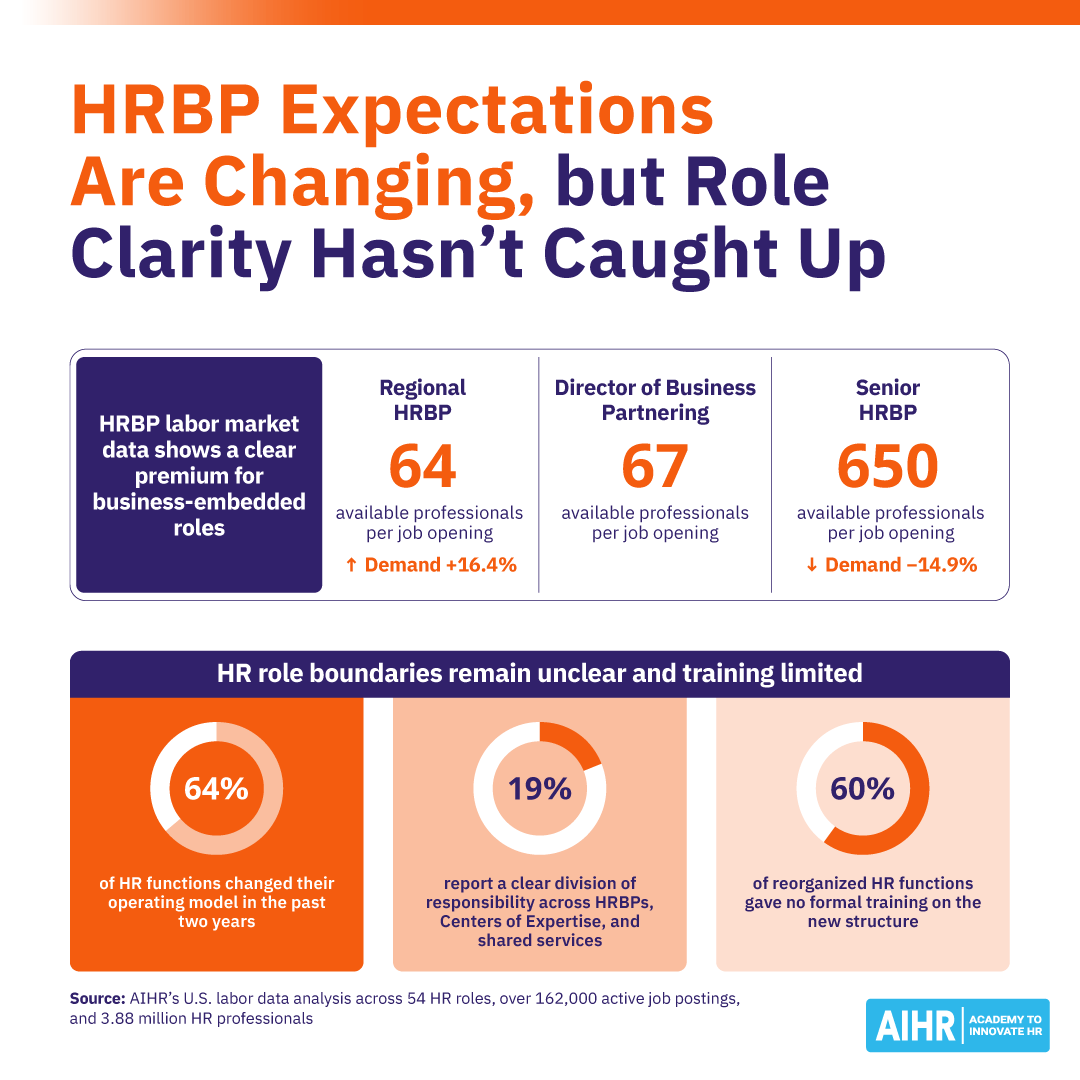
AIHR’s U.S. labor data analysis shows that Regional HRBPs and Directors of Business Partnering draw from much smaller candidate pools, with 64 to 67 available professionals per opening, while demand for Regional HRBPs rose 16.4% over six months. Other HRBP roles show a different pattern: Senior HRBP demand fell 14.9%, with 650 available professionals per opening. These differences suggest the HRBP role is starting to split, with the market rewarding embedded business partnering much more than the coordinating kind.
The labor market may be moving faster than the role itself. Gartner’s research found that only 51% of leaders agree their HRBPs are involved in important strategic discussions, suggesting that many HRBPs are still spending significant time on coordination rather than staying close to the business, advising leaders, and translating business needs into workforce decisions. As AI takes over more routine inquiries, drafting, summarizing, and routine decision support, HRBPs will have to create more of their value through contextual judgment, business understanding, and helping leaders work through complex people decisions.
This won’t happen automatically. AIHR’s State of HR 2026 research found that 64% of HR organizations changed their operating model in the past two years, yet only 19% report a clear responsibility division between HRBPs, centers of expertise, and shared services, and 60% of the reorganized functions gave no formal training on the new structure. If HRBP value is moving toward contextual judgment and complex advice, organizations need to be explicit about which business problems HRBPs should help solve, which decisions they should shape, and what they are accountable for.
→ Bottom line: AI is removing more of the coordination work that pulled HRBPs away from their core purpose, putting greater weight on business context, judgment, and complex advisory work.
HR actions to take
- Look at where HRBP time actually goes today, and move transactional and coordination work into shared services, centers of expertise, or AI-enabled channels so HRBPs can focus on work that depends on business context and judgment.
- Bring HRBPs into workforce and organizational decisions early enough to shape the outcome, with access to the business context behind those decisions.
- Set clear responsibility boundaries between HRBPs, centers of expertise, and shared services when the operating model changes, and back that redesign with practical training on how the new structure is meant to work.
10. The market is repricing HR capabilities
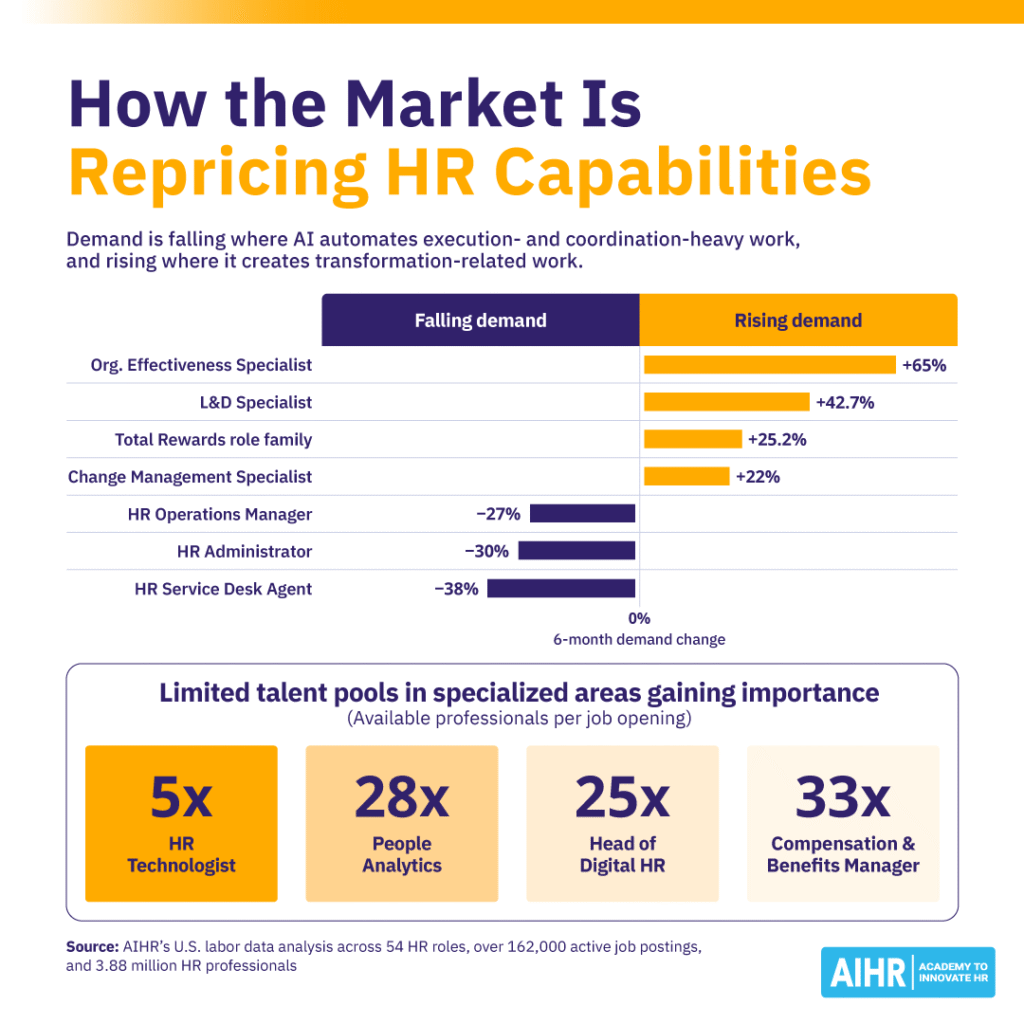
The shift visible in business partnering is part of a broader change in what the HR labor market rewards. The market is already placing a premium on capabilities tied to business judgment, technology, analytics, rewards, and organizational effectiveness, while roles focused on routine delivery and coordination are seeing their market value decline. AIHR’s U.S. labor data analysis shows demand for Organizational Effectiveness Specialists climbed 65.4% over just six months, while the demand for Change Management Specialists rose 21.6%.
Several of the specialized areas gaining importance also have relatively constrained talent pools. HR Technologist roles have about five available professionals per opening, Head of Digital HR 25, Head of People Analytics 28, and Compensation and Benefits Manager 33. Together, the demand and scarcity signals point to a growing premium on specialized capabilities that shape systems, workforce decisions, and how the organization operates.
At the same time, demand is weakening for roles centered on process execution and coordination. HR Service Desk Agent demand fell 38.3%, HR Administrator demand 29.6%, and HR Operations Manager demand 26.9%. This does not mean operational work no longer matters; it still has to happen, but AI and self-service are allowing organizations to handle more of that work with fewer people. As technology increases output per person, execution and coordination become less differentiated in the labor market, while the need for specialized capabilities grows.
The repricing is also showing up in pay. Robert Half’s 2027 Human Resources Salary Trends research found that 61% of HR leaders are adjusting their offers to compete more strongly for talent, while 52% have exceeded their planned salary range to secure specialized hires. Robert Half also projects above-average salary growth for several specialized HR roles, showing where competition for talent is strongest.
The implication is that job title and seniority are becoming weaker proxies for market value. Two HR roles at a similar level can face very different labor market conditions depending on whether the work relies on scarce expertise, business judgment, or repeatable execution. The capabilities inside the role are becoming a stronger determinant of what employers are willing to compete for.
→ Bottom line: The external labor market is placing a premium on HR capabilities that shape systems, pay, analytics, and organizational change, while demand is weakening for capabilities centered on coordination and execution.
HR actions to take
- Look past job titles to the underlying skills and capabilities the market is rewarding, since a senior generalist title does not necessarily signal more scarcity than a specialist role sitting lower in the hierarchy.
- Use scarcity, demand growth, and salary data together when assessing which HR capabilities are becoming harder to source externally, rather than relying on any single signal.
- Compare external scarcity with the capabilities you already have internally, and identify where development or redeployment could reduce dependence on a difficult hiring market.
11. HR investment reflects the past, not the future
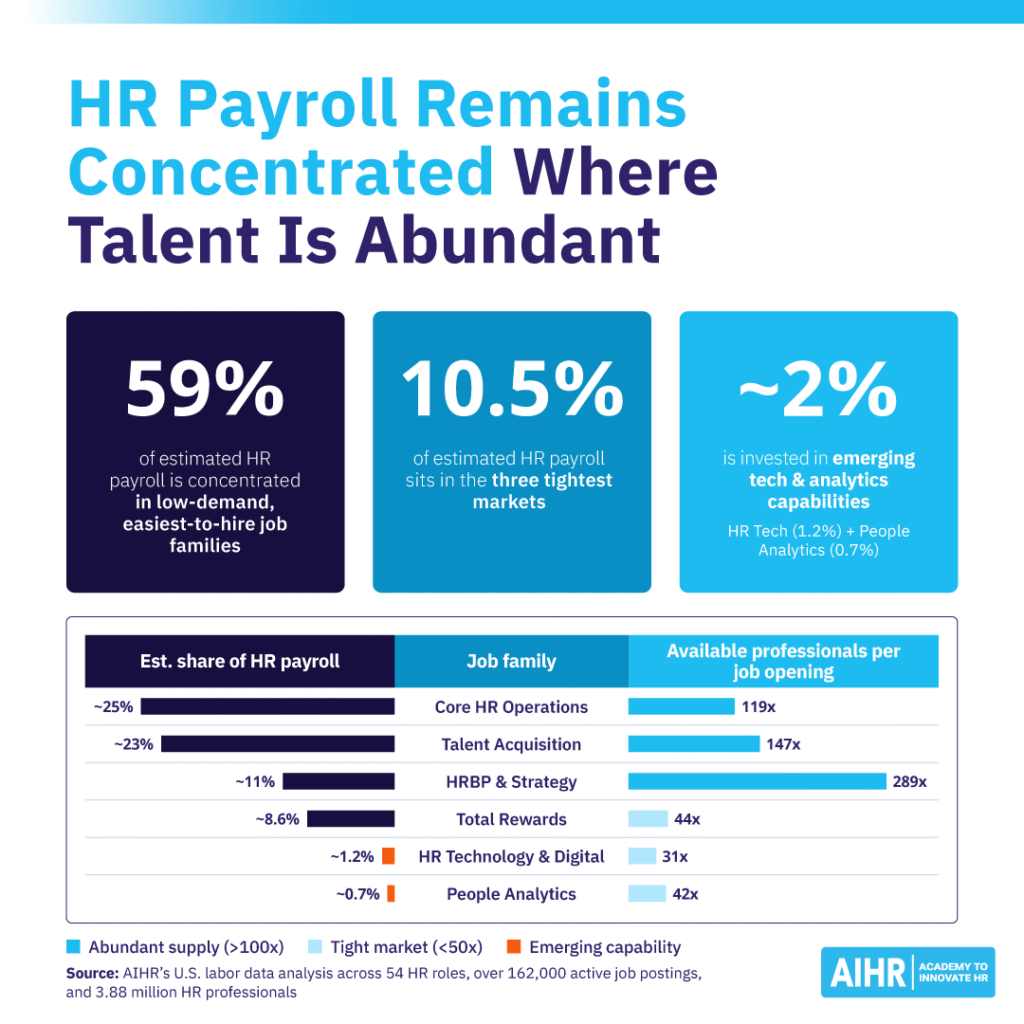
The market may be changing what HR capabilities are worth, but HR’s own resource mix has been slow to move. Hiring demand is growing for capabilities that increasingly drive organizational transformation, including organizational effectiveness, change management, technology, and analytics. Yet these capabilities still represent a small share of HR’s existing capacity, which remains concentrated in large, established role families.
AIHR’s U.S. labor data analysis provides a directional view of that imbalance: around 59% of HR payroll sits in role families with more than 100 available professionals per opening. Core HR operations comprise roughly 25% of payroll, and Talent Acquisition for 23%. HR Technology and Digital and People Analytics together account for around 1.9%, despite being among the tightest labor markets in HR. How HR allocates its people and payroll still reflects an operating model in which technology, analytics, and transformation carried less weight than they do today.
Much of this imbalance reflects how slowly workforce structures change. Headcount is sticky, shaped by years of service volumes and prior operating-model choices. AIHR’s analysis shows budget allocation tends to reflect history and current demand rather than strategy and future supply. So even when HR priorities shift, the function may still have most of its people and payroll tied to the capabilities it needed in the past.
Even as businesses expect HR to take on more analytics, transformation, and technology-enabled work, 51% of leaders still cite administrative load as a strategic barrier. That makes it harder to redirect people and payroll toward the capabilities HR increasingly needs. Some of those capabilities are also among the hardest to hire externally, which means waiting until demand becomes urgent can lead to longer vacancies, higher hiring costs, and delays to critical work. The longer HR’s investment remains concentrated in its historical workforce mix, the harder and more expensive it becomes to build the capabilities its future work requires.
→ Bottom line: HR’s internal allocation of headcount, payroll, and capability investment still largely reflects its current operating reality rather than the one its expanding scope requires. That gap can widen until underfunded capabilities become scarce and expensive to build or buy.
HR actions to take
- Map current HR headcount and spend against where the function’s scope is actually expanding, rather than treating the existing allocation as a neutral starting point for next year’s budget.
- Check whether operating-model changes have actually shifted capacity and capability to different work, not just changed reporting lines or team structures.
- Prioritize investment where future capability needs are growing, internal strength is limited, and external talent is difficult to source. That helps HR decide where to build capability before the gap becomes urgent.
Over to you
These 11 trends don’t describe a single technology story, but organizations trying to catch up with an environment where technology is evolving at an extraordinary pace. Businesses are redesigning work faster than they are clarifying accountability; they are asking more of HR without resourcing the function accordingly; and external markets are repricing capabilities faster than internal budgets can keep pace.
None of this resolves on its own. The organizations that will pull ahead in 2027 will be the ones that make deliberate choices about how work, accountability, capability, and investment need to change. HR’s focus should be on redesigning work around AI, protecting critical knowledge and human capability, and bringing the workforce perspective into business decisions earlier. The HR function won’t solve these challenges alone, but it sits at the center of all of them. 2027 is the year HR either claims that position or cedes it.