


The conversation about HR and AI usually starts with the workforce.
Which jobs will change? What skills will people need? How should employees learn to work with AI? How can managers lead through uncertainty? What will happen to workforce demand? These are important questions, and HR has a clear role in answering them. But they cover only one side of the transformation.
HR also needs to prepare itself for the organization and workforce that AI will create. That does not simply mean adopting AI tools within HR. It means asking whether HR’s mandate, practices, capabilities, and structure are suited to a business that may operate and compete very differently.
This leads to a dual role for HR in AI transformation. HR must help the workforce adapt to AI. At the same time, it must become the type of function that can support an AI-shaped and powered organization. And it has to become both these things as the business grapples with the impact of AI on the current operating environment.
The two responsibilities are closely connected. HR cannot decide how to prepare the workforce until it understands how AI is changing the business. And it cannot support that change effectively if it applies the same HR transformation agenda in every situation. There is no single form of AI transformation, and there should not be a single HR response either.

Start by understanding how the business is being disrupted
Most organizations are taking similar first steps in response to AI. They are introducing AI literacy programs, reviewing policies, assessing skills, updating roles, and automating selected processes.
These activities can be useful, but they can also create the impression that every organization is dealing with the same workforce challenge. This is a hidden trap, as the opportunities and advantages that AI can bring are not the same for each organization.
For example, a business using AI to reduce costs is building a different organization from one using it to redesign its operating model. In contrast, a company adding AI to its products and customer experience needs different capabilities from one creating a new AI-powered business model.
A broad AI skills program may support adoption, but it will not solve an organizational design problem. Updating job descriptions will not create the talent model needed for a new business venture.
Automating HR processes will not, on its own, prepare HR to guide a major shift in the operating model. So HR needs to start with a more fundamental question: How is AI changing our business specifically, and what strategic bets do we want to make to create value?
There are two main signals that provide insight into the type of transformation or disruption the business is navigating. The combination of these two signals also indicates where the organization is making its biggest AI bets.
Signal 1: Where do we want to leverage AI for value?
Is AI value creation primarily focused inward, on operations, productivity, processes, and the cost base? Or is it focused outward, on customers, products, markets, and how the organization competes?
Signal 2: What level of risk exposure are we willing to absorb?
Is the organization using AI to improve what already exists, implying a lower level of risk as AI is adopted into known areas of work? Or is it making a larger structural bet that changes how the business operates or what it offers, thereby applying AI into new territories or untested waters?
Together, these 2 signals create four transformation agendas: Smart Optimizer, Bold Reinventor, Customer Enhancer, and Market Disruptor. Each of these unlocks a different type of value for the business and requires different responses from HR.
Identifying where the organization chooses to play is a critical inflection point as the transformation agenda dictates the role and activities that HR should prioritize when dealing with the business.
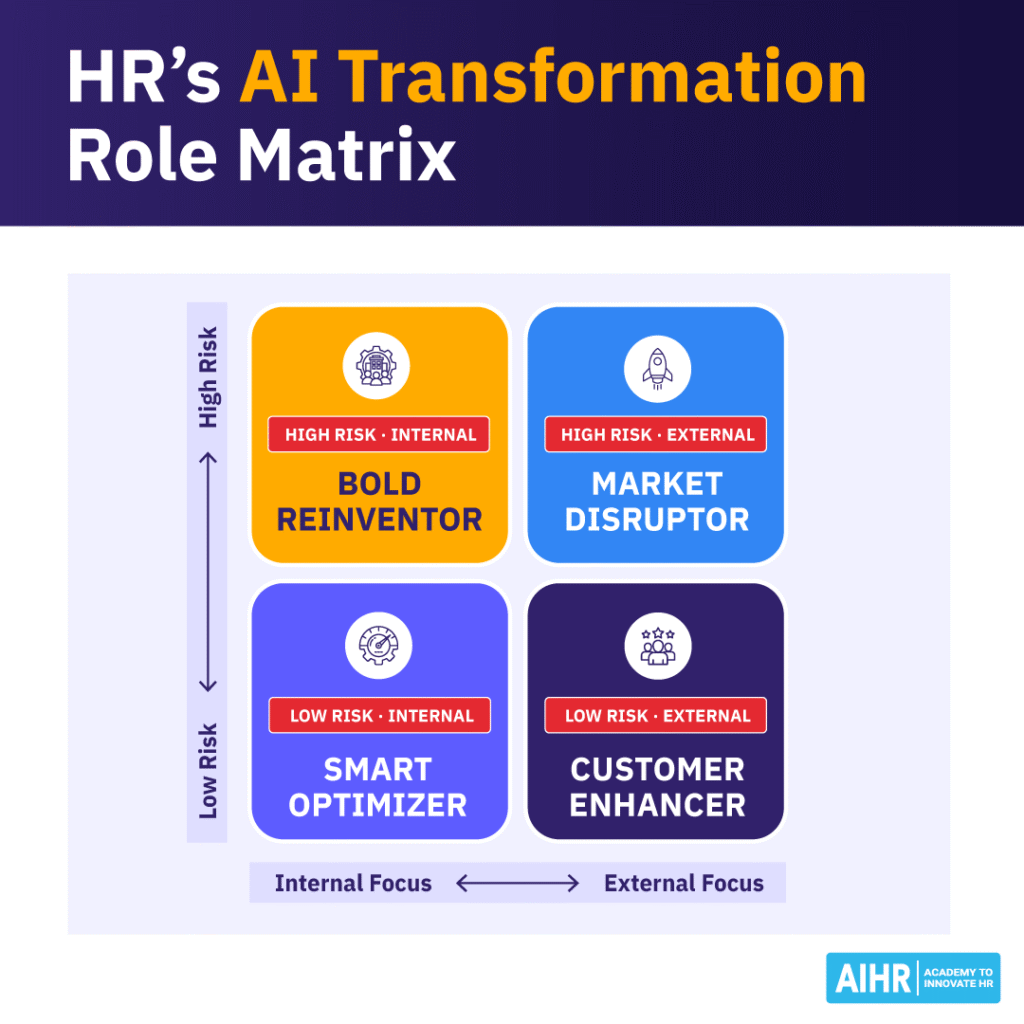
Most organizations will have activity in more than one area. A company may automate internal processes while also improving its products. It may restructure one function while experimenting with a new business model elsewhere.
Viewing transformation through these four agendas is not about neatly placing the organization into a category; rather, it shows where the most significant transformation is happening, what type of organization it is creating, and whether HR is responding accordingly.
Transformation agendas create different HR responses
The Smart Optimizer (Low risk x Internally focused)
In a Smart Optimizer agenda, AI is used to improve current business operations. Typically, processes become faster, errors reduce, teams handle more work, costs fall, and headcount may grow more slowly than business volume. However, the underlying operating and business models remain largely intact.
HR leaders can often recognize this agenda in how value is discussed and measured. AI projects are tied to productivity, cost savings, process speed, or error reduction. Investment is commonly led by operations, finance, IT, or individual functions. Business cases are clear, and returns are expected relatively quickly.
How this agenda develops
- Stage 1: Tool adoption. Individual employees or functions begin using AI to complete existing work faster, but the gains remain local and depend heavily on personal initiative.
- Stage 2: Process integration. AI becomes part of core workflows. Reporting is automated, approval steps are reduced, and work moves more quickly across the organization.
- Stage 3: Structural efficiency. The business can handle more volume without increasing headcount at the same rate, and the cost of delivering each unit of work begins to fall.
- Stage 4: Reinvest or plateau. The organization can use the savings, data, and capability it has built to fund a more ambitious transformation, or allow optimization to remain the final destination.
Changes in the workforce | HR’s response |
The first impact is usually on specific tasks rather than jobs. Routine processing, coordination, reporting, and first-line analysis begin to move to AI. Roles that once focused on producing or moving information are increasingly focused on oversight, judgment, quality control, and exception handling. This also changes workforce planning. If a team can handle significantly more work with the same number of people, business growth may no longer require a matching increase in headcount, but rather a redistribution of work between humans and AI. | Focus on the areas where work is changing fastest rather than launching the same intervention across the entire organization. Identify which tasks are moving to AI, clarify which human responsibilities remain, and redesign the most affected roles around judgment, oversight, and outcomes. Reskilling should be tied to those redesigned roles. Employees need clear pathways into work, such as exception handling, quality assurance, AI-supported decision-making, and process supervision. Update workforce plans that still assume a direct relationship between business volume and headcount. The question becomes less about how many people are required to process the work and more about which capabilities are needed to deliver the outcome. |
How HR must change
Apply the same optimization logic to its own function. High-volume administration should increasingly move to technology, while HR capacity shifts toward workforce analytics, work and job redesign, internal mobility, skills planning, and adoption.
If this is the business reality, HR becomes less focused on processing workforce activity and more focused on interpreting what higher productivity means for the shape and size of the workforce.
The Bold Reinventor (High risk x Internally focused)
A Bold Reinventor agenda implies that the organization is not simply making current processes more efficient, but AI is fundamentally changing how the organization operates. This means workflows are rebuilt around AI, management layers may be reduced, spans of control may widen, teams may become smaller, and decisions may be made faster and closer to the work.
The relationship between headcount, cost, and output changes at a structural level. This agenda is usually visible in the scale of the decisions being made. AI investment is connected to operating model redesign rather than a collection of automation projects.
The CEO or COO is likely to be directly involved. Leaders are reconsidering structures, decision rights, delivery models, and the work of entire functions.
How this agenda develops
- Stage 1: Process redesign. Core processes are rebuilt around what AI makes possible rather than adjusted to fit existing structures and handoffs.
- Stage 2: Operating model restructuring. Span of control widens, organizational layers reduce, and delivery models shift as AI takes on work previously carried out by larger teams or management structures.
- Stage 3: Competitive advantage. A structurally lower cost base, faster decisions, or a more flexible delivery model gives the organization room to change pricing, improve margins, or reinvest in growth.
- Stage 4: Structural moat. The organization is not simply running its old model more efficiently; it is harder to compete with because its underlying model has changed.
Changes in the workforce | HR’s response |
The organization is not only automating tasks, but it is also changing how work is organized. Team composition and traditional hierarchies may be reduced. Decision-making may move closer to the work, and entire role families or delivery models may be redesigned. This creates a more structural workforce challenge. The organization must determine what work still requires people, where expertise should sit, how accountability will work, and how the new operating model will function after the transition. | Take part in designing the new organization. That means helping leaders decide how work should be grouped, where decisions should sit, which roles the new model requires, and which capabilities must be retained or built. Identify the institutional knowledge held in roles that may be reduced or removed. If that knowledge is lost too early, the organization may remove the expertise needed to supervise AI systems, handle complex exceptions, or keep critical operations running. Balance speed with transformation. Moving too quickly can damage capability and continuity. Moving too slowly can leave the business caught between its old and new operating models. Prepare leaders for a flatter organization. Wider spans and fewer layers change how managers communicate, make decisions, develop people, and maintain accountability. |
How HR must change
HR needs stronger capability in organization design, workforce scenario planning, role architecture, transition management, and knowledge retention. Its own practices must become faster and more adaptable. A function built around stable structures, slow job evaluation, and lengthy approval processes will struggle to support an organization being redesigned at a pace.
To support this business agenda, HR cannot wait for the new structure to be designed and then manage its implementation. It needs to help shape what the new organization will be.
Practical application of the disruption matrix
One financial services organization had launched a broad AI agenda across the workforce. HR was running AI literacy training, reviewing skills, and planning large-scale job updates.
When we applied the matrix, the picture became clearer. Most investment was going into claims, compliance, service operations, and reporting. Success was measured through cost, speed, and lower error rates. The dominant agenda was Smart Optimization. That changed HR’s priorities.
Rather than redesigning every role, the team focused on the areas where work was already changing. It mapped tasks moving to AI, redesigned a small number of high-impact roles, and created targeted pathways into oversight, quality, and exception handling.
HR also revisited workforce planning assumptions and shifted its own investment toward workforce analytics, job redesign, and internal mobility. The framework helped the team move from a broad AI agenda to a focused transformation plan.
The Customer Enhancer (Low risk x Externally focused)
A Customer Enhancer uses AI to improve the customer experience with the existing business. This may include better personalization, smarter recommendations, faster service, more useful products, or more relevant customer interactions.
The business model remains recognizable, but the way value is delivered begins to change. The signals are often found in where investment is concentrated and how results are measured. AI activity sits within product, marketing, customer experience, sales, or service. Success is linked to retention, satisfaction, conversion, product use, or customer lifetime value.
How this agenda develops
- Stage 1: Feature layer. AI capabilities are added to existing products and services through assistants, recommendations, smarter search, or faster support.
- Stage 2: Experience redesign. AI is no longer an additional feature. The customer journey itself is rebuilt around personalization, intelligence, and more responsive service.
- Stage 3: Relationship deepening. The product or service learns from each interaction and becomes more useful to the individual customer over time.
- Stage 4: Loyalty moat. Customers stay not only because they like the product, but because the organization has built enough understanding and context that switching would mean starting again.
Changes in the workforce | HR’s response |
The main change is often in how teams work together. Product, data, technology, marketing, sales, and service become more interdependent. The teams building AI need a deeper understanding of customer needs and frontline realities. Teams using AI with customers need sufficient fluency to question outputs, apply judgment, and use the tools effectively. New hybrid roles may emerge, combining technical understanding with product, commercial, or customer expertise. The challenge is less about reducing workforce size and more about improving the organization’s ability to turn AI investment into better customer outcomes. | Focus on the capabilities and team conditions that connect AI investment to customer value. That means designing cross-functional teams around customer problems and defining the hybrid capabilities required in product and customer-facing roles. Contextualize learning. Employees should develop AI capability through real customer situations, live workflows, and the decisions they need to make. Course completion is a weak measure if employees cannot apply what they have learned to improve an actual customer outcome. Evolve role and career path design. HR needs to create pathways for people whose work combines technical, commercial, product, and customer expertise. Ethical judgment should be treated as part of that capability, particularly where AI influences personalization, pricing, service, or customer decisions. |
How HR must change
HR needs stronger skills intelligence, cross-functional team design, contextual learning, and more flexible job architecture. It also needs to work more closely with product, data, and customer teams. Supporting these functions from a distance will not provide enough understanding of how work and roles are changing in practice.
In this agenda, HR serves as a connector between technical capability, customer insight, and workforce development.
The Market Disruptor (High risk x Externally focused)
Organizations that have a Market Disruptor agenda use AI to create a different way of competing.
The organization may enter a new market, launch a new product type, reach customers it could not previously serve, or introduce a different revenue model. AI is not simply improving the existing business. It is making something new possible.
This agenda is often evident in the language and structure surrounding the investment. The focus is on growth, new revenue, or category creation. A dedicated venture, innovation, or product unit may be established. Teams have greater autonomy, and the organization starts recruiting people with profiles that differ from those in the core business.
How this agenda develops
- Stage 1: New capability. AI makes it possible to offer something that was previously too expensive, slow, difficult, or impossible to deliver.
- Stage 2: Market entry. The new product, service, or business model reaches customers, and the organization starts testing whether the market values it.
- Stage 3: Category definition. It begins to shape customer expectations and set the terms on which competitors must respond.
- Stage 4: Market leadership. But this is also the least certain of the four agendas. The same journey can end in a costly bet if customer demand, regulation, infrastructure, or execution does not develop as expected.
Changes in the workforce | HR’s response |
The new business may require a very different workforce from the core organization. It may depend on scarce technical and product talent, smaller teams, faster decisions, broader roles, greater autonomy, and a higher tolerance for experimentation. The core business, however, may still rely on consistency, scale, control, and predictable delivery. This creates a dual workforce challenge. HR has to support both without forcing one model onto the other. | Determine which parts of the talent model need to differ for the disruption agenda. Hiring may need to move faster, with decisions made closer to the business. Roles may need to remain broader and more flexible. Rewards may need to reflect a different talent market. Performance practices may need to focus on learning, experimentation, market progress, and evidence of customer demand rather than predictable short-term delivery. Clarify the decision authority of the new unit. Small teams cannot move quickly if every significant choice must pass through the core business’s governance. At the same time, the unit should not become completely disconnected. Create pathways that allow knowledge and talent to move between the core organization and the new venture. Give the disruption agenda enough freedom to operate differently while preserving access to the customers, knowledge, capital, and scale of the wider organization. |
How HR must change
HR needs a dual operating capability. It must remain disciplined and scalable where the core business needs consistency, while becoming faster and more tailored where the new business needs freedom.
This requires HR to become more deliberate about differentiation. Fairness does not always mean applying the same process everywhere. In some cases, using the same hiring cycle, reward structure, role model, or performance process across the whole organization can limit the business strategy.
In this agenda, HR’s task is to know where standardization supports performance and where it prevents it.
Practical application of the disruption matrix
In another organization, the matrix revealed two agendas operating simultaneously. AI-powered personalization sat in the Customer Enhancer quadrant, while a new digital service for a different customer segment sat closer to Market Disruptor.
Initially, HR supported both through the same hiring, learning, reward, and performance practices. The matrix showed why that was not working. The personalization agenda needed stronger cross-functional teams and contextual learning.
The new venture needed faster hiring, more flexible roles, and greater autonomy.HR stopped trying to force both into one model. It retained consistent practices where scale mattered and created a more tailored talent approach where speed mattered more. In both cases, the value of the matrix was not classification, but rather prioritization.
How to prepare HR for the organization that AI will create
To ensure HR can meet its dual transformation mandate, HR leaders should take four steps.
Step 1: Understand how AI is changing the business today
Use real investment, performance, customer, and workforce signals. Do not rely only on strategy documents or executive language.
The clearest signals are often found in a small set of practical questions:
- Where is AI investment going?
- Who owns the largest decisions?
- How is value being measured?
- What is changing in the organization?
- What can customers or competitors see?
- Where is workforce demand already shifting?
If returns are measured mainly through cost, speed, and productivity, the organization is likely leaning toward optimization.
If roles, layers, and delivery models are being redesigned, reinvention is underway. If investment is focused on product and customer outcomes, the agenda is likely enhancement. If AI is linked to new revenue, markets, or business models, disruption is the stronger signal.
Step 2: Identify the dominant transformation agenda
Determine whether the organization is mainly optimizing, reinventing, enhancing, disrupting, or deliberately building a portfolio across these agendas.
Step 3: Translate that agenda into its specific workforce and organizational implications
Define what it means for work, roles, skills, structure, leadership, culture, and workforce demand. Replace broad statements about AI readiness with clear choices about the organization that needs to be built:
What work will change? What roles and capabilities will be needed? How should the organization be structured? What will leaders need to do differently? What should remain consistent, and what needs to be redesigned?
Assess whether HR is equipped to support it. Review HR’s mandate, practices, capabilities, technology, structure, and measures. Decide what needs to be built, what needs to change, and which inherited practices no longer support the direction of the business.
The bottom line
Most HR teams are already preparing the workforce for AI. The next step is to prepare HR for the organization and workforce AI will create. That requires HR leaders to stop looking for a single transformation playbook. Different forms of disruption create different organizations, and each one requires a different HR response.
The role of HR is to understand which future the business is building and make sure the organization, the workforce, and HR itself are ready for it


