

Clear work goals matter to employee performance, engagement, and retention. And worryingly, according to Gallup’s most recent annual update of U.S. employee engagement, only 46% of employees strongly agree that they know what’s expected of them at work.
Staring at a blank page to help guide managers or employees? Start with these concrete work goals examples instead. Below, you’ll find 24 work goals examples across five categories you or your managers can adapt for performance reviews, development plans, and day-to-day team conversations. Use this library to show employees where to focus, what success looks like, and how their work connects to business priorities.
Contents
What are work goals and why do they matter?
How to set effective work goals with the SMART framework
24 work goals examples to guide employee performance
How HR can support effective employee goal setting
What are work goals and why do they matter?
A work goal is a specific, time-bound outcome that managers and employees agree on, based on a role or business priority. It’s different from a job duty. “Answer support tickets” is a duty, while “reduce average first-response time from six hours to three hours by the end of Q2” is a goal. A strong work goal doesn’t change someone’s responsibilities; it improves how they carry them out.
Effective goals work because they give employees a clear target, and give managers something concrete to coach against. They also connect day-to-day work to what the team and company are trying to achieve. Helping your people understand where to focus pays off. Recent McKinsey & Company research shows organizations that focus on their people’s performance are 4.2 times more likely to outperform their peers.
To ensure company-wide consistency, HR should own the goal-setting process, not each manager on their own. This doesn’t mean HR writes every goal; it means HR sets the format, timing, review process, and expectations, so goals stay consistent across the business.
Establishing and tracking goals gives HR better data for pay, promotion, and development decisions. It also helps motivate employees by giving them a clear target to work toward, and a better sense of progress.
You can spot useful patterns across goals, too. When many managers and employees set goals around the same skill, your business probably needs more of that skill. That’s an early signal of where to spend your training budget, instead of waiting for a full skills review to confirm the gap later.

How to set effective work goals with the SMART framework
The SMART framework helps turn vague ideas into goals people can act on. Each goal should be Specific, Measurable, Achievable, Relevant, and Time-bound. Without this structure, goals stay vague. For example, “speed up our hiring” sounds useful, but you can’t act on it, measure it, or know when it’s done. Here’s how to turn it into a SMART goal:
Before (vague): Speed up our hiring.
After (SMART): Cut time-to-hire for engineering roles from 45 days to 30 days by the end of Q2 by adding a pre-screen step before hiring-manager review.
The second version works because it spells out what needs to change and by when:
- Specific: It names the metric, the role type, and the action (time-to-hire, engineering roles, and a pre-screen step).
- Measurable: The move from 45 days to 30 days is easy to track in your applicant tracking system (ATS).
- Achievable: Cutting 15 days by fixing one bottleneck is realistic.
- Relevant: Open roles strain the teams they’re meant to support, so faster hiring matters.
- Time-bound: “By the end of Q2” gives the goal a clear deadline.
For more SMART goal examples and a deeper look at how to use them, AIHR’s guide to HR SMART goals explains how to build them, and the employee goal setting guide helps you run the process across a team.
Clear work goals help employees understand where they’re headed, and help you connect those goals to longer-term development, mobility, and organizational needs. Build the talent management skills you need to make these connections and drive employee development.
AIHR’s Talent Management & Succession Planning Certificate Program gives you the practical tools to:
✅ Design a talent management approach that connects people priorities to business goals
✅ Build succession pipelines and development pools for critical and leadership positions
✅ Support career management and talent mobility to keep key employees engaged and growing
💡 Explore the AIHR Demo Portal to preview lessons and discover what you could learn next.
24 work goals examples to guide employee performance
Use these examples as starting points for performance, development, communication, leadership, and process improvement goals.
Performance and productivity goals
Goal example 1: Demo bookings
Increase qualified demo bookings from 12 to 20 per month by the end of Q3 by tightening lead-qualification criteria.
- Specific: Grow qualified demo bookings by applying stricter lead-qualification criteria.
- Measurable: Move from 12 to 20 bookings per month.
- Achievable: Refines an existing pipeline instead of building a new one.
- Relevant: Qualified demos feed directly into revenue targets.
- Time-bound: By the end of Q3.
Goal example 2: Reporting admin
Cut monthly reporting time from eight hours to three within 60 days by building a reusable template and automating the data pulls.
- Specific: Cut reporting time by building a reusable template and automating the data pulls.
- Measurable: Reduce the monthly report from eight hours to three.
- Achievable: Streamlines an existing report instead of rebuilding it from scratch.
- Relevant: Gives the team a full workday back each month for higher-value analysis.
- Time-bound: Within 60 days.
Goal example 3: Customer satisfaction
Raise your customer satisfaction (CSAT) score from 78% to 90% within 90 days by resolving every follow-up query within one business day.
- Specific: Lift CSAT by resolving follow-up queries within one business day.
- Measurable: Move the score from 78% to 90%.
- Achievable: Improves response time on existing tickets, instead of adding headcount.
- Relevant: Satisfaction scores connect directly to retention and renewals.
- Time-bound: Within 90 days.
Goal example 4: On-time delivery
Close 95% of your assigned tasks by their agreed due date for two consecutive quarters.
- Specific: Hit agreed due dates on assigned tasks.
- Measurable: Reach a 95% on-time completion rate.
- Achievable: Tracks delivery you already own instead of adding new work.
- Relevant: Predictable delivery builds trust with your team, clients, and stakeholders.
- Time-bound: Across two consecutive quarters.
Goal example 5: Data accuracy
Reduce your data-entry error rate from 4% to under 1% by the end of Q2 by adding a second-pass check before anything goes out.
- Specific: Lower the error rate by adding a second-pass check before submission.
- Measurable: Drop from 4% to under 1%.
- Achievable: Adds one verification step to an existing process.
- Relevant: Fewer errors reduce costly rework for the whole team.
- Time-bound: By the end of Q2.
Professional development and skill-building goals
Goal example 6: Analytics upskilling
Complete a recognized people analytics certificate and apply it to one live workforce report by the end of Q4.
- Specific: Earn a People Analytics certificate and use it on a real report.
- Measurable: One certificate completed and one workforce report delivered.
- Achievable: Pairs structured study with a report you already produce.
- Relevant: People analytics skills help HR make better workforce decisions.
- Time-bound: By the end of Q4.
Goal example 7: Presentation skills
Deliver three internal presentations this year and collect peer feedback after each one.
- Specific: Present to internal audiences and gather structured peer feedback.
- Measurable: Three presentations, with feedback captured after each.
- Achievable: Uses existing team meetings instead of external speaking opportunities.
- Relevant: Strong presentation skills build influence and prepare employees for more senior roles.
- Time-bound: Across the current year.
Goal example 8: Language skills
Reach B1 conversational Spanish within nine months by studying 30 minutes a day and joining a weekly practice group.
- Specific: Build conversational Spanish through daily study and a weekly practice group.
- Measurable: Reach a B1 proficiency level.
- Achievable: A daily 30-minute habit is realistic alongside a full workload.
- Relevant: Spanish skills can support work with Spanish-speaking colleagues and clients.
- Time-bound: Within nine months.
Goal example 9: Data tooling
Earn an Artificial Intelligence for HR certificate within four months and build one HR agent with it.
- Specific: Complete an AI for HR certificate program and apply the skills you’ve learned to one HR workflow.
- Measurable: One credential earned and one HR agent built.
- Achievable: Focuses on one credential and one practical output.
- Relevant: Practical AI skills can save time on recurring HR tasks.
- Time-bound: Within four months.
Goal example 10: Stakeholder exposure
Shadow a senior colleague in five stakeholder meetings, then lead one yourself this quarter.
- Specific: Observe a senior colleague in stakeholder meetings, then run one yourself.
- Measurable: Five meetings shadowed and one led.
- Achievable: Builds on meetings already on the calendar.
- Relevant: Stakeholder management is a key skill for stepping up.
- Time-bound: Within the quarter.
Communication and collaboration goals
Goal example 11: Team handoffs
Cut missed handoff deadlines between your team and one partner team by half within a quarter by running a 15-minute daily stand-up.
- Specific: Reduce handoff misses with a short daily stand-up between two teams.
- Measurable: Cut the number of missed handoff deadlines by half.
- Achievable: Adds a 15-minute habit, not a full process overhaul.
- Relevant: Clean handoffs keep delivery on schedule.
- Time-bound: Within one quarter.
Goal example 12: Message response time
Respond to internal messages within four working hours, measured over a calendar month.
- Specific: Reply to internal messages within a set response window.
- Measurable: Respond within four working hours, tracked over a calendar month.
- Achievable: Creates a realistic response window while still protecting focus time.
- Relevant: Predictable replies stop other people’s work from stalling.
- Time-bound: Measured over one calendar month.
Goal example 13: Stakeholder updates
Publish a stakeholder update every Friday for a full quarter.
- Specific: Send a regular written status update to stakeholders.
- Measurable: One update every Friday.
- Achievable: Builds a short recurring update into the week.
- Relevant: Scheduled updates reduce status-chasing and repeat questions.
- Time-bound: For a full quarter.
Goal example 14: Project retrospectives
Run a retrospective review after every project this quarter and log two agreed improvements each time.
- Specific: Hold a retrospective at each project close and record actions.
- Measurable: One retrospective per project, with two agreed improvements each time.
- Achievable: Adds a light session to existing project wrap-up.
- Relevant: Turns lessons into changes instead of repeating the same mistakes.
- Time-bound: For every project this quarter.
Goal example 15: Peer feedback
Give structured feedback to at least two peers a month for a full quarter using a simple situation-behavior-impact format.
- Specific: Give peer feedback using the situation-behavior-impact format.
- Measurable: Share feedback with at least two peers each month.
- Achievable: Sets a modest monthly target using a simple structure.
- Relevant: Specific feedback can strengthen team performance and trust.
- Time-bound: Across a full quarter.
Leadership and people-management goals
Goal example 16: One-on-ones
Hold biweekly one-on-ones with every direct report for two quarters and capture one development action from each meeting.
- Specific: Run regular one-on-ones and record a development action each time.
- Measurable: Meet biweekly with every direct report and capture one action per session.
- Achievable: Creates a predictable rhythm instead of relying on ad hoc check-ins.
- Relevant: Consistent one-on-ones help people grow and stay aligned.
- Time-bound: Across two quarters.
Goal example 17: Team engagement
Raise your team’s engagement-survey score from an average of 3.6 out of 5 to 4.0 out of 5 by the next survey cycle.
- Specific: Improve the team’s engagement survey results.
- Measurable: Move from 3.6 to 4.0 out of 5.
- Achievable: Focuses on a measured score that the team already tracks.
- Relevant: Engagement scores help managers understand the environment they’re creating.
- Time-bound: By the next survey cycle.
Goal example 18: Internal mobility
Move two team members into stretch roles within 12 months through documented development plans.
- Specific: Help team members move into stretch roles through documented development plans.
- Measurable: Move two people.
- Achievable: Sets a realistic number and supports it with clear plans.
- Relevant: Growing people from within supports retention and succession planning.
- Time-bound: Within 12 months.
Goal example 19: Voluntary turnover
Cut voluntary turnover on your team from 18% to under 10% before year-end by acting on common themes from exit interviews.
- Specific: Lower voluntary turnover by addressing recurring reasons people leave.
- Measurable: Reduce turnover from 18% to under 10%.
- Achievable: Targets known issues such as promotion paths, manager feedback, or pay.
- Relevant: Turnover increases recruitment costs and drains team knowledge.
- Time-bound: Before year-end.
Goal example 20: Development conversations
Reach 100% completion of quarterly development conversations with your direct reports for the next two quarters.
- Specific: Complete a development conversation with every direct report each quarter.
- Measurable: Reach 100% completion.
- Achievable: Schedules a conversation, not a new program.
- Relevant: Development talks often fall off when work gets busy.
- Time-bound: Across the next two quarters.
Process improvement and efficiency goals
Goal example 21: Onboarding setup
Reduce new-hire setup time from five days to three within 90 days by standardizing the IT and access checklist.
- Specific: Speed up new-hire setup with a standard IT and access checklist.
- Measurable: Cut setup time from five days to three.
- Achievable: Standardizes steps you already run for every hire.
- Relevant: A smooth first week shapes how new hires experience your organization.
- Time-bound: Within 90 days.
Goal example 22: Task automation
Automate three recurring manual tasks by the end of Q3, saving the team at least 10 hours a month.
- Specific: Replace recurring manual tasks with automated workflows.
- Measurable: Automate three tasks and save at least 10 hours a month.
- Achievable: Focuses on three known, repetitive tasks.
- Relevant: Time saved on manual work can go toward higher-impact activities.
- Time-bound: By the end of Q3.
Goal example 23: Invoice approval
Shorten the invoice-approval cycle from seven days to three by year-end by removing one non-critical sign-off.
- Specific: Speed up invoice approval by cutting a redundant sign-off.
- Measurable: Reduce the cycle from seven days to three.
- Achievable: Removes a single step instead of rebuilding the process.
- Relevant: Faster approvals improve supplier relationships.
- Time-bound: By year-end.
Goal example 24: Workflow efficiency
Map and streamline one core workflow per division each quarter, cutting its step count by 10% to 20%.
- Specific: Map a core workflow in each division and remove unnecessary steps.
- Measurable: Cut the step count by 10% to 20% each quarter.
- Achievable: Improves one workflow at a time, per division.
- Relevant: Small, steady process improvements can add up to major time savings.
- Time-bound: Every quarter.
How HR can support effective employee goal setting
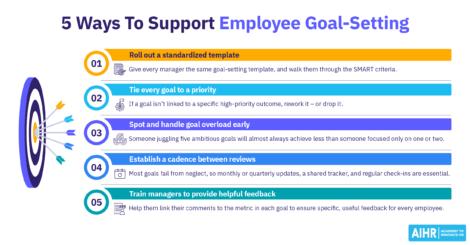
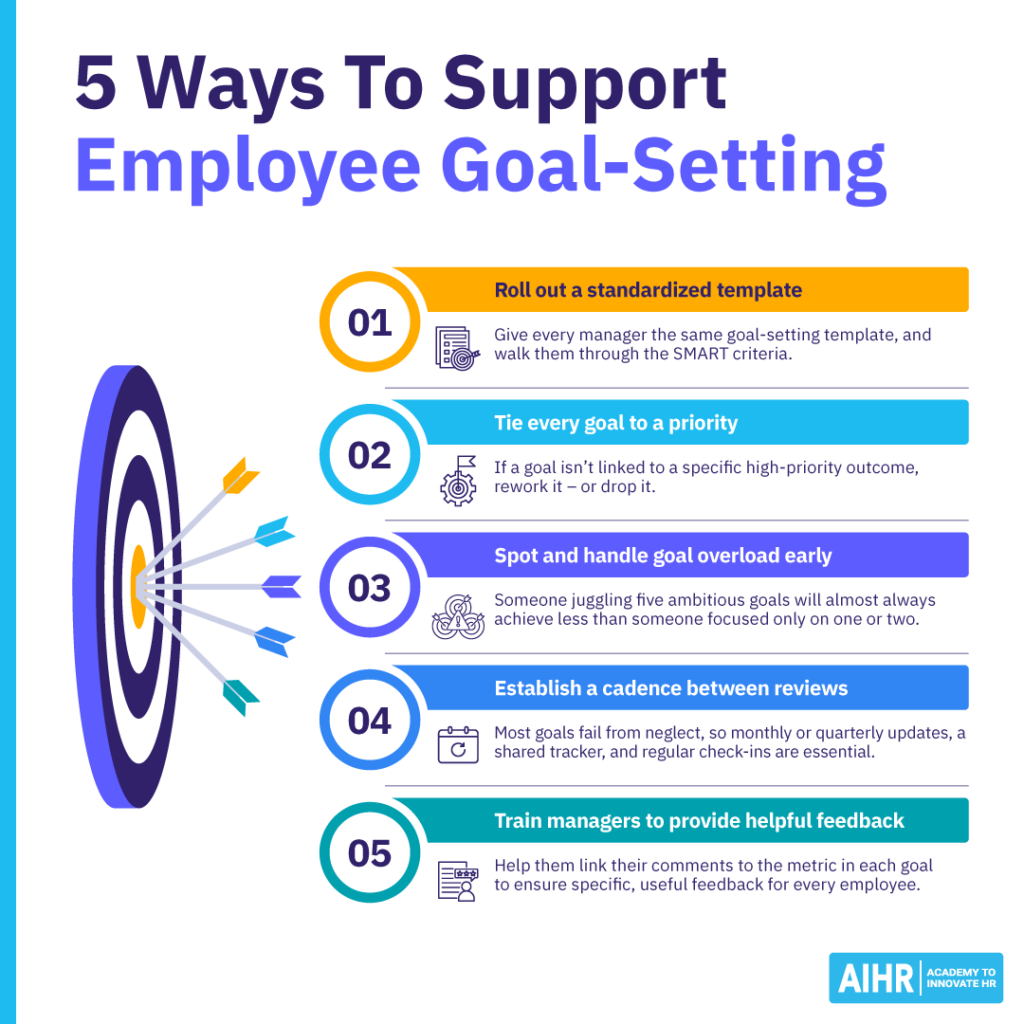
Managers set goals with their employees, but the quality of those goals depends on the system HR builds around them. Use these five tips to guide the process:
- Roll out a standard template: Give every manager the same goal setting template, then use the work performance goals examples above as models. Walk managers through the SMART criteria so they know how to build useful goals, not just approve whatever gets submitted.
- Connect every goal to a priority: 23% of employees say they don’t know how hitting their goals affects the organization’s success. If a goal doesn’t link to a clear business priority, rework it or drop it. Once the goal is in place, explain how it supports the company.
- Catch goal overload early: A team member juggling five ambitious goals will almost always achieve less than someone focused on one or two. Help managers set priorities before goals start competing with each other.
- Set a check-in rhythm between reviews: You don’t want goals set in January and forgotten by March, as goals fail if no one follows up. Monthly or quarterly updates, a shared tracker, and regular check-ins can keep goals alive.
- Train managers to give helpful feedback: Help them tie review comments to the metric in the goal, not just to a general impression of effort. For instance, “You hit 90% on-time delivery, up from 70%” tells someone more than “well done, great work this quarter” ever will.
Next steps
Strong work goals help you choose outcomes that matter, add real numbers and dates, and check progress often enough to keep the work moving. Build that habit to turn goals into a practical tool for growth for you, your managers, and your employees.
To build these skills deliberately, AIHR’s Talent Management & Succession Planning Certificate Program covers how to connect goal setting to development, internal mobility, and career growth across your organization. It’s a practical way to turn good intentions into a repeatable system your whole team can use and add measurable wins to your résumé.