


People come into Human Resources from all sorts of backgrounds. Some study HR directly, others arrive from fields like psychology, business, or law, and many move across from adjacent roles in recruitment, administration, or operations. That variety is exactly why there is no single best degree for HR. The function sits at the meeting point of business, psychology, law, and data, so several paths can prepare you well. The right choice depends on where you are starting from, the kind of HR work you find interesting, and how far you want to climb.
This guide walks through the degrees most relevant to an HR career, what each one emphasizes, and the roles it tends to lead to. It also looks at how degrees compare with other ways of building HR skills, like online HR learning, so you can map a path that fits your goals and your budget.
Contents
Do you need a degree to work in HR?
The main degree fields for HR
HR degrees vs other learning options
How to choose the right path for you
Key takeaways
- There is no single best degree for HR. Common degrees for HR professionals span HR management, business, I/O psychology, and labor relations, each suiting different goals.
- A degree helps but is not always required to enter HR, though requirements rise with seniority, from about 49% of HR specialist roles to 82% of HR manager roles.
- Successful HR professionals build their skills in different ways, often combining formal study, hands-on experience, and professional certifications.
- Online HR learning helps fill the gaps a degree can leave. Practical courses, including AIHR’s, build current HR skills and feed recertification credits for professional HR credentials.
Do you need a degree to work in HR?
A degree often helps you land an HR role and is expected for many positions, but it is not always a strict requirement. According to the recent U.S. Bureau of Labor Statistics, a bachelor’s degree was required for roughly 49% of HR specialist roles, while about 40% listed a high school diploma as the requirement. Prior work experience mattered for around three-quarters of positions.
At the same time, BLS workforce data shows that Human Resources specialists typically need a bachelor’s degree in Human Resources, business, communications, or a related field, and earn a median of around $73,000 a year.
Requirements also tighten as roles become more senior: for HR manager positions, O*NET reports that about 82% call for a bachelor’s degree.
Overall, the pattern that emerges is clear: employers care most about whether you can do the work. A degree is one way to prove that, and a common one, yet it is not the only route. What hiring managers consistently look for are the skills behind the credential:
- Core HR knowledge: A working grasp of HR process, recruitment, employee relations, compensation and benefits, and employment law.
- Data literacy and analytics: People decisions now lean on metrics, so the ability to read and act on HR data is increasingly expected.
- Business acumen: HR professionals increasingly need to connect their work to organizational goals.
- Communication: Strong written and verbal skills, since HR works with people at every level daily.
- HR technology: Comfort with the systems and tools that run modern HR processes.
A degree in a relevant field is an efficient way to build that foundation. Candidates who enter from adjacent disciplines, or who move across from another function, can build the same capability through targeted learning and on-the-job experience, often paired with a professional certificate that signals readiness to employers.
The main degree fields for HR
Several degree paths feed into HR careers. Each one shapes your knowledge in a slightly different direction.
Human Resource Management
A degree in human resource management is the most direct path for someone aiming for a career in HR. It covers the full breadth of the function, from talent acquisition and performance management to compensation, employee relations, and HR strategy. It suits people who already know they want a career in HR and want to enter ready to contribute.
Graduates commonly start as HR generalists, coordinators, or specialists. Available at the bachelor’s and master’s level, it gives strong technical depth, though some programs cover less of the wider business context, which is worth supplementing. It is also one of the most common backgrounds in the field, with human resource management the second-most-cited major on HR resumes (around 25% for HR business partners), behind only business.
Business Administration and the MBA
A business degree, including an MBA with an HR concentration, builds a broad understanding of how an organization works across finance, marketing, operations, and strategy. It demonstrates commercial fluency and credibility, which matters in senior HR conversations.
This path suits people who want flexibility to move between functions or who aim for HR leadership. The trade-off is depth: most business programs include only a few HR courses, so technical HR knowledge often needs reinforcing through experience or certification.
Business is, in fact, the single most common major among HR professionals, according to Zippia’s analysis of resumes. Roughly a third of HR specialists, generalists, and managers have a degree in business, which reflects how much employers value commercial grounding.
Industrial and Organizational Psychology
Industrial and organizational psychology focuses on human behavior at work, including motivation, assessment, selection, and performance. Programs build rigorous skills in statistics, research, and data analysis, which align closely with the rising importance of people analytics.
This degree suits analytically minded people drawn to areas such as talent assessment, selection, and organizational research. Usually pursued at the master’s or doctoral level, it offers deep behavioral and quantitative expertise, with less coverage of general business topics like finance or marketing.
Labor and Industrial Relations
Labor and industrial relations programs concentrate on the employment relationship, labor law, collective bargaining, and dispute resolution. Modern versions also cover the wider HR body of knowledge. This path suits people interested in unionized environments, labor relations, or employment law, and it pairs well with a law degree.
Graduates work as HR generalists or as specialists in labor relations, mediation, or workforce policy. The trade-off is that its focus is narrower than a general HR degree, so it offers less breadth if you later move into other areas of HR.
Organizational Development and Organizational Behavior
These degrees combine organizational behavior with development, centered on leading change. Coursework typically spans leadership, motivation, planned change, and applied behavioral science. The path suits people drawn to consulting, transformation work, culture, and organizational effectiveness. It produces strong diagnostic and change-management skills. As with I/O psychology, the emphasis sits more on behavior and change than on the operational mechanics of running an HR department, which experience can fill in.
Management
A management degree focuses on leadership and organizational behavior, with a broader scope than a dedicated HR program. It prepares graduates for management roles across public and private organizations and gives a solid grounding in leading teams.
Students usually take fewer HR-specific courses, so those committed to HR often combine it with applied HR learning or a certification to add functional depth. Around 4% of HR specialists have a major in management.
Adjacent majors
Several other majors can be a good fit if you want to build a career in HR. Each builds useful ground, though none is HR-specific:
- Psychology: Builds insight into behavior and motivation, which supports HR work in areas such as employee engagement, assessment, and performance. It is a common entry point into the HR field, named by around 8% of HR specialists.
- Sociology: Develops an understanding of groups and organizations, useful for shaping culture, diversity and inclusion, and workforce dynamics.
- Communications: Strengthens the interpersonal and writing skills HR relies on daily, from employee relations to policy and internal messaging.
- Education: Builds skills in learning design and facilitation, which transfer directly into training, onboarding, and learning and development roles.
Because these majors sit outside HR specialization, graduates usually layer on practical HR knowledge through early roles, internships, or focused courses to become competitive.
HR degrees vs other learning options
Getting a relevant degree is one route to an HR career, and it is worth weighing against the alternatives before committing several years and significant tuition.
A degree gives you a structured, in-depth foundation, whether that is in HR itself or in a related field such as business or psychology, and it clears the bachelor’s bar that most HR employers expect, especially for manager roles. The cost is real, in both time and tuition, and even an HR-specific curriculum can lag behind fast-moving areas of the profession, such as people analytics and AI in HR, where practice changes faster than syllabi.
Online HR learning
Online HR learning platforms close that gap by teaching the HR skills employers are hiring for now, and do so in weeks rather than years. They suit several situations: people entering HR who need to build foundations quickly, professionals who want to move into a specialism or step up to a more strategic HR role, and career changers who need job-ready HR knowledge without enrolling in a full degree. For those who already hold a professional certification, course completions also count toward the recertification credits, such as SHRM PDCs, that keep a certification active.
AIHR is one alternative to consider. Its offer includes:
- 16 certificate programs and more than 85 courses, fully online and self-paced
- Coverage of in-demand areas of HR, like AI for HR and HR business partnering
- Programs of roughly 20 to 35 hours, so you can build a specific capability in weeks rather than years
- Digital certificates designed to strengthen your professional profile and are verifiable on LinkedIn
- Eligibility for SHRM professional development credits, with recognition from other major HR associations, including HRCI, HRPA, CPHR, and CIPD.
With the AIHR Demo Portal, you get a free preview of practical lessons, templates, and resources, so you can experience what learning with the platform is like.
Professional HR certifications
Professional certifications are a different kind of credential from a degree, specific to HR and awarded by industry bodies rather than universities.
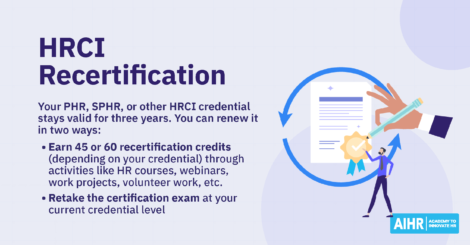
The SHRM-CP and SHRM-SCP, along with HRCI credentials such as the PHR and SPHR, validate HR knowledge to employers. SHRM states that SHRM-CP candidates do not need a degree or previous HR experience to apply, which opens the credential to newcomers and career changers, while the SHRM-SCP and HRCI’s PHR call for qualifying experience. Certifications are maintained through ongoing professional development credits, which keep your knowledge current after you earn them.
In practice, these options can work together or stand on their own. A degree builds the foundation, applied platform learning keeps your skills current and fills specialist gaps, and a certification adds an HR-specific, industry-recognized credential. Some HR professionals draw on all three throughout their careers, while others build a strong path with just one or two.
How to choose the right path for you
Start with the question this article opened on: Do you actually need a degree? The answer depends on where you are in your career and the roles you want.
A degree matters most if you are early in your career, want the widest range of options open to you, or aim for a management level, where most roles expect a bachelor’s. It matters less if you already have solid HR experience, hold a degree in another field, or are targeting operational and entry-level roles, where degree requirements typically aren’t strict. As a rule, the more senior the role, the more a degree shifts from helpful to expected.
If you pursue a degree
Choose the field that fits your goals: human resource management for the most direct route, business or an MBA for breadth and a path to leadership, I/O psychology if you are drawn to data and assessment, or labor relations for employment law and unionized settings.
Treat a bachelor’s as the baseline, and consider a master’s for senior and strategic roles. Weigh the time and tuition, and since even specialized HR programs can lag in fast-moving areas like people analytics and AI in HR, plan to pair your studies with shorter, self-paced HR courses to stay current.
If you skip the degree
Build your foundation through practical HR learning, such as AIHR’s courses and certificate programs, and hands-on experience, such as AIHR’s certificate programs, and hands-on experience. You can also earn a professional certification to signal competence to employers; the SHRM-CP, for one, needs no degree to apply.
Target operational and entry-level HR positions first, then build a track record. Because the bachelor’s bar tightens as you move toward management, plan early for how you will demonstrate equivalent capability, whether through results, certifications, or continued learning.
Over to you
A degree carries the highest investment of time and money, and it pays off most early in your career, for roles that expect one, or when you are moving into senior management. Applied HR courses and certifications cost far less and deliver faster, which suits building a specific skill, testing your interest in HR before committing to a degree, or staying current once you are working in the field. Map each option against your timeline and the roles you are targeting, and the right sequence usually becomes clear.