

AIHR’s HR Trends 2027: As AI Reshapes Work, the Capabilities That Create Value Are Shifting. Most Organizations Aren’t Ready to Respond.
HR Trends 2027 combines AIHR U.S. labor data analysis with research on AI readiness, HR capabilities, operating models, and workforce change to identify the forces reshaping work and HR in 2027.
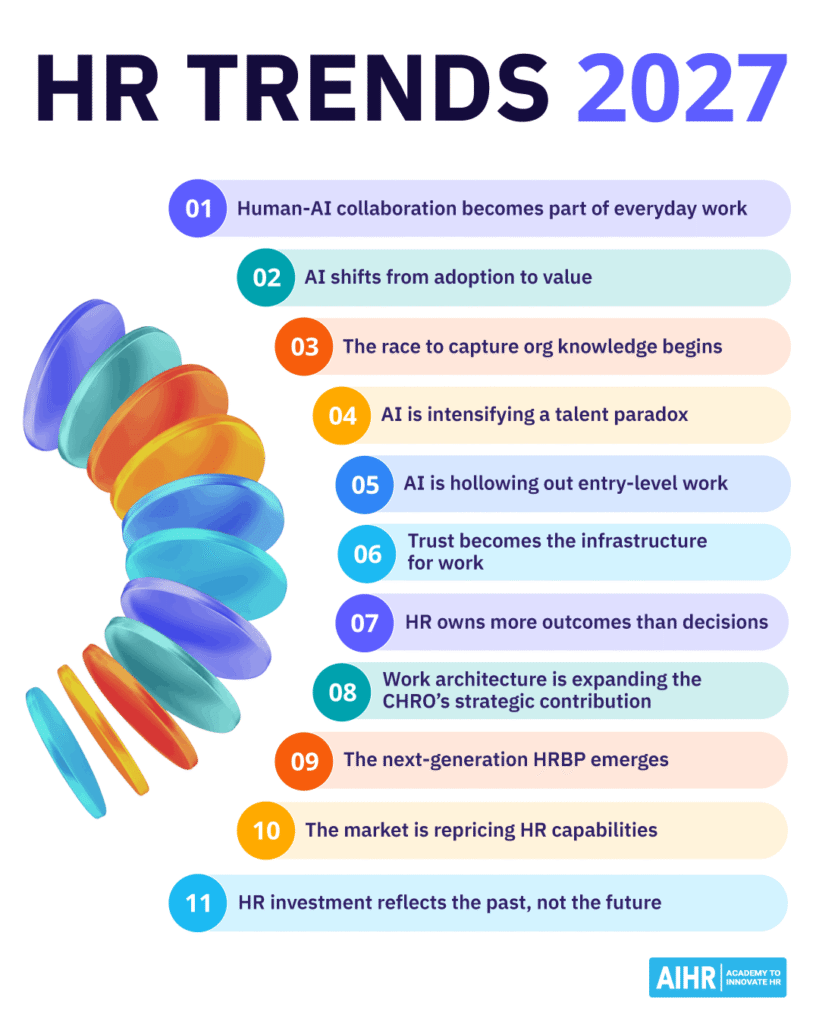
NEW YORK, September 22, 2026 — AIHR today released HR Trends 2027, its annual report on 11 major shifts changing work, the workforce, and the HR function.
The report finds that widespread AI use is pushing organizations to focus more closely on where the technology creates measurable value and how work needs to change in response to it. At the same time, labor market demand is shifting toward different HR capabilities faster than most HR functions can adjust their structures, skills, and investment to match.
AIHR also published a companion report, HR Priorities 2027, which sets out how HR leaders can respond.
“AI is changing where HR creates value,” said Erik van Vulpen, Co-Founder and Dean of AIHR. “The market is placing greater value on judgment, specialized expertise, and the ability to lead change, while organizations are still working out how to translate AI adoption into measurable results. HR leaders now face a dual challenge: transforming the HR function while helping the business reshape work, roles, and capabilities.”
Key findings
The market is changing what HR capabilities are worth
AIHR’s U.S. labor data analysis, in collaboration with Revelio Labs, reveals sharp shifts in demand across the HR profession. The analysis covers 54 HR roles, more than 162,000 active U.S. HR job postings, and 3.88 million HR professionals.
The strongest growth and talent scarcity signals appear in roles that help organizations navigate and deliver transformation. For example, demand for Organization Effectiveness Specialists rose 65.4%, while demand for Change Management Specialists increased 21.6%. Talent for many of these in-demand roles is also scarce. HR Technologist roles, for example, have only around five professionals available per opening.
Demand is moving in the opposite direction across several administrative and service-focused roles. Demand for HR Administrators fell 29.6%, while HR Service Desk Agents saw an even steeper 38.3% decline.
Employers are competing more strongly for capabilities tied to technology, analytics, organizational effectiveness, change, and specialized business needs. Demand is weakening in areas where work is more routine, administrative, or easier to deliver through technology and self-service.
The shift also has implications for how HR careers develop. Administrative roles have traditionally provided an entry point into the profession, giving early-career employees exposure to HR processes, business context, and increasingly complex decisions.
“As routine and entry-level work narrows, organizations face a bigger talent question around how to develop the experienced HR professionals they will need in the future,” said Dr. Marna van der Merwe, Research & Insights Lead at AIHR. “If some of the work that traditionally built business context, judgment, and HR expertise disappears, career development will need to become much more intentional.”
Businesses are shifting their focus from AI adoption to measurable value
As AI becomes part of everyday work, businesses are paying closer attention to where the technology improves performance, which work needs to change, and what is required to capture value at scale.
AIHR research across 334 HR teams provides one illustration of that wider enterprise shift. While 65% demonstrate strong AI buy-in and advocacy, only 30% of HR teams have a clear purpose, expected value, and relevant use cases for AI. Just 29% are confident they have the data, tools, and infrastructure required to support AI at scale, and 35% are confident they have the necessary skills and development opportunities.
The current state of capabilities picture adds another dimension. Separate AIHR research across 961 HR teams and 13,665 HR professionals identifies gaps in digital agility, data literacy, and business acumen, as well as organization development, workforce planning, job design, and strategic business partnering. Only 30% of HR professionals have received job-specific AI training.
Taken together, the data shows that moving from AI adoption to measurable value requires clear use cases, the infrastructure to support them, and the capabilities to redesign work and translate AI into better outcomes.
“AI value is created in how organizations redesign work around the technology,” said Dr. Dieter Veldsman, Chief HR Scientist at AIHR. “That requires clarity on which problems AI should solve, where human judgment remains critical, and how roles, workflows, and skills need to change. Those choices are what turn widespread use into measurable results.”
HR must transform to lead the redesign of work
Organizations increasingly expect HR to help redesign work, build AI capability, reshape roles, and prepare the workforce for change. AIHR’s research shows that many HR functions are still adapting their operating models to meet those expectations.
In the past two years, 64% of HR functions changed their operating model. Yet only 19% report a clear division of responsibilities across HR Business Partners, Centers of Excellence, and shared services.
Among HR functions that were reorganized, 60% provided no formal training on how to work within the new structure.
HR’s investment mix has also been slow to reflect where capability demand is moving. AIHR’s U.S. labor data analysis estimates that around 59% of HR payroll sits in role families with more than 100 available professionals per opening. HR Technology and Digital and People Analytics together account for around 1.9% of the payroll, despite being among the tightest markets in HR.
At the same time, 51% of leaders still cite administrative load as a strategic barrier. That leaves less capacity to redirect people and investment toward analytics, technology, organizational effectiveness, and transformation.
The result is a growing tension for HR. The function is being asked to help the business redesign its work and build new capabilities, while much of its own workforce and investment still reflect an earlier operating model.
Some of the capabilities HR increasingly needs are also difficult to hire externally. Delaying investment can therefore lead to longer vacancies, higher hiring costs, and slower progress on transformation.
From trends to priorities for HR leaders
HR Trends 2027 describes the forces reshaping work, the workforce, and the HR function. Its companion report, HR Priorities 2027: Redesigning for the Future, focuses on how HR leaders can respond.
It identifies five priorities for the year ahead: redesign work for human-AI performance, prioritize talent as an enterprise capability, define shared workforce authority, redesign HR’s operating model for human-AI delivery, and refocus HR investment on the capabilities with the highest return.
Together, the two reports give HR leaders a practical way to interpret the trends and set priorities for 2027.
The full HR Trends 2027 and HR Priorities 2027 reports are available at:
HR Trends 2027: aihr.com/blog/hr-trends
HR Priorities 2027: aihr.com/hr-resources/hr-priorities-2027
About AIHR
Academy to Innovate HR (AIHR) is the global online learning platform that helps HR professionals and teams build the practical, strategic skills the modern HR function demands. Its 16+ certificate programs and 85+ courses span every HR domain, from AI in HR and people analytics to HR business partnering and organizational development. Members also have access to ready-to-use templates, tools, and hands-on labs to apply what they learn at work, as well as a global HR community.
AIHR is recognized by SHRM to offer Professional Development Credits (PDCs). Its programs are also eligible for HRCI, HRPA, CPHR, and ATD credits, and CPD-accredited by CPD UK, allowing CIPD members to record AIHR programs as verified Continuing Professional Development.
Through these programs, AIHR helps HR professionals and organizations worldwide build the skills the modern HR function demands. Learn more at aihr.com.
Media contact
Monika Nemcova
[email protected]
More AIHR News
 Oct 13, 2026
Executive Program Prepares HR Leaders to Shape AI Transformation Across the Business
Read article Oct 2, 2026
AI Hackathons Help HR Teams Move From Individual AI Use to Shared Workflows
Read article Sep 14, 2026