


When a transformation stalls, the business usually asks HR why employees aren’t adopting the change. HR typically responds with more communication, more training or stronger leader sponsorship. These fixes rarely help, because the problem is usually in decisions the roadmap left out. Nobody agreed who has decision-making authority, how work moves between teams or what good performance looks like afterward.
By stepping in before anything is implemented, HR can close that gap. As HR maps how roles, capabilities and workflows will shift, those insights go straight into the roadmap. That turns the ambition for transformation into concrete decisions about what to change and in what order. The 3I framework gives HR a structure for that business conversation, linking intent, impact and implications up front.
Why your roadmap can still leave the organization unprepared
When an organization is under pressure, moving quickly from ambition to implementation is understandable. Sponsors need to show progress, project teams need deliverables and employees want to know what’s coming. New technology, structural changes and training become the visible proof that the transformation is moving.
Planning these activities before anyone knows where the impact will fall creates problems that more training can’t fix. A new structure might leave old approval steps intact. Employees get trained for responsibilities they have neither the time nor the authority to take on.
Leaders ask teams to collaborate across functions, while the performance system still rewards individual output. Each of these activities can be delivered on time and on budget without the organization working any differently.
This is where transformation differs from a large implementation. An implementation can affect thousands of employees and still leave the business model and ways of working largely intact. Transformation changes how the organization creates value, operates, leads and builds capability.
The deeper that shift, the more decisions about people and work belong on the roadmap. HR leaders can surface them by weighing the business ambition against the conditions people need to deliver it. That analysis needs to happen before the roadmap is locked in.
Connect intent to action through the 3I framework
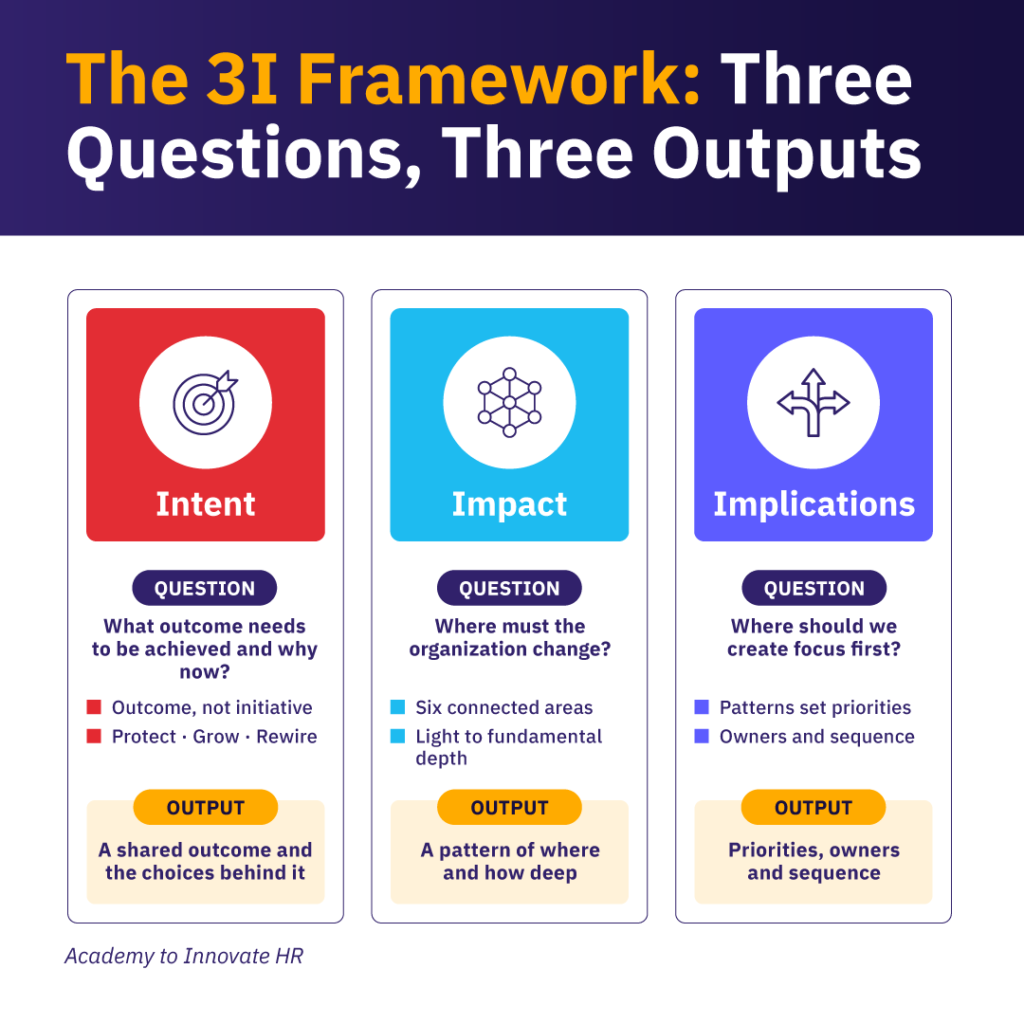
The 3I framework gives HR leaders a structured way to work through transformation decisions with the business. The three Is stand for intent, impact and implications, and each one shapes the next.
- Intent sets out what the transformation should achieve and why it matters.
- Once that’s clear, impact looks at where the organization needs to change to deliver it.
- Implications then cover what the business and HR must get right as a result. Working through them in order gives you a set of decisions with named owners, before anyone commits to a plan.
You can use the framework before implementation begins or to revisit a transformation that’s already underway. Either way, it brings HR into the discussions where transformation decisions get made. HR leaders can bring the sponsor and the leaders who own the affected work into the same room.
Together, they can answer the questions the roadmap has left open. HR then takes ownership of analyzing what the ambition requires of roles, capabilities and leadership. Doing this work early means HR helps shape the decisions behind the transformation, as well as preparing people for it.
Intent defines the outcome and the choices behind it
Transformation intent explains what must be different, why it matters now and what the organization needs to become. When leaders describe a transformation as “implement AI” or “introduce a global structure,” they’re naming an initiative. They still need to define the business outcome it should enable and the choices that follow when priorities compete.
We group transformation intent into three broad categories:
- Protect responds to pressure on the existing business, such as a threat to its viability or a need to restore productivity.
- Grow creates new value through new markets, services, revenue models or a different competitive position.
- Rewire redesigns work or the organization, including technology-enabled change, integration, separation or simplification.
Intentions can overlap, for example when a manufacturer needs to protect current margins while building a service business. Naming each one helps leaders work through the tension between them.
HR needs enough clarity to know which outcomes come first and what the workforce must deliver. HR also needs to know which assumptions the business still has to test.

Impact identifies the organizational changes required
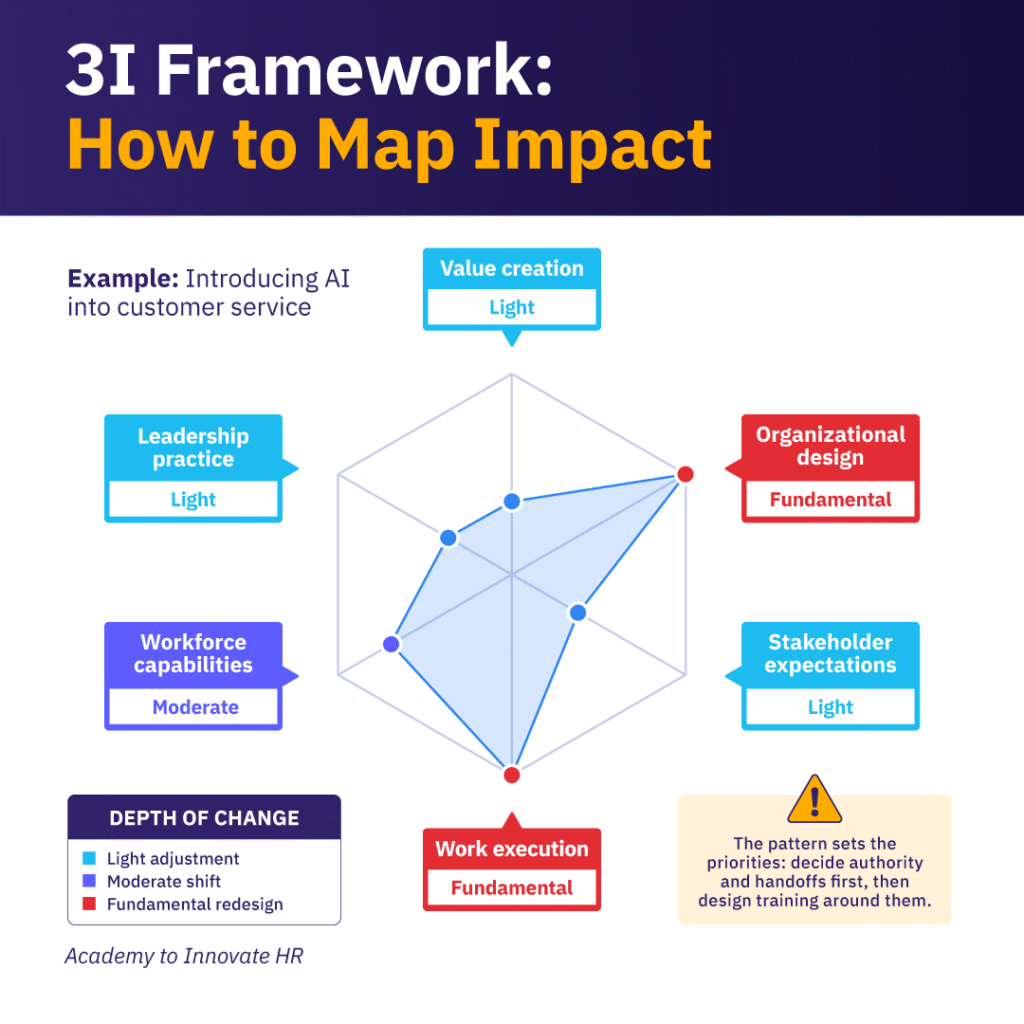
Once the intent is clear, HR and business leaders can assess its impact across six connected areas. For each one, they decide how deeply it needs to change and how that change affects the others.
- Value creation covers how the organization competes and delivers for those it serves. Whether the ambition improves an existing offer or changes what customers receive shapes what the organization needs from its people.
- Organizational design covers how roles, authority and accountability are arranged. Leaders need to check who owns outcomes and where decisions sit. A transformation can shift authority substantially even when reporting lines stay the same.
- Stakeholder expectations reflect what customers, employees and other groups need from the organization. When those groups want different things from the change, leaders should let the tension inform the design and their commitments.
- Work execution covers how tasks, decisions and handoffs happen day to day. When automation removes some tasks, the work that remains can become more complex and more intense.
- Workforce capabilities cover what people need to do in the future organization. Link these requirements to changing responsibilities, then decide whether to develop, recruit or otherwise access them. Tool proficiency is only one part of what employees need to perform well.
- Leadership practice covers how leaders behave, make choices and take accountability. Leaders influence whether changes in the other five areas take hold. Their decisions on resources, performance and problems need to match what they expect of employees.
When you look across all six areas, a pattern of impact emerges. Some areas need a light adjustment, while others need a moderate shift or a full redesign.
The assessment should account for where the organization starts, as well as where it wants to go. An existing capability may support the transformation, while an unresolved ownership issue can hold back several parts of it.
Implications establish where the roadmap needs to focus
The pattern of impact across the six areas tells HR and business leaders where the roadmap should focus first.
When value creation and organizational design change most, start by defining the future organization and its decision rights. If work execution and workforce capabilities are most affected, let role and workflow redesign guide your learning investments. Where stakeholder expectations shift significantly, leaders may need to revisit service commitments and how they show up in daily behavior.
Treat these combinations as a starting point. HR leaders still need to identify dependencies, agree on ownership and judge how much change the organization can absorb. You end up with a set of priorities showing what needs to happen and who must act. Each priority also links back to the business outcome the transformation is meant to deliver.
Applying the 3I framework to an AI rollout in customer service
A consumer services organization is introducing AI into customer service to handle rising contact volumes without adding headcount. The initial roadmap lists chatbots, automated ticket routing, updated scripts and agent training.
- Step 1: Intent. When asked what success looks like, one leader expects headcount savings and another expects agents to focus on complex problems. Each answer implies different staffing and performance expectations. The leaders agree to use the capacity AI releases for more complex, advisory service.
- Step 2: Impact. With routine queries automated, the remaining work is harder. Agents need authority to resolve cases that currently wait for approval elsewhere, and handoffs between teams become the main constraint. Judgment and expertise matter more than script knowledge. Organizational design and work execution need a fundamental redesign, workforce capabilities a moderate shift and the other areas light adjustments.
- Step 3: Implications. Leaders first agree which interactions stay human-led and how difficult cases move between teams. Operational leaders own those service decisions, while HR leads role design and capability planning. Training and performance measures are then built around the new roles. The revised roadmap now covers authority, handoffs and performance measures, none of which appeared in the original plan.
5 obstacles that keep HR out of transformation decisions
HR leaders who use the 3I framework with the business tend to meet the same five obstacles. Each one has a cause that HR can address with practical steps:
- HR joins after the solution is chosen: Sponsors often define success as deployment and assume HR will handle the people side. Bring the sponsor a short, evidence-based view of what the roadmap is missing, framed around the outcome they want. That gives HR a clear reason to join the design conversation.
- Sponsors define success as an initiative: “Implement AI” is easy to agree on because each leader can keep a different expectation about headcount, workload and performance. Ask each leader to describe success in operational terms, then compare the answers. In the customer service example, that comparison exposed the split between headcount savings and advisory service.
- Pressure to show progress favors visible deliverables: Deployments and training schedules look like movement, while open design questions feel like delay. Run the assessment alongside early implementation and let its findings reorder the plan. That way, you don’t have to ask the sponsor for a pause.
- Cross-functional decisions have no owner: Questions about authority fall between HR, operations and technology, and each function can reasonably see them as someone else’s job. Agree who resolves each issue and what depends on it. For example, HR leads role design and capability planning, operations owns service decisions and technology owns technical delivery. Where outcomes cross those lines, set an explicit way to decide together.
- The impact assessment rests on opinion: Without evidence from the work itself, the six-area review turns into a debate about views. Ground it in current decision rules, handoffs, customer problems and capability gaps. Leaders then have something concrete to act on.
Getting started
Before your next transformation moves into implementation, start with these four questions:
- Can leaders describe the intended business outcome in the same way, including what they’ll prioritize when goals compete?
- Do you know where the biggest changes sit across the six areas and how they depend on each other?
- Does the roadmap include the decisions on work, authority, capability and leadership that the outcome requires?
- Who owns those decisions, and what evidence will show the new arrangements are working?
When an answer is unclear, it points to a specific task for HR. That could mean testing a workforce assumption, clarifying authority across functions or checking performance expectations against the redesigned work. A roadmap is most useful when it connects the business outcome to the decisions leaders must make. It should also set out the conditions employees need to deliver that outcome.
The 3I framework gives HR leaders a practical way to build that link with the business. It also helps HR keep those decisions visible as implementation moves forward.


