


Most HR leaders face the same set of pressures. AI is reshaping work. The business wants growth, but that growth depends on skills that are either unavailable, misaligned, or too expensive to justify. The risk is not these realities themselves. Rather, it is the assumption that they will correct over time or by applying strategies built for a different environment.
Traditionally, HR managed disruption in a stable system. Now, Lightcast’s Fault Lines research shows the system itself is shifting; geopolitics, AI, and labor shortages are changing simultaneously and will not return to the old ‘normal.’
This requires a different kind of strategic clarity. In this environment, HR effectiveness is not defined solely by capability maturity but by the choices leaders make within structural constraints. This article translates the data into the strategic trade-offs that now define the HR leadership agenda.
The 3 forces shaping workforce reality
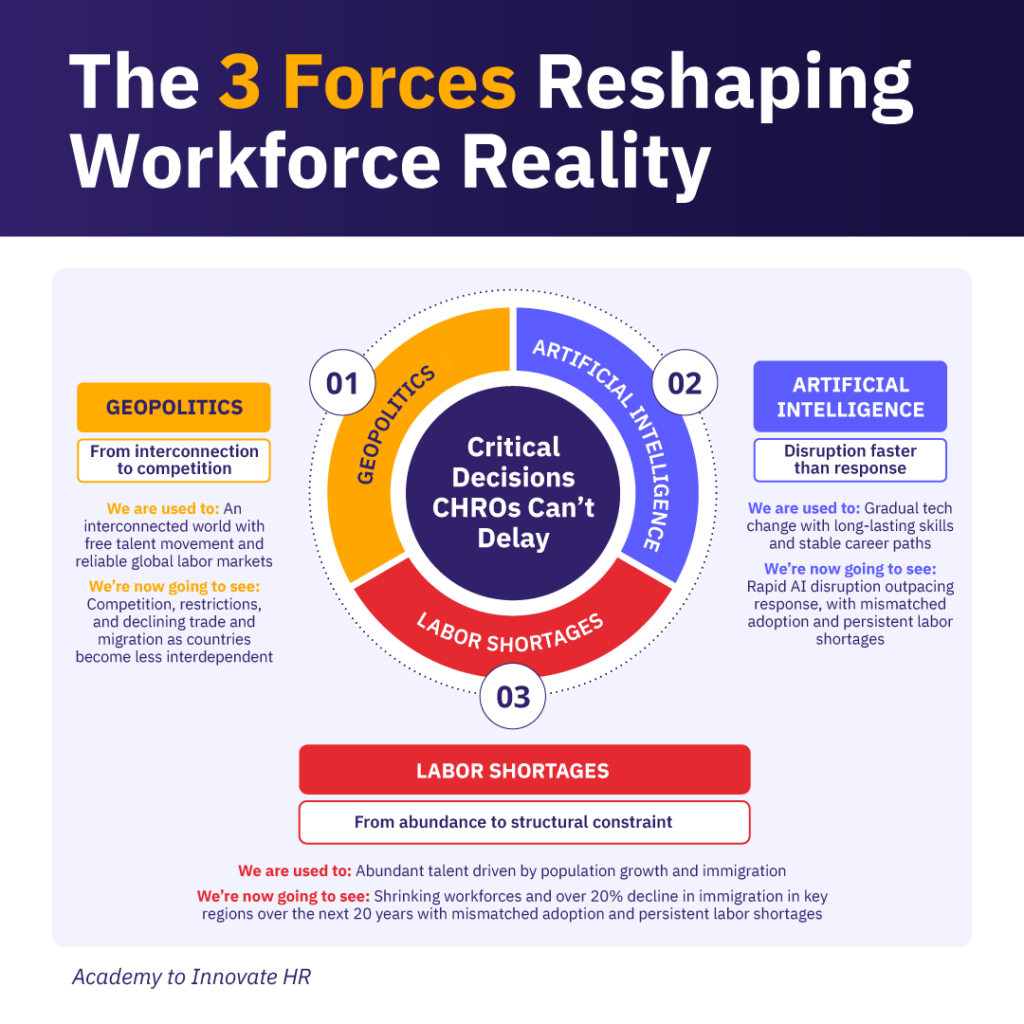
Three forces identified in Lightcast’s Fault Lines research are reshaping the workforce landscape and redefining the constraints within which HR must operate. These forces represent a shift away from assumptions that have underpinned workforce strategy for decades.
1. Geopolitics: From interconnection to competition
We’re used to an interconnected world optimized for efficiency where talent moved relatively freely across borders, and global supply chains and labor markets functioned as reliable systems of mutual benefit.
Instead, we’re seeing competition, restrictions, and reshuffling as countries become less dependent on one another. International trade and migration are declining as relationships become more cautious. Immigration is slowing from both sides: feeder countries have fewer people to send, and destination countries are imposing new restrictions. Geopolitical tensions are amplifying uncertainty as nations race to establish themselves as technological and economic leaders.
What this means: Global mobility is becoming less reliable for closing skill gaps. Access to talent is increasingly shaped by policy, geography, and strategic alignment, not just demand.
2. Artificial Intelligence: Disruption faster than response
Previously, technology advanced at a manageable pace, and skills lasted from graduation to retirement. Formal education prepared workers for long-term roles, and organizations planned capability development around stable jobs.
Instead, disruption moves faster than anyone can respond, with a gold rush of AI investment outpacing strategic clarity. AI is not solving labor shortages: supply and demand are misaligned, and sectors with the most severe shortages have the lowest AI adoption.
What this means: Skill lifecycles are shortening, and capability can no longer be built around static roles or fixed curricula. AI’s impact varies significantly by function, requiring organization-specific adoption strategies rather than universal responses.
3. Labor shortages: From abundance to structural constraint
We’re used to abundant talent and reliable economic growth, resulting in a labor market where workforce expansion could be assumed, supported by stable population growth and expanding talent pools supplemented by immigration.
Instead, populations are smaller, worker availability is limited, and economic priorities are shifting. Over the next 20 years, working-age populations will slow or shrink across major economies. Immigration into regions that rely on it most, such as advanced economies in Europe, North America, and Oceania, is projected to fall by more than 20%.
What this means: The talent shortage is not a temporary dip that will correct when the economy shifts. It is a long-term reality stemming from macro trends that will define the next decades. As populations age, production needs and consumption patterns will shift, so HR must plan not just for fewer workers but for a workforce with different characteristics and needs.
The realities that HR leaders need to manage
The convergence of these major forces creates three compounding workforce realities. Each demands a different response from HR, in terms of the capabilities the function must build and the strategic trade-offs and choices it must make.
For each reality, we outline what the data shows, what it demands of HR leadership, and the trade-offs that ultimately determine how organizations respond.
“When we started the research that eventually became Fault Lines, we realized we were facing something unprecedented. We’ve never seen the magnitude and speed of change we’re facing in the years ahead. But instead of wanting to alarm HR leaders, we want to help them understand what’s happening and how to prepare for it.”

Reality 1: From talent shortage to capacity constraint
The first and most immediate implication of these shifts is that organizations are no longer operating in a labor market where supply can be assumed to meet demand.
What the data shows
Working-age population growth is slowing globally and already contracting in parts of Europe. In the United States, the native-born population is expected to decline within the next decade, with future growth dependent on immigration. Fertility rates continue to fall with no projected recovery.
At the same time, the balance between workers and dependents is shifting. Fewer workers are supporting more retirees and children, increasing the amount each worker must produce simply to maintain current economic output.
The supply problem
Every major trading bloc will see slower working-age population growth between 2025 and 2045. In Europe and BRICS countries, the population will actually shrink.
Implication: The workers who will retire in the next decade have already been born, so have the workers who will not yet be available to replace them.
The dependency problem
In 2025, the EU will have approximately 1.7 working-age adults per dependent. By 2065, that falls to 1.3.
Implication: Fewer workers are supporting more non-working people. Economic output per worker must increase simply to maintain current living standards, before any growth ambition is factored in.
The fertility problem
Fertility rates are declining across every global trading bloc. There is no projected recovery in any major region through 2100.
Implication: Even if fertility rates reversed today (which there is no evidence of), it would take twenty years before those births translated into workers.
This is a structural constraint on labor supply, not a recruiting problem. Organizations treating this as a hiring issue will overspend on sourcing. Those recognizing the shift will redesign how work gets done.
“After you look at the global demographic data, you realize that worker shortages are not going to be limited to just one region or one sector of the economy—this is happening everywhere. Every organization will need to find the specific workforce strategies that apply to their unique environment.”

What does this demand of HR leadership
This shift changes the role of HR from managing talent flows to designing how work is delivered under constraints.
- Workforce design becomes a core strategic capability: The question is no longer how to attract more talent, but how to structure work to deliver outcomes with the talent that is realistically available. This requires HR to shape business decisions at the design stage, not execute them after the fact.
- Long-term workforce modeling becomes a source of advantage: Compared to other economic factors that develop more quickly. Demographic data is unusually predictable. Organizations that model workforce supply over five- and ten-year horizons, by region, role, and skill, are making decisions with visibility that most competitors do not yet use.
- Productivity becomes a strategic investment, not an efficiency exercise: If supply is constrained, output per worker must increase. This requires investment in tools, automation, and work design, not incremental cost optimization.
- Retention becomes a capacity decision: In a tightening labor market, losing experienced talent creates a disproportionate impact. Retention must be prioritized based on its effect on organizational capacity, not treated as a general engagement initiative.
The strategic trade-offs that define your position
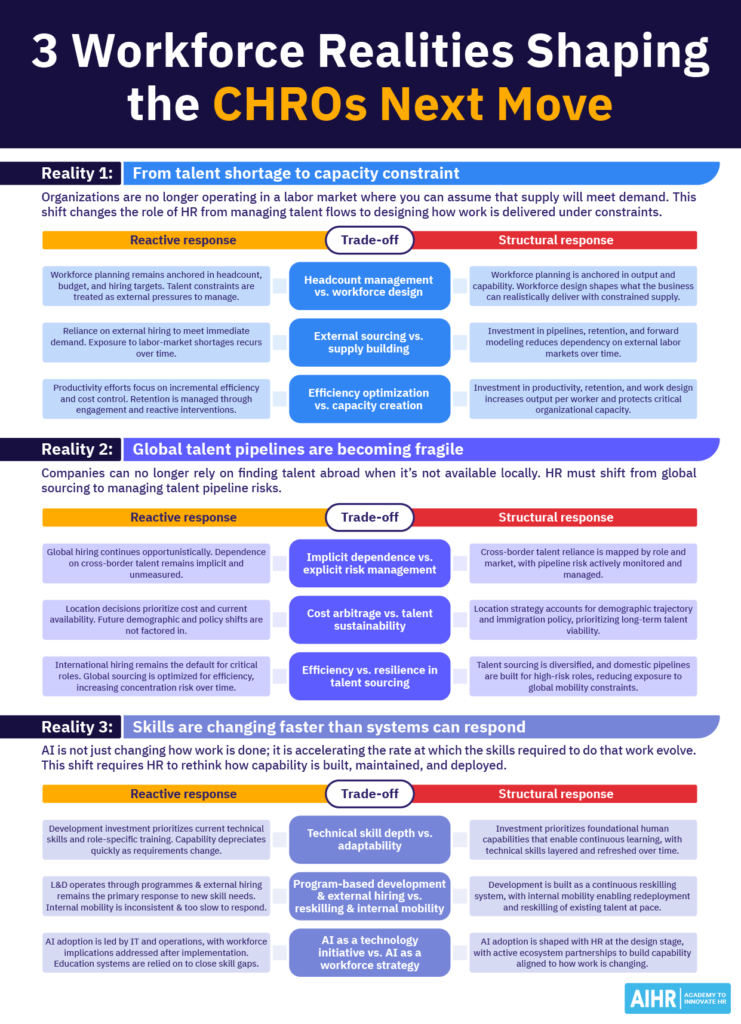
The shift from talent shortage to structural capacity constraint forces a set of choices. Each path leads to a fundamentally different operating model for the organization.
Workforce planning remains anchored in headcount, budget, and hiring targets. Talent constraints are treated as external pressures to manage.
Headcount management vs. workforce design
Workforce planning is anchored in output and capability. Workforce design shapes what the business can realistically deliver with constrained supply.
Reliance on external hiring to meet immediate demand. Exposure to labor-market shortages recurs over time.
External sourcing vs. supply building
Investment in pipelines, retention, and forward modeling reduces dependency on external labor markets over time.
Productivity efforts focus on incremental efficiency and cost control. Retention is managed through engagement and reactive interventions.
Efficiency optimization vs. capacity creation
Investment in productivity, retention, and work design increases output per worker and protects critical organizational capacity.
Organizations that depend on labor market conditions remain exposed. Those redesigning work delivery gain strategic planning advantages that compound over time.
Dr Dieter Veldsman, Chief HR Scientist at AIHR, elaborates: “CHROs today need to become architects of work systems. Viewing work as something to be deliberately designed, shaped, and enabled, within the realities of a world that is becoming increasingly unstable. That demands a serious reframing of how we think about talent supply and demand strategies.”
Reality 2: Global talent pipelines are becoming fragile
The assumption that talent can be sourced globally when it is not available locally is no longer holding true.
What the data shows
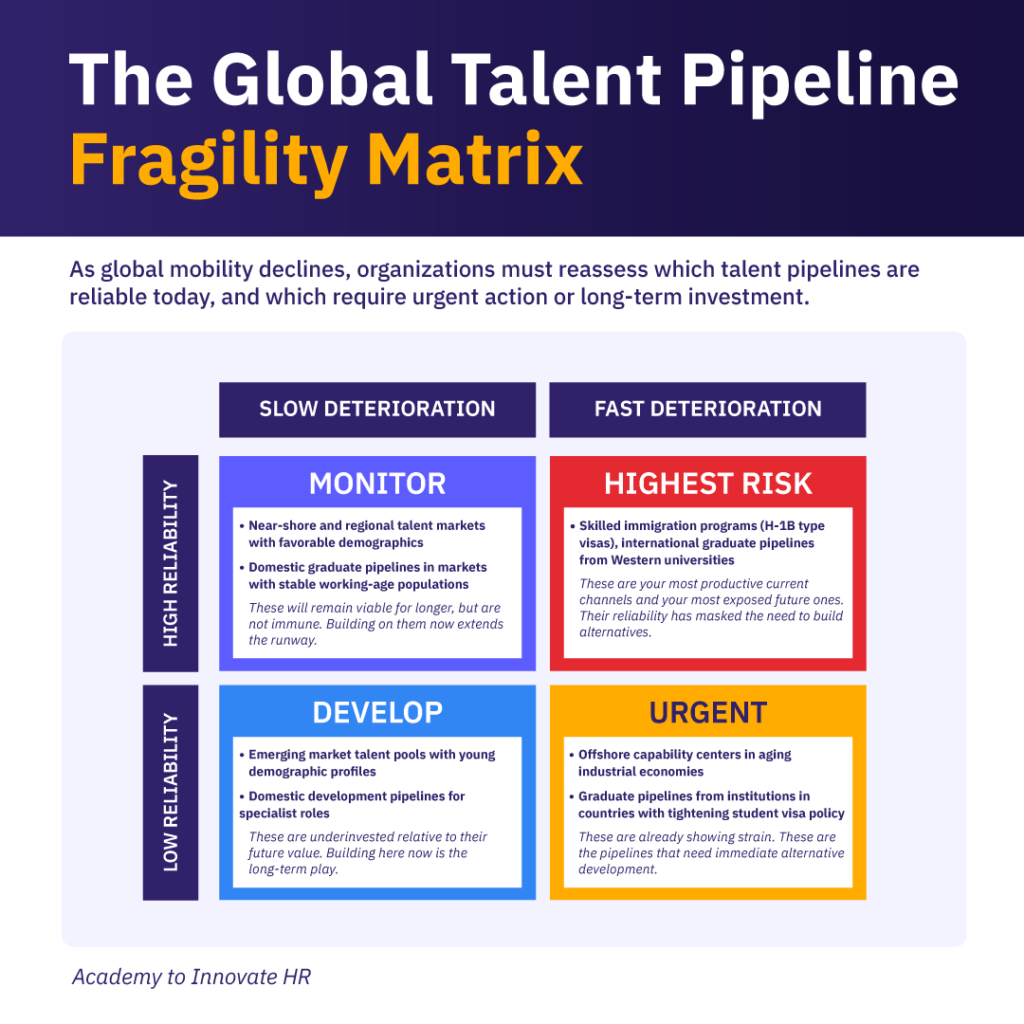
For decades, global mobility has bridged the gap between domestic talent supply and organizational demand. The system worked because both sides were aligned: origin countries had surplus labor and incentives to send talent abroad, while destination countries had the policies and demand to receive it. That alignment is now breaking down.
International student flows are declining, visa costs are rising, and migration rates are projected to fall across most major economies. At the same time, countries that have historically exported talent are facing their own demographic pressures, reducing their ability to supply talent abroad.
Despite these shifts, hiring behavior has not changed materially. Many organizations remain structurally dependent on cross-border talent without explicitly recognizing that risk.
“Political and demographic disruption around the world, and policy changes domestically, are forcing hard choices onto organizations that rely on immigrant workers, especially for non-degreed roles. Do you follow the workers back to their countries of origin? Do you shut down domestic operations?”

The result is increasing fragility in global talent pipelines, often hidden until disruption happens.
What does this demand of HR leadership
This shift requires HR to move from managing global sourcing to actively managing pipeline risk.
- Visibility into talent dependencies becomes critical: Most organizations lack a clear view of where and how they depend on international talent. HR needs to map which roles, functions, and markets rely on cross-border hiring and where those dependencies create exposure.
- Location strategy becomes a talent decision: Where the organization operates can no longer be determined primarily by cost and current availability. Demographic trajectory and policy direction must be factored into location and investment decisions.
- Domestic capability building becomes a strategic priority: For roles heavily dependent on international talent, organizations need to understand how long it would take to build equivalent capability locally and whether to begin that investment while global pipelines remain operational.
- Immigration policy becomes a strategic variable: Policy changes in skilled migration have direct workforce implications. Monitoring and scenario planning around these shifts must be treated with the same rigor as other external risks.
The strategic trade-offs that define your position
The fragmentation of global talent mobility does not remove access to talent overnight. It erodes it gradually, unevenly, and often invisibly until constraints become acute. Organizations that navigate this well make their dependencies explicit and act on them early.
Global hiring continues opportunistically. Dependence on cross-border talent remains implicit and unmeasured.
Implicit dependence vs. explicit risk management
Cross-border talent reliance is mapped by role and market, with pipeline risk actively monitored and managed.
Location decisions prioritize cost and current availability. Future demographic and policy shifts are not factored in.
Cost arbitrage vs. talent sustainability
Location strategy accounts for demographic trajectory and immigration policy, prioritizing long-term talent viability.
International hiring remains the default for critical roles. Global sourcing is optimized for efficiency, increasing concentration risk over time.
Efficiency vs. resilience in talent sourcing
Talent sourcing is diversified, and domestic pipelines are built for high-risk roles, reducing exposure to global mobility constraints.
Organizations that remain on the left continue to benefit from global talent flows while they last, but face increasing and often unrecognized exposure to disruption. Those moving to the right make dependencies visible, build alternatives, and turn fragility into managed risk.
Reality 3: Skills are changing faster than systems can respond
AI is not just changing how work is done; it is accelerating the rate at which the skills required to do that work evolve.
“In our research so far, we’ve found that AI is more about job redesign than disruption and creation, and this is why understanding skills is becoming essential. A job title is no longer sufficient to understand the complexity of an employee’s work. Instead, looking at tasks and skills can allow HR professionals to get to the root of AI’s impact, so that they can be better prepared to respond.” –

What the data shows
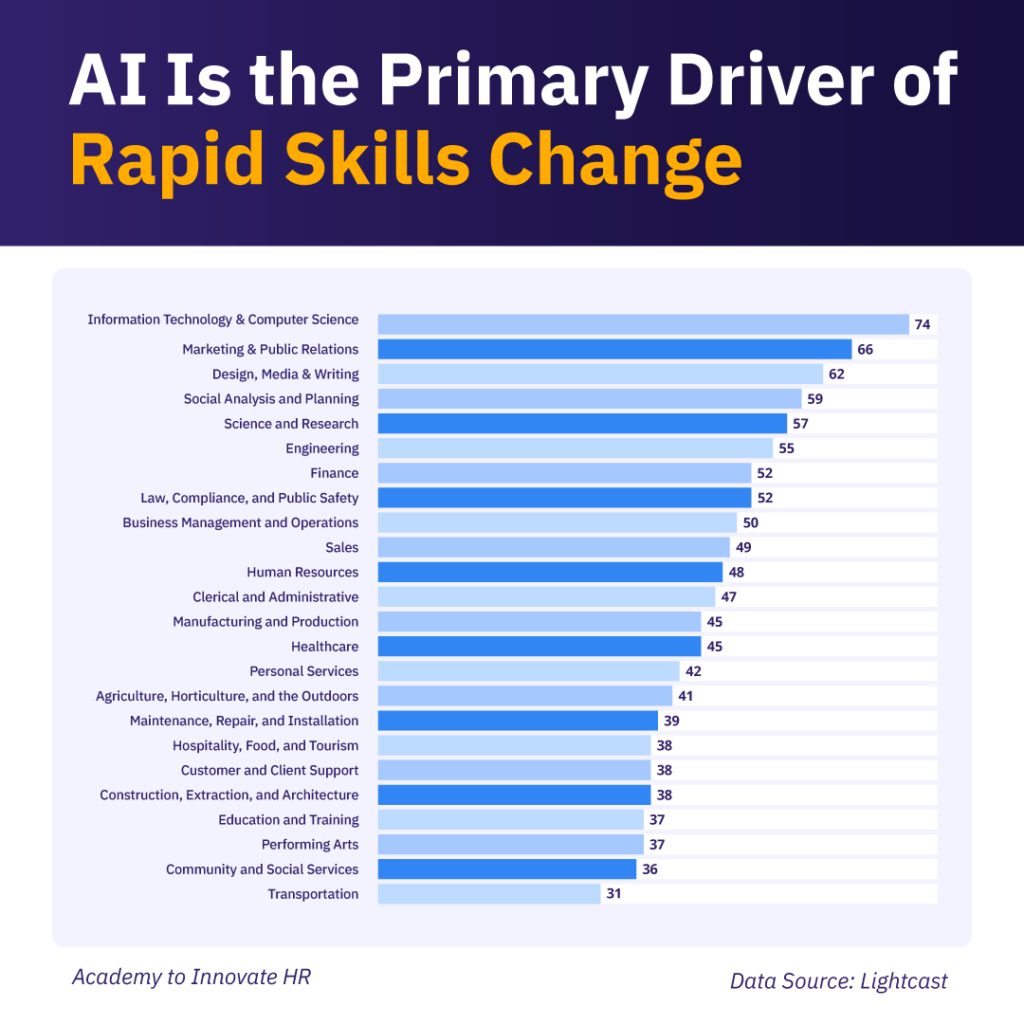
Between 2021 and 2024, a third of the skills in the average job changed. In technology roles, the rate of change is significantly higher. AI is a primary driver. Rather than stabilizing skill requirements, it is accelerating their evolution, particularly in functions where adoption is highest.
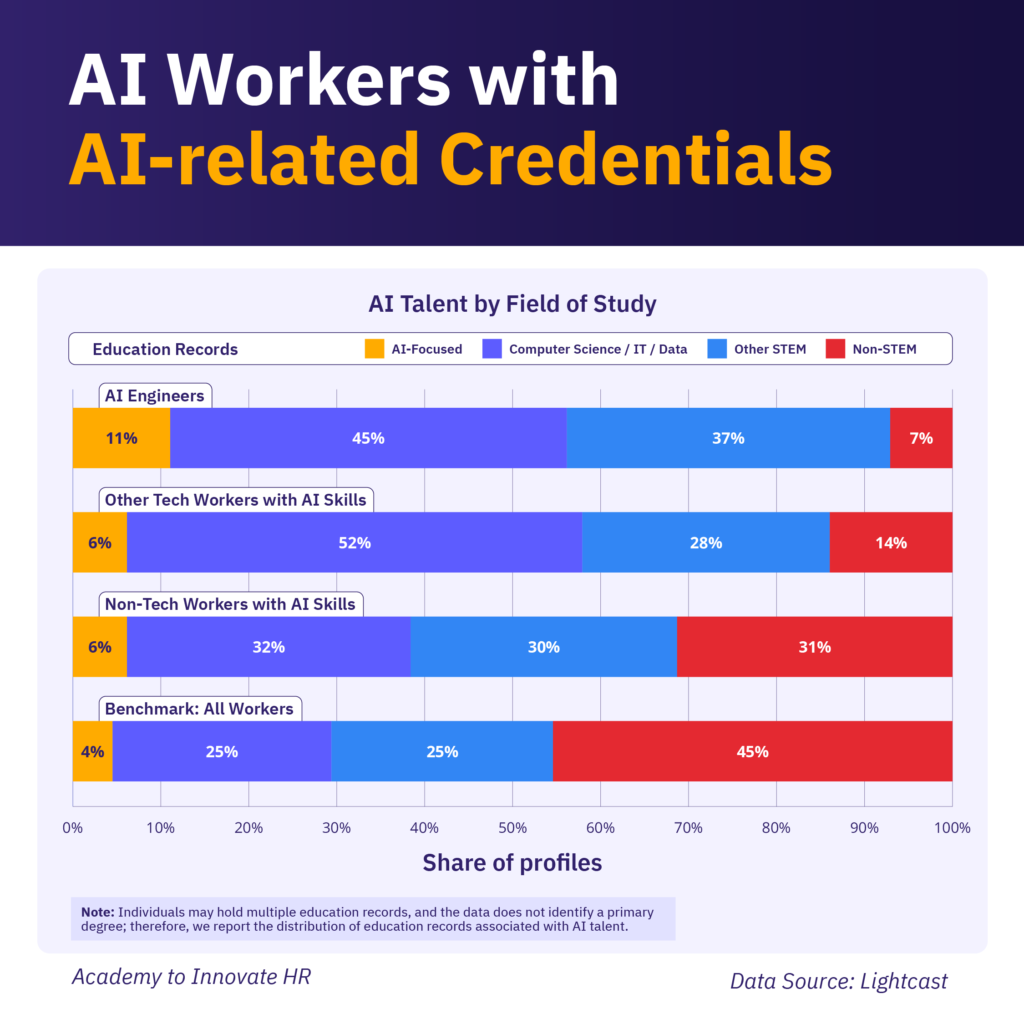
At the same time, development systems are not keeping pace. Most AI professionals lack formal AI qualifications, and the most in-demand skills in AI-related roles are not technical but human capabilities such as communication, leadership, and problem-solving.
What does this demand of HR leadership
This shift requires HR to rethink how capability is built, maintained, and deployed.
- Development must shift from content to capability: If technical skills are changing faster than they can be codified, then the most durable investment is in foundational capabilities that enable continuous learning and adaptation.
- Reskilling must become continuous, not periodic: Traditional L&D models, built around programs and annual cycles, are not designed for constant skill change. Organizations need systems that can respond in near real time.
- Internal mobility must operate at scale: As external hiring slows and becomes misaligned, the ability to redeploy and reskill existing talent becomes a core capability. This requires not just systems, but a shift in managerial incentives and behavior.
- AI adoption must be treated as a workforce decision: AI is often implemented as a technology initiative, with workforce implications addressed later. HR needs to be involved at the design stage to shape how roles change and how people transition.
The strategic trade-offs that define your position
The acceleration of skill change is not a future problem. It already outpaces the systems most organizations use to build capability. The question is no longer how to close current skill gaps but how to operate in an environment where those gaps continuously shift.
Development investment prioritizes current technical skills and role-specific training. Capability depreciates quickly as requirements change.
Technical skill depth vs. adaptability
Investment prioritizes foundational human capabilities that enable continuous learning, with technical skills layered and refreshed over time.
L&D operates through programs, and external hiring remains the primary response to new skill needs. Internal mobility is inconsistent and too slow to respond.
Program-based development & external hiring vs. continuous reskilling & internal mobility
Development is built as a continuous reskilling system, with internal mobility enabling redeployment and reskilling of existing talent at pace.
AI adoption is led by IT and operations, with workforce implications addressed after implementation. Education systems are relied on to close emerging skill gaps.
AI as a technology initiative vs. AI as a workforce strategy
L&D operates through programs, and external hiring remains the primary response to new skill needs. Internal mobility is inconsistent and too slow to respond.
Organizations that remain on the left build capability for a relatively stable environment and fall behind as requirements shift. Those moving to the right build adaptability and operate at the pace of change.
The new HR leadership agenda
The implication of these realities is not that HR needs to do more but that HR needs to operate differently.
The environment described by these fault lines does not reward incremental improvement. It rewards organizations that make informed choices under constraint about where to invest, where to operate, and what their workforce can realistically deliver. That changes the role of HR.
Workforce planning is no longer an annual exercise calibrated to last year’s conditions. It becomes a continuous, scenario-based discipline that integrates demographic trajectories, policy direction, and the pace of skill change into business decision-making. The question is not how many people are needed next year but what the organization needs to look like in five to ten years and what decisions must be made now to get there.
Sourcing strategy cannot assume existing pipelines will hold. It must be explicitly risk-weighted with clear visibility into dependencies on global talent, graduate pipelines, and specific markets. Location and investment decisions are not driven solely by cost but by the long-term viability of the talent supply.
Development is no longer about closing current skill gaps. It is about building the capacity to adapt as those gaps continuously shift. This requires moving beyond programs toward infrastructure: continuous reskilling, internal mobility at scale, and closer integration of learning and work.
Labor market data is no longer a reporting tool. It becomes a strategic input. Organizations that treat workforce intelligence with the same rigor as financial or operational data will make fundamentally different decisions earlier and with greater confidence.
Taken together, these shifts redefine HR’s position in the organization.
Talent planning anchored in historical data and near-term demand
Workforce modeling over multi-year horizons, grounded in demographic and structural supply constraints
Sourcing optimized for availability and cost
Sourcing strategy explicitly risk-weighted for pipeline fragility and policy volatility
Periodic L&D aligned to fixed skill frameworks
Continuous reskilling infrastructure designed to adapt at the pace of skill change
Headcount as the primary planning unit
Output, capability, and workforce design as the basis of planning
HR as a downstream executor of business decisions
HR is an upstream shaper of what business decisions can credibly assume
Labor market data used for reporting and optimization
Labor market intelligence used as a strategic input to investment, location, and workforce decisions
Retention managed through engagement and pay interventions
Retention managed as a capacity investment based on replacement risk and business impact
Internal mobility as an exception
Internal mobility as a systematic alternative to external hiring
Immigration managed as compliance
Immigration policy is treated as a strategic variable in workforce planning
AI adoption led by IT and operations
AI adoption shaped with HR at the design stage, with workforce implications defined upfront
This shift requires HR leaders to operate with strategic clarity, analytical depth, and business influence that most organizations have not historically demanded. The differentiator is not activity but the ability to translate external constraints into informed choices about what the organization can deliver and how.
That requires credibility that comes from the quality of the organization’s workforce insight: the ability to model supply, understand exposure, and quantify the implications of decisions before they are made.

Closing remarks
None of these shifts is sudden. The data has pointed in this direction for some time. What is changing is the visibility of the implications and the speed at which they affect day-to-day decisions.
For HR leaders, the challenge is less about reacting to disruption and more about deciding how to respond to constraints that are increasingly difficult to avoid. The trade-offs are rarely comfortable or neutral but are becoming unavoidable.
Organizations that move early do not do so because they have more certainty. They do so because they are willing to act on signals already available and build the capability to adjust as those signals evolve.


