Quick facts
- Name: Ashley Valenzuela-Ruesgen
- Role: Senior HR Director, 14 years of HR leadership experience
- Plan: Full Academy Access, plus a Team License for her direct reports
- Programs: Artificial Intelligence for HR Certificate Program and Talent Management & Succession Planning Certificate Program
- Results: Faster, standardized job description workflows, a structured AI governance approach, formalized succession planning follow-through, and a team-wide learning culture
Ashley Valenzuela-Ruesgen was accepted to law school. Then the University of New Mexico offered her a full scholarship and graduate assistantship that introduced her to the people side of organizations. And she never looked back.
Over the next 14 years, Ashley built a career across a variety of HR leadership roles – from college recruiting to Senior Director overseeing corporate business partners and a shared services team. She earned a second master’s degree in strategic human resources and organizational leadership, became a certified forensic interviewer, and a certified change management practitioner.
HR wasn’t her original plan, but she committed to it fully. Ashley refers to herself as a perpetual student, saying, “I’m a continuous lifelong learner. I’m a nerd. I’m all about delivering excellence.”
Why an experienced HR leader chose structured online HR training
Ashley had led succession planning conversations with executives, managed talent reviews, and led business partnering across complex organizations. But she was drawing on instinct rather than structure. She knew what to do, but wanted a more polished approach when explaining the framework behind it.
AI was another challenge. She was using ChatGPT, testing what it could do, figuring it out as she went. But in a senior role where her decisions ripple across a team, “playing with it and teaching myself” wasn’t a responsible foundation. She didn’t know enough about prompt design, governance, or data risk to feel confident guiding others, let alone making the case for how AI should be used at an organizational level.
“I really want to understand how to leverage AI and what I need to watch out for,” she says. As a part of a leadership team, getting it wrong was beyond a personal risk. It shaped what her entire team prioritized and how they worked.
Fourteen years of being an on-the-job practitioner had taken her far. But for what she wanted to do next — go deeper and operate with more precision at the executive level — she needed structure, and she knew exactly where to find it.
Why AIHR: Enrolling with a trusted and recommended HR training provider
The Academy to Innovate HR (AIHR) wasn’t new to Ashley. The platform consistently emerged as a trusted, recommended resource for HR training, HR skills development, and reference tools.
Ashley had enrolled her direct reports in AIHR for years across multiple organizations, matching each person to the program that fit their development goals. She saw the results firsthand: team members who returned with sharper skills and greater confidence in their work. She knew AIHR was built by HR practitioners for HR practitioners. So when it came to her own development needs, the choice was straightforward.
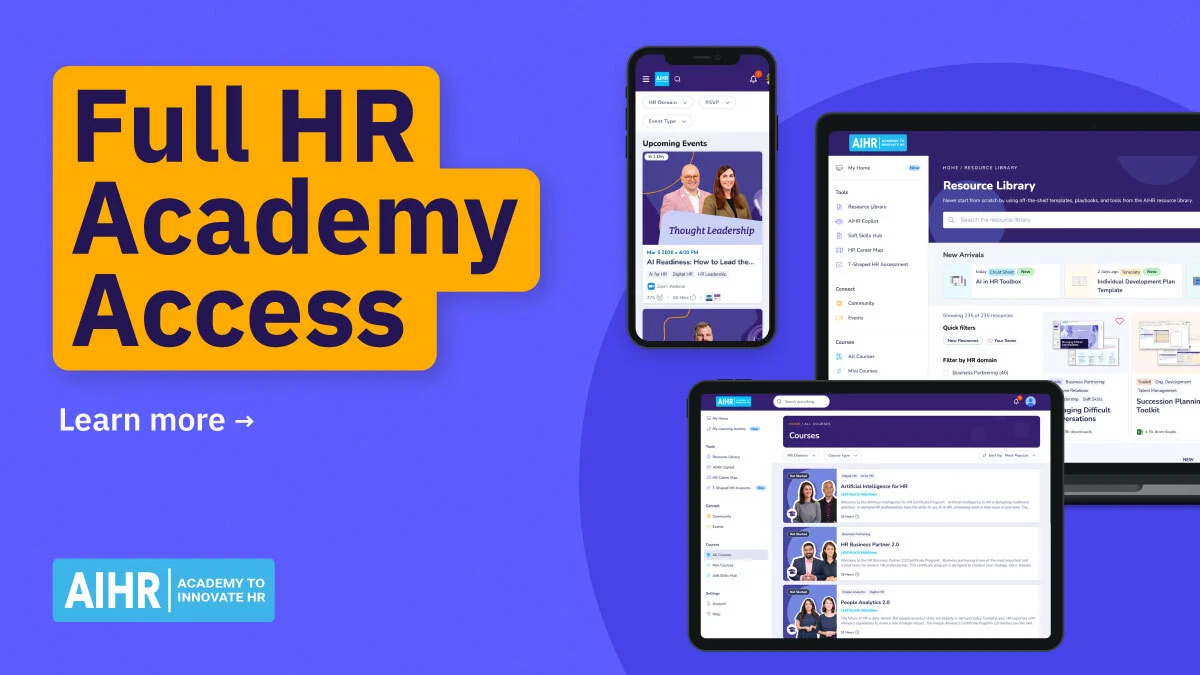
She signed up for Full Academy Access and enrolled in two programs: the Artificial Intelligence for HR Certificate Program and the Talent Management & Succession Planning Certificate Program.
As a senior HR leader and a mother of two young children, Ashley is intentional about making time for learning. “Even if I have to schedule it on my calendar, that’s the best way I’ve found to hold myself accountable,” she says.
She carved out time early in the morning before the kids were up, in the evenings after they were in bed, or on weekends when she could find a quiet hour. The online, self-paced format allowed me to revisit sections without losing progress when a week got busy.
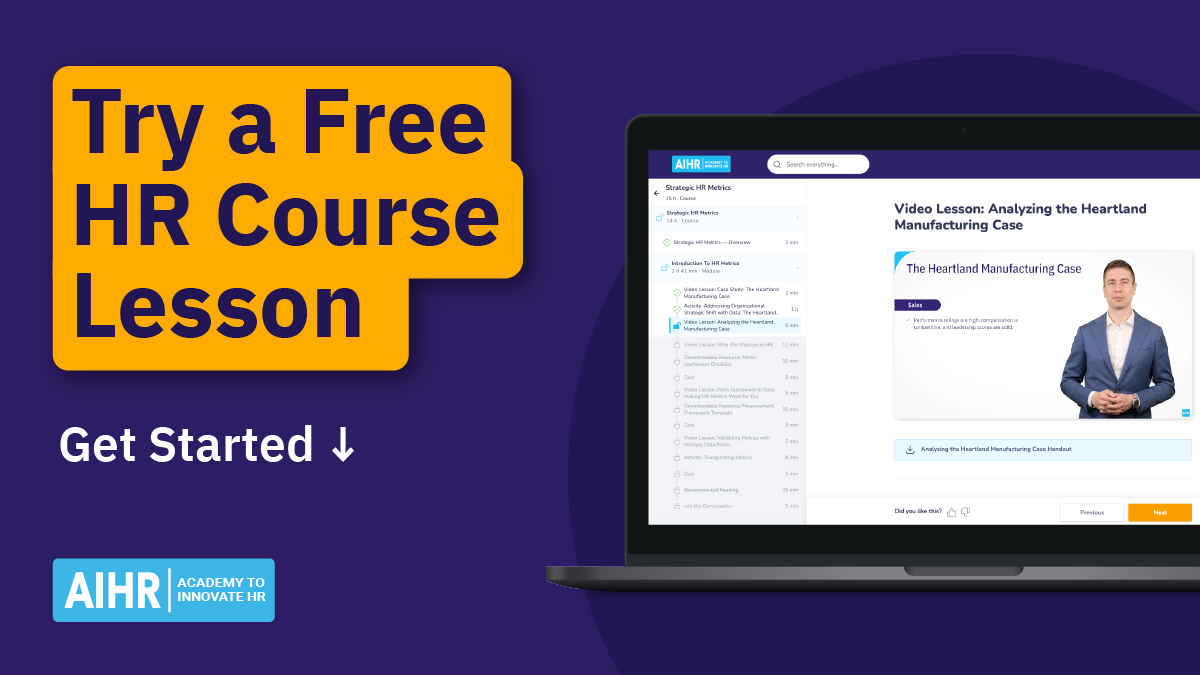
See what the learning experience looks like for yourself.
The Demo Portal allows you to:
✅ Preview AIHR lessons before committing to a course or certificate program
✅ Explore guides, templates, and tools you can use in your day-to-day HR work
✅ Browse learning paths that match your role and goals
✅ Get a feel for AIHR’s learning experience and resources for ongoing development
Immediately applying the learnings from the AI for HR Certificate Program
Before the Artificial Intelligence in HR Certificate Program, Ashley was experimenting and figuring out AI tools as she went. The prompt design module gave her the structure: how context, tone, and output framing shape what you get back. “There’s truly an art behind knowing what you’re asking and what you need,” she says.
She applied it immediately to writing job descriptions, then built up to comparing HR competencies across a job family, flagging gaps, and checking language for accessibility and inclusivity. The process that used to take up significant time became faster, more consistent, and repeatable enough to standardize across her team.
And that shift pointed to something bigger. “If you’re a director or executive, time saving becomes more impactful,” she says. “If you’re spending a lot of time on administrative, low-impact tasks, the whole team and business suffer.”
The governance sections of the certificate program also gave her a leadership perspective. Organizations are deploying AI tools faster than they’re building policies around them. As a senior leader, that’s not just an IT problem. Ashley came out of the program knowing the questions she should ask before anything is rolled out: What platforms are approved? What data can go in, and where does it go? Who is responsible when something goes wrong?
“It taught me to think about those things not just as a practitioner, but as a senior leader responsible for how the team uses these tools”, she says.
What the succession planning program taught her beyond her 14 years of experience
The Talent Management and Succession Planning Certificate Program worked differently. Ashley had run succession planning conversations with senior leadership for years, but she had never formalized that experience.
The 9 box follow-through frameworks are named something she’d seen organizations get wrong repeatedly: talent review conversations happen, placements get made, and then…nothing. “That’s where a lot of organizations fall short,” she says. “Now we have all this great data, and we’ve had all these wonderful conversations, how are we going to act and execute on it?” The program gave her a concrete answer: individual development plans, executive coaching, and targeted managerial training, each calibrated to where the employee was placed and what they needed.
The third shift was in how she thought about her role in those conversations. Succession planning isn’t just a process that an HR leader facilitates. It’s one of the people leaders need to own. Ashley came out of the program thinking differently about how to equip her people leaders to have those conversations effectively. She had a clear plan for what comes next, regardless of where someone lands on the grid.
Leading a team-wide culture of learning with the AIHR Team License
Investing in her team’s development was always a part of how Ashley led. What her own programs added was the ability to guide not just what they learned, but how they applied it. She enrolled each team member in the program that matched their goals under an AIHR Team License, such as data analytics for her senior business partner, and reporting and dashboards for a newer HR coordinator.
As her team progressed through their certificate programs, Ashley created the conditions for individual learning to become a shared way of working. Team sessions became a regular format. Members presented what they were learning and how they were putting it into practice, while others built on the ideas.
“It was really cool to see them taking that, embracing it, and then applying it in a very individualized sense, and then getting excited about it, bringing it back and sharing in a group setting,” she says.
The AIHR Resource Library became part of how Ashley worked, particularly the prompt writing guides, which broke down context, tone, and output considerations in a way she could apply immediately. She shared the HR resources with her team rather than asking them to figure it out from scratch.
“You can’t just hand someone a tool and walk away,” Ashley is careful to note. “You have to understand it yourself first, the benefits, the risks, the limits, so you can actually guide how your team uses it.”
Using the frameworks taught to earn credibility with senior leaders
The frameworks Ashley gained through AIHR changed how she showed up in executive conversations.
The stakeholder motivations chart from the Talent Management Certificate Program was a meaningful shift. She had been running succession planning conversations with senior leadership for years, but the chart pushed her to think through who was in the room, what each person cared about, and what they needed from the conversation before walking in. Structure now complements instinct.
The 9 box grid follow-through frameworks shifted her role in talent reviews. Instead of facilitating the conversation and leaving next steps open, she came in with a deeper understanding of what should happen after each placement conversation. That preparation gave her more legitimacy in the room.
The cumulative effect showed up in how she engaged with the C-Suite, senior leadership, and other key stakeholders. She was no longer relying on experience alone, but now with evidence-backed thinking, data, and a clear, compelling narrative to go with it.
What’s next for Ashley
A recent organizational restructuring left Ashley in a role limbo. “It’s not a chapter I would have written on my own, but I’m making the best of a temporary pause,” she says.
She’s using the time deliberately and continuing with AIHR to build her AI for HR knowledge, stay current on where the profession is heading, and prepare for her next goal: moving to a VP role.
You can check out the preview lessons of the AI for HR Certificate Program and the Talent Management & Succession Planning Certificate Program for yourself to see what Ashley loves so much about AIHR.
Are you ready to transform your own career? Browse our extensive course catalog and explore Full Academy Access, the plan Ashley chose, and make your HR skill set future-proof!
Building your peer network? Connect with Ashley on LinkedIn.
FAQ
Yes, when the goal is putting formal frameworks behind experience-built instincts. The certificate programs are designed by HR practitioners and combine practical application with the strategic context senior roles demand. For Ashley, a Senior Director with 14 years of experience, they formalized how she runs succession planning, built her AI governance knowledge, and “challenged me to think about how I work, why I do it the way I do, and how I can do it differently and better.”
Yes. AIHR programs are self-paced, so you can revisit sections without losing progress when work gets busy. Ashley, a senior leader and mother of two, completed two certificate programs by scheduling learning blocks on her calendar in early mornings, evenings, and weekends.
The certificate program covers practical AI application in HR, including prompt design (context, tone, and output framing) and AI governance topics such as data risk, approved platforms, and accountability. Ashley applied the prompt design module immediately to job descriptions and competency comparisons, and used the governance sections to define the questions she asks before any AI tool is rolled out to her team.
Yes. The Talent Management & Succession Planning Certificate Program covers succession planning, including 9-box follow-through frameworks and stakeholder preparation for talent reviews. Ashley used it to formalize 14 years of succession planning practice, taking away calibrated follow-through actions for each placement: individual development plans, executive coaching, and targeted managerial training.
Yes. Through an AIHR Team License, each team member can be enrolled in the program that matches their individual development goals. Ashley matched her direct reports to programs ranging from data analytics to reporting and dashboards, then ran team sessions where members shared what they were learning and applying.