

The best online compensation and benefits courses (and certificate programs) help you build practical pay, benefits, and analytics skills, but not every online C&B course fits the same career goal. Some courses and programs help HR generalists handle compensation and benefits (C&B) work with more confidence, while others prepare specialists for compensation, benefits, or total rewards roles.
This article explains the difference between courses and certificate programs, compares 10 such online C&B courses and programs, and looks at how you can align the right program with your career goals to ensure you move in the right direction.
Contents
Compensation and benefits course vs. certificate program
10 best online compensation and benefits certificate programs
3 ways to match a C&B program to your career goals
Key takeaways
- The best compensation and benefits course or certificate program depends on the specific skills gap you need to close, not the price tag or prestige attached to it.
- Courses are short and topic-specific, while certificate programs bundle several courses around a broader theme, and finish with a certificate of completion.
- For applied, immediately usable C&B skills, prioritize programs built around templates, case studies, and a capstone project you can mirror in your real work.
- If you hold a major HR association credential, check that the program is a recognized recertification provider before enrolling to get the most out of your study hours.
Compensation and benefits course vs. certificate program
A compensation and benefits course is a focused learning unit that covers a single topic, such as pay principles, benefits administration, or market pricing, in a handful of hours. Courses are quick, narrow, and often cost a few hundred dollars or less. They’re suitable if you have a specific gap (e.g., you’ve never run a market pricing exercise) and want to fix it without committing to a full curriculum.
A certificate program bundles several courses around a broader theme, usually involves around 20 to 40 hours of study, and finishes with a certificate of completion (typically along with a capstone project). Certificate programs can build broad capability across an HR domain like C&B, or help you step into a role where it will be a bigger part of your role.
The distinction matters because a two-hour course won’t make you a credible total rewards lead, and a 40-hour certificate program is unnecessary if, for instance, you just need to brush up on ERISA before an upcoming renewal.

10 best online compensation and benefits courses
The list below mixes broad certificate programs, focused single-topic courses, and short refreshers, so you can pick the C&B course or certificate program based on what’s most likely to help you achieve your career goals.
1. Cornell ILR Compensation and Benefits Certificate (eCornell)
Cornell ILR’s Compensation and Benefits certificate program is an online certificate program delivered through eCornell. It’s instructor-led and includes cohort discussions and structured project work tied to workplace scenarios.
- Duration: Seven to 10 hours of study per week over two months.
- Cost: $3,750; eCornell offers flexible “pay as you go” payment plans (e.g., two monthly payments of $1,925 or four monthly payments of $988).
- Best for: HR professionals who want a university-issued certificate from a recognized institute. It’s also a good fit if you prefer instructor support over fully self-paced learning.
2. Cornell ILR Compensation Studies Certificate (eCornell)
The Compensation Studies Certificate, developed by Cornell’s Institute for Compensation Studies and delivered through eCornell, focuses on pay-for-performance and compensation strategy. It helps you connect pay decisions to business goals.
- Duration: Three to five hours of study per week over two months.
- Cost: $3,750; eCornell offers flexible “pay as you go” payment plans (e.g., five monthly payments of $830).
- Best for: HR professionals who want a strategic view of pay-for-performance. It’s especially relevant if you work on incentive design or support executive compensation work.
3. Cornell ILR Executive Compensation Fundamentals Certificate (eCornell)
Cornell ILR’s Executive Compensation Fundamentals Certificate focuses on senior-level pay design. It covers equity, long-term incentives, governance, and benchmarking for executive roles.
- Duration: Three to five hours of study per week over two months.
- Cost: $3,750; eCornell offers flexible “pay as you go” payment plans (e.g., two monthly payments of $1,925 or four monthly payments of $988).
- Best for: HR professionals moving into roles that touch executive compensation, and generalists who support compensation committees or boards.
Choosing the right C&B program can help you move from understanding rewards concepts to applying them in a way that supports fairness, competitiveness, and business impact.
AIHR’s Compensation & Benefits Certificate Program will teach you how to:
✅ Develop a Total Rewards strategy aligned with business goals and employee expectations
✅ Use benchmarking and C&B analytics to make data-informed rewards decisions
✅ Analyze pay gaps, identify key drivers, and create an action plan for pay equity
✅ Design pay structures, understand job grading, and manage sales compensation more effectively
Preview the lessons on the AIHR Demo Portal to find out what you can expect from this program.
4. Compensation & Benefits Certificate Program (AIHR)
The AIHR Compensation & Benefits Certificate Program is a hands-on, self-paced program built around five courses and a capstone project. It covers total rewards strategy, pay principles, sales compensation, benefits, and compensation and benefits (C&B) analytics. You’ll also work with templates, case studies, and a project you can apply at work.
- Duration: Around 40 hours of study, fully self-paced; 12 months of access.
- Cost: $1,125 as a standalone certificate, or included in AIHR’s Full Academy Access for $1,850.
- Best for: HR generalists, HRBPs, and early-to-mid-career professionals who want practical C&B skills. It’s a strong fit if you need to close a skills gap or start specializing in rewards.
5. Pay Principles course (AIHR)
Pay Principles is a focused course on job evaluation, grading, variable pay, global compensation, and pay budgeting. It’s a single-topic deep dive, so your time goes straight to compensation, and not wider total rewards or benefits content.
- Duration: Four hours, fully self-paced.
- Cost: Included with AIHR’s Compensation & Benefits Certificate Program for $1,125, or AIHR’s Full Academy Access for $1,850.
- Best for: HR professionals who already handle benefits but need more confidence with pay structure design, market benchmarking, or salary budgeting.
6. Compensation and Benefits Analytics course (AIHR)
Compensation and Benefits Analytics is AIHR’s hands-on course on the data side of C&B. It covers pay equity analysis, market pricing, benefits utilization, and dashboards your leadership team can use. Like Pay Principles, it’s a focused module rather than a full certificate program.
- Duration: Four hours, fully self-paced.
- Cost: Included with AIHR’s Compensation & Benefits Certificate Program for $1,125, or AIHR’s Full Academy Access for $1,850.
- Best for: HR professionals who understand C&B strategy but want stronger data skills. It’s especially useful if you’re working on pay transparency or pay equity reviews.
7. Compensation and Benefits course (HRCI)
The HR Certification Institute’s Compensation and Benefits course is a short, introductory course that covers compensation systems, legally required and optional benefits, and pay equity basics. It’s built for people who want a quick primer and recertification credit.
- Duration: Three hours; available for 180 days from date of purchase.
- Cost: $79
- Best for: HR professionals, people managers, and business owners who want foundational C&B knowledge without committing to a longer program.
8. Human Resources: Compensation and Benefits (LinkedIn Learning)
LinkedIn Learning’s Human Resources: Compensation and Benefits is a short foundational online course aimed at HR practitioners and managers who want a quick introduction to compensation and benefits program design.
- Duration: Approximately one hour.
- Cost: $39.99 per month or $239.88 annually for individual accounts; free with a LinkedIn Premium subscription.
- Best for: Busy HR practitioners and people managers who want a low-cost, low-time-commitment introduction. It’s also useful if you’re moving into HR from another function.
9. Entry-Level Compensation and Benefits Analyst Professional Certificate (ADP)
ADP’s Entry-Level Compensation and Benefits Analyst Professional Certificate on Coursera is a multi-course online program that covers total rewards strategy, the C&B analyst role, compensation fundamentals, and financial-protection and growth benefits. Other topics include health and wellness benefits, and the data analytics skills used in day-to-day C&B work.
- Duration: 10 hours a week over two months.
- Cost: Usually $49/month (the standard Coursera monthly fee). The faster you finish the program, the less it will cost.
- Best for: People entering an HR or C&B Analyst role from another function, junior HR professionals formalizing on-the-job knowledge, or career changers who want a structured intro and a portfolio-ready certificate.
10. Total Rewards Today (ERI Distance Learning Center)
ERI’s Basics of Total Rewards is a short, foundational course covering the building blocks of a total rewards program; This includes program objectives, base pay, short- and long-term incentives, medical plan structures, dental, vision, life and disability, retirement plans, salary surveys, market pricing, and executive perquisites.
- Duration: Approximately one hour.
- Cost: Free
- Best for: HR generalists, HR managers, and entry-level C&B professionals who want a foundational overview of total rewards in about an hour.
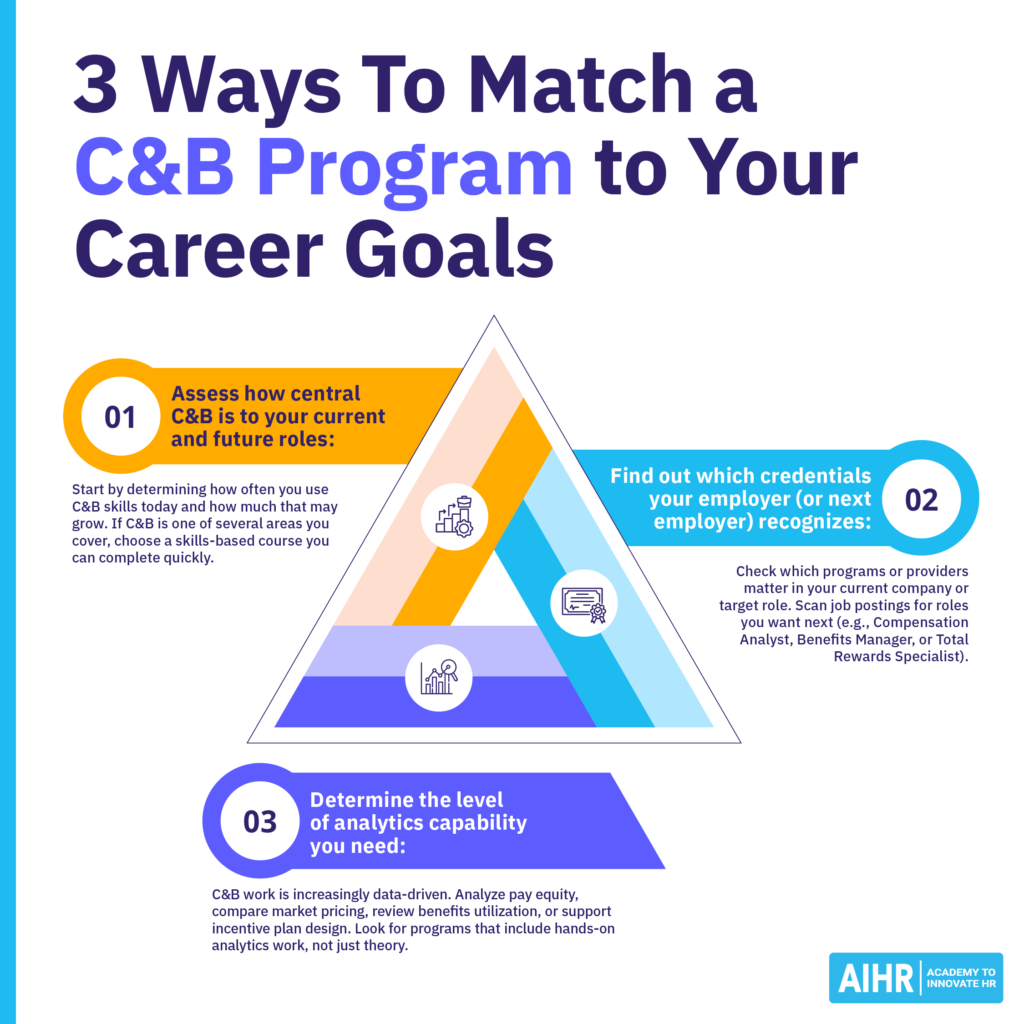
3 ways to match a C&B program to your career goals
Choosing the right compensation and benefits course starts with your career goal. A short course can help you close a specific skills gap, and a full certificate or credential may be a better fit if you want to move deeper into C&B or rewards.
1. Assess how central C&B is to your current and future roles
Start by determining how often you use C&B skills today and how much that may grow. If C&B is one of several areas you cover, choose a skills-based course you can complete quickly. Options like LinkedIn Learning’s Human Resources: Compensation and Benefits course, or HRCI’s Compensation and Benefits course can help you build a foundation without a major time commitment.
2. Find out which programs your employer recognizes
Before you enroll, check which programs or providers matter in your current company or target role. Scan job postings for roles you want next, such as Compensation Analyst, Benefits Manager, Total Rewards Specialist, or Rewards Manager.
You’ll quickly see what employers value. Some roles may ask for hands-on pay structure, benchmarking, or analytics experience. In that case, AIHR’s Pay Principles course, AIHR’s Compensation and Benefits Analytics course, or ERI Distance Learning Center courses can help you target those skills. For roles that mention university-backed learning, Cornell ILR’s compensation programs may be worth considering.
3. Determine the level of analytics capability you need
C&B work is increasingly data-driven. You may need to analyze pay equity, compare market pricing, review benefits utilization, or support incentive plan design. Look for programs that include hands-on analytics work, not just theory. AIHR’s Compensation and Benefits Analytics course is a strong fit if you want to practice with C&B data.
If you need broader coverage, AIHR’s Compensation & Benefits Certificate Program combines analytics with pay principles, benefits, and total rewards strategy. ERI’s short courses can also help if you need targeted refreshers on specific technical topics.
Avoid programs that only define analytics without giving you practice. Look for exercises that use salary ranges, survey data, benefits cost data, or dashboards. Excel or Power BI practice is especially useful if your role involves reporting to leaders.
Next steps
The best online compensation and benefits course or certificate program is the one that closes your specific skills gap with the least friction. Start by writing down three things:
- The C&B tasks you’ve struggled with in the past six months
- The C&B tasks coming up in the next six months
- The HR credential, if any, you need to maintain.
That short list should narrow your choice quickly. If you want a hands-on option that covers total rewards strategy, pay principles, benefits, and C&B analytics in one curriculum, AIHR’s Compensation & Benefits Certificate Program is a practical fit. It’s online, self-paced, and built around templates, case studies, and a capstone project you can apply at work.