

An overtime pay calculator helps HR and payroll teams check that every extra hour is paid correctly, and those mistakes are more common than they seem. ADP Research found that 38% of workers worldwide put in six or more unpaid hours a week. Employees who worked more unpaid hours were also more likely to report lower productivity and say they were looking for another job.
When overtime isn’t paid accurately, the impact goes beyond a payroll correction. It can affect compliance, trust, and retention. This guide includes a free Excel overtime calculator and explains how overtime pay works, how to calculate it, and which federal and state rules HR should check.
Contents
What is overtime pay?
How does overtime pay work?
How to calculate overtime pay
Overtime pay calculation examples
Free overtime pay calculator
Overtime laws in the U.S.
FAQ
What is overtime pay?
Overtime pay is extra compensation employees receive when they work beyond a legally defined threshold of hours. In the United States, the Fair Labor Standards Act (FLSA) generally requires employers to pay covered, nonexempt employees at least 1.5 times their regular rate for hours worked beyond 40 in a workweek. This is commonly called “time and a half.” For example, an employee who earns $20 per hour would earn at least $30 for each qualifying overtime hour.
Eligibility depends on the employee’s duties, compensation, and applicable federal and state laws. Nonexempt employees qualify for federal overtime protection, while exempt employees fall outside these rules. State laws, employment contracts, collective bargaining agreements, and employer policies may provide additional or more generous overtime rights.

How does overtime pay work?
Under the FLSA’s standard overtime rule, covered, nonexempt employees earn overtime for hours worked beyond 40 in a workweek. Employers count each workweek separately, even when they pay employees every two weeks or monthly. For example, an employee who works 45 hours one week and 35 the next earns five hours of overtime for the first week, even though their total hours across the two-week pay period equal 80. A workweek is a fixed, recurring seven-day period set by the employer.
The two common overtime rates are time and a half and double time. Time and a half means multiplying the employee’s regular rate by 1.5, which is the standard federal minimum for qualifying overtime hours. Double time means multiplying that rate by two and may apply under state requirements, an employment agreement, or an employer policy. The applicable arrangement determines which hours qualify for the higher rate.
For an employee with a regular rate of $24 per hour, time and a half pays $36 per overtime hour, while double time pays $48. If they work 45 hours in a week and qualify for time and a half, they earn $960 for their first 40 hours and $180 for their five overtime hours, bringing their total weekly gross pay to $1,140.
Overtime calculations are one part of a wider compensation picture. Understanding how different types of pay work helps HR make more accurate decisions and connect compensation practices to wider business needs.
AIHR’s Compensation & Benefits Certificate Program helps you learn how to:
✅ Understand different types of pay and how they fit into compensation practices
✅ Apply pay principles across job evaluation, grading, and reward decisions
✅ Use C&B data and benchmarking to support more informed pay decisions
✅ Connect compensation practices with HR processes, including salary-cost budgeting
💡 Explore AIHR’s Demo Portal to preview lessons and build practical compensation and benefits skills.
How to calculate overtime pay
To calculate overtime pay, multiply the employee’s regular rate of pay by 1.5, then multiply that by the number of overtime hours worked in the workweek. The steps below use an hourly employee who earns $25 per hour, works 46 hours in one workweek, and qualifies for time and a half. The example assumes they receive a single hourly rate with no additional payments that affect the calculation.
Step 1: Find the regular rate of pay
The regular rate of pay is the hourly amount used to calculate overtime. For an employee who earns one hourly rate and receives no additional compensation, this usually equals their hourly wage. In this example, the employee’s regular rate is $25.
When an employee receives payments such as nondiscretionary bonuses, commissions, or different rates for different tasks, payroll needs to account for the compensation that belongs in the regular rate. Generally, this means dividing total includable compensation for the workweek by total hours worked. The Department of Labor’s regular rate guidance explains which payments are typically included or excluded. Salaried employees who qualify for overtime also need a regular-rate calculation that reflects their pay arrangement.
Step 2: Count overtime hours in the workweek
Add up the hours the employee actually worked during the employer’s established workweek. Then identify the hours above the applicable overtime threshold. Under the standard FLSA rule, subtract 40 from total hours worked. Use zero overtime hours when the total is 40 or fewer.
The employee in this example worked 46 hours, giving them six overtime hours. Review each workweek separately, including when a pay period covers several weeks. This helps payroll capture overtime in the week the employee earns it. The Department of Labor’s overtime guidance confirms that averaging hours over two or more weeks is not allowed.
Step 3: Apply the overtime multiplier
Multiply the regular rate by the applicable overtime multiplier to establish the overtime hourly rate. For time and a half, multiply by 1.5. For double time, multiply by two.
At a regular rate of $25, the employee’s time-and-a-half rate is $37.50 per hour. Multiplying $37.50 by six overtime hours gives $225 in overtime pay. If different overtime rates apply within the same week, calculate the pay for each group of qualifying hours separately. Then add those amounts together.
Step 4: Add overtime pay to regular pay
Calculate pay for the employee’s regular hours, then add overtime pay to find their total gross pay. In this example, the first 40 hours at $25 produce $1,000 in regular pay. Adding $225 in overtime pay brings the employee’s weekly gross pay to $1,225, before taxes and other deductions.
This approach assumes the regular-pay amount covers the first 40 hours. If payroll has already paid the employee their regular rate for all 46 hours, the remaining overtime amount is the additional half-time premium for the six overtime hours. Checking what the initial payment covers helps payroll calculate the correct total.
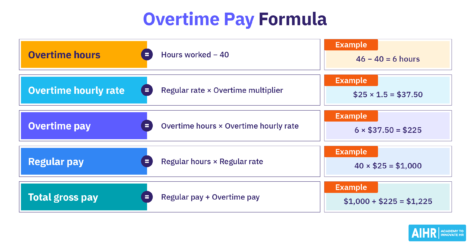
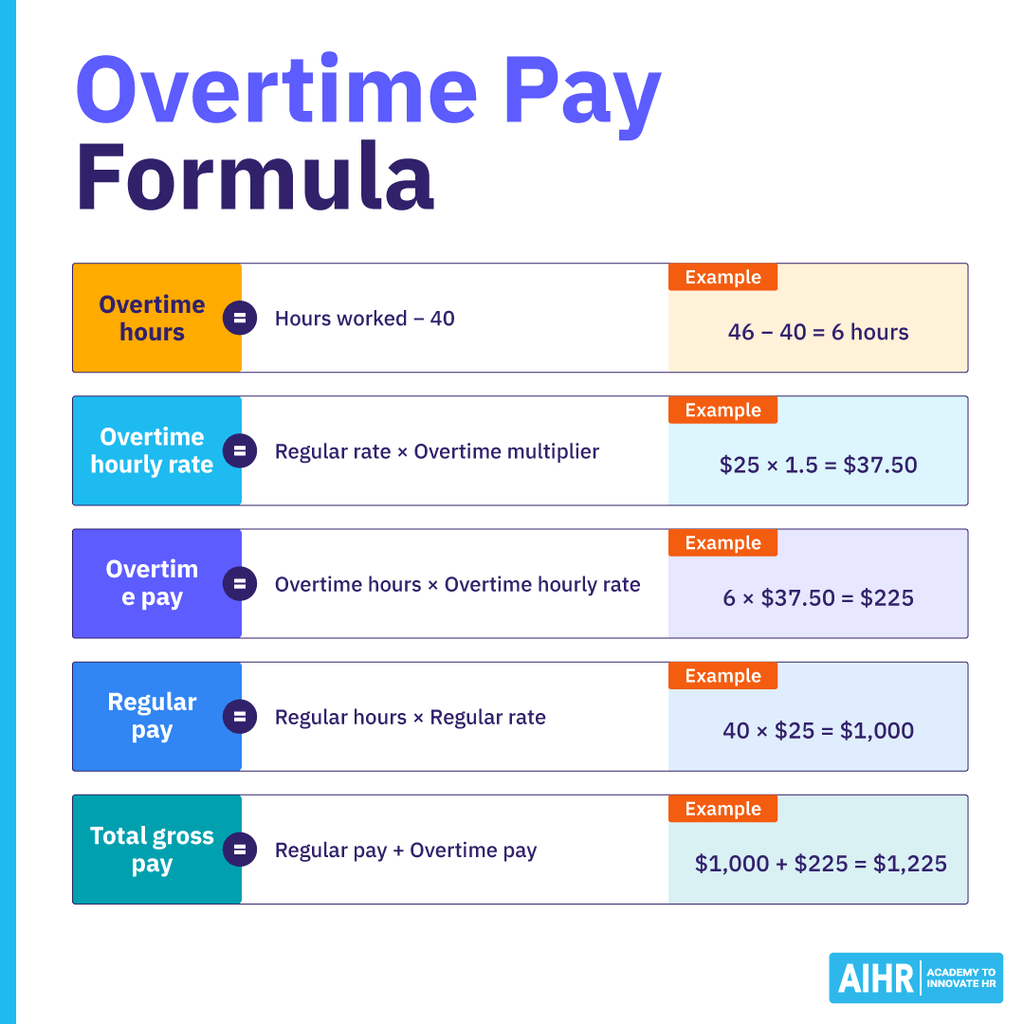
Overtime pay formula
For an employee earning a single hourly rate, with overtime paid at time and a half after 40 hours, use the following formulas.
Overtime hours
Hours worked in the workweek − 40, with a minimum of zero
46 − 40 = 6 hours
Overtime hourly rate
Regular rate × overtime multiplier
$25 × 1.5 = $37.50
Overtime pay
Overtime hours × regular rate × overtime multiplier
6 × $25 × 1.5 = $225
Regular pay
Regular hours × regular rate
40 × $25 = $1,000
Total gross pay
Regular pay + overtime pay
$1,000 + $225 = $1,225
Overtime pay calculation examples
How much overtime pay an employee earns depends on their pay arrangement and the overtime rules that apply. The examples below show how to calculate overtime pay for hourly wages, fixed salaries, multiple pay rates, and double time. All figures show gross pay before taxes and deductions, and assume no additional payments affect the regular rate.
Example 1: Overtime pay for an hourly employee
An employee earns $25 per hour and works 45 hours in one workweek. They qualify for time and a half for the five hours worked beyond 40.
- Overtime hours are 45 − 40 = 5 hours
- Overtime hourly rate is $20 × 1.5 = $30
- Overtime pay is $30 × 5 = $150
- Regular pay is $20 × 40 = $800
- Total pay is $800 + $150 = $950
The employee earns $30 for each overtime hour, bringing their weekly gross pay to $950.
Example 2: Overtime pay for a salaried nonexempt employee
A nonexempt employee receives a weekly salary of $1,200 that covers 40 hours of work. They work 46 hours during the week and qualify for time and a half for the additional six hours. With this salary arrangement, dividing their weekly salary by 40 gives the regular hourly rate used to calculate overtime.
- Regular hourly rate is $1,200 ÷ 40 = $30
- Overtime hours are 46 − 40 = 6 hours
- Overtime hourly rate is $30 × 1.5 = $45
- Overtime pay is $45 × 6 = $270
- Total pay is $1,200 + $270 = $1,470
The employee receives their $1,200 salary plus $270 in overtime pay. This calculation applies to a salary that covers a fixed 40-hour workweek. Other salary arrangements require a regular-rate calculation that reflects the hours the salary covers.
Example 3: Overtime pay for an employee with multiple pay rates
An employee works 30 hours at $20 per hour and 20 hours at $30 per hour during the same workweek. Using the weighted-average method described in the Department of Labor’s overtime calculation guidance, first calculate their earnings at both rates. Then divide those earnings by total hours worked to find their regular rate.
- Earnings at the first rate are 30 × $20 = $600
- Earnings at the second rate are 20 × $30 = $600
- Straight-time earnings for all 50 hours are $600 + $600 = $1,200
- Weighted-average regular rate is $1,200 ÷ 50 = $24
- Overtime hours are 50 − 40 = 10 hours
- Additional overtime premium is $24 × 0.5 × 10 = $120
- Total pay is $1,200 + $120 = $1,320
The $1,200 already covers straight-time pay for all 50 hours, including the ten overtime hours. Adding the half-time premium brings compensation for those overtime hours to time and a half based on the weighted-average regular rate.
Example 4: Double time pay
An employee in California earns $28 per hour and works a 14-hour day. Under California’s daily overtime rules, hours over eight and up to 12 are paid at time and a half, and hours over 12 are paid at double time.
- Regular pay for the first 8 hours is $28 × 8 = $224
- Time and a half for hours 9 to 12 is $28 × 1.5 × 4 = $168
- Double time for hours 13 and 14 is $28 × 2 × 2 = $112
- Total pay for the day is $224 + $168 + $112 = $504
The employee earns $56 for each double time hour. Employers should also track their weekly hours, since time and a half applies to any qualifying hours beyond 40 in the workweek.
Free overtime pay calculator
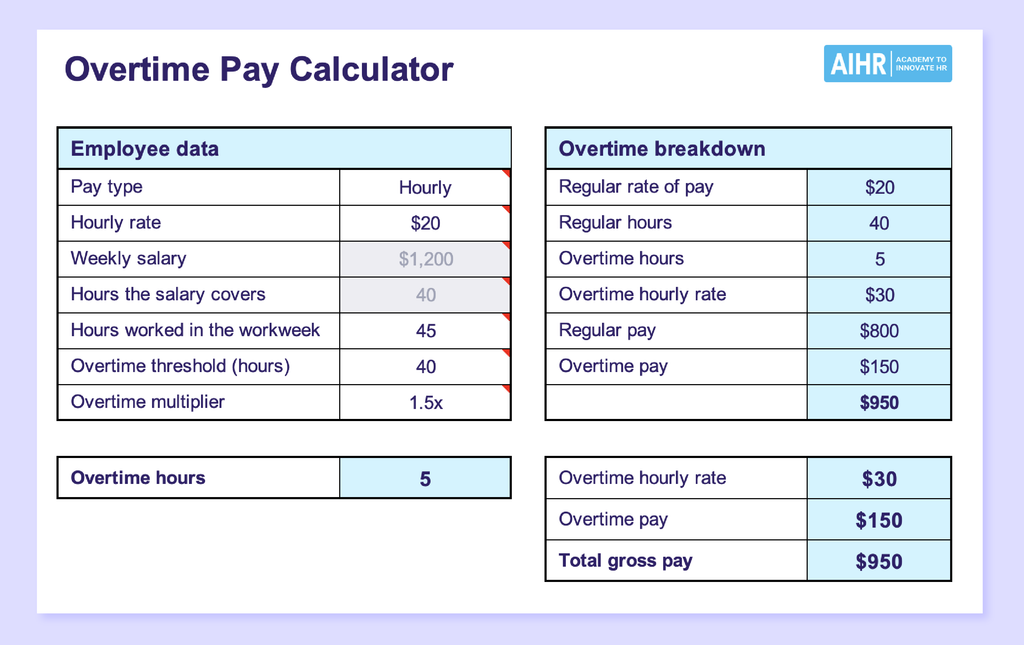
Download our free Excel overtime calculator to work out overtime pay and total gross pay for a workweek. Enter the employee’s hourly rate or weekly salary, hours worked, and overtime multiplier, and the calculator does the rest.
Set the multiplier to 1.5 or 2 to use it as an overtime pay rate calculator for time and a half or double time. HR teams can use it to check payroll, and employees can use it as an hourly pay calculator with overtime.
Overtime laws in the U.S.
Overtime requirements come from both the Fair Labor Standards Act (FLSA) and state law. The FLSA generally requires covered, nonexempt employees to receive at least time and a half for hours worked beyond 40 in a workweek. When federal and state overtime laws both apply, employers must follow the standard that gives the employee greater overtime protection, as the Department of Labor notes in its FLSA guidance.
Federal overtime exemptions depend on pay and duties
The FLSA provides overtime exemptions for certain executive, administrative, and professional employees. To qualify for these exemptions, employees generally must meet a salary basis requirement, earn at least the applicable salary threshold, and perform duties that satisfy the relevant exemption test. The Department of Labor’s exemption guidance outlines the requirements for each category.
The standard federal threshold is $684 per week, equivalent to $35,568 annually. Employees generally must meet this earnings requirement and the relevant duties test to qualify for the standard executive, administrative, or professional exemption. Separate rules apply to some categories, including teachers, practicing doctors and lawyers, outside sales employees, and certain computer employees.
State laws can provide additional overtime rights
State overtime laws can change when employees qualify for extra pay and the rate they receive. California and Colorado show how daily working hours can trigger overtime alongside weekly totals. When federal and state laws both apply, employers must follow the rule that provides the employee with greater overtime protection.
For example, California’s general overtime rules require eligible nonexempt employees to receive time and a half for hours worked beyond eight and up to 12 in a workday. They also require time and a half for qualifying hours beyond 40 in a workweek. Double time applies after 12 hours in a workday.
California also generally requires time and a half for the first eight hours worked on the seventh consecutive day in a workweek. Double time applies for hours beyond eight on that seventh day. These daily rules mean an employee can earn overtime even when their weekly hours total fewer than 40. The state lists exemptions and exceptions that affect how these requirements apply.
Colorado’s wage and hour guidance generally requires covered, nonexempt employees to receive time and a half for hours worked beyond 40 in a workweek, 12 in a workday, or 12 consecutive hours, whichever calculation produces the highest pay.
The consecutive-hours rule can capture long shifts that cross the employer’s workday boundary. Employers with staff in different states should check the applicable thresholds, exemptions, and calculation rules for each location when configuring timekeeping and payroll.
Next steps
Start by downloading the overtime pay calculator and working through a typical workweek for one employee. Check their classification, regular rate, and applicable overtime rules. Then compare the result with your payroll records. Use any differences to spot questions about how your team records hours or calculates pay.
To go beyond overtime and build fair, competitive pay practices, explore AIHR’s Compensation & Benefits Certificate Program. You’ll learn how to benchmark pay, build pay structures, design a total rewards strategy, and use pay data to support pay equity, while earning SHRM and HRCI recertification credits.
FAQ
Under the standard FLSA overtime rule, overtime is time a covered, nonexempt employee works beyond 40 hours in a workweek. State laws may also require overtime pay when employees exceed daily thresholds or meet other qualifying conditions.
Yes. Overtime pay generally remains subject to income tax withholding, Social Security, and Medicare taxes. For tax years 2025 through 2028, eligible workers can claim a federal income tax deduction for qualifying FLSA overtime premiums, subject to limits and income restrictions. The IRS overtime deduction guidance states that the deduction generally covers the portion of qualified overtime pay that exceeds the employee’s regular rate.
Time and a half is the standard federal minimum for qualifying overtime hours. State laws, employment agreements, or employer policies can provide higher rates, including double time. The applicable rules determine which hours qualify for each rate.