

The best compensation and benefits certifications should help you make sound C&B decisions more confidently. Some validate your knowledge through exams, while others offer structured learning and practical projects. Comparing different certifications requires you to assess how each one could enable you to impact your company’s C&B function positively.
To help you decide which one might suit you best, this article compares five options, including certificate programs and exam-based certifications. You’ll find details on costs, study requirements, and focus areas, so you can clearly see which program or certification fits your budget and career goals.
Contents
Best compensation and benefits certifications compared
Best compensation and benefits certifications by goal
How to choose a compensation and benefits certification
Which compensation and benefits certification should you choose?
Best compensation and benefits certifications compared
Here’s how the five options compare. Prices are in USD; be sure to confirm current fees and package details before enrolling.
Program | Best for | Type | Format, duration | Cost |
Compensation & Benefits (AIHR) | Applied total rewards skills | Certificate program | Online, self-paced; 40 hours | $1,125 for one program; $1,850 for Full Academy Access to all 16+ programs |
Certified Compensation Professional (WorldatWork) | U.S. compensation specialists | Certification (eight exams) | E-learning or virtual classroom; about 17 hours per course | $9,500 to $11,960 (depending on membership status and other options) |
Certified Benefits Professional (WorldatWork) | Benefits design and management | Certification (seven exams) | E-learning or virtual classroom; up to two years with a bundle | $6,835.50 (seven-course bundle) |
Certified Employee Benefit Specialist (IFEBP) | Health and retirement plan specialists | Designation (five exams) | Self-paced self-study; no time limit | $5,324 |
Compensation and Benefits (eCornell) | University certificate with a cohort | Certificate program | Online, cohort-based; two months (seven to 10 hours a week) | $3,750 |
The monetary and time investment required for the different programs vary widely. Below, we explain what each option covers, so you can judge which one suits your goals and budget best.

Best compensation and benefits certifications by goal
People usually look at C&B certifications for one of four reasons:
- To solve a problem in their current role, like building a salary structure or closing a pay gap
- To prepare for a compensation career through a credential that employers in their market recognize
- They’re benefits specialists who need deeper expertise in health and retirement plans
- They favor structure and deadlines of a university cohort, and want a degree to strengthen their résumé and improve their career prospects.
Build applied total rewards skills
Choose this route to practice designing and improving C&B programs. For work across countries, check how you’ll adapt the learning to local requirements.
1. Compensation & Benefits Certificate Program (AIHR)
AIHR’s Compensation & Benefits Certificate Program helps you develop a total rewards strategy and the skills to manage it. You’ll practice grouping roles into pay levels, benchmarking salaries, and investigating pay gaps.
- Best for: HR generalists, HRBPs, and total rewards professionals who need practical C&B skills they can use right away.
- Topics covered: Total rewards strategy, job evaluation and grading, base and variable pay, salary benchmarking, sales compensation, C&B analytics, and pay gap analysis.
- Practical tools: Resources that include a salary benchmarking exercise, a pay gap dashboard, and a sales compensation plan template.
- Format and duration: Online and self-paced, with 40 hours of learning across five courses and a capstone project.
- Recertification credits: Eligible for 27 SHRM PDCs, 27 HRCI credits, and 32 HRPA PDCs. AIHR is recognized by SHRM to offer professional development credits (PDCs) for SHRM-CP or SHRM-SCP recertification activities.
- Cost: $1,125 with 12 months of access to one program, or included in Full Academy Access at $1,850 per year.
Choose the right C&B certification to help you take the important step toward building the practical skills you need to design competitive, equitable, and data-driven rewards strategies.
AIHR’s Compensation & Benefits Certificate Program teaches you to:
✅ Develop a Total Rewards Strategy that aligns compensation and benefits with business goals
✅ Design competitive pay structures using job evaluation, grading, and compensation principles
✅ Analyze compensation data to benchmark rewards, evaluate effectiveness, and inform strategic decisions
✅ Conduct pay gap analyses to identify inequalities, understand their drivers, and improve pay equity
🚀 Explore the AIHR Demo Portal to preview lessons and discover how the program can help you advance your C&B career.
Validate compensation expertise
For a compensation-focused career, check which credentials employers recognize in your target market.
2. Certified Compensation Professional (WorldatWork)
WorldatWork’s Certified Compensation Professional (CCP) validates your knowledge of compensation design and management through eight required exams.
- Best for: Compensation analysts and managers who work on programs in one country. WorldatWork’s Global Remuneration Professional (GRP) is its multinational counterpart.
- Topics covered: Total rewards strategy, the regulatory landscape, base pay systems, variable pay, market pricing, compensation analytics, finance and accounting for rewards, and business acumen and communication.
- Format and duration: E-learning or virtual classroom courses, each paired with an online exam. WorldatWork estimates an average of 17 study hours per course.
- Cost: $7,812 for the eight-course e-learning bundle, which includes two years of access and membership. Note that it’s available only in the U.S., Canada, and Mexico. Individual courses start at $1,395 each.
Specialize in employee benefits
These two credentials focus on benefits rather than pay. Compare their curricula against the plans and responsibilities you manage.
3. Certified Benefits Professional (WorldatWork)
WorldatWork’s Certified Benefits Professional (CBP) focuses on benefits design and management, with an emphasis on U.S. practices.
- Best for: Entry- to mid-level HR professionals who manage benefits programs.
- Topics covered: Total rewards for benefits, regulatory environments for benefits programs, and benefits communication.
- Format and duration: Seven courses and required exams, with up to two years to finish the bundle.
- Cost: $6,835.50 for the seven-course e-learning bundle (U.S., Canada, and Mexico only), or $1,395 per individual course.
4. Certified Employee Benefit Specialist (IFEBP)
The International Foundation of Employee Benefit Plans (IFEBP) offers the Certified Employee Benefit Specialist (CEBS), which focuses on group health and retirement plans.
- Best for: Benefits specialists and consultants who work closely with health and retirement plans.
- Topics covered: Group benefits and retirement plan design and management. You earn the Group Benefits Associate (GBA) and Retirement Plans Associate (RPA) credentials along the way.
- Format and duration: Five self-paced, self-study courses, each with an exam. There’s no time limit to finish.
- Cost: Each exam costs $580, including two attempts. IFEBP lists the full program at $5,324 if you buy the study package for every course.
Learn in a university cohort
A university-issued certificate may suit you if you prefer instructor guidance, peer discussions, and set deadlines.
5. Compensation and Benefits Certificate (eCornell)
Cornell ILR (Industrial and Labor Relations) School’s Compensation and Benefits Certificate, delivered through eCornell, teaches total rewards through four faculty-developed courses.
- Best for: HR professionals working with U.S. pay and benefits who want instructor feedback.
- Topics covered: Total rewards compensation, compensation structures, pay benchmarking, and employee benefits.
- Format and duration: Online and cohort-based, with courses taken in order. Plan for two months at seven to 10 hours per week.
- Cost: $3,750.
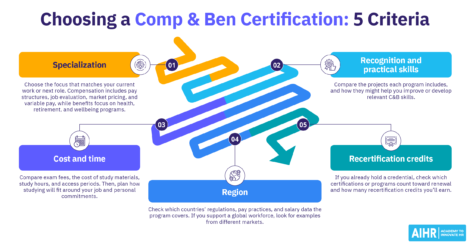
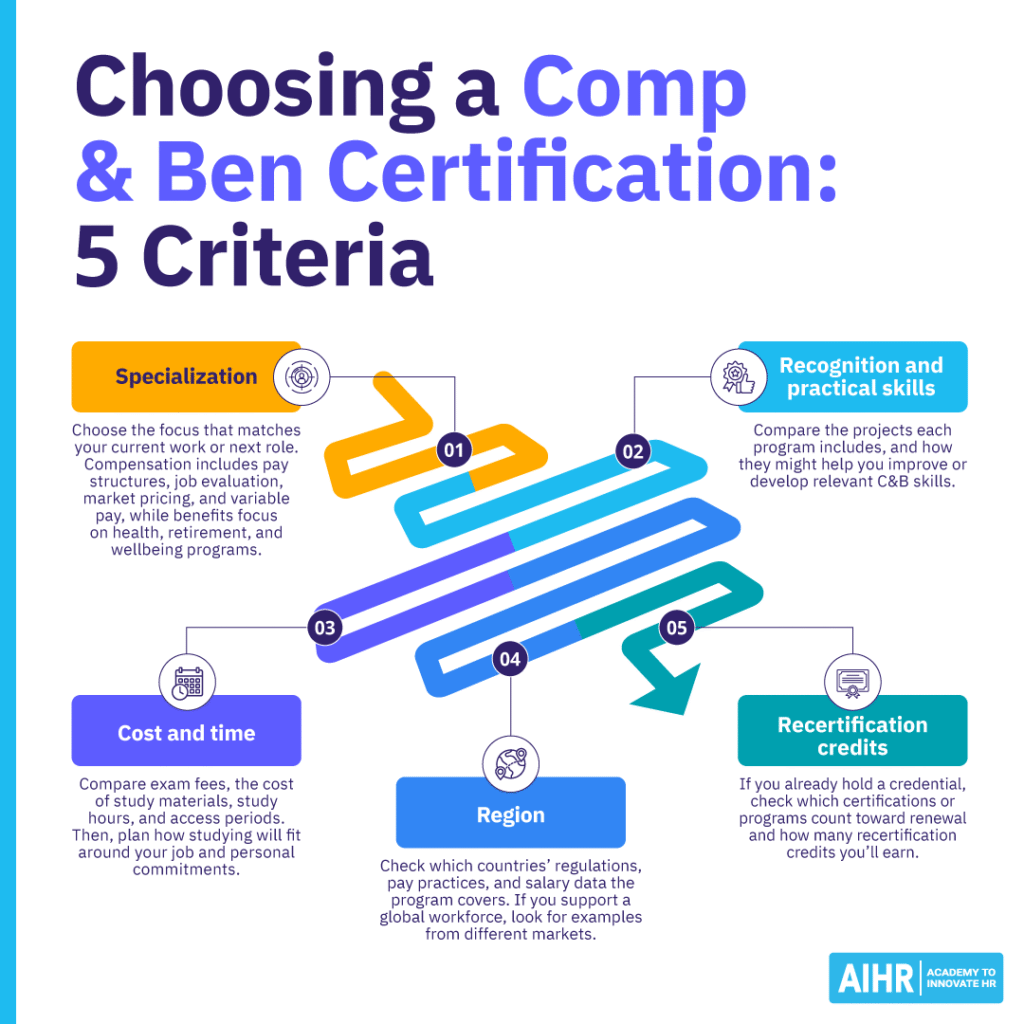
How to choose a compensation and benefits certification
Use the following criteria to narrow your options:
Specialization
Choose the focus that matches your current work or next role. Compensation includes pay structures, job evaluation, market pricing, and variable pay. Job evaluation compares roles’ value, while market pricing compares their pay with similar jobs elsewhere. Additionally, benefits focus on health, retirement, and wellbeing programs, and total rewards combines pay and benefits with recognition and other employee rewards.
Recognition and practical skills
While some prospective employers may prefer specific credentials or qualifications, some emphasize skills such as salary benchmarking or investigating unfair pay gaps. In the latter case, it’s important to compare the projects each program includes, and how they might help you improve or develop relevant C&B skills.
Cost and time
Compare exam fees, the cost of study materials, study hours, and access periods (a two-year access window doesn’t mean you have two years to complete your program or certification).
Plan how studying will fit around your job and personal commitments. Some learners prefer interactive or in-person lessons, while others (especially those employed full-time) prefer online, self-paced programs like those offered by AIHR.
Region
Check which countries’ regulations, pay practices, and salary data the program covers. If you support a global workforce, look for examples from different markets. Ask how you’ll adapt the tools to local requirements. Don’t assume international enrollment means the content fits your region. Request a sample lesson to assess its relevance before you commit.
Recertification credits
If you already hold a SHRM or HRCI credential, check which certifications or programs count toward renewal and how many recertification credits you’ll earn. Confirm eligibility with your certifying body before enrolling. Then choose learning that fills a skills gap, and keep your completion records for your renewal application.
Which compensation and benefits certification should you choose?
Your next role and immediate work priorities should guide your choice.
If you’re an HR generalist or HRBP handling C&B alongside other duties, start by comparing applied programs. AIHR’s Compensation & Benefits Certificate Program lets you study alongside your job.
If you’re a U.S.-based compensation analyst, shortlist the CCP when your target employers request it. For benefits roles, compare the CBP and CEBS against the job requirements you keep seeing.
For global work, check how much of the curriculum assumes U.S. rules and practices. If you already hold an HR credential, check eligible recertification credits before enrolling. For one specific skill, such as salary benchmarking, a short C&B course may meet your immediate needs.
Next steps
Choose one work challenge or career goal, then shortlist two programs that could help you address it. Compare their curricula, assessment requirements, and total costs against that goal. If a target employer requires a specific credential, make that your starting point.
Preview AIHR’s Compensation & Benefits Certificate Program to explore total rewards, pay design, C&B analytics, and pay equity through self-paced learning and applied projects. For people analytics or HR leadership skills, Full Academy Access includes all 16+ certificate programs at a standard $1,850 annually. Check current offers, then choose the learning that helps you make better HR decisions at work.