
HR budgeting best practices are changing. Where HR teams traditionally predominantly relied on what the budget was spent on the year before, modern HR budgeting focuses more on the company’s future needs and how HR can contribute to them.
In this article, we’ll explore what modern HR budgeting looks like and why it matters, and what modern HR teams invest in vs. what they traditionally allocated their budgets to. We also share seven HR budgeting best practices to keep in mind when budgeting in this new way.
Contents
What is modern HR budgeting?
Why traditional HR budgeting no longer works
What modern HR teams invest in
7 HR budgeting best practices for modern HR teams
What is modern HR budgeting?
Modern HR budgeting is a planning approach that allocates HR money, capacity, and skills based on business outcomes, future workforce needs, and capability gaps rather than just HR activities.
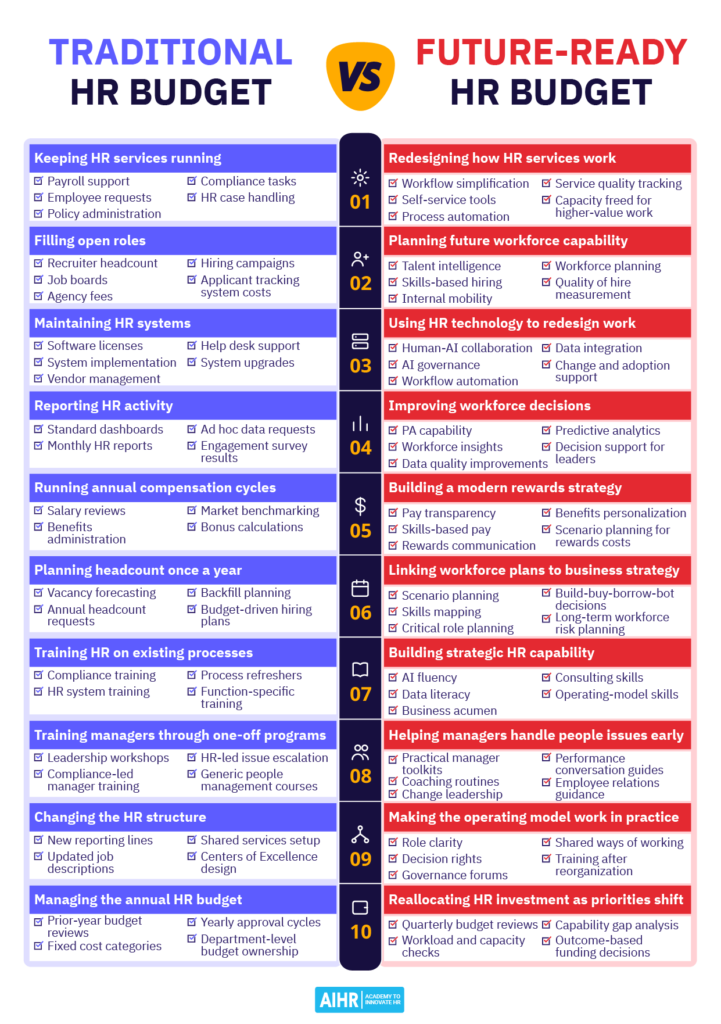
Traditionally, HR budgeting tended to focus on maintaining HR’s existing services. Teams often built the budget by reviewing the prior year’s spend, adding known cost increases, and making room for recurring needs such as payroll support, recruitment, compliance, learning programs, benefits administration, and HR technology contract renewals.
This approach gave HR leaders predictability. It helped them fund essential work, manage risk, and keep employee services stable. But it didn’t account for operating model changes, capability gaps, or future workforce needs, for example. Modern HR budgeting does, because it is a planning approach that is based on HR’s broader business impact.

Why traditional HR budgeting no longer works
HR budgets often start with what HR already has and does: existing teams, recurring costs, and established ways of delivering services. In other words, HR budget allocation tends to follow historical headcount, legacy service volumes, and old operating-model choices.
That approach becomes less effective as HR’s role expands. Organizations now expect HR teams to implement new technology, use workforce data to inform decisions, support AI adoption, do workforce planning for human-AI collaboration, lead organizational change, and rethink rewards. At the same time, parts of traditional administrative and service-delivery work are being automated, streamlined, or shifted to self-service.
AIHR’s analysis of how HR teams allocate their own payroll budget reflects this pattern:
- 59% of the payroll is spent on role families that are the easiest to hire and where talent is in abundant supply (e.g., employee relations, HR service delivery, and talent management)
- 30.5% goes to other role families (talent acquisition and L&D, for example)
- Only 10.5% of the payroll budget is spent on role families with the fastest-growing capabilities but in the tightest markets (examples include HR tech, people analytics, and total rewards).
The data shows that for many HR teams, around two-thirds of their headcount spend still goes to roles with an abundant talent supply, rather than to scarce roles where demand is growing.
This does not mean HR should simply cut established functions. Core HR operations and talent acquisition remain essential. The issue is that HR is being asked to deliver new capabilities while much of its capacity remains tied to the work and structures built for an earlier mandate.
That creates a budgeting problem. If HR continues to carry historical allocations forward, it may struggle to invest enough in the technology, data, specialist expertise, and competencies needed for newer priorities. That’s why modern HR budgeting needs to look beyond what HR costs today and ask where resources will be needed to deliver value next.
What modern HR teams invest in
Modern HR teams direct their budgets toward the business priorities, workforce needs, and capability gaps that will matter most in the future. Naturally, they’ll still need to invest in many of the traditional HR budget areas, too, but in general, the investment is going to be redistributed.
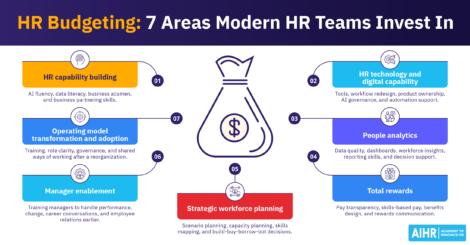
Here are some of the elements of a modern HR budget, including examples of what exactly the investment goes into:
HR capability building
Future-ready HR teams invest deliberately in the capabilities they will need as the function evolves. Part of that investment is developing the competencies employees need to work effectively within new systems, operating models, and ways of working. Key areas include:
- AI fluency
- Business acumen
- Consulting skills
- Data literacy
- Digital agility
- Skills related to their HR operating model.
Traditionally, HR development budgets often went to standard, standalone training. A more modern approach is to fund structured development that builds competencies over time. This could mean giving your team access to HR certificate programs and courses, or enrolling them in a boot camp to strengthen priority competencies across the team.
Organizations with more specific capability gaps can also invest in custom learning tailored to their roles, priorities, and operating model.
AIHR worked with a global insurance organization of 4,500 employees that invested in structured, ongoing HR capability building rather than one-off training. AIHR assessed where the HR function stood, then defined the future-ready capabilities it needed and defined the underlying competencies in a shared framework.
To build those competencies, the HR team followed role-based learning journeys. The organization also revisited the framework regularly, keeping competencies aligned with changing business and technology needs. The result was a stronger, more strategic HR function and roughly $1.6M in efficiency gains.
HR technology and digital capability
AI is reshaping what digital transformation in HR looks like. It is no longer mainly about replacing manual processes with digital systems. Today, HR teams are using AI to redesign workflows, automate parts of service delivery, improve decision support, and change how employees and managers interact with HR.
To support this digital transformation, HR teams need to budget for, among other things, digital capability building, which includes the right tools, workflow redesign, product ownership, AI governance, automation support, and digital agility development.
People analytics
People analytics budget is typically used to go to standard dashboards, monthly HR reports, employee survey results, and ad hoc data requests. Now, HR teams increasingly allocate budget to improving data quality, workforce insights collection, and building reporting skills.
People analytics also provides a foundation for HR budget planning. It helps you collect relevant organizational, people, and talent data to inform talent management and workforce planning decisions, including their associated costs.
Total rewards
Budgeting for total rewards goes beyond your workforce’s salary and benefits. It also includes your people’s development and recognition in the form of, for example, a promotion, both of which should tie into a broader strategy such as a succession or workforce (capability) plan.
Traditionally, HR teams allocated budget for this category to things like salary reviews, bonus calculations, and market benchmarking. Modern HR budgeting also includes investments in pay transparency initiatives, skills-based pay, benefits design, and rewards communication.
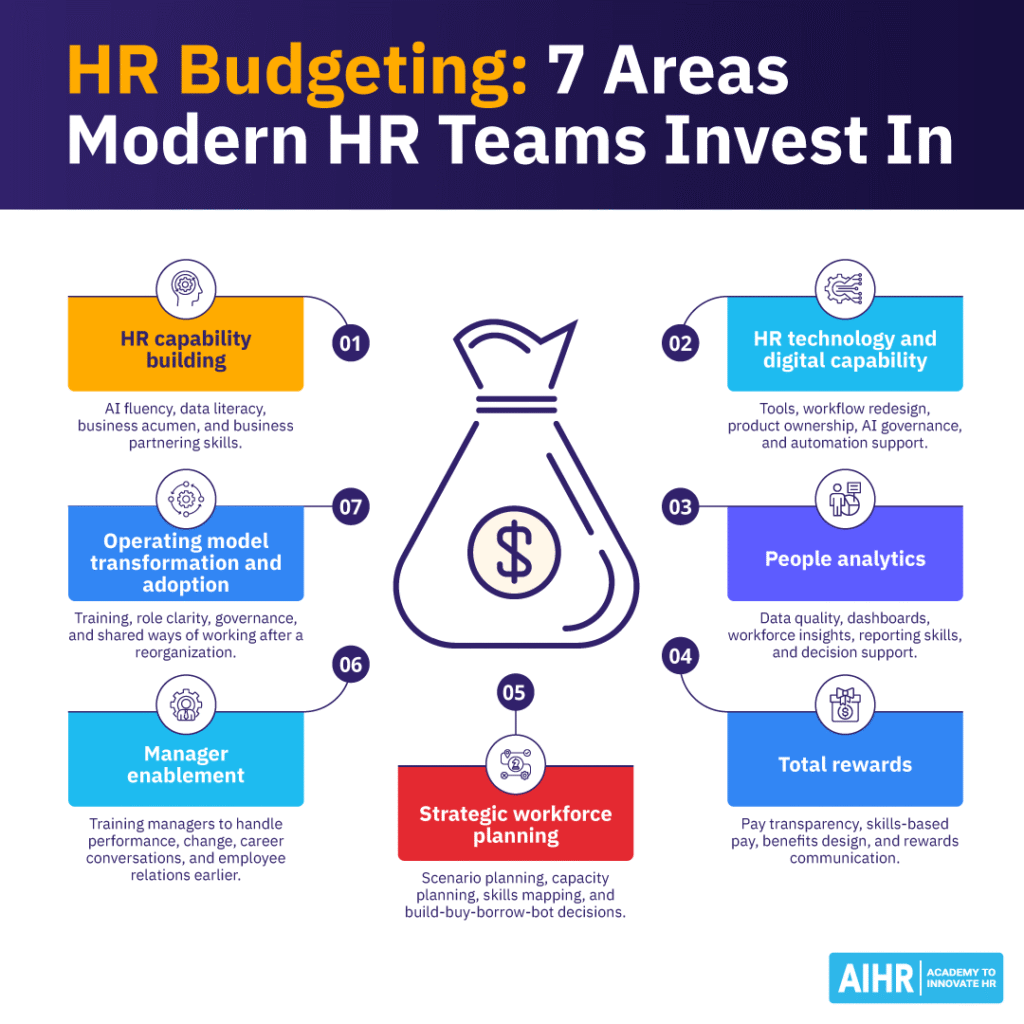
Strategic workforce planning
Strategic workforce planning is about ensuring the organization has the right people, knowledge, and skills to achieve both its current and future business goals. As such, it is an integral part of any modern HR budgeting plan.
Many organizations already set aside a budget for annual headcount requests, backfill planning, and vacancy forecasting. Future-ready HR teams allocate resources to scenario planning, capacity planning, skills mapping, and build-buy-borrow-bot decisions as well.
Manager enablement
Helping managers handle people issues earlier – or perhaps prevent them altogether – allows HR teams to spend their resources on other matters and increase their efficiency.
To get to this point, managers need to receive training around performance, change, and career conversations, as well as certain employee relations matters. Additional resources should be available for ongoing support, for instance, in the form of practical manager toolkits and help from an HR professional when needed.
Operating model adoption
HR functions change their operating models to serve the business more effectively as priorities, structures, and ways of working evolve. While the HR business partner model remains prevalent, some organizations may increasingly explore AI-first models.
But changing the structure is only part of the work. AIHR’s research shows that in the past two years, 64% of HR organizations changed their operating model. Yet only 19% report a clear division of responsibilities, and 60% of reorganized functions provided no formal training on the new structure.
To facilitate the switch to a different operating model, teams must allocate resources to providing training on shared ways of working after the reorganization, role clarity, and decision rights, and to build governance forums.
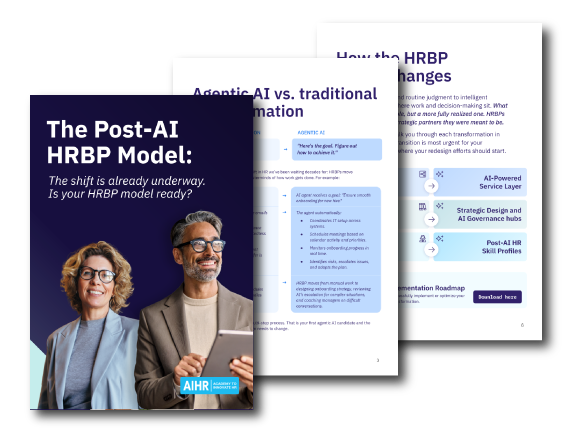
As a starting point, download AIHR’s Post-AI HRBP Model guide to help you think through how roles, responsibilities, and ways of working may need to evolve in an AI-enabled HR function.
7 HR budgeting best practices for modern HR teams
Let’s explore some modern HR budgeting best practices you can already start adopting for the next quarter or year. Here’s what to consider to optimize your HR budgeting and cost management:
1. Start with business outcomes, not budget categories
Tie each major budget item to a workforce risk, a business goal, or a capability gap. Examples could be:
- Workforce risk: High vacancy rates in critical roles are causing operational burnout. This may justify spending on targeted recruitment, retention measures, internal mobility, or workforce planning support.
- Business goal: Improve customer satisfaction rate by 15% within the next six months. Relevant investments could include manager training, frontline employee development, and performance support.
- Capability gap: A lack of leadership readiness among mid-level managers for succession planning. Funding may go toward leadership development, coaching, succession planning tools, or assessment programs.
2. Challenge existing spend before adding new budget
New priorities don’t always require a larger HR budget. Before requesting additional funding, modern HR teams review existing spend for areas they can consolidate, stop, or redirect. This could include underused technology, overlapping vendors, low-impact programs, or activities that no longer support current priorities.
The aim is to create room for new investment rather than continuously layering new costs onto a budget built around previous priorities.
3. Map current HR spend against future capability needs
Many HR teams still budget based on a legacy operating model; we already mentioned the AIHR research showing that HR functions direct around 60% of their payroll to roles with an ample talent supply. Meanwhile, a much smaller share goes to areas such as HR technology and people analytics, where demand for these professionals is growing, and talent is harder to find.
This creates a mismatch between where HR resources sit today and where future capability needs are emerging. HR teams should therefore consider future demand and talent scarcity when making budgeting decisions, rather than allocating resources based mainly on current headcount and workload.
4. Protect essential HR operations while redesigning the work
Core HR services still need funding, even as HR’s role changes. HR teams will continue to need budget for administration, systems, compliance, employee support, and other essential services.
What changes is how much of the budget goes into maintaining those activities in their current form. As more administrative work is automated or shifted to self-service, HR teams can reassess the level of spend required and gradually redirect part of that budget toward newer priorities and capabilities.
5. Budget for HR competencies as the foundation for future capability
HR teams need the skills behind business priorities like AI adoption, people analytics, strategic workforce planning, and operating model changes. Allocate a dedicated budget to develop these HR competencies needed for future-ready capabilities.
6. Document your HR budgeting and cost management strategy
Create a working document or other type of online space that relevant stakeholders can easily access. This provides you with a point of reference that holds all the information regarding how specific budget allocations were determined and why.
It’s something your own HR team can come back to, but also a useful resource to refer managers to when explaining why they are being trained on performance conversations or employee relations matters, for example.
7. Regularly review your budget
Especially if this is the first time you’re budgeting in this ‘new way’, you want to keep checking in with your HR budget regularly (quarterly, at least). Are you over- or underspending, or perhaps you are right on track? And what categories look like they can use some extra attention? Adjustments to the HR budget may also be necessary when the organization changes its business goals.
A final word
HR budgeting is no longer primarily based on what the HR team spent last year, adjusted by a couple of percent for inflation and other cost increases. Instead, modern HR teams increasingly allocate their budgets based on both traditional spending and future needs, such as capability gaps and workforce changes.
This does not mean overhauling the entire HR budget at once. Teams can make gradual shifts by reviewing where spend sits today, identifying where future needs are emerging, and reallocating budget over time. AIHR’s HR budgeting best practices described in this article can help make those decisions more deliberate and manageable.