

Knowing how to handle employee performance issues helps HR protect manager credibility, team morale, and employee trust. Leaving managers to handle these issues with uneven guidance and unclear escalation paths erodes employee trust and causes unnecessary friction. It’s also important to note that HR can’t run every difficult conversation for every manager.
Rather, HR’s role is to design a fair process, set clear standards, and help managers guide staff toward those standards. AIHR’s High-Impact Performance Management mini course teaches HR professionals a structured approach for managers to use before performance issues escalate.
This article explores common types of performance issues, how to handle them, and how to broach the topic with employees.
Contents
What is a performance issue?
5 common types of employee performance issues
How to handle employee performance issue in 7 steps
How to talk to an employee about poor performance
What is a performance issue?
A true performance issue occurs when the employee’s work, conduct, or reliability consistently falls short of what the role requires, whether that shows up as missed deadlines, recurring errors, friction with the team, or unreliable attendance. When you can measure it against a clear expectation, such as a KPI, a job description, or a company policy, and see it genuinely affecting the team or the business, that’s when it moves from an off day to a performance issue worth addressing.
When is it not a performance issue?
Not every gap between what you expected and what you got is a genuine performance issue, though, so train managers on how to spot the differences:
- When nobody ever defined what “good” looks like for the role, whether that’s a specific target, a deadline, or a quality bar, you can’t fairly measure someone against a standard they were never told existed.
- When the employee didn’t have the tools, training, or authority to do the job, and kept hitting walls a manager could have cleared, that’s a resourcing failure dressed up as a performance one.
- When priorities kept shifting without anyone saying which one mattered most, or two managers gave conflicting instructions, the confusion belongs to the system, not the person stuck navigating it.
- When feedback only showed up at review time, after months of silence, the employee never had a real chance to correct course, which makes the outcome hard to call theirs alone.
- When the role itself was built around an unrealistic workload or an unclear scope, and even a strong performer would have struggled.
- When a health issue, personal crisis, or temporary life circumstance affects someone’s output.

5 common types of employee performance issues
Here are five common employee performance issues:
1. Productivity
Productivity issues show up when employees fall short of output expectations. For example, a Sales Development Representative (SDR) consistently misses their sales quota, or a project team member consistently misses client deadlines.
Solution: First, ensure that the employee understands their expectations, then have the manager compare current performance against documented goals. If there’s a clear gap, agree on one or two measurable improvement targets (e.g., completing a specific number of deliverables by a set date).
Managers should also check for workload, skill, or tool-related barriers. If the employee needs support, assign coaching, job shadowing, or a short skills refresher before moving to formal action (if necessary).
2. Attendance and punctuality
Being late once because of bad weather is understandable. A pattern of tardiness, unplanned absences, or leaving early without approval, however, is different and will require closer examination.
Solution: Ask managers to track attendance over time, instead of reacting to one incident. The first conversation should focus on understanding the cause of the issue (e.g., transportation or health issues, or caregiving responsibilities).
Managers can then agree on a practical plan that may include clearer call-in expectations, adjusted scheduling where appropriate, or a reminder of attendance policy requirements. HR should step in when the issue involves accommodations, protected leave, or repeated policy violations.
3. Conduct and behavior
Conduct issues include behavior that violates workplace standards and can range from disruptive communication to serious policy violations.
Solution: Managers should address conduct issues quickly and focus on the specific behavior, not the employee’s personality. For example, “You interrupted three colleagues during today’s planning meeting” is preferable to “You’re disrespectful.” Give managers behavior standards they can point to (e.g., meeting norms or communication guidelines).
The conversation should explain the impact of the behavior and the expected change. For repeated issues, managers should document each incident and agree on clear next steps. They should report serious conduct concerns, such as harassment, discrimination, threats, or safety risks, directly to HR.
4. Quality of work
An employee may complete their work on time, but it may still fall short of the required standard. Frequent errors, a high rework rate, or a growing complaint log can all indicate a quality issue.
Solution: Define what good work looks like before asking the employee to improve. Managers should provide examples, explain where the employee’s work falls short, and identify the most common errors, then create a short improvement plan focused on quality checks.
This may include regular peer review, or manager review at key milestones. Track progress with concrete measures, such as fewer errors, lower rework rates, or fewer customer complaints. This helps the employee see what success looks like and gives HR a fair record of improvement.
5. Teamwork and collaboration
Difficulty working with others can become a performance issue, as can resistance to feedback, or a communication style that creates regular friction.
Solution: Gather specific examples from the manager, peers, or project records, and avoid vague labels like “not collaborative” or “hard to work with”. Instead, focus on behaviors (e.g., missing handoffs, dismissing feedback, or delaying shared work).
Managers should explain how the behavior affects the team’s output, and agree on practical changes, such as confirming handoffs in writing, using shared project updates, or attending conflict-resolution coaching. Peer feedback or 360 degree feedback can also help HR spot patterns one manager alone may not see.
How to handle employee performance issues in 7 steps
Use this process to standardize how managers handle employee performance issues. The goal is simple: every manager should know what to do, what to document, and when to involve HR.
Step 1: Set clear expectations and documentation standards before issues arise
Before any performance conversation, require managers to gather the right information. This should include the employee’s job description, performance goals, KPIs, and notes from past check-ins or feedback sessions. Without these details, the conversation becomes subjective. The manager may rely on memory, and the employee may experience an unfair process.
Build a documentation checklist that managers must complete before every performance conversation to ensure consistency and help them avoid missing important context.
Step 2: Train managers to recognize early warning signs
Train managers to watch for these common patterns:
- Missed deadlines
- Absenteeism
- Lower work quality
- Disengagement.
Repeated missed deadlines can affect team productivity, customer satisfaction, and business outcomes. Habitual lateness, frequent absences, and disengagement can also harm team dynamics. Manager training should explain what to do next, i.e., flag the issue, observe it for one week to one month, and document what happens. If the issue continues and the manager isn’t sure how to respond, they should raise it with HR.
Addressing employee performance issues effectively goes beyond managing the immediate problem. Build the skills you need to connect performance conversations with development, retention, and longer-term talent decisions.
AIHR’s Talent Management & Succession Planning Certificate Program teaches you how to:
✅ Identify and assess talent to make more informed development and talent management decisions
✅ Conduct talent mapping and talent reviews to guide future development priorities
✅ Create career and mobility practices that keep valuable employees engaged and progressing
✅ Build a talent management approach that connects individual development with workforce and business needs
💡 Visit AIHR’s Demo Portal to preview lessons and explore practical case studies, templates, guides, and other learning resources.
Step 3: Use a structured framework for the conversation (AIHR’s 5 Ws)
A structured conversation helps managers stay objective. It also gives the employee space to explain what’s happening. Use these five questions to guide the conversation:
- Why isn’t performance where it should be?
- What’s standing in the way of fixing this?
- Where can the organization support?
- What will be different if that support is provided?
- What happens if nothing changes?
AIHR’s High-Impact Performance Management mini-course explains this framework in more detail. It also covers how to build the framework into a formal PIP and handle the conversation if the issue escalates.
Step 4: Standardize how you document every conversation
When managers document employee performance issues in different ways, the process becomes inconsistent. One manager may capture facts and employee input. Another may record only their own opinion. That creates risk. An employee could face a written reprimand based on notes that don’t show what happened. Train managers to document:
- The employee’s specific action
- The date it happened
- How often has it happened
- The impact on the team, customer, or work
- The employee’s response or context
- The agreed-upon next steps.
Weak documentation to avoid: “[Employee’s name] has a bad attitude and doesn’t take feedback well.”
Strong documentation to use: “On March 14, [employee’s name] was asked in a team meeting to update the shared project tracker by the end of the day. They confirmed they would do it, but the tracker was not updated by the following morning. This is the third instance in five weeks.”
The weak note judges the employee’s character without evidence, whereas the strong note states what happened, when it happened, and how often it’s happened. It focuses on facts, not assumptions. AIHR’s High-Impact Performance Management mini course includes templates HR professionals can use to standardize documentation policies.
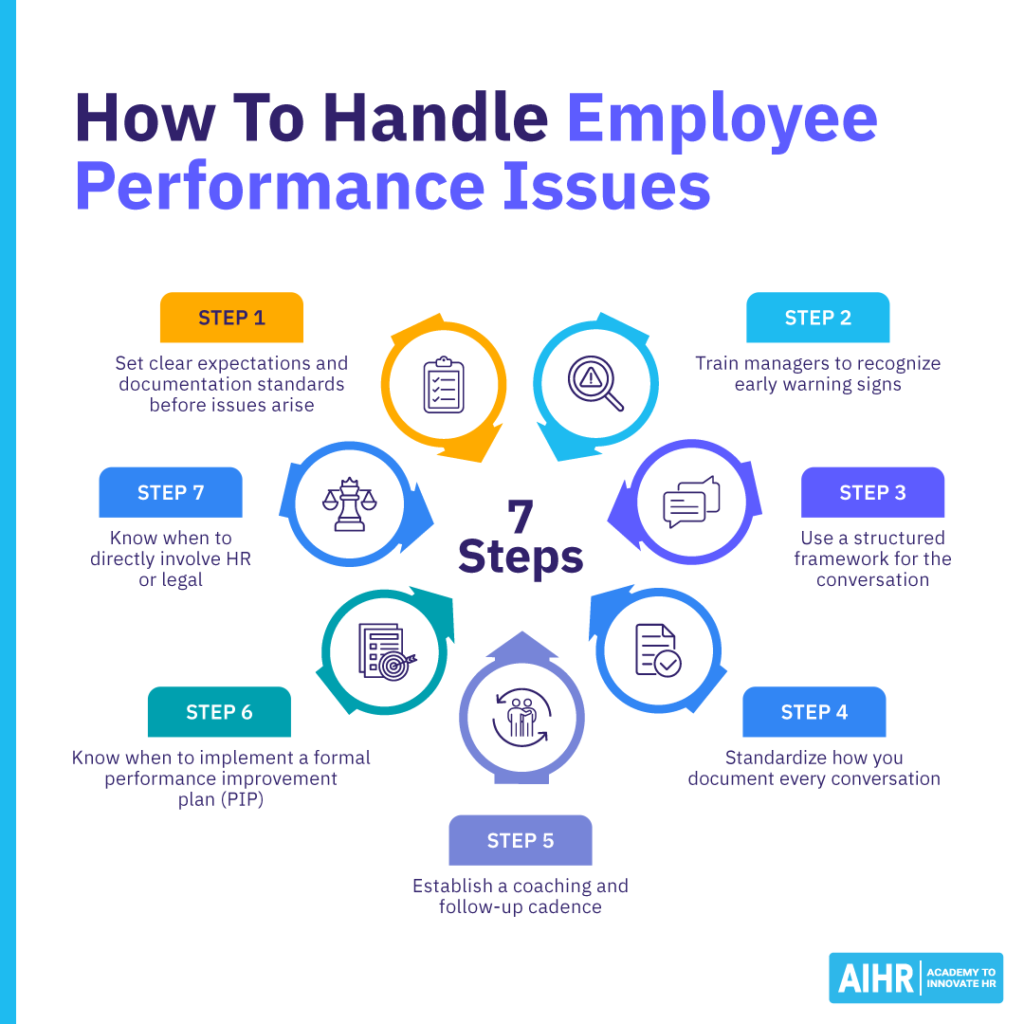
Step 5: Establish a coaching and follow-up cadence
One conversation usually isn’t enough, especially when the issue has happened more than once. Managers need a follow-up schedule, not a vague plan to “check in later”. The right cadence depends on the issue. For some performance issues, biweekly check-ins work, while more serious issues may need weekly follow-ups. At each check-in, require managers to log:
- The performance issue discussed
- What has improved
- What hasn’t improved
- Any new obstacles
- Feedback from the employee
- The agreed next steps.
This cadence gives the employee a fair chance to improve, and gives HR a clear record if the issue continues.
Step 6: Know when to implement a formal performance improvement plan (PIP)
HR should define when managers move from coaching to a formal PIP. A performance improvement plan is a written plan that explains what must improve, how success will be measured, and what support the employee will receive. A PIP may be appropriate when coaching hasn’t led to improvement after several check-ins, or when the issue is serious enough to require immediate formal action.
The manager is closest to the employee’s day-to-day work and understands their strengths, gaps, and potential for improvement. However, they should consult HR before starting any PIP. This gives the decision a more objective review and helps keep the process fair.
Step 7: Train managers on when to directly involve HR or legal
Some situations need HR or legal involvement right away, such as cases involving possible discrimination, protected characteristics, local employment law requirements, or a realistic chance of termination. For jurisdiction-specific issues, be sure to consult your legal team.
You should also create a clear escalation path when an employee disputes a performance rating or decision, starting with a review by the manager’s manager. If the issue remains unresolved, involve HR. A clear escalation path supports fairness and helps employees trust the process.
How to talk to an employee about poor performance
Add these examples to your manager training materials or conversation guide, so managers don’t have to struggle to find the right words in the moment.
“You always mess this up.”
“I’ve noticed this happen a few times, and I want to understand what’s going on.”
“You never listen to feedback.”
“Here are some examples of [behavior], and this is the impact it’s having on your team.”
“You’re just not a team player.”
“I’ve seen some friction in team collaboration. Can we talk through what’s causing this?”
“This isn’t that hard.”
“Let’s break this down together and figure out where the gap is.”
“Everyone else manages fine.”
“Let’s focus on what’s preventing you from meeting expectations.”
“You need to fix this, or else.”
“Here’s what needs to change, and here’s how I can support you.”
“I don’t have time to explain this again.”
“Let’s make sure we’re aligned. What’s your understanding of the expectation?”
“This is unacceptable.”
“This falls short of the standard we agreed on. Let’s talk about why.”
Next steps
Handling employee performance issues shouldn’t depend on which manager has the conversation. A standard process helps managers respond consistently, document fairly, and support employees before issues become harder to resolve.
To build this skill, preview certificate program and mini course lessons on AIHR’s Demo Portal including the Talent Management & Succession Planning Certificate Program. The program helps HR professionals strengthen talent practices, succession planning, and employee development in a structured way.