
Are online HR certifications legitimate? It’s a fair question to ask before you enroll in or pay for one. Search for “HR certification online” and you’ll find everything from globally recognized credentials to sites promising official-sounding designations after a 10-minute quiz. With your money, time, and professional credibility at stake, you should know what’s what before deciding.
The reassuring news is that the online format itself isn’t the problem. HRCI, SHRM, and CIPD all support online study (and sometimes, online testing), while established learning providers like AIHR deliver fully online certificate programs that are also recognized for recertification by those bodies. This guide explains what makes an online HR certification legitimate, the red flags to watch for, and how to verify a program before you pay.
Contents
Legitimacy depends on the issuer, not the format
5 ways to tell if an online HR certification is legitimate
Legitimate online options, based on what they prove
Red flags to watch out for
Do employers take online HR certifications seriously?
FAQ
Legitimacy depends on the issuer, not the format
Online HR certifications can be legitimate, and online delivery is the norm rather than the exception.
HRCI delivers its certification exams at Pearson VUE test centers or through OnVUE online proctoring, which pairs live proctors with AI monitoring. SHRM’s study materials and prep courses are online, although its certification exams are taken in person at Prometric test centers. CIPD qualifications are typically completed fully online through approved study centers.
The most established names in HR credentialing have already moved online, so the real question isn’t whether legitimate online options exist, but whether the specific program you’re evaluating is one of them.
To answer that, you first need to know what you’re looking at, because searching for “HR certification” can show you two different things.
A certification is a formal credential (e.g., the aPHR, PHR, SPHR, SHRM-CP, or SHRM-SCP) awarded by a professional body after you pass a proctored exam. An online certificate program, such as those offered by AIHR, is structured training that builds practical skills and awards a certificate on completion. Both can be entirely legitimate; they simply prove different things. A certification validates what you know, while a certificate program develops what you can do. Judge each by the standards of its own category and, above all, by who issues it.

5 ways to tell if an online HR certification is legitimate
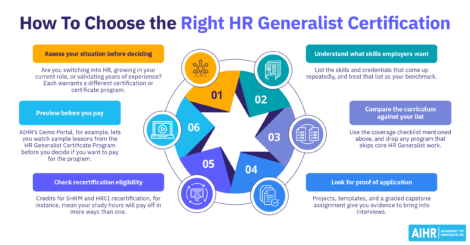
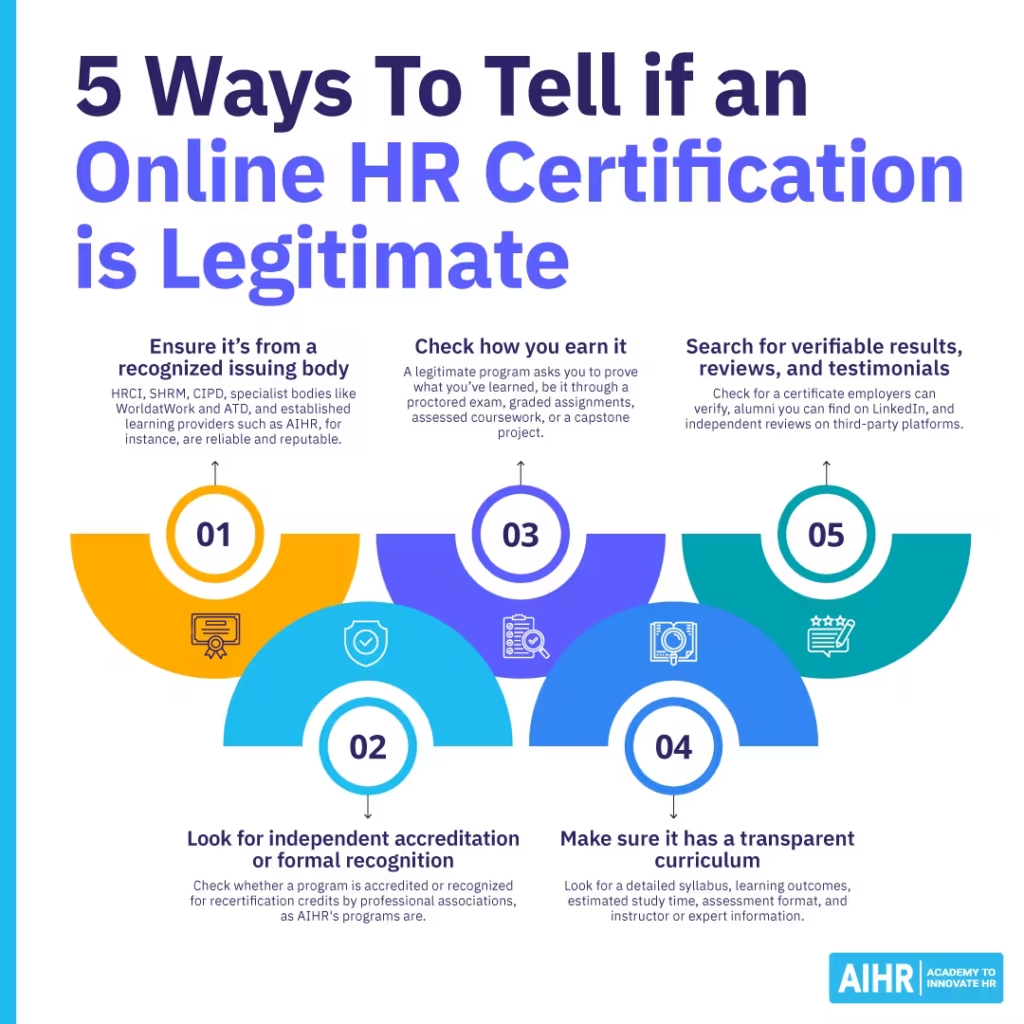
Legitimacy is defined by a set of markers you can verify. Whether you’re assessing an exam-based human resources certification or a skills-based certificate program, these are five reliable ways to tell if it’s legitimate:
1. Ensure it’s from a recognized issuing body
Start with the organization behind the credential. HRCI, SHRM, CIPD, specialist bodies like WorldatWork and ATD, and established learning providers such as AIHR have published standards and reputations to protect.
That history makes the credential easier for employers to understand and verify. If you can’t find the issuer’s leadership, standards, contact details, or professional footprint, treat the credential with caution. A badge is only as credible as the body backing it.
2. Look for independent accreditation or formal recognition
For instance, HRCI’s individual credentials are accredited by the National Commission for Certifying Agencies (NCCA). You can check accreditation through the NCCA directory or the issuer’s own accreditation page.
Certificate programs usually follow a different model. For these, look for formal recognition and alignment with recertification credit. AIHR, for example, is recognized by SHRM to offer professional development credits (PDCs) for SHRM-CP or SHRM-SCP recertification. Its programs are also recognized for credits by HRCI, HRPA, CPHR, and other professional associations.
3. Check how you earn it
A legitimate program makes you demonstrate what you’ve learned before it awards a certificate. That can take different forms: a proctored exam, scenario-based questions, graded assignments, assessed coursework, or a capstone project.
Some respected programs, like CIPD, rely on coursework and written assignments rather than a single exam, so the absence of a test isn’t a red flag on its own. What matters is a clear standard you have to meet to finish the program. Meeting it protects learners and employers alike, since it shows you earned the credential through real work. If payment is the only requirement, the certificate won’t carry much weight.
4. Make sure it has a transparent curriculum
Credible providers show you what you’re signing up for before you pay. Look for a detailed syllabus, learning outcomes, estimated study time, assessment format, and instructor or expert information.
The curriculum should also match your career goals. A beginner program should cover core HR concepts, while a specialist program should go deeper into one area, such as people analytics or compensation. If the description is vague, the learning may be vague, too.
5. Search for verifiable results, reviews, and testimonials
You should be able to find proof beyond the provider’s own website. Look for a certificate employers can verify, alumni you can find on LinkedIn, and independent reviews on third-party platforms like Reviews.io or Trustpilot. Check whether graduates use the credential in real HR roles. If every proof point comes from the provider’s testimonials, keep digging. A credible program leaves a trace you can confirm through people, employers, directories, or professional communities.
Legitimate online options, based on what they prove
Once you apply those checks, credible online HR programs fall into two main groups. Which one you need depends on your goal: proving knowledge or building skills.
Exam-based credentials
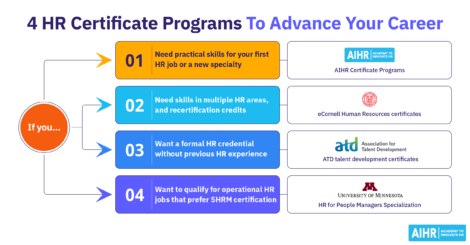
- HRCI offers a tiered set of credentials mapped to career stage. The aPHR suits beginners, the PHR fits operational HR professionals, and the SPHR targets senior strategic roles. HRCI also offers international credentials. You can prepare online and, in eligible locations, take the exam through remote proctoring.
- SHRM offers the SHRM-CP and SHRM-SCP. These credentials focus on applied HR judgment and workplace scenarios. SHRM prep resources are online, but the certification exam must be taken in person at an authorized Prometric test center.
- CIPD qualifications, from Foundation to Advanced levels, carry strong recognition in the U.K. and in markets where CIPD is a common standard, such as the Middle East. Learners complete them through approved study centers.
- Additionally, specialist bodies like WorldatWork focuses on total rewards, while ATD focuses on talent development.
These credentials send a clear résumé signal when job postings name a designation. Your market also matters. HRCI and SHRM credentials are common in the U.S., while CIPD often carries more weight in the U.K. and other international markets. If you work across borders, pair a widely recognized credential with one local recruiters know.
Skills-based certificate programs
AIHR’s certificate programs are a prime example of this group. HR professionals can choose from 16 certificate programs across HR domains, including Artificial Intelligence for HR, People Analytics, HR Business Partner 2.0, and HR Generalist.
The programs are 100% online and self-paced, and most take about 30 to 40 hours to complete. They include lessons, assignments, and a capstone project, and learners receive 12 months of access. They’re also eligible for SHRM PDCs and recognized for recertification credits by organizations like HRCI, HRPA, and CPHR.
Certificate programs work well when you want to build a specific skill, prepare for an exam credential, specialize after earning one, or maintain an existing credential. They don’t replace exam-based credentials. They help you show applied skill through projects, examples, and work outputs.
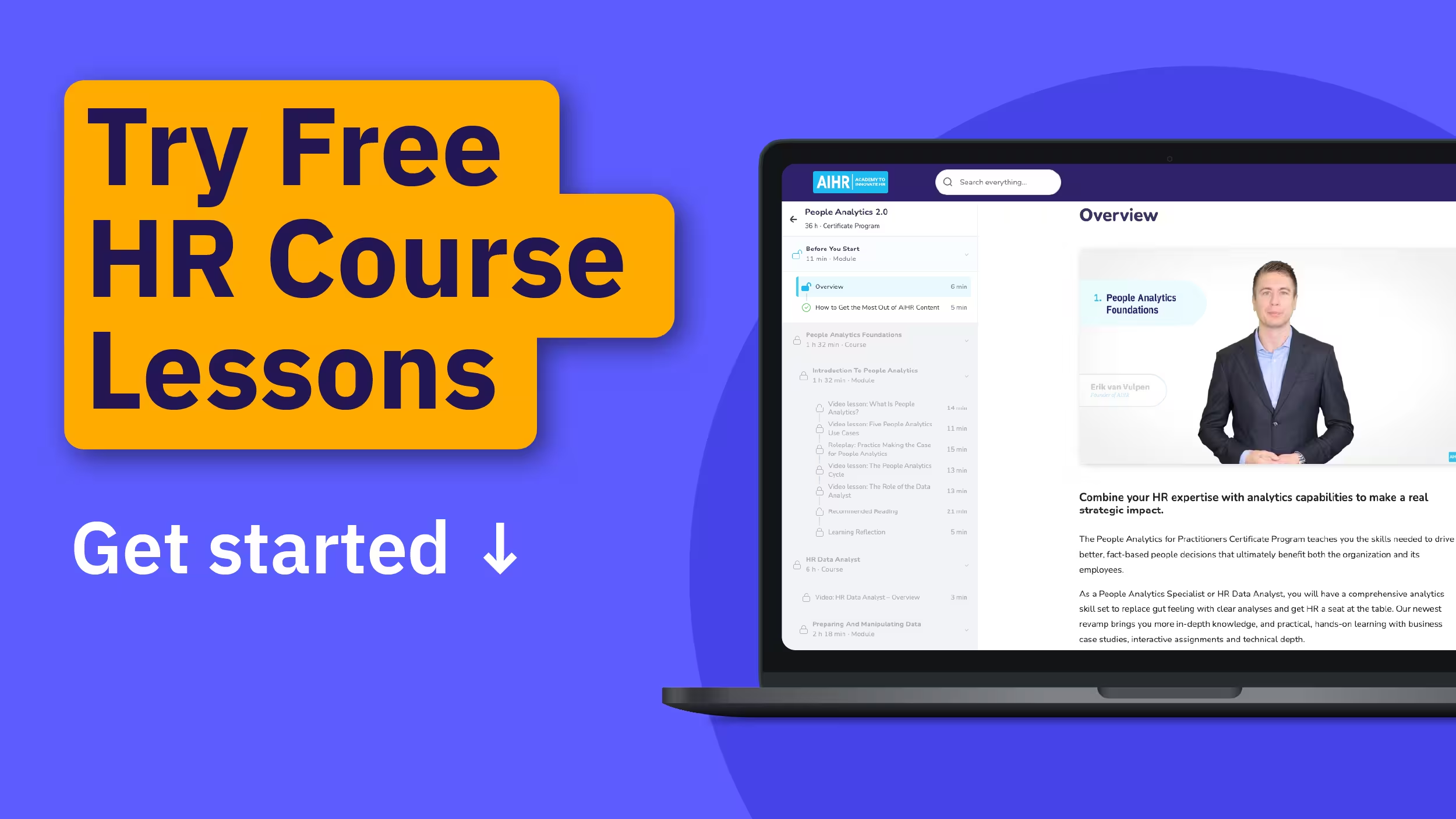
Choosing an online HR course is an important step in your professional development. Before you enroll, it helps to see how the learning experience supports practical skill-building and continuous growth.
AIHR’s Demo Portal gives you a preview of what learning with AIHR looks like:
✅ Watch sample lessons from AIHR’s HR courses and certificate programs
✅ Explore practical guides, templates, and resources you can apply in your HR work
✅ See how bite-sized online learning fits around your schedule and career goals
✅ Discover learning paths that help you choose the right next step for your HR development
➡️ Visit the Demo Portal to explore the platform and find the learning experience that fits your goals.
Red flags to watch out for
Watch out for the following red flags that indicate an online HR certification is unlikely to be legitimate:
Instant or effortless certification
Recognized credentials take preparation, and rigorous certificate programs require real study. If a provider promises you can get “certified” in an afternoon, ask what the credential actually proves. A short course can still be useful for learning, but it shouldn’t pretend to be equal to an established HR certification. Employers can also usually spot the difference. If the process feels too easy to validate real knowledge or skill, it probably is.
No meaningful assessment
A credible program checks that you can apply what you’ve learned. That might mean a proctored exam, scenario-based questions, graded assignments, assessed coursework, or a capstone project. What matters is that something holds you to a standard, not which format it takes.
Passive video watching alone doesn’t prove you can apply HR knowledge at work, and if you can download the certificate just for finishing the modules, the credential won’t carry much weight. Before you enroll, check how the provider evaluates your understanding and practical application.
Invented, official-sounding acronyms
Some providers create designations that sound similar to recognized credentials, such as the PHR or SHRM-CP. The acronym may look impressive on a résumé, but employers may not recognize it. To confirm credibility, search the full credential name and the acronym together, then check whether HR associations, job postings, employers, or credentialing bodies mention it. If only the seller uses the acronym, you’d likely be better off avoiding the “certification” altogether.
Guaranteed jobs or salaries
No legitimate certification body, no matter how reputable, can promise a job, promotion, or specific pay increase. A strong credential can improve your chances, but it works alongside your experience, market, interview performance, and role fit. Be cautious of providers that frame certification as a guaranteed shortcut. Credible programs explain realistic outcomes and career use cases, they don’t promise results they can’t control.
Recognition claims you can’t verify
Terms like “accredited”, “recognized”, and “globally accepted” need proof. A credible provider should name the accrediting body, professional association, or recertification-credit partner. You should also be able to confirm the claim on the other organization’s website or directory. If the provider only makes a broad claim on its own sales page, keep checking. Real recognition leaves a clear trail beyond the provider’s marketing copy.
Do employers take online HR certifications seriously?
Yes, if employers recognize the credential and issuer. A PHR earned after online prep is still a PHR, and job postings usually name the designation, not the study format. Hiring managers care more about the issuer, assessment, and proof.
Credential maintenance requirements also support credibility. HRCI credentials require recertification every three years, and SHRM credential holders must earn 60 PDCs within a three-year cycle or retake the exam. That tells employers you’re keeping your HR knowledge current, not relying on a one-time exam pass.
Certificate programs earn respect differently, i.e., through demonstrated skill. A hiring manager may not screen for a specific certificate, but a capstone project, analytics dashboard, or policy framework can make your skills easier to discuss in an interview.
Free online HR courses with certificates can be useful learning, especially from reputable platforms. They’re usually lighter career signals than recognized certifications or rigorous certificate programs, so you can treat them as supplementary to your other HR upskilling activities.
Next steps
Start with the outcome you need. Need a formal credential on your resume? Choose HRCI, SHRM, or CIPD based on your market. Need practical, job-ready skills? Choose a skills-based certificate program with real assignments, a clear syllabus, and verifiable credits. Many HR professionals earn an exam credential first, then use certificate programs to build deeper skills. AIHR’s guide to how to get HR certification online walks through that sequence in detail.
Before you pay, preview the learning experience. AIHR’s Demo Portal lets you sample the platform and assess the depth, structure, and practical focus of the learning. The right program should help you build credible HR skills, not just collect another badge.
FAQ
Yes, online HR certifications are respected when a recognized HR body or established provider issues them. Employers care less about the online format and more about the credential’s credibility, assessment, and relevance to the role. A PHR, SHRM-CP, or CIPD qualification signals formal HR knowledge, while a rigorous certificate program like one from AIHR builds practical skills through assignments or projects and awards a digital certificate. You should, however, avoid certificates from unknown providers with no verification or recognition.
Getting an HR certificate is worth it when it matches your career goal. If you’re new to HR, a certificate program can help you build core skills and show commitment. If you already work in HR, it can help you specialize in areas like people analytics, HR business partnering, or AI for HR. AIHR’s certificate programs, for instance, cover exactly these areas and many more. A certificate won’t guarantee a job, promotion, or pay increase, but it can strengthen your resume and give you practical examples to discuss in interviews.