



For years, HR has been given the same instruction: ‘Become more mature to be strategic.’
The assumption that all we need to do is move up the ladder from transactional work to strategic partnership, and value will follow. Many of us have spent decades climbing the so-called ladder, yet the business still asks what value HR contributes. Time and time again, HR needs to defend its existence or address mismatches between what we deliver and what the business perceives as valuable.
The problem was never the ladder or HR’s ability to speak the language of the business. What links HR’s purpose to its impact is a clear, agreed mandate, not more maturity.
Below, we explain what an HR mandate is, the four forms it takes, and how to define yours so the business sees the value you already deliver.

The HR maturity ladder that never delivered
Most of us learned the same story about how HR develops in an organization. You start out transactional, handling admin and reacting to problems. You move to reliable service delivery as you build out your process architecture. You mature into an integrated, product-based delivery once practices are established. If you do it all right, you reach the destination the whole profession points to: strategic partnering.
For more than 30 years, this approach has shaped how we build HR operating models and how the field has redefined itself around strategic contribution for more than 30 years. It also assumes that more sophisticated or mature HR is more valuable HR, and that teams still doing operational work simply haven’t climbed far enough and are not mature enough.
A maturity model describes how HR works: the practices it runs, the technology it uses, and how close it sits to the business. It doesn’t describe whether any of that is what the business actually needs, or how the business perceives and expects value from HR.
A small HR team can be highly mature, while a large, well-resourced one can be immature, and a function can tick every box on the model and still leave its CEO wondering what it’s for.
Maturity tells you how HR operates, but it doesn’t tell you whether HR delivers what the business needs. Those are different questions, and we’ve spent too long answering the first while the business keeps asking the second.
Maturity isn’t the same as value
Consider two HR functions. Both are illustrative, but they reflect client cases we have recently encountered.
The first HR team sits inside a mid-sized financial services firm with 12 regional offices in a heavily regulated sector. The business runs on consistent, defensible people decisions. Disciplinary, grievance, and conduct processes have to work the same way in every office, because inconsistency creates legal exposure.
As a result, HR follows a centralized blueprint. Instead of business partners, it relies on generalists who know HR operations and regulations. It reports on turnover, disciplinaries, and compliance training completion.
The second HR team operates inside a logistics company that grows by opening new territories and by acquisition. The CEO is explicit about the need for leaders who can expand and run new territories in line with the business strategy. Whether the business scales depends on whether it has the people depth to do it.
This HR team runs a business-partner model and partners closely with operations. It keeps only talent acquisition and talent management as centers of excellence. It reports on the strength of its talent pipeline and its internal mobility.
The maturity ladder invites one question here: which function is more mature?
At first glance, the logistics team looks more advanced, and the financial services team more operational.
We would argue that this is the wrong question.
Both teams deliver what their business needs because they are aligned on business needs and mandate, rather than on becoming mature in their practice for its own sake.
The first protects an organization where one inconsistent decision can trigger legal risk. The second builds the leadership depth that the growth strategy depends on. Neither would create more value by copying the other. Maturity thinking puts the logistics team ahead because it runs more practices at a higher level of maturity, but it says nothing about whether those practices are the right fit for the business.
AIHR research supports this. Across 961 organizations, 76% rated their HR strategy as a clear strength, but only 56% believed it demonstrated measurable business impact. The gap that erodes HR’s standing is therefore the distance between what HR does and the value the business actually experiences, rather than a maturity gap. Closing it means aligning on mandate and expectations with key HR stakeholders first, before investing in maturity for practices that might not be relevant to the business at this time.
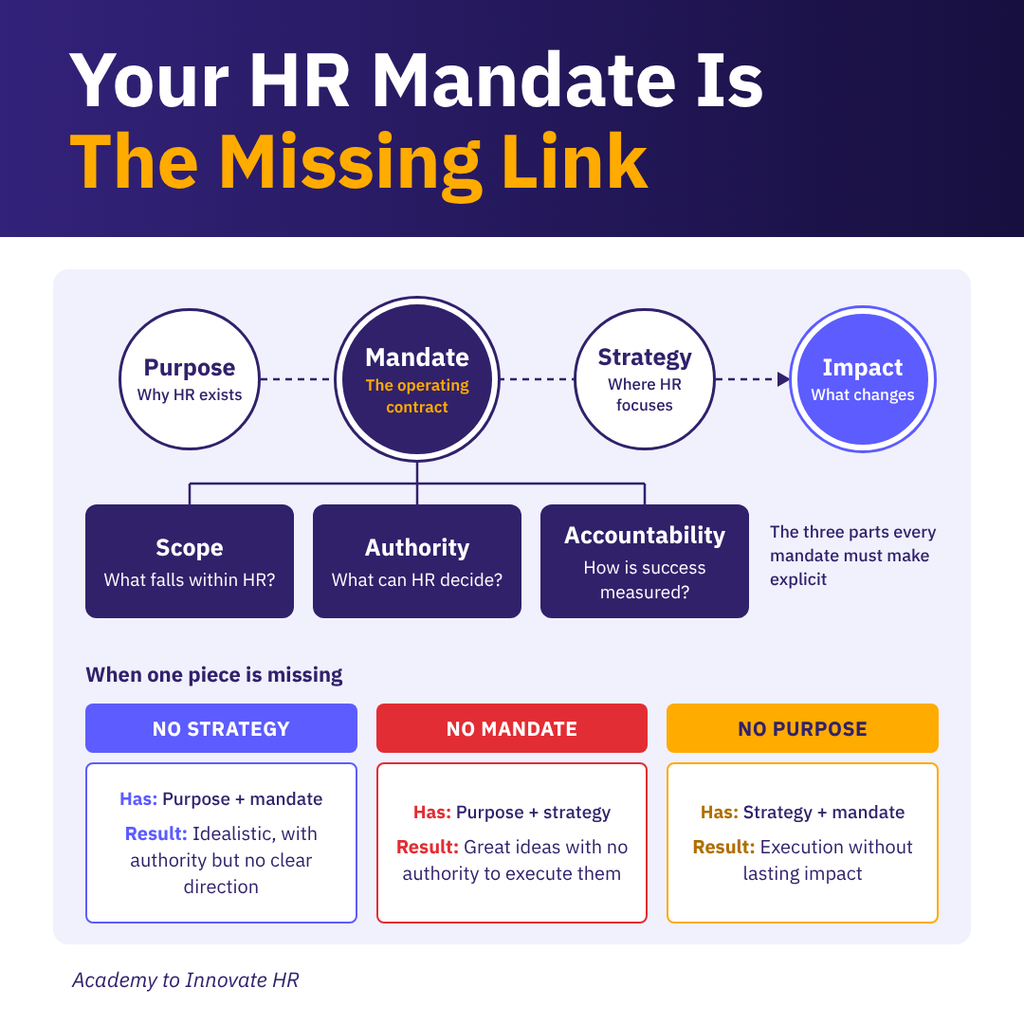
An HR mandate is the explicit scope, authority, and expectations given to HR to fulfill its purpose. It defines what HR is empowered to do, and how. It consists of three parts:
- Scope: What falls within the scope of HR? Which decisions, domains, and responsibilities belong to the function?
- Authority: How are decisions made? Where can HR act, direct, or block, and where does it only advise?
- Accountability: How is success measured? What does the organization expect to change because of HR’s work?
The mandate sits between two things HR talks about far more often: purpose, which is why the function exists, and strategy, which is where it focuses. Without a mandate, purpose, and strategy are a set of good ideas with no authority to execute them.
This is also why “a seat at the table” was never the win we treated it as. Formal proximity to decision-makers doesn’t automatically become influence. A five-wave study of 1,415 firm observations found that HR’s strategic value is built through its advisory relationships with leaders and managers, not conferred by its position on the organizational chart. AIHR’s own data confirms that stakeholder relationships remain a critical factor for getting work done as HR, regardless of industry and sector.
This explains why so many transformation efforts stall. We reach for a new strategy or a new structure when the real problem is simpler: no one ever agreed on what HR was mandated to do.
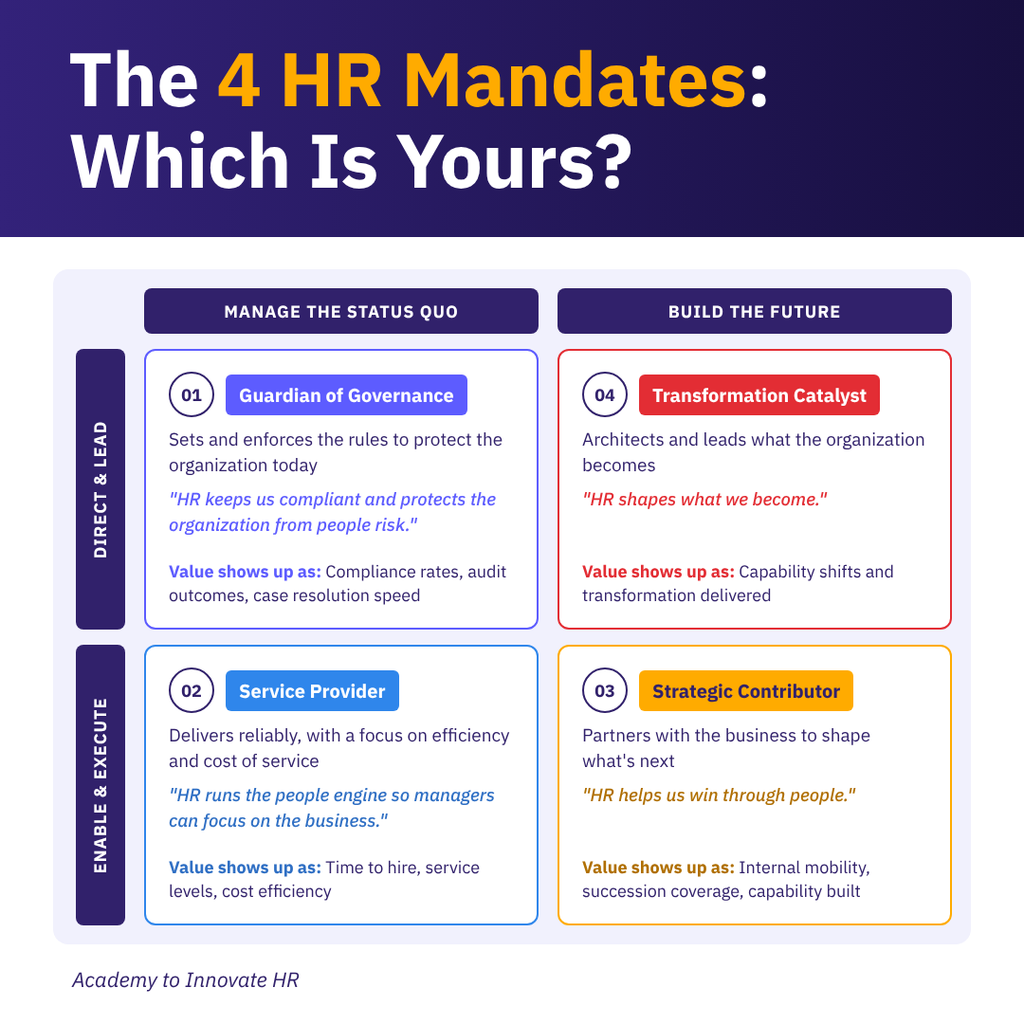
In practice, HR mandates take four forms, which map to two questions: Is HR here to manage the status quo or build the future, and does it enable and execute, or direct and lead?
Depending on the answers to these questions, HR mandates fall into four categories:
Guardian of Governance
Sets and enforces the rules to protect the organization today. “HR keeps us compliant and protects the organization from people risk.” This is the financial services team above. Its authority is tied to policy, gatekeeping rights, and ownership of people risk. Value shows up as compliance rates, audit outcomes, and how fast cases resolve.
Service Provider
Delivers reliably and is concerned with efficiency and the cost of service. “HR runs the people engine so managers can focus on the business.” HR owns operations end-to-end: recruitment, onboarding, payroll, and the HR information system (HRIS) backbone. It’s accountable for service standards. Value shows up as time to hire, service levels, and cost efficiency.
Strategic Contributor
Partners with the business to shape what’s next. “HR helps us win through people.” This is the logistics team. HR has a seat at the planning table, owns talent and workforce strategy, and co-owns people-related business outcomes. Value shows up as internal mobility, succession coverage, and capability built.
Transformation Catalyst
Architects and lead what the organization becomes. “HR shapes what we become.” This mandate carries organizational-systems authority, Board influence, and ownership of enterprise-wide change. Value shows up as capability shifts and transformation delivered.
At first glance, these echo Dave Ulrich’s HR roles of change agent, strategic partner, administrative expert, and employee champion. They draw on the same logic but apply a different lens. Ulrich’s model describes the capabilities HR builds over time, while the mandate describes the authority the business grants and agrees to. You grow into capabilities, but you negotiate and claim a mandate, and three things follow from this difference.
First, none is better than another, because each delivers different value, with its own strengths and limitations. A Guardian mandate in a regulated bank isn’t a lesser version of a Transformation Catalyst; it’s the right answer to a different question.
Second, they overlap. Most functions carry more than one mandate at once, because each era of HR’s history added responsibilities without fully removing what came before. Research on institutional contradictions in HR describes exactly this: professionals managing several competing logics at the same time. Rather than picking one box to stay in forever, the goal is to know which mandate is primary, why, and how to optimize for it.
Third, a mandate has to be explicit. It only works when HR discusses and agrees it with the business, and an assumed mandate is the root of most “HR isn’t valued” complaints.
When the HR mandate holds HR teams back
Sometimes, the mandate the business agrees to is smaller than the value HR could create, or the agreed mandate is used to “keep HR in its place.”
Many HR leaders face this, and sometimes the mandate is imposed rather than negotiated. Part of HR leadership is renegotiating the mandate instead of simply accepting it, even though that is difficult. You don’t do that by asking for a bigger title. You do it by building legitimacy: deliver clear value inside the mandate you have, then use that credibility to widen it.
A mandate gives you authority, and legitimacy allows you to renegotiate and extend it over time. Organizations tend to keep depending on what HR has always done, but with the right legitimacy and stakeholder trust, HR can renegotiate a mandate agreed today once the evidence supports it.
Dr. Dieter Veldsman’s personal reflection
When I stepped into my first CHRO role, I believed I had been appointed to help shape the business’s future. But, the CEO’s brief, delivered shortly after, made his expectation explicit: keep the portfolio running, manage crises as they arise, keep problems off his desk.
Nothing about strategy. Nothing about the future. Just operational control.
I had mistaken a title for a mandate. The organization had not given HR that strategic mandate, and I had not yet earned the legitimacy to claim it.
This is not a rare mistake. HR leaders repeat it across sectors and geographies. We are told to become more strategic, commercially astute, future-focused. Yet many still operate within mandates built on administration, risk, and crisis management.
The question was never whether I was capable of playing a more strategic role. The question was whether I had been given permission to play it.
Redefining HR maturity through the mandate
Maturity and mandate answer different questions.
- The mandate question is: what authority does HR have to do what it needs to do? It’s informed by the business and agreed explicitly, and it can shift fast: a new CEO, a crisis, or a change in strategy can reset it overnight. Its evidence is decision rights, budget, and accountability. During the pandemic, for example, HR was given the mandate overnight to make a range of decisions, and it was widely known that HR, rather than other functions, made some of the people risk decisions about bringing employees back to the office.
- The maturity question is: how well does HR deliver a given outcome, and at what level? HR builds maturity over time; it evolves slowly, in stages, and its evidence is delivery quality, data, and practice.
The mandate comes first because it tells you what to get good at, and maturity follows because it’s how well you deliver on it.
This reframes maturity itself. Rather than a fixed ladder with one destination for every function, maturity means fully delivering on the mandate that fits your context, through your structure, practices, and ways of working. A Service Provider running flawless, low-cost, reliable operations is a mature Service Provider. Chasing a mandate that was never given would make it less effective.
How to define and apply your HR mandate
To operationalize your mandate, we recommend a four-step process.
Step 1: Read your signals
Look at what your business needs from you. A regulated industry, a post-incident recovery, or a risk-primary culture points to Guardian. A cost-efficiency agenda or a multi-country shared-services setup points to Service Provider. A growth agenda, a competitive talent market, or leadership as a constraint points to Strategic Contributor. A major inflection point with CEO sponsorship points to Transformation Catalyst.
A national bank decided to adopt a Guardian of Governance mandate for the immediate future, given the regulatory environment it operates in. Its longer-term ambition was to become a Service Provider, but it felt that what the business needed now was a Guardian of Governance.
Step 2: Validate your authority and scope
Name what the mandate actually lets you do. Then resolve the tensions before they surface later. Tensions come from three places: your own structure and legacy can work against your strategy, what the business expects can differ from what it gets, and the strategic choices themselves can contradict each other. Strategic HR partnering is inherently paradoxical, so treat these tensions as friction to manage. They won’t disappear, but you can manage them well or badly.
The bank held “mandate definition” workshops with its HR leaders and “contracting” discussions with its critical business executive stakeholders. The CHRO also discussed the mandate definition with the business executive team and agreed on what the HR mandate means in practice, what decision rights are required, and what this means for the working relationships between HR and business stakeholders.
Step 3: Operationalize the mandate
Align three things to your predominant mandate: your strategy, your priority practices, and how you measure value. This is where you make trade-offs explicit: inside-out or outside-in focus, efficiency or experience, standardization or flexibility, centralized or distributed decisions. A mandate is as much what you say no to as what you say yes to.
The bank reviewed its current priorities, re-evaluated activities that would not strengthen its agreed mandate, and focused on activities that made HR a stronger Guardian of Governance.
Step 4: Communicate, embed, and reinforce
Name the mandate and explain it to leaders. Use it to set expectations and agree on business value outcomes. Many HR teams assume the mandate is already understood, but with most clients we work with, this assumption is wrong.
How to stress-test your current mandate
When a mandate isn’t made explicit, it exists below the surface and can lead to tension if the activities HR prioritizes are not aligned with the mandate it has or aspires to. A good starting point is to stress-test your current mandate to find where misalignment exists.
Ask these four questions:
- Is your mandate clear and explicit? If not, define your scope, authority, and accountability from your best-fit signals.
- Is your strategy aligned to that mandate? If not, make the strategic choices that reflect it, and resolve the tensions.
- Are you set up to deliver on it? If not, clarify decision rights and ways of working through your structure.
- Would the business agree with how you’ve described it? If not, you have expectations to reset before anything else.
If you answer yes to all four, your mandate is articulated, aligned, and embedded. If not, prioritize the activities that define, align, or operationalize your mandate.
Final thoughts
We’ve spent years challenging HR to climb the maturity ladder, on the promise that the business would finally see its value once HR became more mature. Yet the teams the business trusts most are the ones clearest about what they were asked to do, aligned with the authority they hold, and disciplined about delivering against their mandate consistently, wherever they sit on the ladder.
Maturity is worth building in service of a mandate you’ve made explicit and the business has agreed to, rather than for its own sake. When you do that, the value you’ve been trying to prove becomes something people already see, instead of something you argue for.


