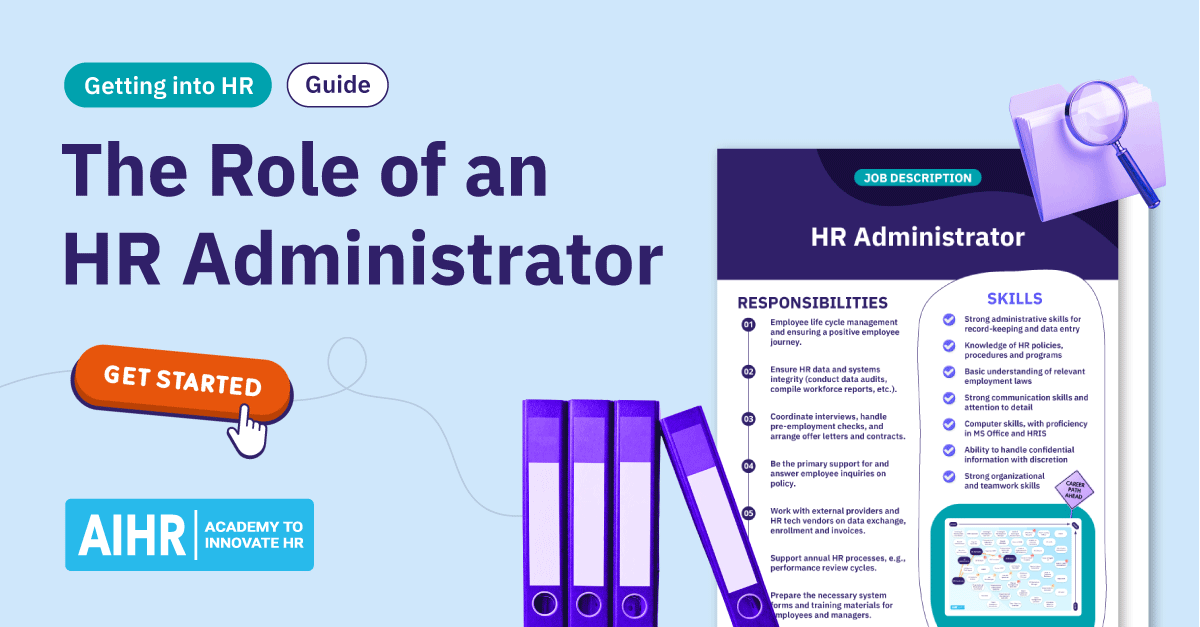
A dedicated HR Administrator significantly lightens the administrative burden for HR Business Partners (HRBPs) and HR Specialists. This frees up their time, allowing them to focus on strategic growth initiatives, such as talent development and organizational design.
Additionally, by mastering essential admin processes, the HR Administrator empowers the entire HR function to deliver high-value, strategic impact. This article looks at what the role entails, what it takes to fill it, and the career opportunities you could have as an HR Administrator.
Contents
What is an HR Administrator?
HR Administrator vs. HR Generalist
HR Administrator job description
Qualifications for an HR Administrator role
Skills and competencies for an HR Administrator role
Average HR Administrator salary
KPIs for this role
Potential career path of an HR Administrator
HR Administrator training courses to take
Key takeaways
- The HR Administrator’s primary responsibility is to maintain data integrity in the HRIS to support accurate payroll, compliance filings, and strategic decisions.
- The role involves handling high-volume admin tasks such as onboarding, offboarding, and status changes.
- Success in this position demands 100% discretion and confidentiality, strong organizational skills, and HRIS proficiency.
- This role provides the critical foundation in compliance, processes, and systems needed to advance into roles such as HR Generalist or HRIS Analyst.
What is an HR Administrator?
The HR Administrator is an entry-level position that serves as HR’s operational backbone, handling foundational people processes accurately and on time. They manage the day-to-day tasks that keep the organization compliant and running smoothly. Since the role involves working with sensitive and confidential employee data, it requires strong attention to detail and discretion.
Although job titles vary across organizations, the HR Administrator typically sits at the same level as an HR Coordinator, with a focus on maintaining system integrity and supporting seamless execution throughout the employee life cycle. This includes coordinating onboarding and offboarding, managing records efficiently, and making timely updates to roles and access.

HR Administrator vs. HR Generalist
HR practitioners may confuse the HR Administrator and HR Generalist roles, but they are distinct from each other. While both are necessary for an effective HR function, they represent fundamentally different scopes.
One way to differentiate between the two roles is to remember that the HR Administrator manages activity and data, while the HR Generalist oversees issues and relationships. Below is a breakdown of the key operational and strategic distinctions between the two positions:
Primary focus
Transactional efficiency and data integrity (the ‘how’ of HR).
Program management and employee relations (the ‘why’ and ‘what if’ of HR).
Scope of work
Focuses on process execution, including HRIS management, payroll coordination, record-keeping, documentation, and system administration.
Covers multiple HR functions, including employee counseling, performance management coaching, handling policy exceptions, and recruitment support.
Key output
Accurate and compliant employee records, timely request processing (e.g., status changes), and functional HRIS reporting.
Successful conflict resolution, manager support on complex disciplinary matters, and rolling out training and development programs.
Problem type
Defined problems with clear procedures, such as updating an employee’s home address or generating a Q3 headcount report.
Ambiguous problems requiring judgment, such as a manager exhibiting micromanaging behavior, or how to handle an employee who refuses mandatory training.
Career level
Typically, entry to junior level and a launchpad for an HR career.
Mid- to senior level, requiring experience and decision-making ability.
HR Administrator job description
While specific duties vary from company to company, the typical HR Administrator job description outlines a role that provides HR with comprehensive support. They support core HR operations (including recruitment, onboarding, and benefits administration), process new hires efficiently, and help employees understand their benefits.
They maintain and update staff records and HR databases to ensure that information is accurate, current, and compliant. They also prepare HR documents, such as contracts, confirmation letters, and standard HR reports that support management decisions. Other key duties include assisting with payroll and timesheet management to ensure accurate and punctual payment.
Additionally, HR Administrators ensure that HR processes comply with legal, regulatory, and internal policy requirements, thereby helping to reduce risk. As the primary point of contact for employee HR queries, they also address questions on policies, benefits, leave, and general HR procedures, providing clear information and escalating issues as needed.
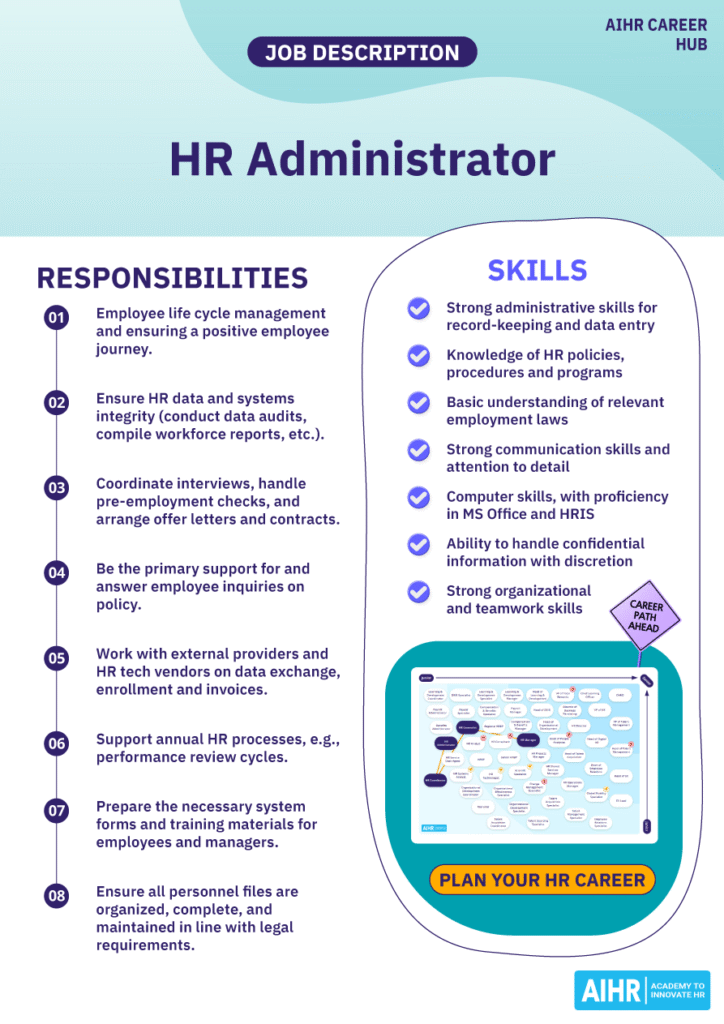
Roles and responsibilities of an HR Administrator
Here are the day-to-day duties and responsibilities of an HR Administrator:
Employee lifecycle management
The HR Administrator must ensure a smooth and compliant employee journey from hire to retirement. Beyond paperwork, it involves executing logistical and legal steps in an employment relationship, including:
- Preparing standardized HR documentation (e.g., offer letters, new hire welcome packets, and compensation change notices)
- Processing new hire and termination workflows in the HRIS, from system setup and benefits enrollment to final payout calculations and revoking system and office access
- Managing status changes — such as internal transfers, department realignments, and title updates — and making sure the paperwork is correct and promptly filed.
HR data and systems integrity
The HR Administrator is the custodian of the HR department’s data. They must:
- Conduct regular data audits within the HRIS to proactively identify and correct inconsistencies, outdated information, or missing required fields across employee profiles
- Manage user permissions and system access rights for HR staff, making sure to protect the confidentiality of sensitive employee data according to company policy
- Compile specialized workforce reports (e.g., department headcount, leave usage, turnover metrics) to ensure the data is clean and verified.
Recruitment and onboarding support
While the talent acquisition team sources candidates, the HR Administrator coordinates the crucial steps needed to transition a candidate into an employee. This means they:
- Coordinate complex interview scheduling logistics, managing communication among candidates, hiring managers, and interview panels
- Handle all necessary pre-employment checks (e.g., background checks and reference verification) and make sure they are completed before the employee’s start date
- Distribute formal offer letters and contracts, coordinating the return and verification of all signed legal documents
- Prepare day one logistics for new hires, including organizing their workspaces, IT access, and initial HR orientation sessions.
Build key HR skills to boost your long-term career
Master essential HR in the areas of HR coordination and administration to make yourself an indispensable HR professional at any organization you join.
AIHR’s HR Coordinator Certificate Program will enable you to:
✅ Master HR fundamentals across the entire employee life cycle
✅ Gain HR project management skills to manage competing demands
✅ Unlock the invisible HR administration skills that keep HR running
Qualifications for an HR Administrator role
To succeed as an HR Administrator, candidates need the right mix of education, certifications, and experience.
Educational requirements
Here are the minimum educational requirements for becoming an HR Administrator in the U.S.:
- High school diploma or GED certificate (minimum requirement). Some small businesses or entry-level admin roles may accept this if the candidate has strong office or administrative experience
- Bachelor’s Degree in Human Resources, Business Administration, or a related field (preferred, especially at larger organizations).
Recommended certifications
Although optional, relevant certifications within the HR Administrator field can help advance your career. Here are some popular certifications:
- AIHR’s HR Coordinator Certificate Program: This foundational HR program provides the essential elements to build your expertise as an HR Administrator — from understanding HR operations to managing policies and processes throughout the entire employee life cycle.
- SHRM-CP: This associate-level HR certification validates your essential HR knowledge, can help you correctly respond to or reroute employee issues, and prevent compliance errors.
Work experience
While organizations and industries vary, here’s the experience you will generally need to be considered for an HR Administrator job:
- One to two years of experience in an administrative, coordination, or data-entry role
- This doesn’t necessarily have to be in HR; experience in a role demanding high data accuracy, meticulous record-keeping, and customer service (e.g., Executive Assistant or Billing Coordinator) can be useful
- This type of experience demonstrates an ability to handle a high volume of issues and maintain organization under pressure — two qualities vital for managing payroll deadlines and onboarding surges.
Skills and competencies for an HR Administrator role
These skills ensure the HR Administrator can successfully balance the volume of tasks and activities with the technical and service-related demands of the role.
Technical skills
HR Administrators must be proficient with HRIS platforms and data auditing. This extends beyond simple data entry to encompass understanding database structures, generating complex reports, and conducting proactive data audits to ensure data integrity.
They need a strong working knowledge of policies, procedures, and local labor laws (such as FLSA, FMLA, and GDPR) as they relate to record retention, reporting deadlines, and mandatory employee documentation.
They must ensure every file is complete and legally compliant. They should also be able to generate standard HR reports, such as turnover rate, time to hire, and headcount, accurately from the HRIS.
Soft skills
HR Administrators handle highly sensitive information (e.g., medical, salary, and disciplinary data), so they must demonstrate discretion, professional maturity, and strict adherence to privacy protocols. They should be adaptable, able to adjust to changing priorities, and remain effective.
As the first line of HR support, they also need a strong customer-service mindset to respond to staff queries in a friendly, helpful, and professional manner, while collaborating with other HR team members. They also need clear written and verbal communication skills to explain complex policies and draft accurate, professional correspondence for all employees.
Analytical and process skills
HR Administrators must be able to map and document HR workflows, such as onboarding or performance review cycles, and identify bottlenecks or inefficiencies to improve or automate. They require exceptional organizational and time management skills to handle a high volume of simultaneous tasks with accuracy.
Finally, they must understand why particular data or metrics are requested. This will help them interpret the numbers in context, ensure the reports they produce address underlying business needs, and make informed recommendations.
HR tip
AI could replace over half of HR Assistant tasks in the next few years. For HR Administrators, this is an opportunity to develop future-proof skills in AI implementation and governance, as well as high-value employee relations interactions AI can’t replicate. Consider AIHR’s Artificial Intelligence for HR or Digital HR 2.0 certificate programs to build tech-savvy skills as an HR professional.
Average HR Administrator salary
Salaries for an HR Administrator role vary depending on experience, the company’s size and location, and the specific job requirements and level of responsibility.
Based on Revelio Labs’ real-time labor market data and intelligence, the role has an estimated annual salary range of $48,000 to $61,000.
You can explore more about the HR Administrator salary, role, and skills with AIHR’s HR Career Map. Learn more about salaries, whether the HR Administrator role is in demand, and what skills you should develop to advance into the role.
KPIs for this role
- Timeliness and accuracy of HR administrative tasks such as data entry, record-keeping, and scheduling
- Compliance with employment laws and regulations related to HR activities, such as maintaining accurate employee records and completing required reporting
- Employee satisfaction with HR services and responsiveness to employee inquiries and concerns
- Successful onboarding of new employees, including timely completion of required paperwork and orientation activities
- Completion of HR projects and initiatives within established timelines and budget
- Maintenance of HR information systems and databases, ensuring data accuracy and integrity
- Contribution to the development and implementation of HR policies and procedures
- Effective communication with internal and external stakeholders, including employees, managers, and external vendors
- Ability to identify and escalate HR issues and concerns in a timely manner
- Participation in HR training and development activities to enhance skills and knowledge.
Potential career path of an HR Administrator
The HR Administrator role provides a strong launchpad because it builds deep knowledge of data, compliance, and process flows — capabilities that often distinguish a strong HR Generalist from a weaker one.
The first step up is often the HR Coordinator role, where professionals typically increase their involvement in recruitment by supporting hiring projects, gathering data for compensation reviews, and managing ATS data. They also begin to apply discretion in interpreting and implementing policies.
From there, many move into an HR Generalist role, a significant shift into a more employee-facing, advisory position. HR Generalists rely on the administrative foundation built as an HR Administrator to confidently coach and advise managers on performance management, disciplinary issues, and policy exceptions.
At the next level, HR professionals may progress to an HR Manager role, where they integrate their process expertise with a strategic understanding of the business. HR Managers lead teams, influence decision-making, navigate organizational change, and champion both employee performance and overall employee experience to support business goals.
HR Administrator training courses to take
AIHR offers three certificate programs and one mini course to help HR Administrators strengthen crucial skills for their role:
HR Coordinator Certificate Program
The HR Coordinator Certificate Program is an in-depth, globally recognized course that provides a solid understanding of what it takes to succeed as an HR Administrator. The program will help you master HR fundamentals, gain project management skills, and understand key HR policies in just 12 weeks.
Artificial Intelligence for HR Certificate Program
While technology has taken over the heavy lifting of data automation, human intervention remains essential for leading decision-making, optimization, and oversight. The Artificial Intelligence for HR Certificate Program equips you with essential AI skills to advance your career, preparing you for more digitally-oriented, impactful HR roles.
Gen AI Prompt Design for HR Mini Course
The Gen AI Prompt Design for HR Mini Course will teach you how to boost your productivity by learning how to work effectively with AI. This 3.5-hour mini-course takes advantage of common HR use cases and prompts frameworks to help you achieve better, faster results from AI to assist with your HR tasks.
People Data & Business Insights Certificate Program
The People Data and Business Insights Certificate Program helps HR Administrators build confidence in working with HR data and translating it into clear, practical insights. Over 12 weeks, you learn how to interpret metrics, recognize trends, and support data-driven conversations across the business. The program is beginner-friendly and gives you a strong foundation in analytics, making it easier to handle reporting tasks and prepare for more advanced roles in HR.
Next steps
If you’re in — or moving into — an HR Administrator role, start by assessing your strengths in HRIS, data accuracy, compliance, and service delivery. Compare your current work to the role requirements, then select two or three clear focus areas (e.g., owning onboarding or improving reporting quality) and develop a simple plan around them.
Next, decide where you want this role to lead you, and align your learning accordingly. Use tools like AIHR’s HR Career Map and certificate programs to strengthen your data, tech, and employee-facing skills. This way, you turn day-to-day administration into a deliberate springboard for a more strategic HR career.