

If you’ve ever asked yourself, “What certification should I get for HR?”, you’re already thinking strategically. There are plenty of HR credential options available, and the right choice depends on both your current and future career paths. The wrong fit costs unnecessary time and money, while the right one builds capability and signals credibility to employers.
As such, it’s crucial to know which path fits your career stage, region, and goals. This guide covers some of the officially recognized HR certifications from SHRM, HRCI, and CIPD, explains how they differ from skills-based certificate programs, and walks through the four questions to ask to help you choose with confidence.
Contents
Why the right HR certification matters
HR certifications vs. HR certificate programs
The major HR certification options
Skills-based HR certificate programs
How to choose an HR certification: 4 questions to ask
How to match certifications to common HR career profiles
Key takeaways
- HR certifications from SHRM, HRCI, and CIPD are officially recognized credentials with eligibility rules, exams, and recertification cycles.
- Certificate programs from providers like AIHR are skills-based qualifications focused on applied capability, not third-party credentialing.
- Your career stage and target role matter more than picking the “best” certification. For instance, aPHR or SHRM-CP suits early-career HR, while SPHR or SHRM-SCP suits strategic leaders.
- Certificate programs are a strong choice when you need specific skills faster than a credential exam allows, or when you want to build capability between credentials.
Why the right HR certification matters
HR is changing. While compliance and operations are still important, HR is now expected to help shape business strategy, use data, manage technology, and lead change. This shift affects which credentials employers value and which ones will benefit your career.
Choosing the right HR certification helps in three main ways. It shows employers you are qualified, since many use credentials to screen candidates. It also makes you learn important HR knowledge, filling in any gaps you might have missed. Additionally, earning a certification boosts your confidence, so you feel ready for your next role.
Choosing the wrong certification can be costly. Exam fees, study materials, and your time all add up. If employers don’t recognize your chosen certification or it doesn’t fit your target role, you may spend months on something that doesn’t help your career. Instead of simply asking which HR certification is best, ask which one fits the career you want.

HR certifications vs. HR certificate programs
Before exploring specific options, it’s important to understand the difference between the two terms, which refer to different types of things.
An HR certification is awarded by a credentialing body such as SHRM, HRCI, or CIPD after you meet certain requirements, pass an exam, and agree to ongoing recertification. The certification itself is the main result. It shows employers that a respected organization has confirmed your knowledge meets a set standard.
An HR certificate program is a structured course that ends with a certificate of completion. Providers like AIHR, university extension schools, and online learning platforms offer these programs. There’s no external exam; you finish by completing coursework, assignments, and assessments within the program. The main benefit is the learning experience and the skills you gain.
Both options are valuable, but it’s good to understand the purposes each serves before making your decision. You should choose a certification if you want a recognized credential that employers accept, especially for senior HR roles. And if you want to build specific, practical skills (e.g., AI in HR, people analytics, HR business partnering, talent acquisition, or compensation design) you can implement immediately in your role, consider a certificate program.
We’ll unpack these options below.
The major HR certification options
Three main organizations lead the HR credential field in the U.S. and the UK: SHRM, HRCI, and CIPD:
SHRM certifications: SHRM-CP and SHRM-SCP
The Society for Human Resource Management (SHRM) offers two certifications: the SHRM Certified Professional (SHRM-CP) and the SHRM Senior Certified Professional (SHRM-SCP).
The SHRM-CP is intended for HR professionals who handle operational tasks, such as implementing policies and supporting daily HR functions. According to SHRM’s eligibility criteria, you don’t need a degree or previous HR experience to apply, but it does recommend having some HR knowledge.
The SHRM-SCP is for senior HR professionals who lead strategy and policy. SHRM requires at least three years of experience in strategic HR, or three years holding the SHRM-CP credential while transitioning into a strategic role. Both exams feature a mix of knowledge-based questions and situational judgment items, and are open to candidates twice a year.
HRCI certifications: aPHR, PHR, SPHR, and GPHR
The HR Certification Institute (HRCI) offers tiered credentials. The Associate Professional in Human Resources (aPHR) is HRCI’s entry-level certification and doesn’t require prior HR experience, making it a good starting point for people new to HR or switching from another field. If you’ve been looking for HR certifications for beginners, consider aPHR.
The Professional in Human Resources (PHR) is for HR professionals who manage daily operations and apply U.S. employment law. To be eligible, you need one year of HR experience with a master’s degree, two years with a bachelor’s, or four years without a degree.
The Senior Professional in Human Resources (SPHR), on the other hand, is for HR leaders who set strategy and policy. It requires four, five, or seven years of HR experience to be eligible, depending on your education.
HRCI also offers the Global Professional in Human Resources (GPHR) for international HR work, as well as the PHRi and SPHRi for global roles, and the PHRca for California-specific HR. All HRCI certifications are valid for three years. To recertify, you must earn credits (60 hours for PHR and SPHR) or retake the exam.
CIPD: The U.K. and international standard
The Chartered Institute of Personnel and Development (CIPD) is the leading professional body for HR and L&D in the U.K., and a recognized standard in many international markets. CIPD qualifications are awarded across three levels: Level 3 Foundation Certificate, Level 5 Associate Diploma, and Level 7 Advanced Diploma.
The Foundation level is for HR or L&D beginners, and level 5 is for HR professionals moving into mid-level management or specialist roles. Level 7 is the strategic, senior leader qualification that leads to Chartered Membership (MCIPD), one of the most respected HR designations internationally.
If you work in the U.K., the Republic of Ireland, the Middle East, or other CIPD-recognized regions, this is often the first certification employers look for.
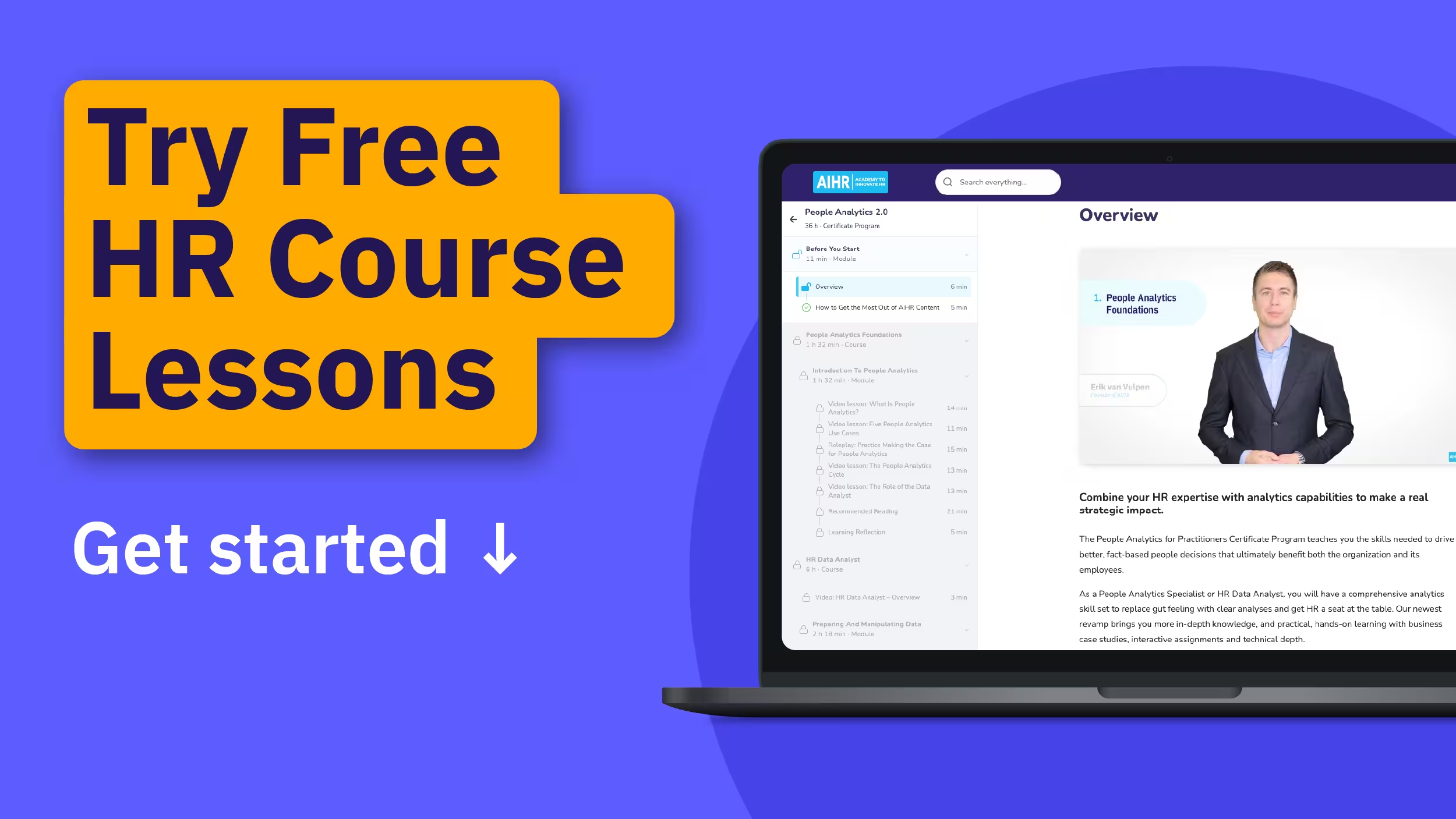
Explore the AIHR learning experience from the inside, and discover how it can support you in building practical, relevant skills to help further your HR career.
AIHR’s Demo Portal allows you to:
✅ Preview AIHR lessons before committing to a course or certificate program
✅ Explore guides, templates, and tools you can use in your day-to-day HR work
✅ Browse different learning paths to find topics that match your role and goals
✅ Get a feel for AIHR’s learning experience and resources for ongoing development.
Skills-based HR certificate programs
Beyond the main credentialing organizations, there are many skills-based HR certificate programs. AIHR is one example, along with university continuing education, online learning platforms, and programs from major HR technology companies.
There are four common reasons to choose a certificate program:
- If you need to develop a specific skill set to start applying immediately in your role.
- If you already have a general HR credential and want to specialize in a specific HR area (e.g., people analytics or HR business partnering)
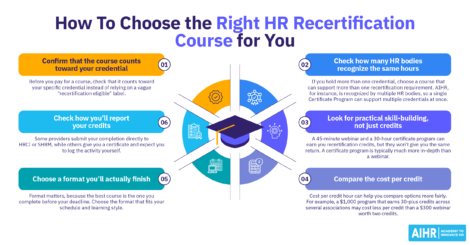
- If you need to recertify and are looking for certificate programs and courses that help you earn professional development credits (PDCs)
- Fourth, you may prefer hands-on, practical learning instead of a knowledge-based exam.
AIHR offers 16 certificate programs covering areas like Artificial Intelligence for HR, HR Business Partnering, People Analytics, Organizational Development, Learning and Development, and how to become an HR Generalist. Programs are 100% online and self-paced, typically requiring 30 to 40 hours of study time and 12 months of access to the materials.
AIHR is also recognized by SHRM, HRCI, HRPA, CPHR, ATD, and CIPD, so completing AIHR certificate programs and courses can earn you PDCss for SHRM-CP or SHRM-SCP recertification, as well as similar credits with other organizations.
How to choose an HR certification: 4 questions to ask
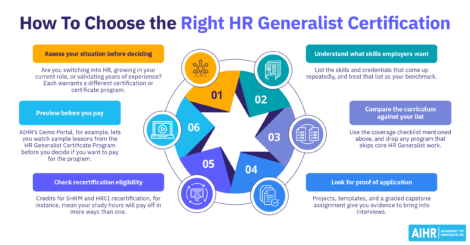
Rather than just asking, “What’s the best HR certification?”, consider these four questions in order. Your answers will help you narrow down your choices quickly.
1. Where am I in my HR career right now?
2. What kind of HR role am I targeting?
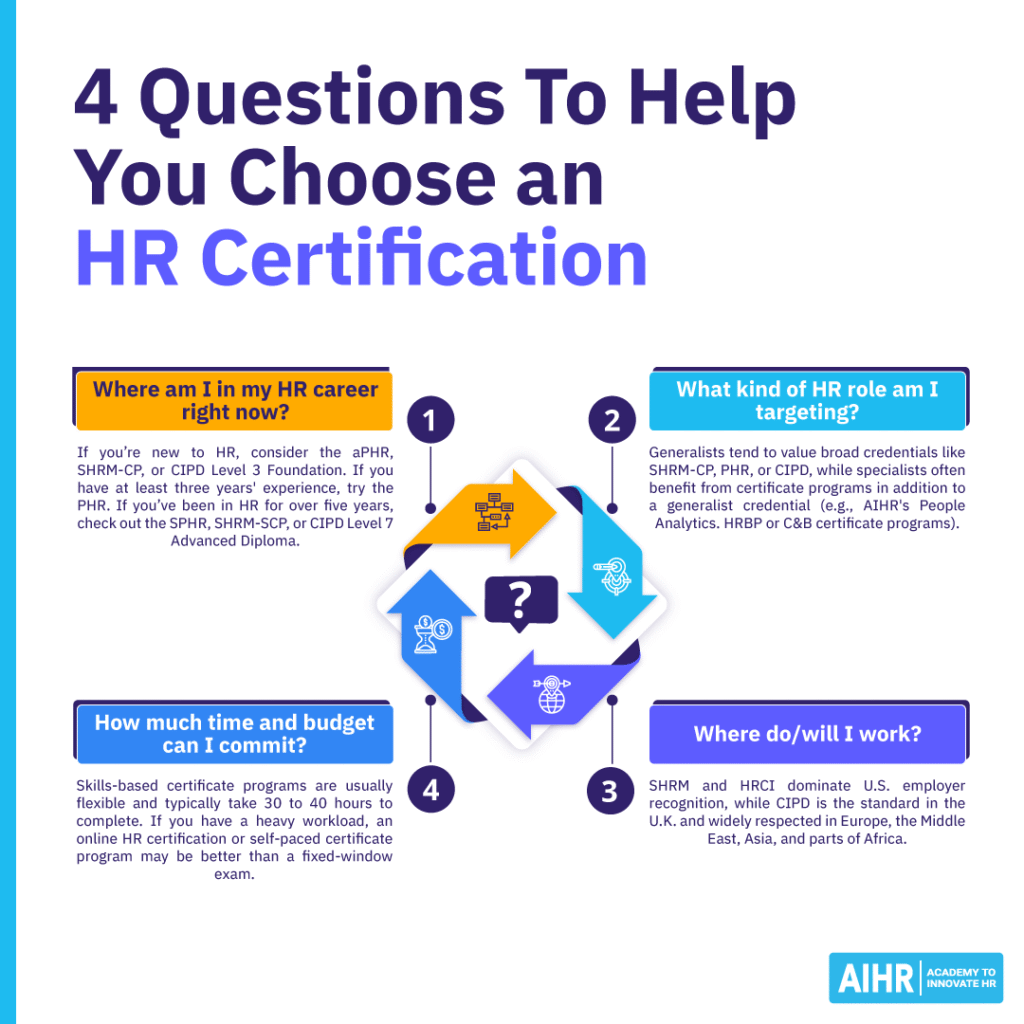
3. Where do/will I work?
4. How much time and budget can I commit?
How to match certifications to common HR career profiles
Here are common profiles and career stages to further guide your decision-making, along with a suggested starting point for each.
Switching into HR from another field
Start with the aPHR or SHRM-CP to build credibility. Then, add an AIHR certificate program in your area of interest (e.g., HR Generalist, HR Operations, or Talent Acquisition) to develop practical skills. This helps you show both HR knowledge and job-ready capability. It’s especially useful if your previous role gave you transferable skills, but you still must prove HR-specific expertise.
HR Coordinator or Specialist with one to three years’ experience
PHR is a good goal. While you gain the required experience, AIHR’s HR Business Partner 2.0 or People Analytics certificate program can enhance your practical skills and demonstrate your initiative. At this stage, choose learning that helps you move beyond task execution. Look for programs that strengthen your ability to solve HR problems, work with data, or improve core people processes.
Pursue a practical certificate program when you need to develop a new capability, and a formal certification when you need external proof of competence.
Mid-career HR Generalist or HRBP
Aim for SHRM-CP if you are U.S.-based. Then, add a focused certificate in HR Business Partnering, People Analytics, or Digital HR 2.0. This mix of a generalist credential and specialist skills is common among top HRBPs. Your priority is to show you can connect HR work to business outcomes. A focused certificate can help you strengthen your expertise in one area while maintaining your broader HR profile.
Senior HR leader
SHRM-SCP, SPHR, or CIPD Level 7 are suitable for this level. Combine these with leadership-focused learning, such as HR Strategy, HR Leadership, or specialist programs, to help you guide initiatives. Your learning should support strategic decision-making and team capability building. Choose programs that help you challenge proposals and guide specialists with confidence.
Working outside the U.S.
CIPD is often the best starting point in the U.K. and many international markets. HRCI’s PHRi or SPHRi can be good additions to CIPD, along with skills-based certificate programs. Your best choice depends on where you work, where you want to work next, and which credentials employers recognize in those markets.
If your role spans multiple countries, combine a locally recognized credential with practical learning that’s relevant across HR contexts.
Next steps
So, which HR certification should you choose? If you’ve followed the recommendations in this article, you should now have a clear shortlist. The next step is to pick a path and get started. If you decide on a formal certification, go directly to the credentialing body to check eligibility, fees, and exam windows. Make a study plan that fits your schedule and start preparing.
If you choose a skills-based certificate program or want to build practical skills while working toward a credential, consider AIHR’s certificate programs. The AIHR Demo Portal lets you access sample lessons from all 16 programs for free, so you can review the format and content before deciding.
No matter which path you take, the most important step is to get started. The HR professionals who advance are those who see learning as a continuous process, not just a single qualification on a résumé.